Review · BERLIN
Berlin: Private Bike Tour of the Berlin Wall and Third Reich
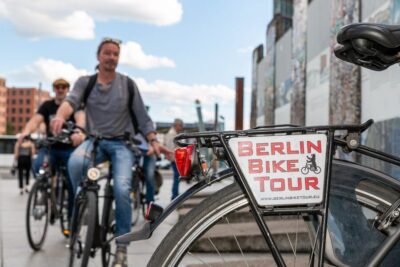
Berlin’s past is best read from a bicycle. This three-hour private ride links the Berlin Wall, Nazi Germany, and modern government in one moving history lesson. I like the personal route and the way a bike lets you cover far more ground than walking. I also like the chance to pause at lesser-known places such as the Günter Litfin Memorial and Invalidenfriedhof.
The main consideration is pace. You visit many sites, but most stops last only about 5 to 15 minutes. I would choose this tour for a first look at Berlin’s 20th-century history, then return on foot to the places that deserve more time.
Key points to know before you book
- A private three-hour ride: Your group travels with its own guide, so the route can be adjusted to your interests.
- Berlin’s Wall is shown as a physical border: The Berlin Wall Memorial, Mauerpark, Günter Litfin Memorial, and Invalidenfriedhof reveal how the barrier cut through daily life.
- Nazi history is handled through actual sites: The tour visits the Humboldthain Flak Tower, Reichstag, Führerbunker site, Holocaust Memorial, and Spreebogenpark.
- Checkpoint Charlie is English-tour only: It is included on the English version, with other language options available by request.
- Cycling saves time: One previous participant praised the ability to reach places in a fraction of the time needed on foot.
- Practical setup matters: The tour requires at least four people, includes a bicycle and helmet, and runs in all weather.
Why a bicycle works so well for Berlin history
Berlin’s major historical sites are spread across a wide area. A walking tour can handle one district well, but the Wall’s former route, Nazi command sites, wartime ruins, government quarter, and Cold War checkpoints are not all neighbors.
A bicycle gives you a useful middle ground. You move quickly between locations, yet you still stop often enough to hear the story and look around. One participant specifically praised being able to see the sights by bike in about half the time required on foot. That is the central value here: not speed for its own sake, but a wider view of Berlin’s past in three hours.
This is a private tour, so you are not tied to a large group’s interests. If the Wall matters most to you, ask for more time in that section. If your group is focused on Nazi architecture or Germany’s democratic history, the guide can shape the route around those subjects.
The tour requires a minimum of four people. That makes it a good fit for a family, a group of friends, or several relatives traveling together. It is less suitable for a solo visitor or a couple unless you can join with others or meet the minimum requirement.
More Private History Tours in Berlin
- Berlin Private Complete History All Day Walking Tour
★ 5.0 · 474 reviews - Berlin Private Half-Day Walking Tour: Discover the German Capital’s History
★ 5.0 · 244 reviews - The History of Berlin: WWII PRIVATE Walking Tour With Locals
★ 5.0 · 209 reviews
Starting in Nikolaiviertel, Berlin’s old center
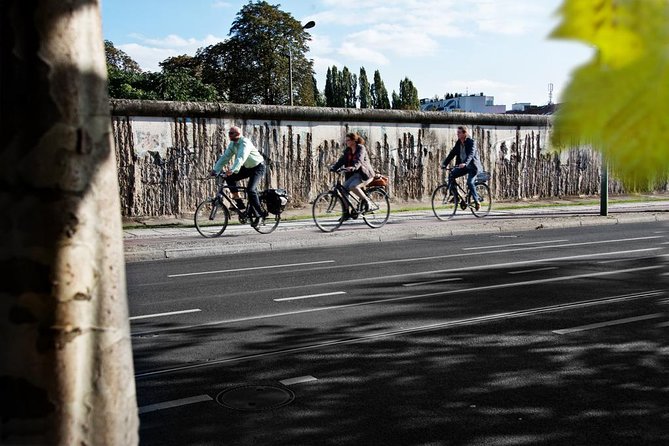
The ride begins at Free Berlin Bike Tours & Rental on Poststraße 11, near Nikolaiviertel. This neighborhood is presented as Berlin’s only genuine old-town area, though its appearance raises an important question: how much of what you see is actually old after the bombing and destruction of the Second World War?
That question sets the tone for the tour. Berlin often looks historic, but its streets can conceal rebuilding, political change, and deliberate reconstruction. A short opening stop helps you understand that the city’s past is not always visible at first glance.
You get about 10 minutes here. I would use this time to listen for the guide’s explanation of what survived, what was rebuilt, and how war changed the center. It is an efficient opening, though not a long architectural visit.
The Neue Synagogue and a story of civil courage
The next stop is the Neue Synagogue Berlin, also known as Centrum Judaicum. The visit focuses on the night of the broken glass, when Jewish homes, businesses, and places of worship were attacked across Nazi Germany.
The guide tells the story of a police officer whose actions helped save this remarkable building. That detail gives the stop a human scale. Instead of treating the synagogue only as a monument, the tour points to an individual decision made during a dangerous period.
The stop lasts about five minutes, so expect a concise explanation rather than a full visit inside. It is a good reminder that Berlin’s Nazi-era story includes both organized persecution and moments of personal courage.
A quieter memorial to deportation victims
The route also includes a memorial for people deported and murdered during the Holocaust. It was designed during the former East German period, and its style differs sharply from the better-known memorial near Brandenburg Gate.
This contrast matters. Berlin’s memorials were created in different political eras, and each reflects the language and priorities of its time. A short stop here adds another layer to the city’s remembrance culture.
The supplied route description does not identify the exact name of this memorial. If this subject is especially important to you, ask the guide to clarify which memorial you will see and how much time is available there.
More Private History Tours in Germany
- Private Taxi Tour City East & West History and Architecture 3-4h
★ 5.0 · 42 reviews - Private Tour: Jewish Heritage Walking Tour of Berlin
★ 5.0 · 29 reviews - Private Berlin WWII and Cold War History Tour with Local Expert Guide
★ 5.0 · 28 reviews - Nuremberg: 1.5-Hour Private Tour through Historical Old Town
★ 4.8 · 283 reviews
Berlin Wall Memorial: the clearest place to understand the border
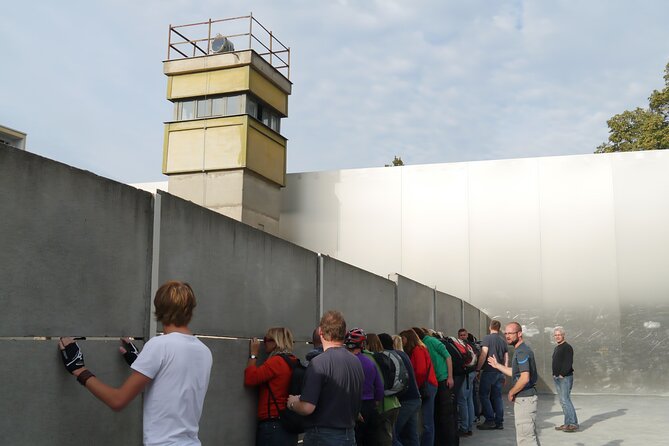
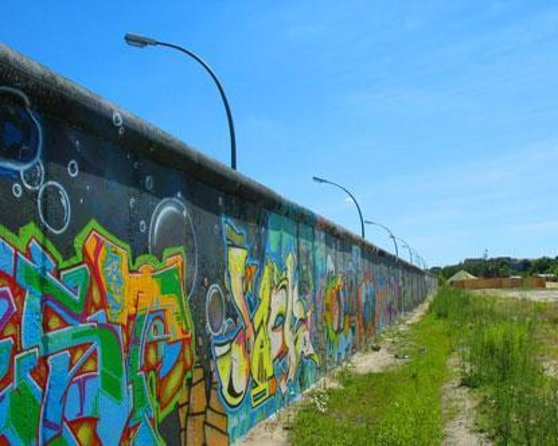
The Berlin Wall Memorial is the heart of the ride. The tour describes three places in Berlin where the Wall remains physically present, and this is the one where its design and effect are easiest to grasp.
You are not just looking at a slab of concrete. The memorial helps explain the border system, the empty strip between barriers, and the way the Wall cut through streets, homes, cemeteries, and neighborhoods. The stop lasts about 10 minutes, so the guide must keep the explanation focused.
I would pay close attention here to the physical arrangement of the site. The Wall becomes much easier to understand when you can see how barriers, watch areas, and open ground worked together. For many people, this is the most useful Wall stop on the tour.
Mauerpark and the border that kept changing
Mauerpark is now associated with its Sunday flea market, but its earlier role was far more severe. The stop examines repeated attempts by East Germany’s leaders to create what they considered a perfect border.
The park is a good place to connect ordinary city life with Cold War control. A popular weekend gathering spot once formed part of a restricted border zone. That contrast is one reason Berlin can feel so layered: a place used for leisure today may have been shaped by fear and surveillance not long ago.
You spend about 10 minutes here. If you visit on a Sunday, the area may have a very different feel from the quiet historical setting described by the guide. That is not a problem, but it can make listening harder.
Humboldthain Flak Tower and the physical remains of Nazi power
The Humboldthain Flak Tower was built as a huge fortress and air-raid shelter during the Nazi period. The tour uses it to discuss wartime defense and the architecture of dictatorship.
This is one of the more unusual stops because it connects ideology with concrete, steel, and sheer scale. Nazi architecture was designed to project power, permanence, and control. A flak tower shows how those ideas could become military infrastructure, built both to defend the city and to shelter people during air raids.
The stop takes about 10 minutes. You should expect discussion and an exterior look rather than a long interior visit. The site is especially worthwhile if you are interested in how political systems express themselves through buildings.
Günter Litfin Memorial and the personal cost of the Wall
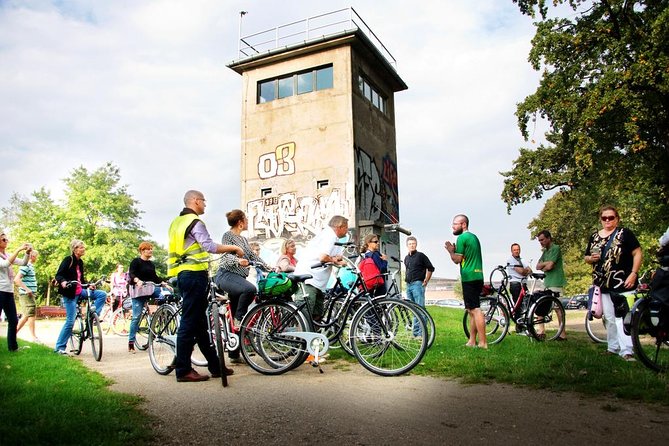
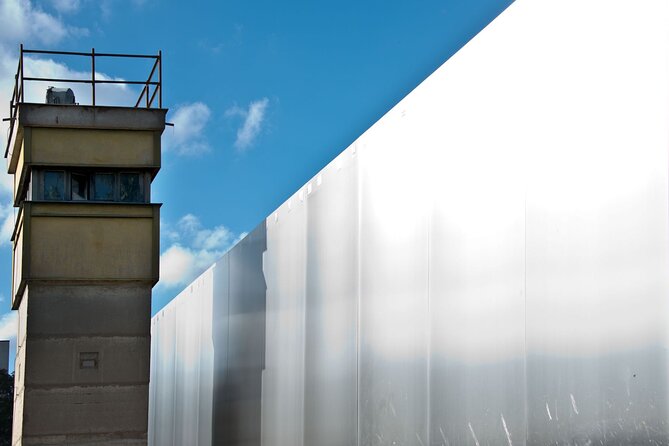
The Günter Litfin Memorial preserves an original watchtower in memory of Günter Litfin, identified here as the first person shot at the Wall.
This stop brings the Cold War story down to one person. The Wall was not merely a diplomatic boundary or an abstract symbol. It was enforced with weapons, towers, and orders that had lethal consequences.
The preserved tower makes the site more direct than a simple plaque. You can connect the human story with the machinery used to enforce the border. Again, the scheduled visit is about 10 minutes, so I would treat it as a focused explanation rather than a complete museum visit.
Invalidenfriedhof, where the Wall cut through military memory
Invalidenfriedhof is a cemetery connected with German military history. The Wall once passed directly through it, dividing the burial ground and altering the way the site could be used.
The guide also points out that some of the military figures remembered there deserve careful thought rather than automatic honor. That makes this more than a cemetery stop. It raises questions about who gets memorialized, how national memory is built, and how later generations judge military leaders.
I like this stop because it avoids a simple good-versus-bad version of history. You see how the Wall disrupted a place of remembrance, while also being asked to think critically about the people buried there.
Spreebogenpark and Albert Speer’s enormous vision
At Spreebogenpark, you get a broad view of Germany’s government district. The stop is not limited to what is visible today. It also examines Adolf Hitler’s architect, Albert Speer, and plans for a Great Hall large enough to hold 180,000 people.
The scale of that proposed building is hard to picture, which is exactly why the open view helps. The guide can connect the present government quarter with the authoritarian plans that once targeted this part of Berlin.
This is the longest stop, at about 15 minutes. It gives the tour room to connect architecture, political ambition, and the later democratic use of the city center.
The Reichstag and Germany’s struggle with democracy
At the Reichstag Building, the guide discusses Hitler’s rise to power and Germany’s democratic history. You remain outside, since there is not enough time to go inside.
That limitation is important. The Reichstag deserves a full visit if you want to explore the building itself, its dome, and its modern parliamentary role. On this ride, the point is historical context rather than an interior tour.
The outside stop lasts about five minutes. I would see it as a useful link between the Nazi period and present-day Germany, not as a replacement for a dedicated Reichstag visit.
Holocaust Memorial and the empty Führerbunker site
The Holocaust Memorial, officially the Memorial to the Murdered Jews of Europe, is one of Berlin’s most important places of remembrance. The tour describes it as the largest genocide memorial in the world and emphasizes its size and historical importance.
The stop lasts about 10 minutes. That is enough to walk among the concrete blocks and hear the guide explain the memorial’s purpose, but you will need more time if you want to visit the underground information center or reflect at length.
Nearby, the route continues to the former Führerbunker. Today, there is no dramatic ruin to see. The site is a parking area, and the guide explains why the bunker is not presented as a conventional historic attraction.
That absence is meaningful. The location invites a discussion about how Germany handles places connected with Hitler and how a site can be marked without turning it into a shrine. The stop takes about 10 minutes.
Checkpoint Charlie and the Cold War showdown
Checkpoint Charlie is included on the English version of the tour. It was the best-known crossing point of the Cold War and the only one shared by American and Soviet forces, according to the tour explanation.
The guide focuses on the moment when tensions here came close to triggering a third world war. That makes the checkpoint more than a photo stop. It becomes a place to discuss how a divided city could become the center of a global confrontation.
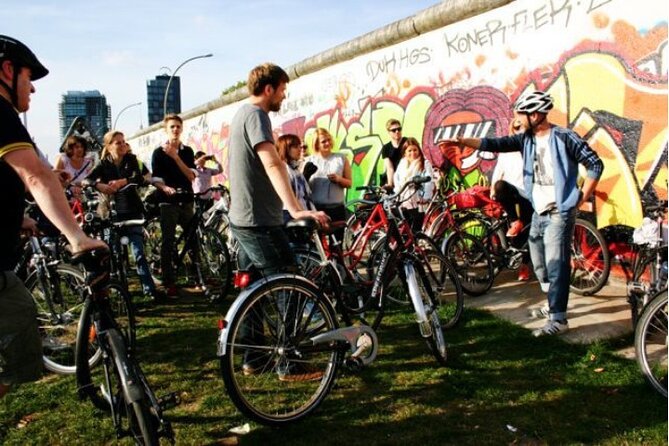
The stop lasts about 10 minutes. Checkpoint Charlie is also one of Berlin’s most commercialized historic sites, so the guide’s context is particularly useful. If you want to see the East Side Gallery as well, ask about it before setting out. It is listed among the tour’s possible highlights, but the detailed route described here does not include it as a numbered stop. The private format may allow adjustments, depending on time and route.
What the three-hour format really gives you
This is a survey tour, not a museum day. Most stops last five or 10 minutes, with 15 minutes at Spreebogenpark. You will see a large number of sites and gain a connected explanation of Berlin’s Nazi, Wall, and democratic eras.
The benefit is range. You can move from the synagogue to the Wall, from a flak tower to the Reichstag, and from the Holocaust Memorial to Checkpoint Charlie without spending the whole day on foot.
The tradeoff is depth. You will not have time for long interior visits, extended photography, or unhurried reflection at every memorial. I would use this ride to identify the places you want to revisit later.
Price, comfort, and practical value
The price is about $107.42 per person. For a private three-hour tour that includes a professional guide, bicycle, helmet, and a route tailored to your group, that can be fair value when four or more people share the experience.
The price makes less sense if you want only one section of Berlin’s history. You might prefer a focused museum visit or a shorter neighborhood walk. But if you want a broad first orientation, the bicycle, private format, and guide’s route add real value.
The tour includes family-friendly arrangements, and infant seats can be provided on request. Children must be accompanied by an adult. You should dress for the weather because the ride operates in all conditions.
English and German are offered, with Dutch, French, and Spanish possible by request. Checkpoint Charlie is specified for the English version, so ask about the exact route if you choose another language.
The tour begins and ends at Free Berlin Bike Tours & Rental on Poststraße 11. Hotel pickup, food, and drinks are not included. You receive confirmation when booking, and cancellation is free up to 24 hours before the start time.
Who should book this Berlin bike tour?
I would recommend it to history-minded families, friends traveling together, and first-time visitors who want a clear sense of how Berlin’s major 20th-century stories connect.
It is especially useful if you want to:
- Cover several distant sites in one morning or afternoon
- Ask questions privately rather than follow a large group
- See both famous landmarks and less obvious memorials
- Compare Nazi, Cold War, and democratic chapters of Berlin’s past
- Use a short tour to plan more detailed visits later
I would hesitate if you dislike cycling, need long periods at each memorial, or want to go inside the Reichstag and other buildings. The route is active and information-heavy, with many short stops rather than a few long ones.
Should you book it?
Book this tour if you want a fast but serious introduction to Berlin’s Wall and Third Reich sites, especially if your group has at least four people. The private format gives you useful flexibility, and the bicycle helps solve Berlin’s biggest sightseeing problem: the sites are spread out.
Choose it with realistic expectations. You will not fully explore every memorial in three hours, and the East Side Gallery or Reichstag interior may require separate plans. But as a first pass through Berlin’s difficult and important history, this ride offers strong value, clear structure, and a route that reaches places many walking tours miss.
FAQ
How long does the private bike tour last?
The tour lasts approximately three hours.
What is included in the price?
The tour includes a professional guide, bicycle, helmet, and private touring for your group.
How many people are required to operate the tour?
The tour operates with a minimum of four people.
Is Checkpoint Charlie included on every language version?
Checkpoint Charlie is included on the English version of the tour. German is also offered, and Dutch, French, and Spanish may be possible by request.
Does the tour run in bad weather?
Yes. The tour operates in all weather conditions, so you should dress appropriately.
Where does the tour start and finish?
The tour starts at Free Berlin Bike Tours & Rental, Poststraße 11, 10178 Berlin, Germany, and ends back at the same meeting point.
More WWII and D-Day Tours in Berlin
- Vienna: World War II Historical Walking Tour
★ 4.8 · 1,772 reviews - Zagreb: City & History Walking Tour & WW2 Tunnels
★ 4.9 · 1,202 reviews - Pearl Harbor History Remembered Tour from Ko Olina
★ 5.0 · 1,009 reviews - Hiroshima Peace (Heiwa) Walking Tour at World Heritage Sites
★ 5.0 · 872 reviews
More WWII and D-Day Tours in Germany
- Berlin: History of the Third Reich Guided Walking Tour
★ 4.7 · 791 reviews - Berlin: Guided Bike tour of the Berlin Wall and Third Reich
★ 5.0 · 160 reviews - Berlin: Nazi History Walking Tour
★ 4.8 · 33 reviews - Eagle’s Nest-Berchtesgaden-Obersalzberg Private Half Day WWII Historical Tour
★ 5.0 · 64 reviews
Just added around Berlin
- Historic center of Berlin – Tour in Italian★ 5.0 · 143 reviews
- Berlin Food & Cultural Tour: Must-Try German & Berliner Classics★ 5.0 · 51 reviews
- Small-Group Historical Bike Tour in Berlin★ 4.5 · 103 reviews
- Private Berlin WWII and Cold War History Tour with Local Expert Guide★ 5.0 · 28 reviews
- Private Tour: Jewish Heritage Walking Tour of Berlin★ 5.0 · 29 reviews
- East Berlin Food & History Tour with Eating Europe★ 5.0 · 204 reviews
- Explore Berlin History and Highlights Sightseeing Walking Tour★ 5.0 · 81 reviews
- Berlin Beers & Battlefields Tour: War History and German Beer★ 5.0 · 29 reviews
Cold War & Communism Tours, compared.
Communism History and Nuclear Bunker Guided Tour
Read our review →
Prague Communism History and Nuclear Bunker Tour
Read our review →
Cold War & Berlin Wall History Guided Bike Tour
Read our review →
Chisinau: Discover Soviet Heritage of Transnistria
Read our review →
Communist History Tour with House of Terror Option
Read our review →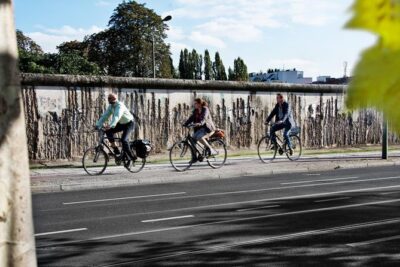
Guided Bike tour of the Berlin Wall and Third Reich
Read our review →