

Review · BUCHAREST-ILFOV
Bucharest: Communism and History Guided City Walking Tour
Communism still shapes Bucharest. This three-hour walk connects grand buildings, demolished neighborhoods, secret-police sites, and ordinary food shortages into one clear story of Romania’s recent past. I like the way it links major events to everyday life, and I like the guides’ use of personal memories, old photographs, and even a period-style snack. The main drawback is that the Parliament building is viewed only from outside.
The route covers a lot of ground, but the pace is manageable and includes a short café break. You should come ready for three hours on foot, with comfortable shoes and a willingness to hear difficult stories about surveillance, hunger, forced relocation, and the 1989 Revolution.
Key points to know before you book
- The walk begins at the Patriarchal Cathedral: You start with religion, royal history, and the political changes that helped bring communism to Romania.
- The Parliament is an exterior stop only: You get a strong view and a detailed explanation of its construction, but this is not an inside tour.
- Personal stories make the period easier to understand: Guides such as Andreea, Daniela, Mihai, Octavian, Ion, and John have been praised for connecting national events with family memories and daily routines.
- The route includes about 15 historical points: These range from nationalized homes and relocated buildings to former Secret Police sites and Revolution Square.
- A communist-era snack adds a small sensory detail: It is a simple but effective reminder that food and household supplies were once tightly limited.
- You pay for the café break yourself: The 15-minute pause gives you time to rest, use the bathroom, and ask extra questions.
Why this Bucharest walk is worth your time
Bucharest can be hard to read at street level. A grand boulevard may hide a demolished neighborhood. An old church may have survived only because it was moved. A plain apartment block may tell you more about communist planning than a polished museum display.
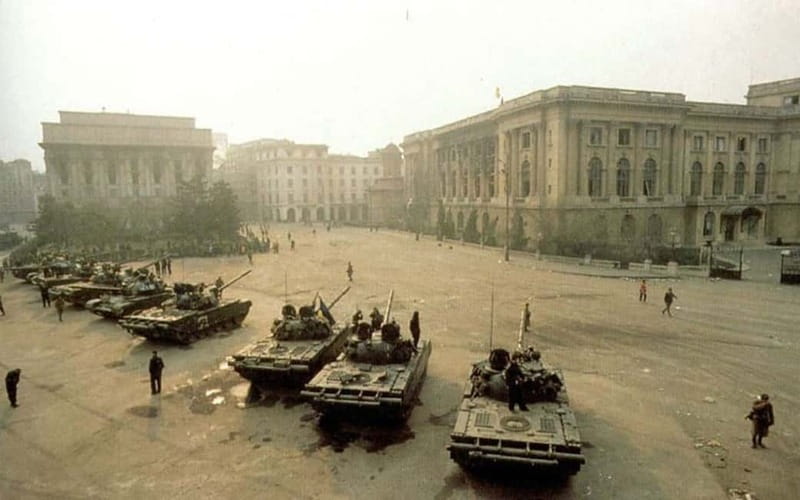
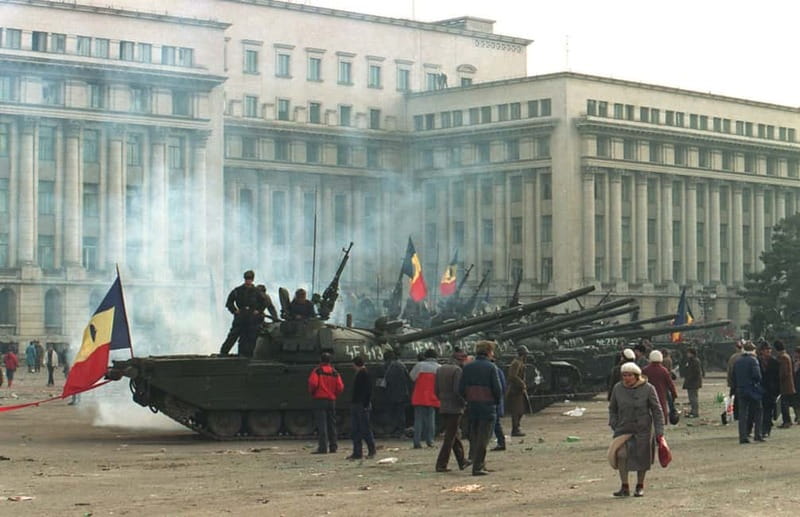
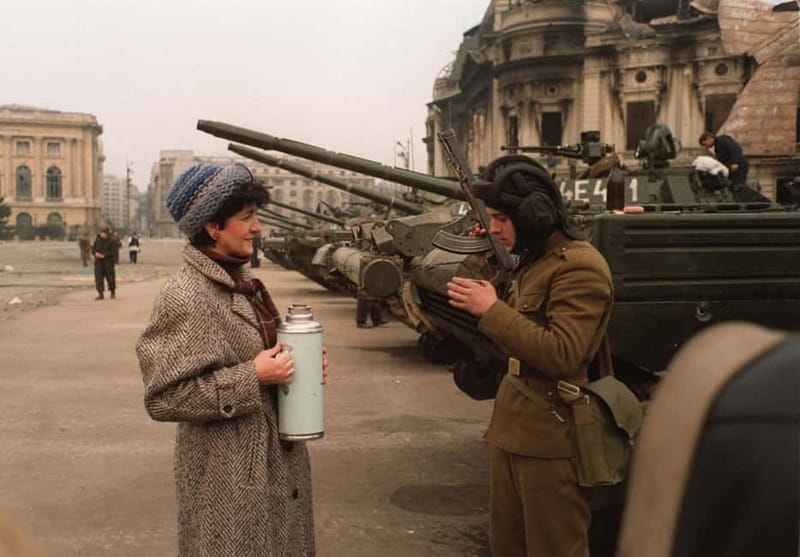
This tour gives those pieces a timeline. You learn how communism took hold, how Nicolae Ceausescu turned Bucharest into a stage for his power, and how the regime controlled housing, work, religion, food, and speech. The final focus is the 1989 Revolution and the uncertain beginning of democracy.
I like this format because it does not treat communism as a collection of dates. The strongest part is the connection between policy and ordinary people. Nationalization was not just an economic decision on paper. It changed who could live in a house. Food shortages were not just statistics. They affected what families could buy and how they planned each day.
At $31 per person, the tour is fairly priced for a three-hour guided walk in central Bucharest. You are paying for a specialist subject, a prepared route, and a guide who can explain the links between places that might otherwise seem unrelated. It is especially good value if you are new to Romanian history or want more context than a general city stroll provides.
More Cold War and Communism Tours in Romania:
- Bucharest Heritage City Tour – The Last Days of Communism
★ 5.0 · 20 reviews - Prague: Communism History and Nuclear Bunker Guided Tour
★ 4.7 · 2,417 reviews - Prague Communism History and Nuclear Bunker Tour
★ 5.0 · 1,742 reviews
Starting uphill at the Patriarchal Cathedral
Meet in front of the Patriarchal Cathedral, reached from Piata Unirii metro station. The final approach involves walking uphill from Union Square, so allow a few extra minutes and do not arrive at the last second.
The cathedral is a smart starting point. It lets the guide explain the role of religion under communism and set out the political events that led to the regime’s rise. Romania was not presented as a society where religion simply disappeared. Instead, religious life continued under close pressure and control, creating a more complicated picture than the simple idea of total suppression.
This opening also gives you useful national context before the route narrows to Bucharest. You begin to see the city not only as the capital of a dictatorship, but as a place where institutions, beliefs, and families had to adjust to a new political order.
Nationalized homes and the cost of state control
The next section moves through a nearby neighborhood where the results of nationalization become visible. This is one of the most useful parts of the route because the buildings are not merely monuments. They show how government policy changed private lives.
The guide explains what nationalization meant for property owners and how housing could be reassigned. You might pass an attractive older building without realizing that its history includes forced changes of ownership and residents. The point is not to admire façades alone. It is to understand how the state reached into the home.
This part also helps explain why Bucharest can feel architecturally uneven. Older streets, state-built housing, later repairs, and empty spaces created by demolition all sit close together. A good guide makes those contrasts readable, and the guides praised most warmly for this tour are described as clear, patient, and willing to answer questions.
The Parliament view and Ceausescu’s grand plan
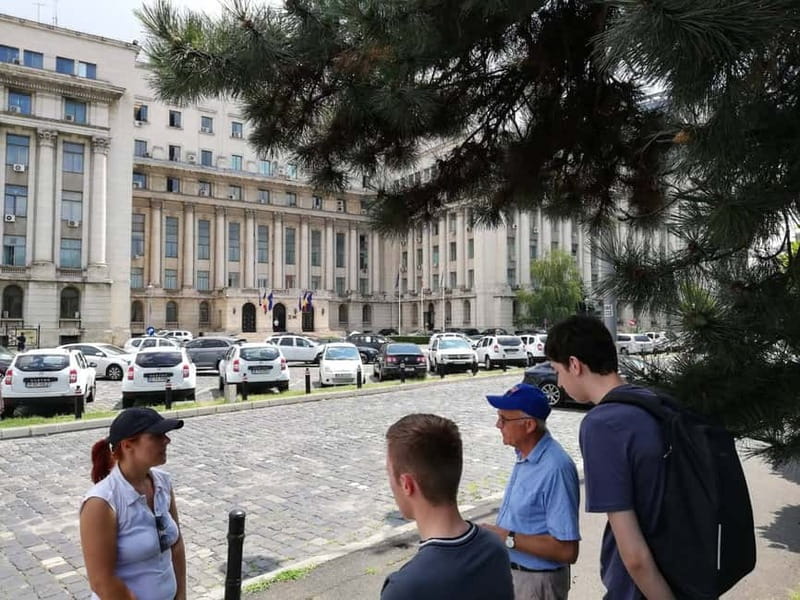
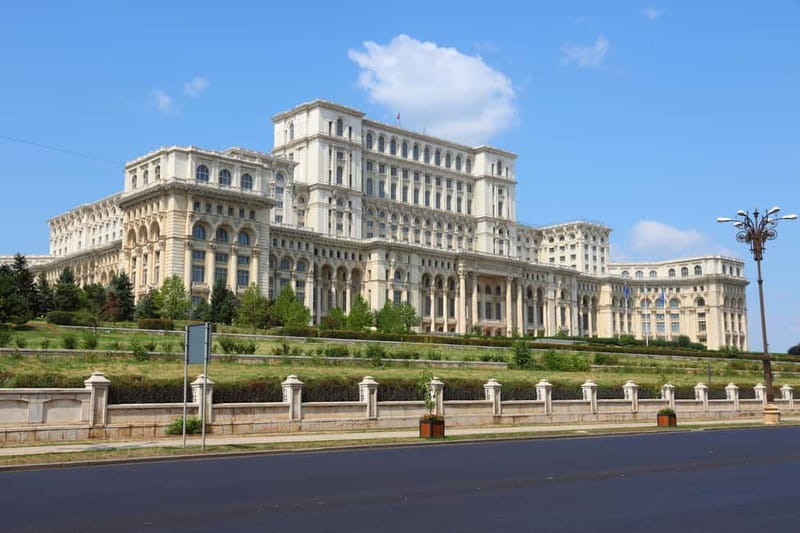
The Palace of the Parliament, still commonly called the House of the People, is the route’s biggest visual moment. You stop for photographs and hear how Nicolae Ceausescu ordered the enormous building as part of a vast reshaping of Bucharest.
The building represents political power, but it also represents scale without restraint. Entire areas were cleared for Ceausescu’s civic center, and the project demanded huge resources at a time when ordinary people faced severe shortages. Your guide places the building beside the human cost of the regime’s priorities, which makes the view far more meaningful than a quick photo stop.
It is important to set expectations: you do not go inside the Parliament on this tour. If you want the interior rooms, security procedures, and formal visit offered by a separate Parliament tour, you will need to arrange that independently. Here, the value is the outside explanation and the position of the building within the wider destruction of central Bucharest.
The tour presents the redevelopment as one of the largest peacetime destructions of a European city. That claim is not used as empty drama. It opens the door to a discussion of demolished churches, homes, streets, and communities, along with the dictator’s wish to create a capital that reflected his authority.
More History Walking Tours in Romania:
- Guided Walking Tour of Historical Bucharest
★ 5.0 · 84 reviews - Roma Culture, Realities and Slavery History, Walking tour
★ 4.9 · 52 reviews - Half-Day Jewish Heritage Walking Tour in Bucharest
★ 5.0 · 20 reviews - Bucharest: Sweet Delights History and Desserts Walking Tour
★ 5.0 · 18 reviews
Moved buildings and Antim Monastery
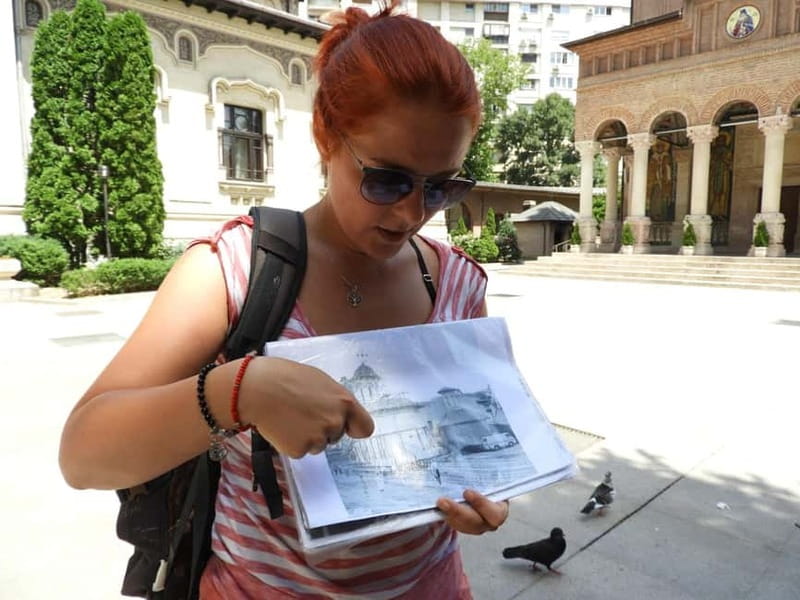
One of the more surprising themes is that not every threatened building was simply lost. Some were physically moved to protect them from demolition, and Antim Monastery is a key example.
Seeing Antim after hearing about forced redevelopment gives you a useful contrast. The monastery represents continuity and survival, while the surrounding story concerns power trying to erase older parts of the city. Your guide explains how buildings could be saved through extraordinary efforts, even as whole neighborhoods disappeared.
This stop also keeps the tour from becoming a parade of communist concrete. Bucharest’s older religious and civic architecture remains part of the story, and the route shows how different layers of the city were pushed against one another.
A short café pause and a taste of rationing
Halfway through, you stop at a local café for about 15 minutes. Your drink or food is not included, so bring a little extra money if you want something. The break gives you time to sit down, use the bathroom, and let the first half of the story settle.
The tour includes a communist-style snack, which is a small detail but a memorable one. It adds smell and taste to an era usually explained through buildings and political speeches. The snack is not meant to recreate hardship theatrically. It helps make the discussion of limited food supplies and rationing more concrete.
The café is also a good moment to ask about subjects that interest you most. Several guides, including Daniela, Mihai, Andreea, and Octavian, have been praised for answering questions at length and using visual material or personal examples when a subject needs more explanation.
Daily life outside the old Alimentara
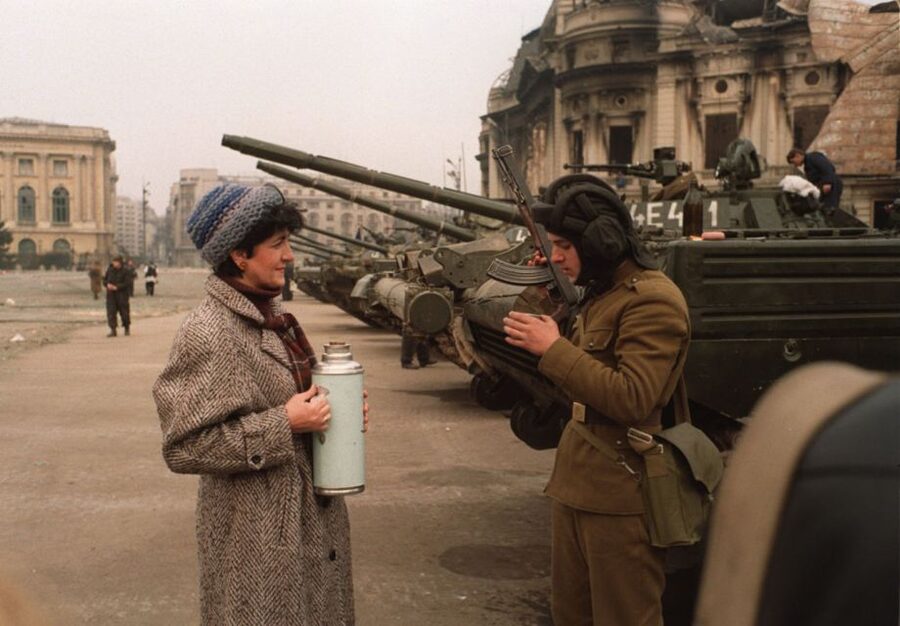
After the break, the group stops near an old Alimentara grocery store. This is where the tour turns firmly toward domestic life under communism.
You hear about the problems people faced when basic goods were unreliable or difficult to obtain. The guide explains how the system affected families, shopping routines, and the general sense of uncertainty. It is an important counterweight to the grand story of Ceausescu’s buildings and political ceremonies.
The most effective guides bring in family experiences from the period. Andreea has been praised for using real-life examples, while Ion has been noted for adding family details from the Cold War years. Mihai has also been praised for combining personal memory with a balanced explanation of the period.
That personal approach matters, but the tour does not depend only on nostalgia. The strongest explanations connect individual memories to wider decisions made by the state. You come away understanding not just that life was difficult, but why it was difficult and how the pressure reached ordinary households.
Calea Victoriei and the old Secret Police
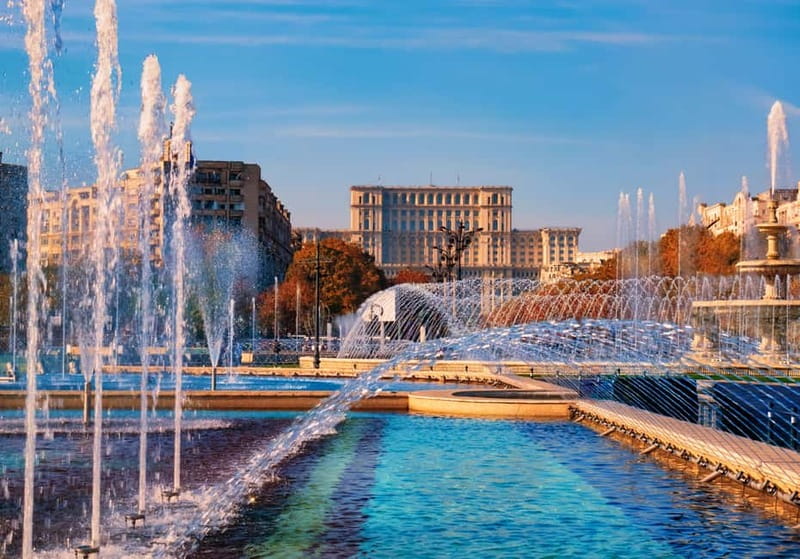
The route then reaches Calea Victoriei, one of Bucharest’s most attractive and important streets. Walking here at a normal pace gives the tour a change of rhythm after the denser material about housing and rationing.
The boulevard also carries darker memories. You see communist symbols and a former center associated with the Secret Police, including its use for torture. The guide explains how surveillance and fear operated, not only through dramatic arrests but through the possibility that a conversation, letter, workplace complaint, or neighbor’s report might be noticed.
This is a serious section of the walk. The subject matter can be upsetting, and the tour does not soften the brutality of the system. At the same time, it places the Secret Police within the broader structure of the regime, showing how political control affected daily behavior and trust.
You also pass Caru’ cu bere, one of the city’s best-known historic restaurants. Here, the route uses a familiar Bucharest landmark as part of the larger story. It is a reminder that the city’s old cultural identity did not vanish under communism, even when the government tried to direct public life and reshape the capital.
Smaller stops that reveal the bigger story
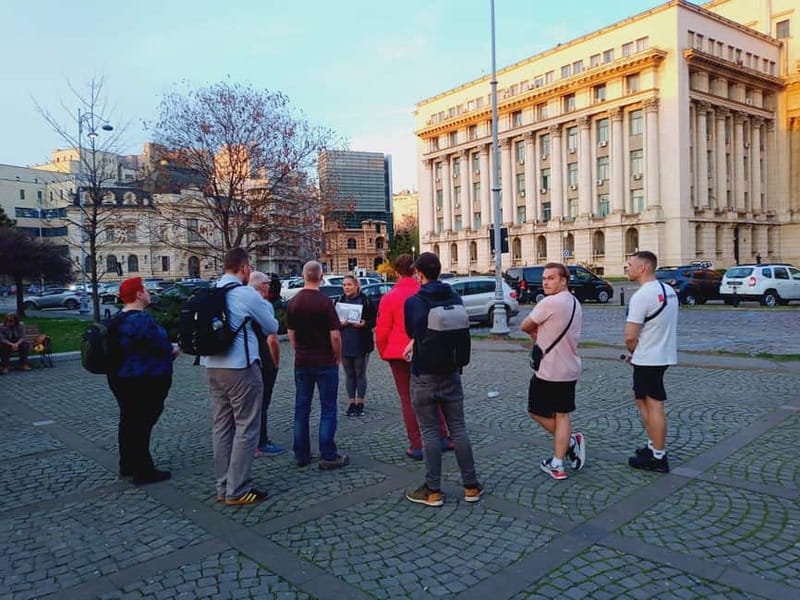
Several points on the route are described simply as less obvious or unnamed stops. That is a benefit, not a weakness. Bucharest’s communist past is often visible in ordinary places, and a guided walk can point out details you would probably pass without noticing.
Together, these stops create a timeline of dictatorship, nationalization, demolition, surveillance, and resistance. You are not just looking at one famous building after another. You are learning to read the city as evidence.
The walk includes roughly 15 objectives, with about 10 to 20 minutes at many of the main points. Some stops are guided visits and others are brief pass-by explanations. That variety keeps the route moving, though anyone who wants long interior visits at every location may find the format too quick.
Revolution Square and the fall of communism
The tour ends at Revolution Square, where the guide explains the final days of the communist regime in 1989 and the start of democracy. This is where the earlier subjects come together: political control, economic hardship, public fear, and growing opposition.
The guide covers the sequence of events and the wider meaning of the Revolution. You should expect a serious account rather than a neat ending. The fall of communism brought freedom and political change, but it did not erase the habits, memories, buildings, or economic problems left behind.
Ending here works well because the route has shown you the system from several angles. You have seen its religious pressures, its housing policies, its grand construction, its food shortages, its secret police, and its effect on the streets. Revolution Square then becomes more than a place for photographs. It is the final chapter of the walk.
Guides, pace, and the practical side
The experience is offered in English, and the guide changes depending on the departure. Names praised for their warmth, clarity, and storytelling include Andreea, Daniela, Mihai, Octavian, Ion, and John. Their styles may differ, but the repeated strengths are clear: strong command of Romanian history, good English, personal examples, and patience with questions.
The walking pace is generally comfortable, but this remains a three-hour outdoor activity. Wear supportive shoes and prepare for changing weather. The tour runs in rain or shine unless heavy rain, snow, extreme wind, or extreme heat makes it unsafe.
This is not a good choice if you have serious back problems or use a wheelchair, since the route includes several hours of walking and an uphill start. One account describes a guide adjusting the pace for someone who needed more time, but the stated suitability information still advises against booking if you require a wheelchair-accessible route.
You do not get hotel pickup or drop-off. The easiest meeting point is the Patriarchal Cathedral, with Piata Unirii as the closest metro station. Cancellation is free up to 24 hours before the tour, and you can reserve now and pay later, which is useful when your Bucharest plans are still shifting.
Is this Bucharest tour right for you?
Book it if you want to understand how communism changed Romanian homes, streets, institutions, and family life. It is also a strong first-day activity because it gives context for the Parliament, old neighborhoods, Calea Victoriei, and Revolution Square.
I would especially recommend it to anyone interested in modern European history, political systems, architecture, or personal stories from the Cold War period. Families with older children and teenagers may enjoy it if they are ready for serious topics.
Skip it if you want a light sightseeing stroll, an interior visit to the Parliament, or a tour focused mainly on medieval and royal Bucharest. The route is sometimes emotionally heavy, and three hours on foot requires reasonable stamina.
For $31, you get a focused history lesson tied to real streets and buildings, not a list of dates in a classroom. If you want to understand why Bucharest looks the way it does and how Romania’s past still affects its present, this is one of the better uses of a morning or afternoon in the city.
FAQ
Where does the tour begin?
The meeting point is in front of the Patriarchal Cathedral. The closest metro station is Piata Unirii, and you need to walk uphill from Union Square to reach the cathedral.
Where does the tour finish?
The tour ends at Revolution Square in Bucharest.
How long does the walking tour last?
The tour lasts three hours.
Is the Parliament building visited inside?
No. The Palace of the Parliament, also called the House of the People, is viewed from outside during this experience.
Is the café break included in the price?
The 15-minute café break is included in the schedule, but anything you choose to eat or drink there is at your own expense. A communist-style snack is included separately.
What should I bring?
Bring comfortable shoes. The tour takes place outdoors in most weather conditions, so you should also dress for the forecast. It may be canceled if severe weather creates safety risks.
Just added around Romania
- Private Tour – Food, Culture, History & Traditions★ 5.0 · 18 reviews
- Half-Day Jewish Heritage Walking Tour in Bucharest★ 5.0 · 20 reviews
- Bucharest Historical Food Tour in Old Center★ 5.0 · 21 reviews
- Bucharest Jewish Heritage | Holocaust Memorial | Private Car Tour★ 5.0 · 38 reviews
- Bucharest Heritage City Tour – The Last Days of Communism★ 5.0 · 20 reviews
- Experience the History of Bran Castle and Saxon Fortifications in Burzenland★ 5.0 · 19 reviews
- Roma Culture, Realities and Slavery History, Walking tour★ 4.9 · 52 reviews
- Private Bucharest: History & Food with Traditional Meal★ 5.0 · 34 reviews
Cold War & Communism Tours, compared.
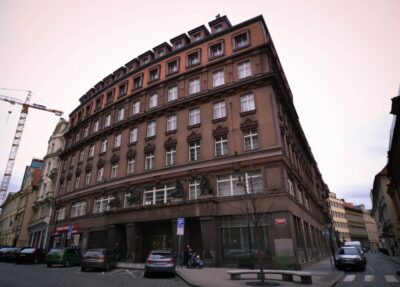
Communism History and Nuclear Bunker Guided Tour
Read our review →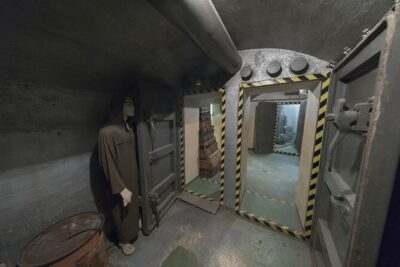
Prague Communism History and Nuclear Bunker Tour
Read our review →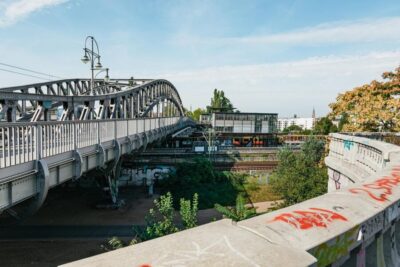
Cold War & Berlin Wall History Guided Bike Tour
Read our review →
Chisinau: Discover Soviet Heritage of Transnistria
Read our review →
Communist History Tour with House of Terror Option
Read our review →
Guided Bike tour of the Berlin Wall and Third Reich
Read our review →
Browse the lists this tour appears in