
Review · BUCHAREST-ILFOV
Private Bucharest: History & Food with Traditional Meal
Bucharest tells its story through lunch. I like the smart route from Revolution Square to Old Town, and I like that the history comes with real local food, from a salty covrig to a full Romanian meal. The main drawback is that the food stops before lunch may be lighter than the description suggests.
This private four-hour walk costs $140 per person, a fair price if you value a personal guide, flexible conversation, and a proper three-course meal. Guides such as Elaina, Andra, Mara, Ioanna, and Monica have earned praise for their warmth, patience, and ability to make children feel included. Still, this is more of a history walk with a meal than a market-style tasting tour.
Key points to know before booking

- Revolution Square sets the political stage: Begin where Ceaușescu gave the speech that helped trigger Romania’s 1989 revolution.
- Romanian food reflects several empires and neighbors: Taste and discuss Balkan mici, Ottoman sarmale, Russian soups, and Austro-Hungarian schnitzel.
- The route links grand avenues with medieval lanes: Victory Street, Kretzulescu Church, Old Town, and Hanul Lui Manuc show Bucharest’s many faces.
- The meal is a real sit-down finish: You receive three courses of Romanian specialties at a traditional inn, plus house beer, wine, or a soft drink.
- Private guiding makes the pace personal: You can ask questions, pause for photos, and keep children involved more easily than on a large group tour.
- The tour has a clear environmental policy: It is carbon neutral and operated by a B Corp certified company.
Starting at Revolution Square with Romania’s modern past
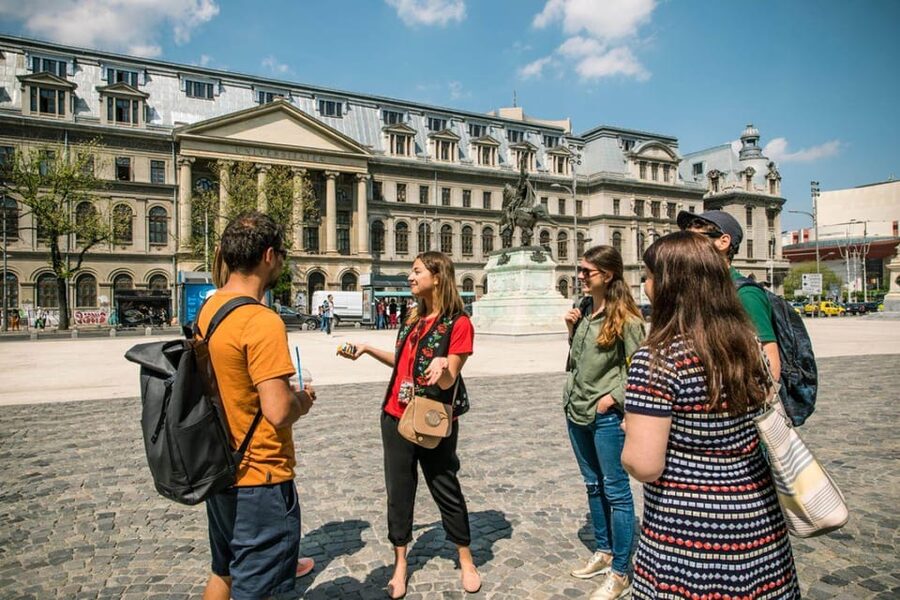
Meet at the Equestrian Statue of Carol I in Revolution Square, also called Palace Square. This is a useful starting point because the square brings together royal ambition, cultural life, political power, and the fall of communism in one compact setting.
Your guide begins with the 1989 Romanian revolution. From this square, Nicolae Ceaușescu delivered a speech meant to rally public support. The crowd turned against him, and the event helped set the revolution in motion. That story gives the rest of the walk some weight. You are not simply looking at handsome buildings. You are seeing places tied to a country’s sharp political turns.
The former Royal Palace helps explain Romania’s monarchy and its place in European affairs. Nearby, the Romanian Athenaeum adds a cultural note, with its role as one of the city’s best-known concert halls. Athenee Palace brings another layer. In the years between the world wars, it was linked with spies, diplomats, and political intrigue.
I like this opening because it avoids treating Bucharest as a city with one simple identity. Royal, artistic, political, and Communist-era stories all meet here. A guide can connect those pieces in a way a quick photo stop cannot.
You also get your first food sample, a covrig. This salty, ring-shaped snack is part of everyday Romanian life and may have arrived with Habsburg or German merchants in medieval times. It is a small bite, not a full tasting course, but it gives you an immediate connection to ordinary local habits.
More Local Culture and Traditions Tours in Romania:
- Roma Culture, Realities and Slavery History, Walking tour
★ 4.9 · 52 reviews - Amsterdam Food and Cultural Tour with Tastings
★ 5.0 · 4,315 reviews - Sevilla Food Tour: Tapas, Wine, History & Traditions
★ 5.0 · 3,468 reviews
Walking Victory Street and reading the architecture
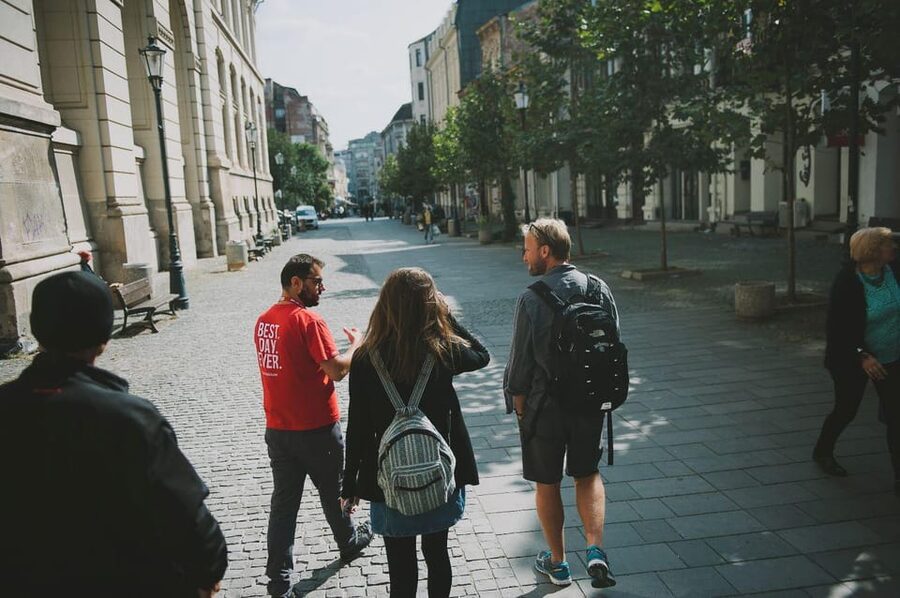
From Revolution Square, the route heads south along Victory Street. Its name recalls the new Romanian nation’s victory in the 1871 War of Independence. Full unification of the three Romanian principalities came later, in 1918, and that political history helps explain why Romanian regional food and customs vary so much.
Your guide uses the walk to introduce those regional differences. Moldova is associated here with sweeter flavors, Transylvania with earthy food, and Muntenia, the region around Bucharest, with spicier cooking. These are broad regional descriptions rather than strict rules, but they help you understand why one national cuisine can contain so many different influences.
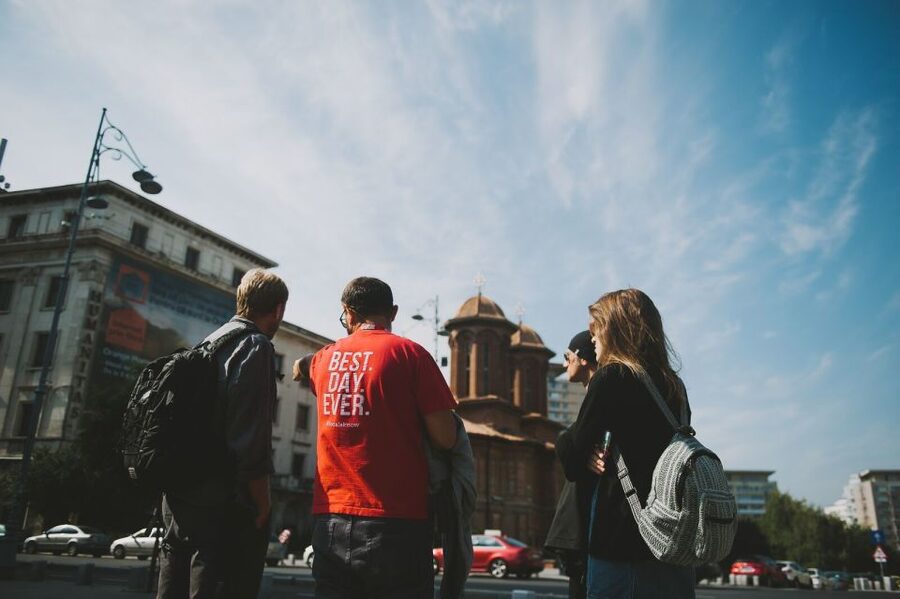
Victory Street also gives you a useful lesson in Bucharest’s architecture. You pass the Telephone Palace, the Military Circle, and the former National Theatre, along with the beautiful Kretzulescu Church. The buildings reflect the city’s inter-war confidence, when Bucharest took on a strong French influence and earned its old nickname as the Paris of the East.
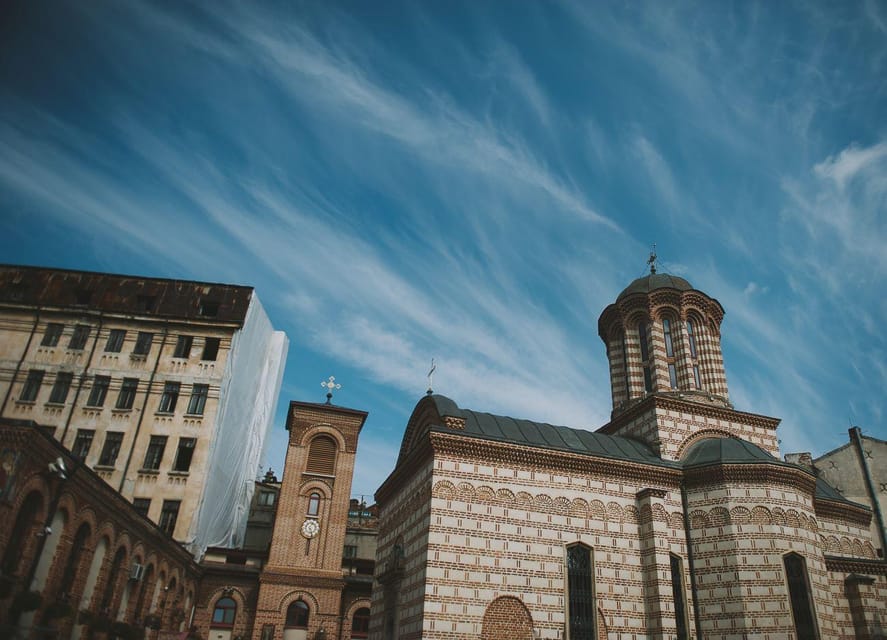
The Kretzulescu Church is especially valuable as a stop because it breaks up the grand civic buildings with a more intimate religious setting. Its red brick exterior and Orthodox character offer a reminder that Bucharest is not just boulevards and government offices.
This part of the walk is best for you if architectural details matter. Guides such as Andra have been praised for pointing out how the city’s buildings fit into its political and social story, rather than treating architecture as decoration. You can also ask questions as you go, which is one of the main advantages of booking privately.
Old Town, where East meets West
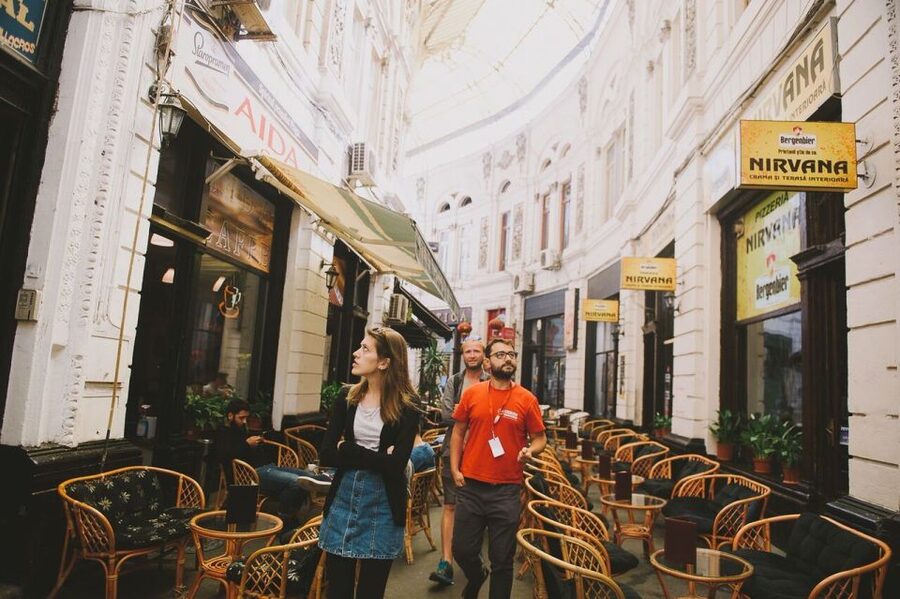
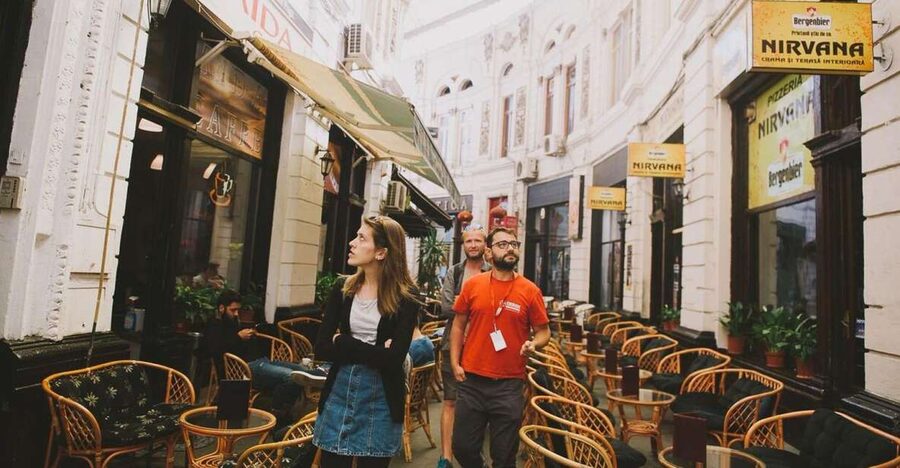
The route then turns into the lanes and passageways of Old Town. This is medieval Bucharest, and it feels different from the formal spaces around Revolution Square and Victory Street. Here, the city’s role as a meeting point between East and West comes into focus.
Ottoman pashas, Transylvanian princes, merchants, and local rulers all shaped this part of the city. Churches and mosques once stood close to one another, and the food still carries traces of those connections.
The guide links familiar dishes to different outside influences:
- Mici, skinless grilled sausages, reflect Balkan food traditions.
- Sarmale, stuffed cabbage leaves, carry Ottoman influence.
- Borscht and ciorba, sour soups, connect with Russian and regional traditions.
- Schnitzel reflects the Austro-Hungarian presence.
That explanation adds value to the eventual meal. You are not simply served a plate and told it is traditional. You have already heard why Romanian cuisine includes sour soups, stuffed leaves, grilled meat, and dishes shaped by neighboring powers.
Old Town also gives the guide room for stories. You may see princely courts, ornate interiors, and the quiet grounds of an Orthodox monastery. Hanul Lui Manuc, the great wooden inn, is one of the most important sights on this part of the walk. It helps you picture the old commercial Bucharest, when inns served as places for merchants, travelers, and business dealings.
The contrast is part of the appeal. Old Town has plenty of modern nightlife now, but its lanes still preserve the outline of an older trading center. The tour explains how the area moved from Ottoman and medieval connections through Communist neglect and into its current capitalist nightlife.
One practical note: the route includes city walking, old lanes, and passageways. Wear casual clothes and sensible shoes. The tour is child-friendly, but a private format matters most when a young child needs a slower pace or a photo break. One guide, Andra, was especially praised for keeping an eight-year-old involved without rushing the walk.
The People’s Palace and the scale of Ceaușescu’s ambition
Before the meal, you get a look at the People’s Palace. This massive building was the center of Ceaușescu’s plan to reshape Bucharest according to his own vision. It is presented as the second-largest building in the world, after the Pentagon.
Even from the outside, the size helps explain the cost of Communist-era city planning. The building was not just an office complex. It represented an attempt to remake the capital on a grand scale, with older neighborhoods sacrificed to the project.
You should not book this tour expecting a full interior visit of the People’s Palace. The itinerary gives you a look at the building as part of the wider city story. That is enough to connect the revolution, Communist planning, and today’s Bucharest, but it is not a substitute for a dedicated palace tour.
This brief stop works because it gives the day a final political marker before lunch. You have seen monarchy, inter-war culture, medieval trade, and Communist power. The meal that follows becomes a way to gather those influences into one setting.
More Private History Tours in Romania:
- Bucharest Jewish Heritage | Holocaust Memorial | Private Car Tour
★ 5.0 · 38 reviews - Private Historical Walking Tour of York
★ 5.0 · 1,324 reviews - Private Guided Historic Electric Cart Tour of St. Augustine
★ 5.0 · 1,194 reviews - Istanbul: Acemoglu Historical Turkish Bath w/Private Options
★ 4.6 · 1,190 reviews
Three courses at a traditional Bucharest inn

The tour ends at a traditional hanu, or inn, widely regarded as one of Bucharest’s most beautiful. Hanul Lui Manuc is associated with the Old Town section of the walk and gives the meal a strong sense of place. You are not eating in an anonymous restaurant chosen only for convenience.
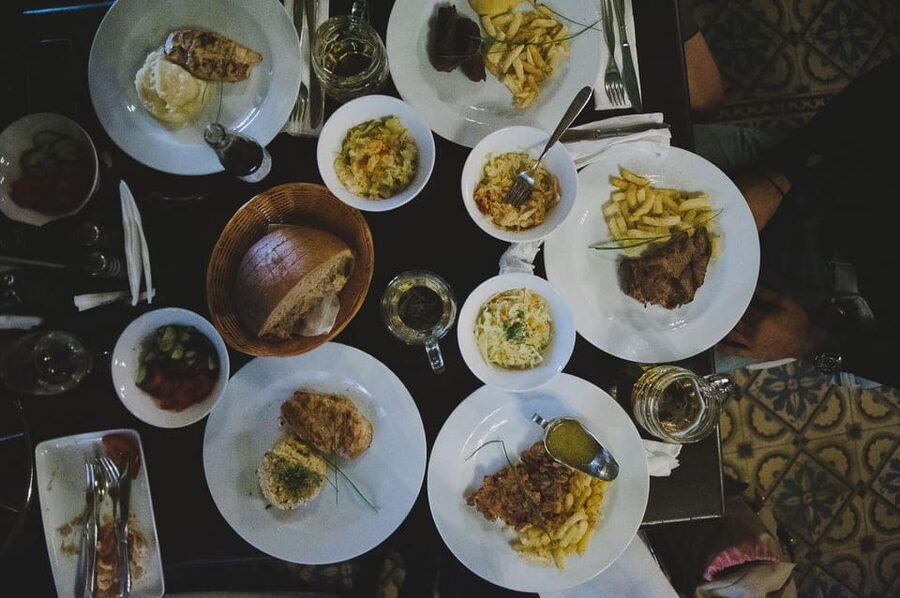
The included meal has three courses and a selection of Romanian specialties. The exact dishes are not fixed in the information provided, so you should not expect a guaranteed menu. The aim is to give you a broad taste of Romanian food and show how geography and history appear on the plate.
Your included drink is house beer, wine, or a soft drink. The tour also tells the amusing story of Burebista, the Dacian leader said to have banned wine production because his people drank so much of it. The Dacians reportedly responded by brewing beer instead, so you can raise either a beer or a glass of Romanian wine to that ancient compromise.
The meal is one of the strongest reasons to choose this tour over a standard city walk. You receive enough food to make lunch part of the booking, and the restaurant setting gives you time to talk with your guide. Several guides, including Monica, Andrei, and Elaina, have been praised for making the meal feel relaxed and social.
Still, keep your expectations clear. This is not a progressive tasting menu with many separate samples. One person enjoyed the three-course meal but expected more small food tastings along the route. That is the key distinction: the food supports the history, but the main tasting event is the final meal.
Additional food and drinks are not included. Souvenirs and personal purchases are also your responsibility.
How the private format changes the day
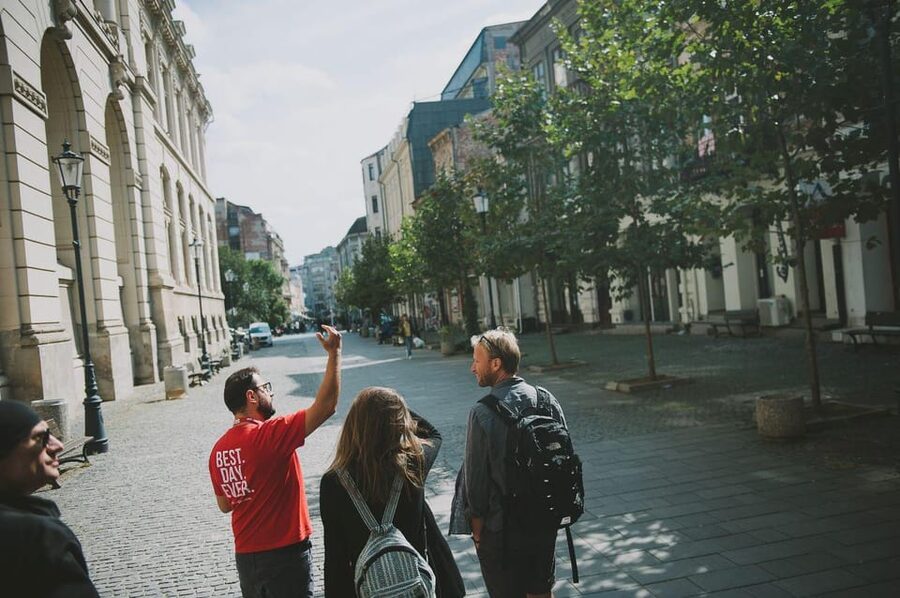
The private group setup is a major advantage. You are not tied to the questions or pace of a large crowd, and the guide can adjust the explanation to your interests. If you care about architecture, ask for more building details. If you want to understand the 1989 revolution, spend more time on the political story. If you are traveling with children, the guide can use shorter explanations and photo breaks.
This flexibility appears in the guide feedback. Elaina was praised for patience with a child dealing with jet lag. Andra was described as good at including children and offering current city tips as well as historical context. Other guides, including Mara, Ioanna, Dana, and Andrei, were praised for friendliness and strong command of Bucharest’s story.
The language is English, and the tour lasts four hours. Because the route combines several districts and ends with a full meal, the time should feel well used rather than rushed. You should still plan for a walking-heavy outing and wear casual clothing.
The tour is also suitable for a first day in Bucharest. It gives you a city overview, points out places you may want to revisit, and helps you understand local food before you order independently. One guide even provided recipes and restaurant tips during the experience, which shows the kind of practical value a private guide can add.
Is $140 per person good value?
At $140 per person, this is not a cheap food walk. The price pays for a private English-speaking guide, four hours of personal attention, and a three-course meal with one included drink.
For two people, the cost may feel high compared with a large group walking tour. But private guiding changes the calculation. You are paying for direct conversation, a flexible pace, and a meal in a traditional setting, not just for admission to sights. If you already planned to hire a private city guide and pay for lunch separately, the package becomes easier to justify.
The value is strongest for first-time visitors who want orientation and context in one outing. It is also a good match for families who do not want to force young children through a large group schedule. Food-focused travelers should book it only if they are happy with one light snack and one substantial meal, rather than a long series of tastings.
The carbon-neutral format and B Corp certification may also matter to you. The operator is committed to using tourism as a force for good, and the tour is organized around that policy. The supplied information does not give a separate carbon offset explanation, so I would treat this as a meaningful operating principle rather than a reason to assume every detail of the tour is environmentally perfect.
Who should book this Bucharest tour?
I would choose this tour if you want three things in one morning or afternoon: a city introduction, a readable explanation of Romanian history, and a traditional meal. It suits couples, families, and small private groups who value conversation over a fixed script.
It is especially useful for a first visit. Revolution Square gives you the modern political story, Victory Street introduces the grander city, Old Town shows the medieval and commercial past, and the meal ties the regional food influences together.
I would hesitate if your main goal is an intensive food crawl. The route discusses many dishes, but only the covrig is specifically identified as an early tasting, and the main food portion comes at the three-course meal. I would also choose a different activity if you want a dedicated interior tour of the People’s Palace.
Free cancellation is available up to 24 hours before the start, and you can reserve now and pay later. Children under six can join free, but tell the supplier at booking. These details make the tour easier to fit into a changing family schedule.
FAQ
Where does the Bucharest food and history tour meet?
The meeting point is the Equestrian Statue of Carol I in Sector 1, Bucharest.
How long does the tour last?
The tour lasts four hours.
What language is the tour offered in?
The live tour guide speaks English.
Is this a private tour?
Yes. It is offered as a private group experience.
What food and drink are included?
You receive a three-course Romanian meal and one house beer, wine, or soft drink. A covrig is also included as an early traditional snack.
Are extra food and drinks included?
No. Additional food and drinks are not included, and souvenirs or personal purchases are also separate.
Can children join the tour?
Yes. The tour is child-friendly, and children under six can join free of charge. You should tell the supplier when booking if you are bringing a child under six.
Can I cancel or pay later?
You can cancel up to 24 hours in advance for a full refund. You can also reserve your place and pay later.
Should you book it?
Book this tour if you want Bucharest explained through both its buildings and its food. The private format, strong guides, child-friendly pace, and atmospheric final meal make it a well-rounded introduction to the city.
Skip it if you want a nonstop tasting tour or a full visit inside the People’s Palace. For most first-time visitors, though, the combination of Revolution Square, Old Town stories, regional food traditions, and a three-course Romanian lunch offers a useful and enjoyable start to Bucharest.
More Food Tours in Romania
- Bucharest Historical Food Tour in Old Center
★ 5.0 · 21 reviews - Barcelona: Tapas Walking Tour with Food, Wine, and History
★ 4.8 · 4,261 reviews - Madrid Tapas & Taverns Small Group Food & History Tour
★ 5.0 · 2,664 reviews - Historic Ybor City Food Walking Tour
★ 5.0 · 2,210 reviews
Just added around Romania
- Half-Day Jewish Heritage Walking Tour in Bucharest★ 5.0 · 20 reviews
- Bucharest Historical Food Tour in Old Center★ 5.0 · 21 reviews
- Bucharest Jewish Heritage | Holocaust Memorial | Private Car Tour★ 5.0 · 38 reviews
- Bucharest Heritage City Tour – The Last Days of Communism★ 5.0 · 20 reviews
- Experience the History of Bran Castle and Saxon Fortifications in Burzenland★ 5.0 · 19 reviews
- Roma Culture, Realities and Slavery History, Walking tour★ 4.9 · 52 reviews
- Discover Romania’s Wine Heritage in Brasov’s Historic Center★ 4.6 · 19 reviews
- Bucharest: Sweet Delights History and Desserts Walking Tour★ 5.0 · 18 reviews
Local Culture & Traditions Tours, compared.

Amsterdam Food and Cultural Tour with Tastings
Read our review →
Sevilla Food Tour: Tapas, Wine, History & Traditions
Read our review →
Tromsø: Reindeer Camp and Sami Cultural Tour with Lunch
Read our review →
Half Day Dominican Republic Cultural Tour : Small Group
Read our review →
Ultimate Melbourne Walking Tour: History, Laneways & Culture
Read our review →
Tromsø: Sámi Reindeer Sledding and Sami Cultural Tour
Read our review →
Kyoto Gion: 2-Hour Geisha Culture & History Walking Tour
Read our review →
Marrakech Historical and Cultural Tour – Half Day City Tour
Read our review →Browse the lists this tour appears in