
Review · HIROSHIMA
History of Hiroshima Group Walking Tour
Hiroshima asks you to remember carefully. This two-hour walk makes that possible, taking you through the Peace Memorial Park, past the Atomic Bomb Dome, and to the city’s ground-zero monument with a guide who adds human stories to the facts. I especially like the compact route for a short stay and the guide’s focus on peace, not just dates and destruction. The price, $32.84 per person, is also fair for a small slice of expert-led context.
I also like that the walk includes less familiar memorials, such as the monument to Korean victims and the Mother and Baby in the Storm statue. The main consideration is emotional: Hiroshima’s history is painful, and the pace leaves little time to linger at every stop. You receive a strong introduction, but you may want to return to the Peace Memorial Museum or selected monuments afterward.
Key details before you book
- Nine meaningful stops: The route covers the Gates of Peace, several memorials, the Peace Bell, the Atomic Bomb Dome, and the Hypocenter.
- A guide with Peace Studies training: The tour is designed to explain why the bombing happened, how it changed world history, and how Hiroshima became a symbol of peace.
- Two hours on foot: The walk is compact and manageable, but the subject matter is intense and the schedule is fairly tight.
- A group of up to 30 people: Group discounts are available, and two children aged 0 to 10 can join free.
- No entrance charge for the listed stops: The tour price covers the guide. Lunch and other food are not included.
- Easy cancellation terms: You can cancel up to 24 hours before the start for a full refund, subject to the weather and minimum-group conditions.
Starting at the Gates of Peace
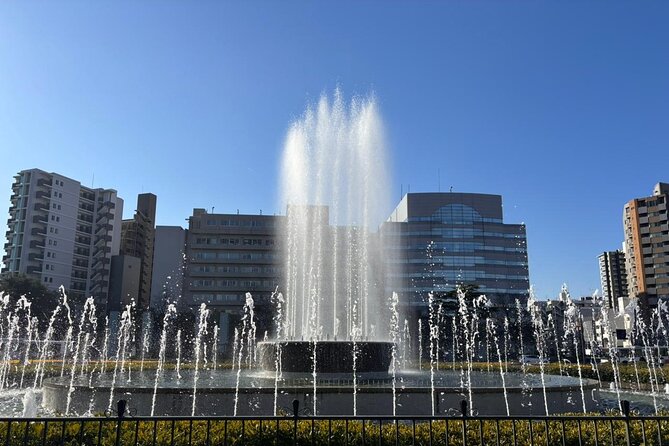
The meeting point is outside Ristorante Mario at 4-11 Nakajimacho, in Hiroshima’s Naka Ward. From there, the guide begins at the Gates of Peace, a fitting place to frame the walk before you begin seeing memorials.
This opening talk explains why Hiroshima was chosen for the atomic bombing and how the event affected world history. That context matters. Without it, the park can feel like a series of solemn objects scattered across green space. With it, the memorials begin to connect into a story about war, civilian life, nuclear weapons, and the city’s effort to promote peace.
The Gates of Peace include ten gates, with nine representing an important idea connected to peace. The opening section lasts about 20 minutes, so you should expect more than a quick greeting and group photograph. It gives you the basic framework needed for the rest of the walk.
If you have not read much about Hiroshima before arriving, this is one of the tour’s strongest features. The guide can organize the subject for you without asking you to absorb a large amount of background on your own.
More History Walking Tours in Japan
- Hiroshima Historical Walking Tour – Why A-Bomb was Dropped
★ 4.8 · 893 reviews - Hiroshima Peace (Heiwa) Walking Tour at World Heritage Sites
★ 5.0 · 872 reviews - Miyajima Half-day Trip Historical Walking Tour
★ 5.0 · 284 reviews
The Mother and Baby in the Storm
The next stop is the Arashi no Naka no Boshi Statue, often described as Mother and Baby in the Storm. It honors mothers who lost their lives while trying to save their children.
The stop lasts only about five minutes, but its short length does not make it unimportant. This monument shifts the story from military decisions and citywide destruction to individual acts of love and sacrifice. It is one of the places where a guide’s explanation can change how you look at an object that might otherwise pass quickly in a park.
You should not expect a long pause here. The value comes from hearing what the monument represents, then carrying that thought into the next section of the walk.
The Cenotaph and the names of the dead
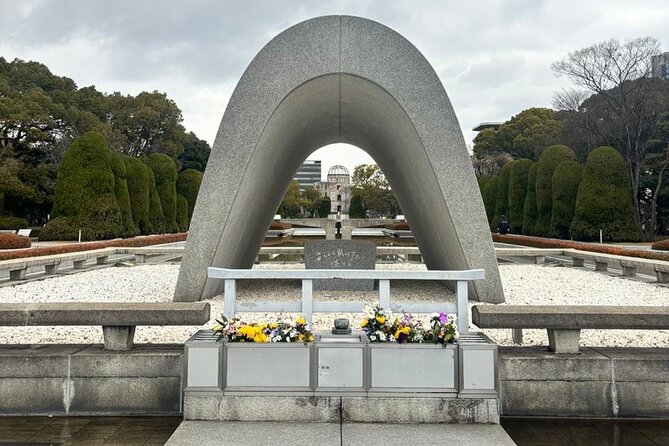
The Hiroshima Peace City Monument, also called the Cenotaph for the Atomic Bomb Victims, receives about 20 minutes. This is one of the central memorials in the park and an important place to slow down.
The cenotaph holds the names of people who died from the bombing. The focus here is not only the number of victims, but the effort to remember each person. A guide can help explain why the memorial is shaped and positioned as it is, and why the names remain central to Hiroshima’s act of remembrance.
This stop may feel more formal than the smaller monuments. That is useful for understanding how Hiroshima presents memory in a public setting. The city does not ask you to think only about the moment of the blast. It asks you to remember the people who lived there, worked there, and lost their lives.
The National Peace Memorial Hall
The Hiroshima National Peace Memorial Hall for the Atomic Bomb Victims is scheduled for about 20 minutes. It presents the destruction of the city and gives the walk an indoor point of focus among the outdoor memorials.
This part is particularly helpful if you want a clearer sense of the scale of the bombing. Outdoor monuments often require imagination. A hall devoted to the victims and the destruction can give the story a more direct shape.
The experience is still guided, so you have someone available to explain what you are seeing and answer questions. The guide’s role matters here because Hiroshima’s history includes complicated subjects: the war in Asia, the United States decision to use the bomb, the suffering of civilians, and the city’s later peace message.
The tour description emphasizes a guide with Peace Studies training. Several guides associated with the experience are praised for answering questions well, with names including Cva, Malek, Moe, Shiva, and Ali. The exact guide can vary, but the repeated strength of this experience is the quality of the explanations and the ability to keep the group engaged during a difficult subject.
More History Walking Tours in Hiroshima:
- Hiroshima: History of Hiroshima Group Walking Tour
★ 4.8 · 266 reviews - Hiroshima: Peace Walking Tour of World Heritage Sites
★ 4.9 · 190 reviews - Hiroshima: Miyajima Half-day Historical Walking Tour
★ 4.7 · 100 reviews - Walking Through History: Hiroshima’s Path to Peace
★ 5.0 · 31 reviews
The Rest House and the distance from ground zero
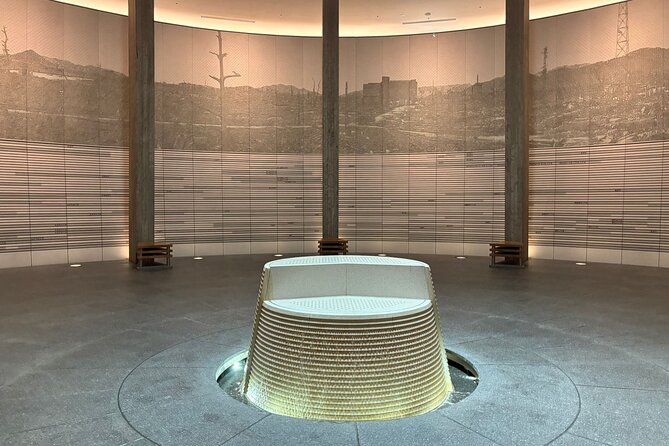
The Rest House of Hiroshima Peace Park gets roughly 15 minutes. Its importance comes from survival. The building was about 170 meters from the blast’s ground zero and remained standing, making it one of the most striking physical reminders of the bombing.
This is a useful stop because it gives you a concrete sense of distance. Numbers about the blast can feel abstract, but standing near a building that survived so close to the center makes the scale more real.
The guide can also explain the building’s place in the park’s story. You should expect a short visit rather than a full building tour, since the group has several more memorials to cover.
Sadako, paper cranes, and the Children’s Peace Monument
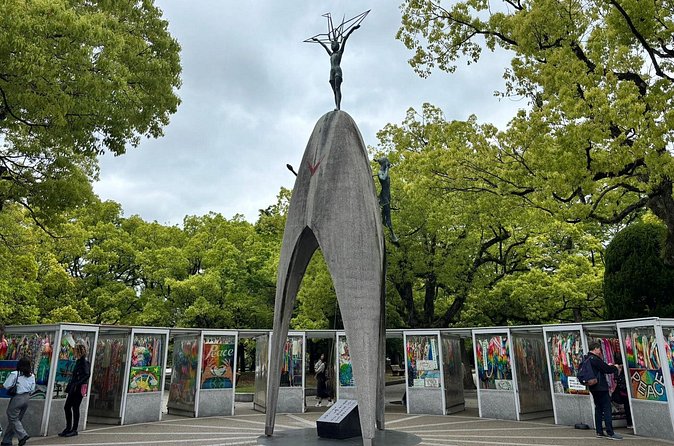
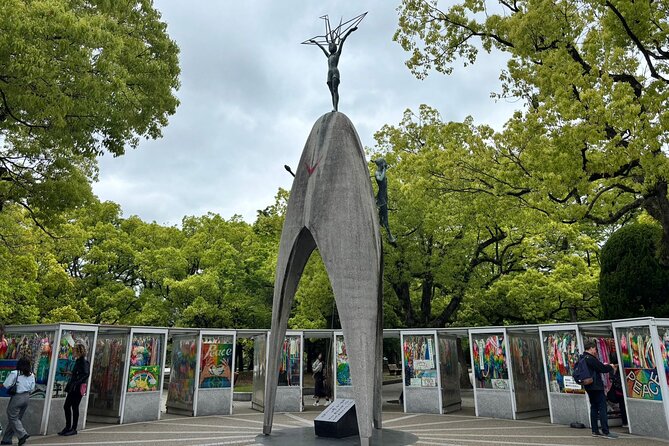
The Children’s Peace Monument receives about ten minutes. It is dedicated to Sadako Sasaki and other children who died after the bombing.
The monument is closely tied to the paper crane, now a widely recognized symbol of peace. Sadako’s story gives younger visitors a personal way into the history, but it is not only a children’s story. It also shows how the effects of the bombing continued after the initial destruction.
This stop often gives the walk a more intimate feeling. The cenotaph speaks for many victims, while the Children’s Peace Monument helps you consider one child and the many children represented by her memory.
If you are visiting Hiroshima with children, this may be one of the easiest places to discuss the subject in human terms. Still, parents should decide how much detail is right for their family. The tour covers serious material throughout.
Remembering Korean victims and survivors
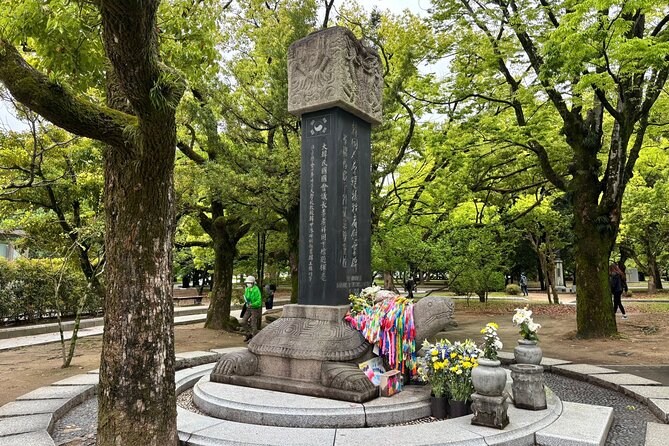
The Monument to Korean Victims and Survivors is an important inclusion. It recognizes Korean people who were among those affected by the bombing.
This stop broadens the story beyond a simple Japanese national narrative. The bombing happened in Japan, but the people living and working in Hiroshima came from different backgrounds. Remembering Korean victims helps you see the city’s wartime history in a wider regional context.
Only about five minutes are assigned here, so the explanation is brief. Even so, this is one of the route’s most valuable choices because it introduces a part of Hiroshima’s memory that you might miss if you walk through the park alone.
Ringing the Peace Bell
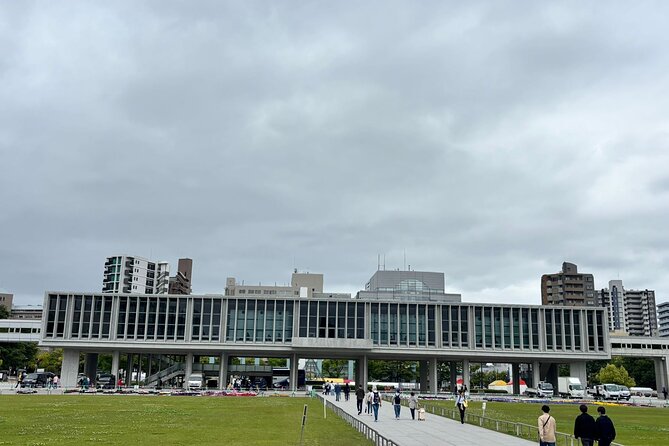
The Peace Bell is another short stop, about five minutes. It represents Hiroshima’s call for peace and gives the walk a quieter moment after the more detailed memorials.
This part may feel less information-heavy than the cenotaph or the National Peace Memorial Hall. That is not a problem. A walking tour about Hiroshima needs a few moments when you can pause and take in the meaning of the park rather than listen continuously.
The guide explains the bell’s role, then moves the group onward. With a maximum of 30 people, the group may not feel tiny, especially at popular sites, but the limit prevents the walk from becoming an enormous crowd.
The Atomic Bomb Dome
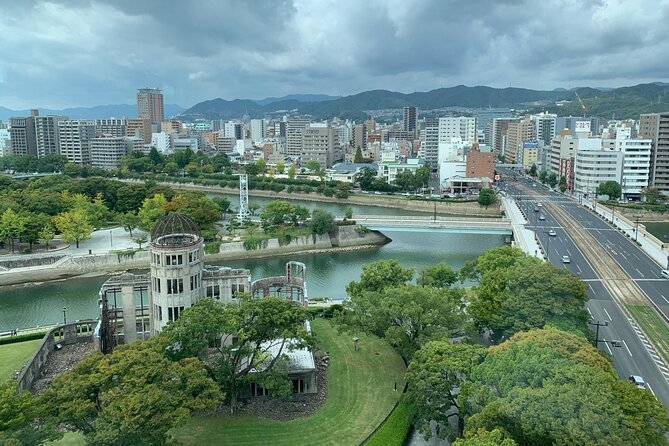
The Atomic Bomb Dome receives about 15 minutes and is the tour’s most recognizable sight. The building survived the atomic bombing, though much of Hiroshima around it was destroyed.
Seeing the Dome in person is different from seeing it in photographs. Its exposed structure and damaged form make the past feel physically present. At the same time, it is easy to spend too long taking pictures and too little time considering what the building represents. The guide helps prevent that by connecting the Dome to the wider story of the city.
This is also where the tour’s peace message comes into sharp focus. The Dome is not simply a ruin preserved for tourists. It represents the destruction caused by nuclear weapons and Hiroshima’s appeal for a world without them.
The walk ends at the Hiroshima Atomic Bomb Hypocenter Monument at 1-5-25 Otemachi. This is the ground-zero location, and ending there gives the route a clear sense of place and purpose.
What the two-hour pace feels like
Two hours is enough for a useful introduction, not enough for every museum room, memorial inscription, and personal story. The route includes nine stops, with several scheduled for only five or ten minutes.
I like this format if you have one day in Hiroshima or are fitting the Peace Park between other plans. The tour gives you a structure, then you can return to the places that affected you most. It is also a good first activity because it helps you decide where to spend more time later.
The pace may feel quick if you prefer long periods of quiet reflection. Hiroshima is not a place to rush, and some people will want more time at the Children’s Peace Monument, the cenotaph, or the National Peace Memorial Hall. You can ask questions, but a group walk must keep moving.
Comfortable walking shoes are sensible. The tour takes place outdoors and requires you to move between sites, though the supplied information describes it as suitable for most people.
Guide quality and the value of $32.84
At $32.84 per person, this walk offers good value if you want historical explanation rather than simple directions between sights. Admission to the listed stops is free, so you are paying mainly for the guide’s preparation, interpretation, and time.
That distinction matters. You can visit the Peace Memorial Park without paying for a tour. The benefit here is having someone explain why each stop matters, connect the memorials, and answer questions as the story develops.
The guides named in the feedback include Cva, Malek, Moe, Shiva, and Ali. Cva is described as warm, engaging, and able to bring in gentle humor when the subject becomes heavy. Malek is praised for his insight into Hiroshima, while Shiva is noted for answering questions and maintaining a positive pace. Moe is associated with explanations of Hiroshima before and after the bombing, and Ali is described as friendly and flexible.
You should not expect humor to turn the subject into entertainment. The best use of it is to give the group a small breath between serious sections. The tone remains respectful.
The maximum group size is 30. That is not a private tour, but it is limited enough to keep the walk organized. Group discounts may reduce the cost for larger bookings, and two children aged 0 to 10 can join free.
Who should book this Hiroshima walk?
I would choose this experience if you want a clear introduction to Hiroshima and prefer learning through conversation. It suits first-time visitors, people with limited time, and anyone who feels that memorials make more sense with context.
It is also useful if you want to hear about people often left out of a basic sightseeing route, including mothers, children, and Korean victims. The guide’s Peace Studies background adds value for anyone interested in the political and ethical questions surrounding the bombing.
This may not suit you if you want a private, silent visit or if you plan to spend several hours inside the Peace Memorial Museum. The two-hour format cannot cover everything, and a group of up to 30 may not allow every question to receive a long answer.
The tour is conducted outdoors and requires walking between stops. It is near public transportation, and most people can participate, but the supplied information does not give a detailed accessibility description. If you have specific mobility needs, ask the operator before booking.
You receive a mobile ticket, and lunch or other food is not included. Plan your meal separately rather than expecting a food stop during the walk.
Weather, cancellation, and timing
The experience requires good weather. If poor weather causes cancellation, you are offered another date or a full refund. It also requires a minimum number of participants, with a similar choice if the operator cancels for that reason.
You can cancel up to 24 hours before the local start time for a full refund. Cancellations or changes inside that 24-hour window are not refunded or accepted, so check your Hiroshima schedule before committing.
The walk starts at Ristorante Mario and ends at the Hypocenter Monument, rather than returning to the restaurant. That makes the ending important for planning. You are near central Hiroshima sites, but you should allow a little time afterward to find your next stop.
Should you book the History of Hiroshima Group Walking Tour?
Yes, if you want a well-organized two-hour introduction to Hiroshima’s memorial sites and the human stories behind them. The route is short, the price is reasonable, and the guide adds meaning that you would not get from simply walking past each monument.
Book it early in your Hiroshima stay if possible, then return to the Peace Memorial Museum or any memorial that deserves more time. Skip it only if you already know the park well, want a private experience, or prefer to explore at your own slow pace.
For most first-time visitors, this is a thoughtful way to begin. It does not pretend that two hours can explain everything. It gives you the framework, the key places, and enough human detail to make the rest of your time in Hiroshima more meaningful.
FAQ
How long does the Hiroshima walking tour last?
The tour lasts approximately two hours.
How much does the tour cost?
The listed price is $32.84 per person.
Where does the tour begin?
The meeting point is Ristorante Mario at 4-11 Nakajimacho, Naka Ward, Hiroshima, 730-0811, Japan.
Where does the tour end?
The tour ends at the Hiroshima Atomic Bomb Hypocenter Monument at 1-5-25 Otemachi, Naka Ward, Hiroshima, 730-0051, Japan.
What sites are included?
The walk includes the Gates of Peace, the Mother and Baby in the Storm statue, the Cenotaph for the Atomic Bomb Victims, the Hiroshima National Peace Memorial Hall, the Rest House, the Children’s Peace Monument, the Monument to Korean Victims and Survivors, the Peace Bell, and the Atomic Bomb Dome.
Is admission to the stops included?
The listed stops have no admission charge. The tour includes a guide, but lunch and other food are not included.
How many people can join the group?
The group can include a maximum of 30 people.
Can children join the tour?
Two children aged 0 to 10 can join free of charge.
Is the tour available with a mobile ticket?
Yes, a mobile ticket is available.
What happens if the weather is poor?
If the experience is canceled because of poor weather, you are offered a different date or a full refund.
Can I cancel for a full refund?
Yes. You must cancel at least 24 hours before the experience start time for a full refund. Cancellations within 24 hours are not refunded.
Just added around Hiroshima
- Morning Hiking Tour: Mt. Futaba & Hiroshima’s History★ 5.0 · 25 reviews
- Walking Through History: Hiroshima’s Path to Peace★ 5.0 · 31 reviews
- Hiroshima & Miyajima: Private Full-Day Tour with a Local Guide★ 5.0 · 39 reviews
- The history of Hiroshima “the event that shape the history”★ 4.9 · 18 reviews
- Hiroshima: Miyajima Half-day Historical Walking Tour★ 4.7 · 100 reviews
- Hiroshima: Peace Walking Tour of World Heritage Sites★ 4.9 · 190 reviews
- Hiroshima & Miyajima Island Private Tour: History & Culture★ 5.0 · 26 reviews
- Hiroshima: History and Hidden Gems Tour★ 4.9 · 81 reviews
History Walking Tours, compared.
History and Hauntings of Salem Guided Walking Tour
Read our review →
Freedom Trail History Small Group Walking Tour
Read our review →
Historic Charleston Guided Sightseeing Walking Tour
Read our review →
Tapas Walking Tour with Food, Wine, and History
Read our review →
Savannah History and Haunts Candlelit Ghost Walking Tour
Read our review →
A History of Terror – Belfast City Centre Walking Tour
Read our review →Browse the lists this tour appears in