

Review · PHILADELPHIA
Philadelphia Historical Independence Walking Tour
Philadelphia tells America’s story block by block. This 90-minute walking tour makes a smart introduction to Independence National Historical Park, linking Independence Hall, Franklin Court, Congress Hall, and more than 20 historic places with clear explanations of how the United States took shape. I like the strong range of landmarks for $25, and I like that guides such as Andrew, Neil, Mike, Matt, and David bring different personalities and stories to the walk.
The main caution is that the experience depends heavily on your guide and the day’s conditions. Most feedback is warmly positive, but one outing ended awkwardly when the guide followed part of the group to a museum before finishing with the others. Some buildings may also be inaccessible during closures or unusual operating conditions, so think of this as an outdoor history walk first, not a guaranteed interior tour.
Key points to know before you book

- Over 20 historic locations in about 90 minutes: You cover a large part of Philadelphia’s old center without paying admission at each outdoor stop.
- Independence Hall is the anchor: The guide explains the Declaration of Independence, the Constitution, and America’s first peaceful transfer of presidential power.
- Strong guides make the difference: Andrew, Neil, Mike, Matt, and David have been praised for storytelling, humor, flexibility, and working well with children.
- The route begins and ends at the Independence Visitor Center: Meet inside at 599 Market Street, near the information desk.
- Good value at $25 per person: The tour gives you orientation and context before you decide which historic sites deserve a longer visit.
- Small groups can feel almost private: The maximum is 30 people, though some departures have had only a handful of participants.
Why this Philadelphia walk is a useful first step
Philadelphia’s historic district can feel like a map full of famous names. Independence Hall, Carpenters’ Hall, Franklin Court, Congress Hall, the Liberty Bell, and the President’s House are close together, but their roles can blur if you see them without context.
This tour gives you a connected story. You learn how colonial Pennsylvania became a center of protest, how the Continental Congress worked, why the Constitution was debated, and how the new government began operating. That connection is the real value. You are not just collecting photos of old brick buildings.
The starting point at the Independence Visitor Center is practical. It is a clear place to find, close to public transportation, and the tour returns there at the end. You should arrive early enough to locate the information desk inside, since the meeting point is specific and one reported missed departure appears to have involved confusion within the visitor center.
The route is conducted in English and uses a mobile ticket. There are morning and several afternoon departure times, which helps if you want to fit the walk around the Liberty Bell, a museum visit, or lunch.
More History Walking Tours in the USA
- Philadelphia Old City Historic Walking Tour with 10+ Top Sites
★ 5.0 · 2,020 reviews - Philadelphia: History, Highlights & Revolution Walking Tour
★ 4.9 · 317 reviews - Philadelphia: Revolutionary Walk Through Historic Old City
★ 4.8 · 208 reviews
Independence Hall sets the tone
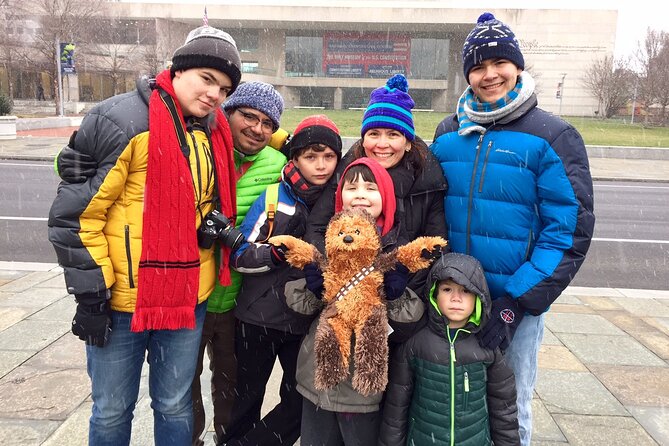
Independence Hall is the key stop, and the guide gives you about 10 minutes here. That may sound brief, but the important point is the explanation rather than a long visit inside the building.
This is where the Declaration of Independence and the Constitution were debated and adopted. Your guide also explains the Father of the Constitution and the peaceful transfer of power that followed the early presidential years. Those subjects help you see Independence Hall as more than a handsome Georgian building.
The stop works best when your guide tells the story in plain language. Several guides have been praised for explaining the events leading to the Revolutionary War, not just reciting dates after the fact. That broader setup matters. You understand why the colonies challenged British rule, what kind of government the founders attempted to create, and how fragile the new system was.
One practical point: an outside view and historical explanation do not necessarily replace an official interior visit. If walking through Independence Hall matters to you, check separate admission and timing requirements before your tour. The walking experience itself is designed to connect the surrounding sites.
Franklin Court and the missing house
At Franklin Court, you spend roughly five minutes seeing the location of Benjamin Franklin’s house. The original structure is gone, so this stop asks you to imagine the site rather than enter a preserved home.
That might sound less impressive than a furnished historic house, but Franklin Court helps explain the scale of the old city. Franklin was not only a statesman. He was a printer, inventor, publisher, diplomat, and civic organizer. The nearby Library Company of Philadelphia, founded by Franklin in 1731, adds another useful piece to that story.
A guide who knows how to connect Franklin’s public work with the physical neighborhood can make this short stop worthwhile. The tour also introduces Franklin Court as a complex of museums, structures, and historic places within the national park, so you can return later if you want more time.
I would not plan to linger here during the walking tour. Five minutes is enough for orientation, a photograph, and a short explanation. Save a longer visit for after the tour if Franklin is your main interest.
Carpenters’ Hall and the first Continental Congress
Carpenters’ Hall receives another short stop of about five minutes. The building is tied to the First Continental Congress, making it an important place for understanding how colonial resistance began to move toward organized political action.
This is one of the tour’s strongest features: it puts major events in modest, nearby buildings. The story of American independence did not happen only in grand halls. It also took shape in meeting rooms where tradespeople, merchants, lawyers, and political representatives argued over what to do next.
The guide’s job here is to give you the setting and purpose of the meeting. You may not have enough time for a long interior visit, but you should leave knowing why Carpenters’ Hall matters and how it fits between colonial Philadelphia and the Revolutionary period.
If you enjoy political history, this stop can be more rewarding than the quick photo opportunities. Listen for the explanation of how protest became cooperation among the colonies.
More History Walking Tours in Philadelphia:
- Walking Tour of Historic Philadelphia
★ 5.0 · 99 reviews - Badass Women’s History Walking Tour of Philadelphia
★ 5.0 · 97 reviews - The Black Journey: An African-American History Walking Tour of Philadelphia
★ 5.0 · 76 reviews - Beyond the [Liberty] Bell History Walking Tour
★ 5.0 · 73 reviews
Congress Hall and the early government
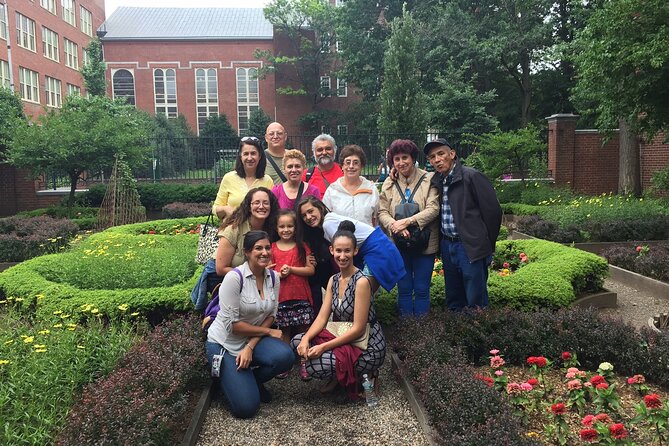
Congress Hall shows you where the first United States Congress met. The stop also returns to the theme of peaceful political change, including the transfer of power from George Washington to John Adams.
That transition is easy to treat as a footnote. It was not. A new country needed to show that leadership could change without a coup, civil war, or collapse. The guide uses Congress Hall to explain how the young government began to function in practice.
The building also helps you picture Philadelphia during the period when the city served as the national capital. This is a useful correction to the common assumption that Washington, D.C. was always the center of federal government.
The stop is short, but it has a clear purpose. You are not simply looking at another old facade. You are learning how the American experiment moved from revolutionary rhetoric to the routine work of governing.
The President’s House and Washington’s Philadelphia years
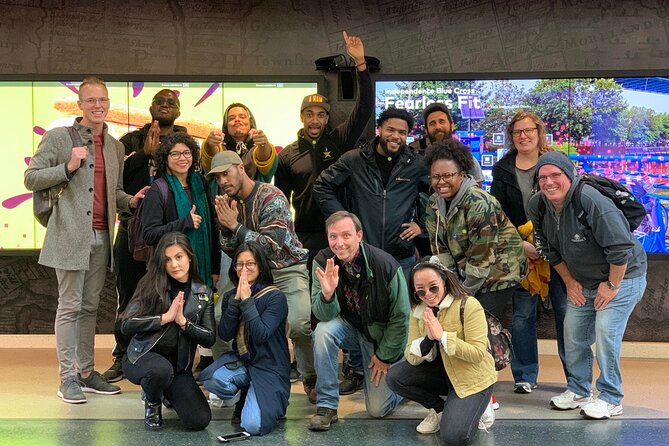
The President’s House marks the place where George Washington lived during his presidency. The site offers a chance to discuss the early executive branch and the realities of presidential life in Philadelphia.
This stop can raise difficult subjects as well as interesting ones. The early government existed alongside slavery, inequality, and competing ideas about freedom. The tour’s central focus is the formation of the United States, but your guide may connect the site to the larger questions surrounding Washington’s presidency and the new republic.
Five minutes is enough to identify the location and hear the key facts. You may want extra time later if the President’s House is a particular interest.
I appreciate that the route includes this place because it shifts the story away from abstract documents. Washington did not govern from a distant symbol. He lived in the city, worked among other officials, and helped set customs that later presidents inherited.
Betsy Ross House, Declaration House, and the places in between
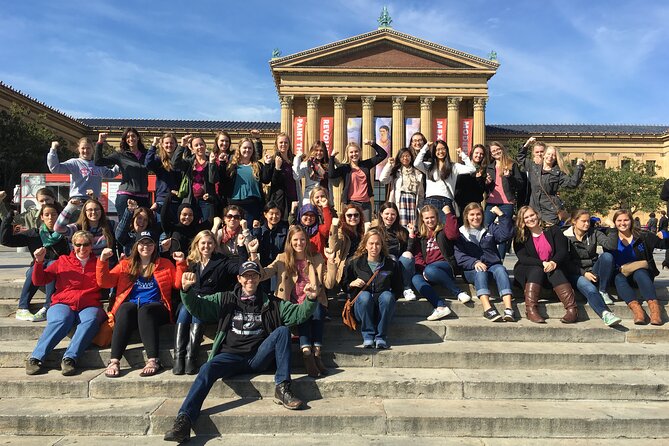
The advertised route includes the Betsy Ross House, the landmark associated with the seamstress believed to have sewn the first American flag. It also includes Declaration House, associated with Thomas Jefferson’s writing of the Declaration of Independence.
These sites add personal stories to the political narrative. Jefferson’s work on the Declaration becomes easier to picture when you know where he stayed and wrote. The Betsy Ross story adds a familiar figure, though the historical evidence around her role is more complicated than the popular version suggests.
Here, guide quality matters greatly. One disappointing experience involved the Betsy Ross House being skipped in the explanation, despite its expected place on the route. If this site matters to you, ask at the start whether the guide plans to include it and how much time the group will spend nearby.
The route also covers the original Supreme Court building, the Library Company of Philadelphia, Franklin Court, the Liberty Bell area, a print shop, and other locations in the old city. You see how law, publishing, government, protest, and private life were packed into a compact district.
What the storytelling is like

The strongest praise for this tour centers on the guides. Andrew has been singled out for making the events leading to the Revolutionary War easier to understand and for engaging children around age 11. Neil is often praised for his command of American history and for linking past events with current topics. Mike has received credit for mixing history with architecture, politics, and unusual facts.
Matt has been especially flexible with very small groups. In one case, he changed the route for a father and son and pointed out details they would likely have missed alone. David has been praised for humor and for answering questions in depth. Other guides, including Mike Rhodes and Cpl. Mike, have also been described as friendly, informed, and entertaining.
That variety is both a strength and a small risk. You are booking the tour company, not a guaranteed named guide. The experience can be lively and tailored, or it can feel less focused if the guide gives too much attention to one family or lets the group split up.
Families appear to fit the tour well. One guide kept six children engaged, including toddlers, school-age children, and a teenager, and two strollers managed the route. Still, a 90-minute walk requires patience from very young children. The best guides ask questions and use stories rather than giving a nonstop lecture.
Group size, pace, and the real length
The maximum group size is 30 people. That is large enough to create a crowd around a guide, but small enough to remain manageable on ordinary city sidewalks. Groups can also be much smaller. Some departures have had only six people, and one became a private-style outing for two family members and their guide.
The stated duration is about 1 hour 30 minutes. A few experiences have lasted longer, especially when the group had questions or the guide adjusted the route. That can be a benefit if you want more context, but it may affect plans for a timed museum entry afterward.
The itinerary describes several five-minute stops, one 10-minute stop, and many additional locations. The pace is therefore purposeful. You will see a lot, but you should not expect long interior visits at every building.
Wear comfortable shoes and prepare for outdoor conditions. The experience requires good weather, and poor weather can lead to a different date or a full refund. The route is near public transportation, service animals are allowed, and most people can participate, but the details do not promise a fully step-free route or seating at each stop.
Is $25 a fair price?
At $25 per person, this is a reasonable orientation walk for Philadelphia’s historic district. You receive about 90 minutes of guiding, a route through more than 20 locations, and a framework that can save you from wandering between landmarks without understanding their connection.
The value is highest if you are visiting Philadelphia for the first time, have limited time, or want help deciding which buildings deserve a second visit. A good guide can explain in minutes why Congress Hall matters, how Franklin Court fits into the city, and why Independence Hall is central to both the Declaration and the Constitution.
The value is lower if you want long interior visits, museum-style detail at every stop, or a fixed script with no changes. Admission to the listed stops is shown as free for the tour, but that does not mean every building is open for an interior visit during your walk. Closures can alter the route, including periods when government-related sites are inaccessible.
The tour also requires a minimum number of participants. If that minimum is not reached, you are offered another date or experience, or a full refund.
Booking advice and cancellation terms
The experience is often booked about eight days ahead, so I would reserve before your Philadelphia visit rather than wait until the last afternoon. Choose a morning departure if you want the rest of the day for museums, or use one of the afternoon times if your morning is already committed.
You can cancel for a full refund up to 24 hours before the start time. Cancellations and changes made inside that 24-hour window are not refunded or accepted. Cutoff times use Philadelphia local time.
Because the tour depends on good weather and a minimum group size, the operator may cancel and offer a different date or a full refund. Keep your plans flexible if this walk is the only activity you have scheduled for that part of the day.
Who should book this walk?
I would choose this tour if you want a clear introduction to Philadelphia’s founding era without spending half a day inside one museum. It suits families, first-time visitors, history students, and anyone who prefers stories connected to actual streets and buildings.
It is also a smart choice before visiting the Liberty Bell or Independence Hall on your own. You will recognize the names and understand why the nearby sites matter.
I would skip it if you dislike group pacing, need guaranteed access to every interior, or want a tightly controlled 90-minute finish. The experience can run long, and the guide’s style shapes the day.
For most visitors, the combination of location, price, and historical range makes it a solid opening activity. Book it early, confirm the meeting point inside the visitor center, and treat the walk as your orientation to Old City rather than the complete Philadelphia history experience.
FAQ
Where does the Philadelphia Historical Independence Walking Tour start?
The tour starts inside the Independence Visitor Center at 599 Market Street in Philadelphia. The advertised meeting point is near the information desk.
Where does the tour end?
The activity ends back at the Independence Visitor Center, the same place where it begins.
How long does the tour last?
The expected duration is about 1 hour and 30 minutes. Some outings may last longer if the guide answers questions or adapts the route.
What language is the tour offered in?
The tour is offered in English.
How much does the tour cost?
The listed price is $25 per person.
Is the tour suitable for children?
Yes. Guides have successfully engaged children of different ages, including toddlers, school-age children, and teenagers. Families have also managed the route with strollers.
Can I cancel for a refund?
You can receive a full refund if you cancel at least 24 hours before the experience begins. Cancellations or changes made less than 24 hours before the start time are not refunded or accepted.
Just added around Philadelphia
- Badass Women’s History Walking Tour of Philadelphia★ 5.0 · 97 reviews
- Historic Sites of Philadelphia Self-Guided Walking Audio Tour★ 4.5 · 24 reviews
- The Black Journey: An African-American History Walking Tour of Philadelphia★ 5.0 · 76 reviews
- Walking Tour of Historic Philadelphia★ 5.0 · 99 reviews
- Philadelphia Old City History Pub Crawl Small-Group Tour★ 5.0 · 294 reviews
- One Hour Tour Of Philadelphia Historical Sites In A Vintage Car★ 4.5 · 52 reviews
- Philly Gayborhood and LGBTQ History Walking Tour★ 5.0 · 36 reviews
- Beyond the [Liberty] Bell History Walking Tour★ 5.0 · 73 reviews
History Walking Tours, compared.

History and Hauntings of Salem Guided Walking Tour
Read our review →
Freedom Trail History Small Group Walking Tour
Read our review →
Historic Charleston Guided Sightseeing Walking Tour
Read our review →
Tapas Walking Tour with Food, Wine, and History
Read our review →
Savannah History and Haunts Candlelit Ghost Walking Tour
Read our review →
A History of Terror – Belfast City Centre Walking Tour
Read our review →Browse the lists this tour appears in