
Review · SPLIT
Walking Tour of Split with a ‘Magister’ of History
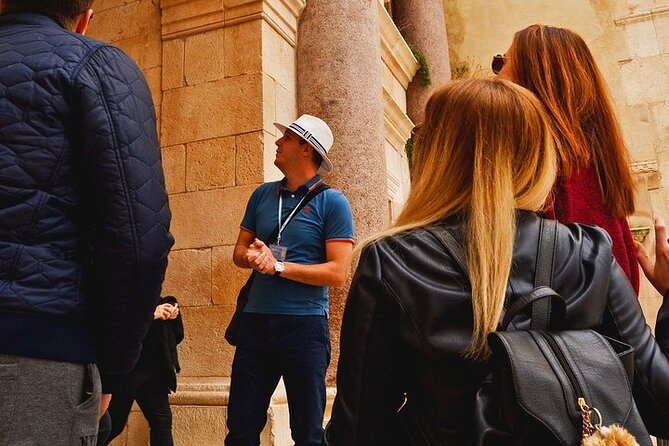
Split makes history hard to miss. This walking tour gives the Roman palace a clear story, then follows its medieval, Renaissance, Venetian, and modern layers with Toni Šare, a local historian and the owner of DiocleSpot Tours. I like the clever 3D reconstructions, and I like that Toni explains small details that are easy to pass without noticing.
The main drawback is that you do not enter the cathedral, Temple of Jupiter, museums, or other paid sites. You get context from outside, not admission tickets. Still, at $34.83 for roughly 1 hour and 45 minutes, the tour offers strong value if you want an intelligent introduction before exploring Split on your own.
Key points to know before booking
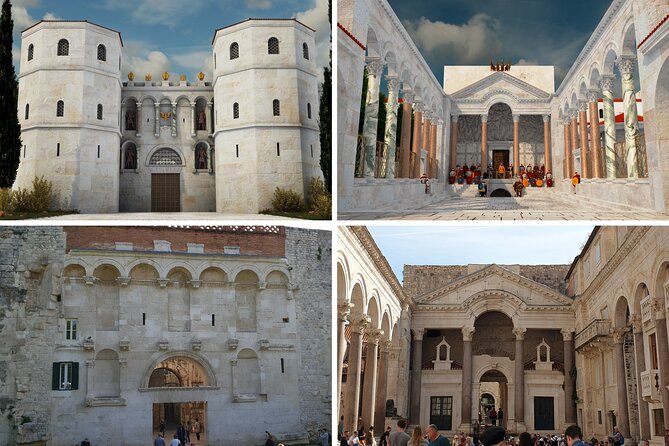
- Toni’s 3D palace reconstructions help you picture Diocletian’s complex before later centuries changed it.
- The route covers more than Roman ruins, including noble palaces, medieval defenses, Renaissance courtyards, and Croatian cultural history.
- No paid attractions are entered, so plan separate visits to the cathedral, Temple of Jupiter, or museums.
- The tour ends at Pjaca, Split’s main medieval square, a useful place to continue sightseeing or find your bearings.
- Groups are limited to 18 people, with a private option available if you want more room for questions.
- An evening departure can help in hot weather, while a morning tour gives you useful ideas for the rest of your day.
Why this Split history tour earns its price
Split is not a museum sealed behind glass. Diocletian’s Palace is part of the working city, with homes, shops, cafés, churches, squares, and narrow lanes built into and around the ancient structure. That makes the city exciting, but it can also make the story hard to follow.
This tour solves that problem with a short, focused walk through the old center. Toni connects the Roman palace to the later city instead of treating the Roman period as the whole story. You hear about medieval changes, Renaissance noble families, Venetian influence, Croatian language and culture, and the way people reused Roman walls for later needs.
The price is $34.83 per person. For a tour lasting about 100 to 110 minutes, that is not the cheapest way to walk around Split, but the value comes from interpretation rather than admission. You are paying for a guide who can explain why a wall, gate, courtyard, or oddly placed stone matters.
The tour also has a strong record, with a five-star rating and 1,122 reviews, plus a 100 percent recommendation rate. Toni is repeatedly praised for his clear explanations, humor, local perspective, and willingness to answer questions after the formal walk ends. Those qualities matter in Split, where many important sights are easy to overlook.
More History Walking Tours in Croatia
- Split Walking Tour with Professor of History
★ 5.0 · 926 reviews - Split: History and Heritage Walking Tour
★ 4.9 · 650 reviews - SPLIT-PRIVATE Walking Tour of Diocletian’s Palace & Old Town
★ 5.0 · 467 reviews
Starting at Riva Harbor with a palace overview
The meeting point is by the Brass Gate, also called Porta Aenea, at the eastern end of Riva Harbor. This is a practical place to begin because Split’s waterfront is easy to find, and the southern wall of Diocletian’s Palace is visible from the promenade.
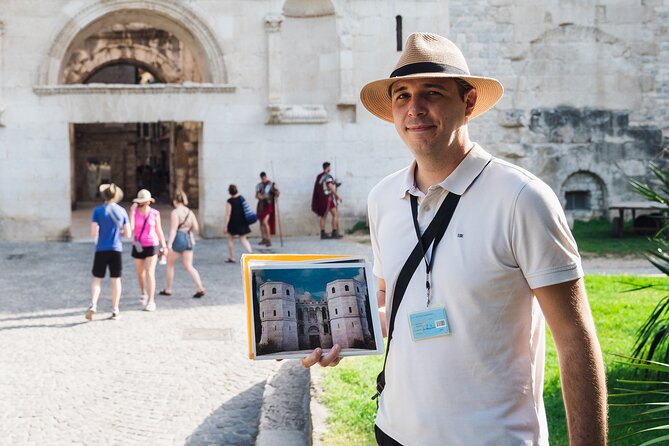
Toni uses the opening minutes to set up the rest of the walk. Graphic displays and models help you understand what you are about to see inside the palace. His 3D reconstructions are one of the tour’s most useful features because they show the original arrangement and decoration in a way that a bare wall cannot.
You should pay attention here. It is tempting to treat Riva as a place for a quick photograph and a coffee, but the harbor gives you the right first view of the palace. You begin to see it not as a single ruined building, but as a large imperial residence with walls, entrances, courtyards, and private areas.
This opening stop lasts about 15 minutes and has no admission charge. Since the walking tour is outdoors, comfortable shoes and sun protection make sense, especially in summer.
Peristyle: the Roman heart of Split
From the waterfront, the tour moves toward the Peristyle, the central square of Diocletian’s Palace. This is one of the most impressive parts of the route because Roman structures remain visible within the modern city.
Toni’s reconstructions are especially helpful here. He can show how the area looked in its imperial period, which helps you separate original Roman features from later additions. Without that explanation, you may see columns, stonework, and grand steps without understanding their original relationship.
The Peristyle is also a good place to notice how Split mixes old and new. People cross the square, pause for photographs, and move through the same space once designed for imperial ceremony. The setting is not frozen in time, and that is part of its appeal.
The stop lasts about 10 minutes. Expect people around you and some noise, since this is one of the city’s central public spaces. A smaller group can make it easier to hear, which is one reason the maximum of 18 people is useful.
Saint Domnius and the story of conversion
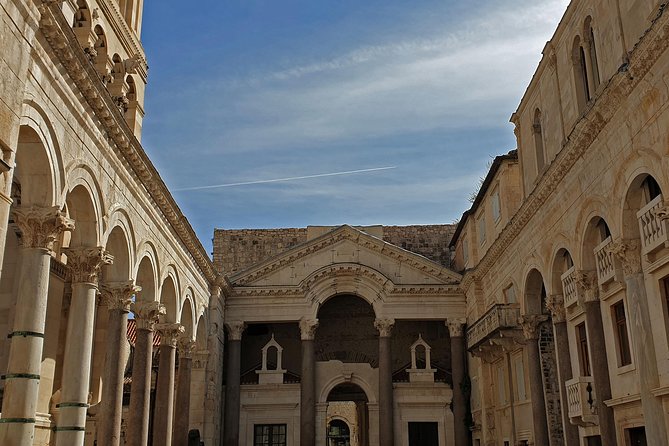
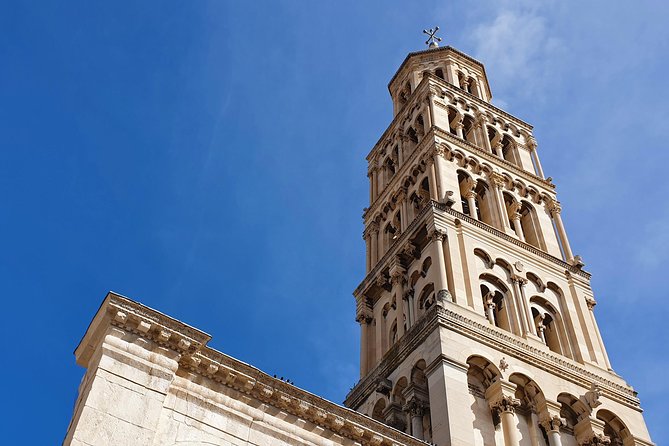
The Cathedral of Saint Domnius occupies a Roman mausoleum originally connected with Emperor Diocletian. Toni explains how the building changed from an imperial tomb into a Christian cathedral and how the bell tower fits into the later story.
This is an important part of the tour because it shows that Split’s history is not a simple sequence of ruins. The same building served different purposes as the city changed. Roman imperial power, Christian worship, and medieval urban life all left their mark in one compact place.
You do not enter the cathedral on this walk. That limitation is worth knowing before you book. If you want to see the interior, you will need to return separately and pay any required admission. The tour instead gives you the outside explanation and the historical setting.
The stop takes about 10 minutes. If you are interested in architecture, religion, or the reuse of ancient buildings, this is one of the most worthwhile parts of the route.
More History Walking Tours in Split:
- Split: Local History and Culture 90-Minute Walking Tour
★ 5.0 · 194 reviews - Private History Split Walking Tour in English
★ 5.0 · 159 reviews - Split: Walking tour of Split with a ‘Magister’ of History
★ 5.0 · 110 reviews - History & Cultural Walking Tour of Split and Diocletian’s Palace
★ 5.0 · 104 reviews
Temple of Jupiter and Roman building mistakes
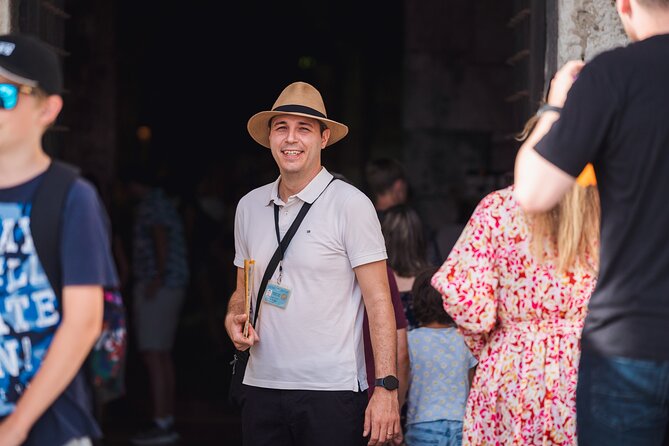
The Temple of Jupiter is another stop where Toni looks beyond the obvious. It is described as one of the best-preserved late Roman temples in the city, but the interesting detail is that he points out construction anomalies and mistakes made by the Roman builders.
That is a welcome change from the usual polished version of ancient history. Monumental buildings were made by people working with practical limits, and the small errors can make the past feel more real. You are not just hearing that Roman engineers were skilled. You are also looking closely at evidence of human decisions and imperfect work.
Again, you do not enter. Toni explains the relevant details from outside, and the stop lasts about 15 minutes. If your priority is seeing the interior of every major monument, this tour will not replace an admission ticket. If your priority is understanding what you are looking at, the outside discussion still has real value.
The Silver Gate and a rare surviving road
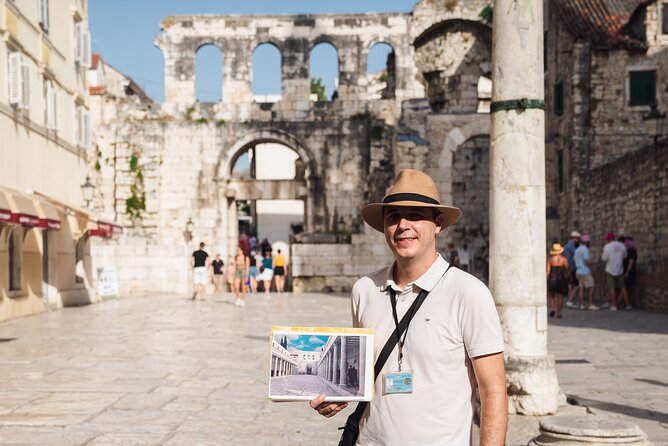
The Eastern, or Silver, Gate provides one of the best views on the walk. From here, you can see the cathedral and the gate together, with a preserved section of the original road below.
This is a strong visual moment because several layers of Split line up in one place. You see Roman planning, later city development, and the practical use of ancient structures by people who came after Diocletian.
The stop is short, about five minutes, but it adds variety to the route. Toni does not need a long lecture at every location. Sometimes a well-chosen view explains more than a crowded list of dates.
Grgur Ninski and Croatian cultural identity
The statue of Grgur Ninski is one of Split’s most recognizable landmarks. Toni explains what the figure represents and connects it with the Croatian language and early medieval culture.
This stop broadens the tour beyond architecture. If you only focus on the palace, it is easy to leave Split knowing plenty about Roman stonework but little about the people and traditions that shaped the later city. The Grgur Ninski story helps correct that imbalance.
The stop lasts about five minutes. It is also a useful place to ask Toni questions about Croatian identity, language, and the transition from the Roman world to the medieval period.
Vestibule and Diocletian’s private residence
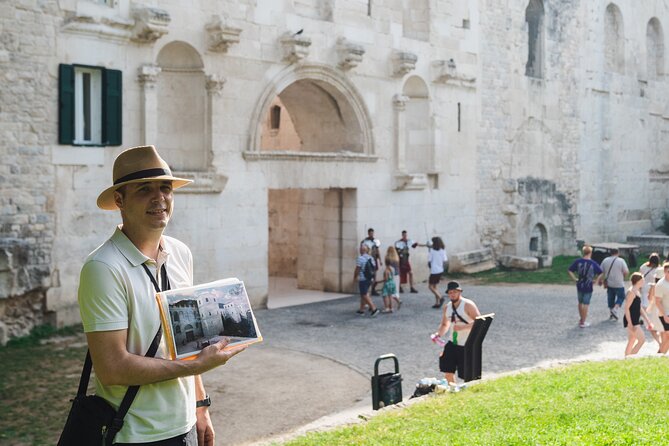
The Vestibule was an entrance to Diocletian’s private residential area. From here, Toni guides you around the remains associated with the emperor’s personal section of the palace.
The word private can be misleading if you imagine a small home. This was an imperial residence, and the scale and planning help explain why Diocletian chose this location for retirement. Toni’s visual material makes it easier to picture the lost rooms and decorated areas that are no longer complete.
This section lasts about 10 minutes. It is one of the places where the 3D images do their best work, since the surviving walls alone do not tell you how the original spaces were arranged.
Along the way, Toni points out noble palaces and other later buildings. These are not side notes. They show how Split grew inside and around the Roman complex, with later residents adapting old spaces rather than clearing everything away.
Noble palaces, Game of Thrones, and later Split
The route includes several palaces belonging to noble families. Toni uses these buildings to explain the medieval, Renaissance, and early modern periods, including the Venetian influence seen in Renaissance architecture.
The City Museum of Split is housed in one of the best-preserved Renaissance noble palaces. You do not enter the museum, but you visit the courtyard. That is a smart compromise for a short walking tour because you can see the building from within without turning the outing into a museum visit.
If your group is interested, Toni can also point out filming locations associated with Game of Thrones and the fan shop along the route. This is an optional extra, not the main purpose of the tour. It works best as a light connection to modern popular culture after you have learned about the much longer story of the city.
The route’s wider focus is one of its strengths. Split is not only a Roman site with a few later additions. It is a city shaped by many periods, and the noble palaces make that clear.
The Golden Gate and reused Roman defenses
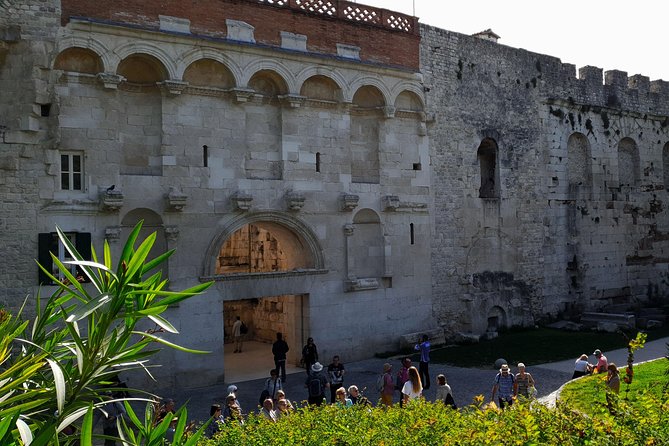
The Golden Gate is the most decorated and best-preserved of the palace’s four entrances. It is also the place where the northern wall is easiest to appreciate.
Toni explains how the medieval city continued using the Roman structures for defense. He also points out where later residents removed parts they no longer needed. This gives you a practical lesson in how old buildings survive: not because every generation protected them perfectly, but because people kept finding new uses for them.
The stop lasts about 15 minutes. Bring your camera, but listen before reaching for it. The gate is visually striking, yet its real interest lies in the changes around it. Roman construction, medieval defense, and the modern city all appear in the same view.
Ending at Pjaca and planning the rest of your day
The tour ends at Narodni trg, usually called Pjaca or Piazza Square. This has been Split’s main square since medieval times, and the 14th-century Town Hall is one of the key buildings here.
Ending at Pjaca is practical. You are not left at an isolated monument or sent back to the starting point. From the square, you can continue walking through the old town, return to a sight you want to see inside, or stop for food and a rest.
I especially like taking this tour early in a Split stay. The route gives you a useful mental map, and you can then return to the cathedral, Temple of Jupiter, museum, or palace corners that caught your attention. A morning departure is useful for planning the afternoon. An evening departure can be more comfortable during hot summer weather.
Group size, private options, and practical limits
The standard tour allows up to 18 people. That is not a private walk, but it is small enough for questions and for the group to fit into tighter parts of the old town. Several accounts of the tour praise Toni for making time for questions and keeping the explanations engaging.
A private upgrade is available if you want a more personal pace or have a group with specific interests. Group discounts may also help if you are booking for several people. The tour is offered in English and includes a mobile ticket.
Most people can take part, and service animals are allowed. The route is on foot through historic streets, so wear shoes you can comfortably use on uneven pavement. The experience requires good weather. If poor weather cancels it, you can choose another date or receive a full refund. Standard cancellation is free up to 24 hours before the start time.
Who should book the DiocleSpot walking tour?
I would choose this tour if you enjoy history but do not want a dry recital of dates. Toni’s background as a historian, teacher, and Split native gives the walk a personal quality. His explanations cover architecture, culture, politics, religion, and local life, and his enthusiasm is one of the clearest strengths of the experience.
It also suits first-time visitors who want orientation. The route touches the main palace areas without trying to cover every museum or attraction. You finish with a better idea of where to return and what deserves more time.
You may want something else if you mainly want interior visits, a slow photography walk, or a tour centered on food. This experience is built around explanation and observation. You will see many important sights, but you will not receive entrance tickets to the cathedral, Temple of Jupiter, or museums.
Should you book it?
Book it if you want Split to make sense, not just look impressive. The 3D reconstructions, the coverage of later periods, and Toni’s local perspective make the $34.83 fee reasonable, especially for a first day in the city.
Skip it only if you already know the palace well or prefer to explore without a guide. For most visitors, this is a focused, well-paced introduction that adds meaning to the stones, gates, courtyards, and squares you will see afterward.
FAQ
How long does the Walking Tour of Split with a Magister of History last?
The tour lasts approximately 1 hour and 40 minutes to 1 hour and 50 minutes.
What is the price of the tour?
The listed price is $34.83 per person. Group discounts and a private tour upgrade are available.
Does the tour include admission to the cathedral or Temple of Jupiter?
No. The tour does not enter the cathedral, Temple of Jupiter, museums, or other paid sites. Toni explains the cathedral and temple from outside.
Where does the tour begin and end?
The tour begins at the Brass Gate, or Porta Aenea, at Obala Hrvatskog narodnog preporoda 22. It ends at Narodni trg, also called Pjaca or Piazza Square.
Is the tour offered in English?
Yes. The tour is offered in English and includes a mobile ticket.
What happens if bad weather cancels the tour?
The experience requires good weather. If it is canceled because of poor weather, you can receive a full refund or choose a different date.
Just added around Split
- Split Walking Tour with History Professor★ 5.0 · 23 reviews
- Split: Local History and Culture 90-Minute Walking Tour★ 5.0 · 194 reviews
- Split: Historical & Gastro Treasures Tour with Green Market★ 4.9 · 144 reviews
- Split: Private Walking Tour in the Historical Town Center★ 5.0 · 25 reviews
- Split: Walking tour of Split with a ‘Magister’ of History★ 5.0 · 110 reviews
- Experience Split History Walking Tour With Local Historian★ 5.0 · 28 reviews
- History Split Walking Tour in French -Small group★ 5.0 · 41 reviews
- Split History and Gastro Small-Group Tour with Food and Drinks★ 5.0 · 375 reviews
History Walking Tours, compared.
History and Hauntings of Salem Guided Walking Tour
Read our review →
Freedom Trail History Small Group Walking Tour
Read our review →
Historic Charleston Guided Sightseeing Walking Tour
Read our review →
Tapas Walking Tour with Food, Wine, and History
Read our review →
Savannah History and Haunts Candlelit Ghost Walking Tour
Read our review →

A History of Terror – Belfast City Centre Walking Tour
Read our review →Browse the lists this tour appears in