
Review · SPLIT
Private History Split Walking Tour in English
Split’s past is built into its streets. This private 90-minute walk takes you through Diocletian’s Palace, the Old Town, Riva Harbor, and several places that are easy to miss without a guide. You’ll hear about Emperor Diocletian, Roman construction, Croatian literature, Jewish life, and the city’s changing identity.
I like the private format, since your group gets the guide’s full attention rather than following a large crowd. I also like the route’s range, from the palace’s central Peristyle to the open-air waterfront and Fruit’s Square. The main drawback is time: 90 minutes goes quickly, and the tour does not include the museum section of the palace substructures.
The experience costs $66.54 per person, with group discounts available. That is not the cheapest way to see Split, but it can be fair value if you want a clear introduction, personal questions answered, and useful orientation before exploring on your own. The tour is offered in English and has a 99 percent recommendation rate from 159 reviews.
Key points at a glance
- A private introduction to Diocletian’s Palace: Only your group takes part, making it easier to ask questions and set the pace within the available time.
- Seven meaningful stops in 90 minutes: The route covers the Peristyle, Vestibule, palace substructures, Golden Gate, Riva Harbor, Fruit’s Square, and Split Synagogue.
- History beyond Roman ruins: You’ll hear about Gregory of Nin, Marko Marulić, Venetian rule, Dalmatian singing, and Split’s Jewish community.
- The palace substructures are only partly included: You pass through the historic underground spaces, but the museum area requires a separate visit.
- A good first-day activity: The meeting point is at Peristyle, right in the center of the Old Town, and the walk ends there.
- Plan around the steps: The activity is not recommended if high steps are a problem.
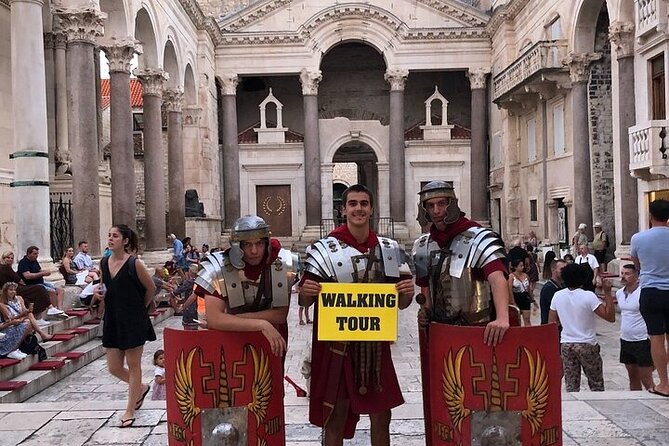
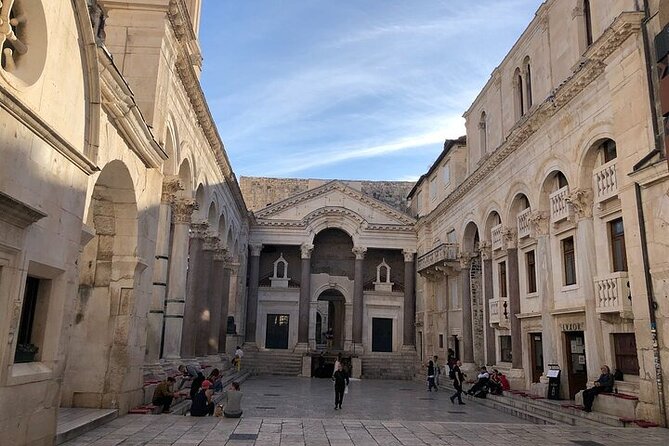
Starting at the Peristyle of Diocletian’s Palace
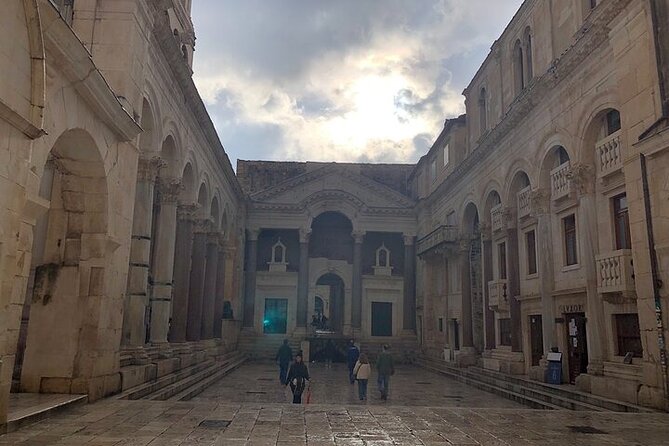
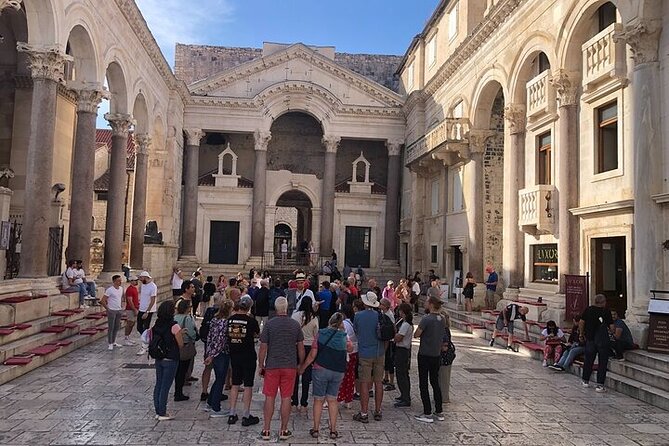
The tour begins at Peristyle, the central square inside Diocletian’s Palace. This is the right place to start because the square connects to much of the palace complex, and it helps you understand Split’s unusual layout before the details begin piling up.
You’ll spend about 15 minutes here. That may sound brief, but a good explanation in this space can do a lot of work. The Peristyle is not simply a Roman courtyard preserved behind ropes. It is part of the living center of Split, with historic stone, active passageways, and daily city life sharing the same space.
I like this opening because it gives you a reference point. Once you know where the central square sits, the rest of the palace becomes easier to read. You can understand the route as a connected Roman residence and defensive complex rather than a collection of unrelated stone walls.
The private setup should help here. If you have a question about the palace’s design, construction, or Diocletian himself, you can ask immediately instead of waiting for a guide to finish with a large group.
More History Walking Tours in Croatia
- Walking Tour of Split with a ‘Magister’ of History
★ 5.0 · 1,122 reviews - Split Walking Tour with Professor of History
★ 5.0 · 926 reviews - Split: History and Heritage Walking Tour
★ 4.9 · 650 reviews
The Vestibule and the sound of Dalmatia
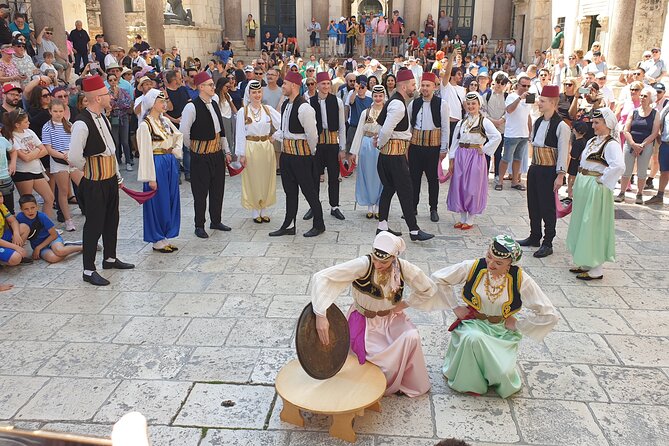
Next comes the Vestibule, the entrance space associated with Emperor Diocletian. The stop lasts about five minutes, so expect a concise explanation rather than a long visit.
This is also the point where you might hear traditional Dalmatian singing. The wording is important: it is a possibility, not a guaranteed performance. Still, it adds a welcome human touch to an ancient setting. The palace is not only an archaeological site, and a local musical tradition can help connect the old stone to the culture of the region today.
I would keep expectations sensible. The tour’s main focus is history and architecture, and the singing may not happen during every visit. If it does, treat it as an extra rather than the reason to book.
What the palace substructures reveal
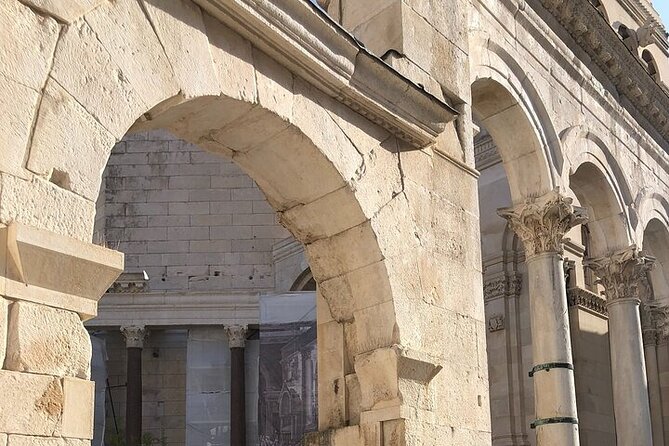
The palace substructures receive about ten minutes. You’ll learn how they were built and how their function changed over time. These underground spaces are especially useful for understanding the palace above them, since their layout helps explain the structure and planning of Diocletian’s residence.
The tour does not include the museum part of the substructures. That distinction matters when you compare the price with other palace activities. You will pass through the historic underground area during the tour, but a separate visit is needed if you want the museum experience.
I see this as one of the more valuable stops for first-time visitors. Above ground, the palace can feel like a maze of alleys, shops, courtyards, and later additions. Below ground, the construction story becomes easier to follow. You get a better sense of how the Roman complex was arranged and how its spaces were used across different periods.
The short time allowance also means you should not expect every chamber or display to receive attention. If the substructures are a priority for you, ask the guide where to continue after the walk.
The Golden Gate and Gregory of Nin
The Golden Gate is the main entrance to Diocletian’s Palace and one of the route’s clearest landmarks. You’ll hear about its role in the palace and see the statue of Gregory of Nin nearby.
The statue is not just a photo stop. Gregory of Nin is important to Croatian history and language, and the guide explains why. This adds a national and cultural layer to the Roman story. You move from an emperor and an ancient palace to a figure linked with Croatia’s own identity.
This is one place where a private guide can make the difference between seeing a monument and understanding it. Without context, the Golden Gate is an impressive entrance. With context, it becomes part of a larger story about power, religion, language, and the way Split has been shaped by different eras.
The stop lasts about ten minutes. You should have time to look, listen, and take photographs, but the guide will need to keep the group moving to fit in the harbor and Old Town stops.
More Private History Tours in Croatia
- SPLIT-PRIVATE Walking Tour of Diocletian’s Palace & Old Town
★ 5.0 · 467 reviews - Jewish Heritage & Diocletian’s Palace Private Split Tour
★ 5.0 · 80 reviews - Split: Private Walking Tour in the Historical Town Center
★ 5.0 · 25 reviews - Dubrovnik Jewish Heritage Private Walking Tour
★ 5.0 · 121 reviews
Riva Harbor and Split’s waterfront
The route then leaves the palace area for Riva Harbor, where you’ll see a bronze model of Diocletian’s Palace and hear about Split’s waterfront promenade. This change of setting is useful. You are no longer looking only at ancient walls, but at the relationship between the palace and the modern city around it.
The stop takes about 15 minutes, making it one of the longer pauses. The bronze model can help you visualize the palace as a complete structure, especially after seeing only selected courtyards and entrances on foot.
I like this part because it gives the tour breathing room. Historic sites can blur together when every stop involves another wall or doorway. The waterfront offers a wider view and a chance to understand how Split’s central area faces the harbor.
The tour does not include a boat ride or a separate harbor activity. This is a walking stop focused on the promenade, the model, and the city’s history.
Fruit’s Square, Venetian power, and Croatian literature
Fruit’s Square, officially Trg Braće Radić, brings another period into the story. Here you’ll learn about a 15th-century Venetian citadel and Marko Marulić, often called the father of Croatian literature.
This is a strong choice for a short walking tour because it keeps Split’s story from becoming only a Roman history lesson. The city’s identity developed long after Diocletian, and the Venetian connection shows how outside powers influenced its buildings and public life.
Marko Marulić gives the stop a cultural angle. You are not just looking at a square and a fortress. You are also hearing about a figure linked to Croatian writing and language. The guide’s explanation can help you connect the streets you are walking through with the wider development of Croatian culture.
You’ll spend around ten minutes here. The square is close enough to the palace route to fit comfortably into the walk, but it adds a useful change of focus.
Passing Split Synagogue
The final listed stop is Split Synagogue, where you’ll learn about the history of the Jewish people in the city. The synagogue dates to the 16th century, and the tour passes by rather than offering a full interior visit.
This is a modest stop in physical terms, but it broadens the tour’s view of Split. Cities are shaped by communities that can be easy to overlook when a palace dominates the sightseeing map. The synagogue provides an opening to discuss Jewish life and the city’s changing population over time.
Admission is not included here. The supplied information describes a pass-by stop, so I would not book this tour expecting an extended synagogue visit. Its value is in the historical context and the chance to notice a less obvious part of Split’s past.
Why the private format matters
A private tour means only your group takes part. That can be worthwhile in Split, where the palace streets are compact and full of small details. You can ask for clarification, request practical suggestions, and focus more closely on the subjects that interest you.
The guide is described as educated and well informed about the palace and surrounding locations. The strongest praise centers on clear explanations, historical detail, and guides who make the subject enjoyable rather than dry. One guide named Antonella is singled out for bringing the palace to life in an easy, engaging way.
Several comments also point to useful recommendations for things to do and places to try after the walk. That is one of the practical benefits of a local guide. The tour can help you decide how to spend the rest of your time in Split, not just explain what you have already seen.
Still, private does not mean unlimited time. The route covers seven stops in roughly 90 minutes, so you should expect a brisk introduction. If your group likes to linger at every doorway or take many photographs, you may need to continue exploring after the tour ends.
Is $66.54 per person good value?
At $66.54 per person, this is a mid-priced short walking tour. The price makes the most sense for a small group that values private attention and wants a focused introduction to Split rather than a long, public group walk.
You are paying for an English-speaking guide, local explanation, and a route that combines Roman, Venetian, Croatian, Jewish, and modern Split history. The tour does not include admission to the museum part of the palace substructures, so budget separately if you want to visit that area afterward.
Group discounts may improve the value for larger parties. If you are traveling with family or friends, compare the total private cost with several individual places on a public tour. The more people in your group, the more attractive the private arrangement may become.
The 90-minute length is also part of the value calculation. I would choose this tour if you want a useful orientation without spending half a day. I would choose a longer experience if you want extended time inside the substructures or a slower architectural study.
Timing, meeting point, and practical details
You meet at Peristil ulica, at Peristyle in Split’s Old Town, and return to the same meeting point at the end. That makes the tour easy to pair with your own sightseeing before or after it.
The activity is near public transportation, service animals are allowed, and most people can participate. High steps are the main physical warning. Since this is a walking tour through an old palace and historic streets, anyone with difficulty using high steps should think carefully before booking.
Confirmation is provided when you book. The experience is generally reserved around nine days ahead, so I would not leave it until the last moment if your Split schedule is fixed.
Free cancellation is available up to 24 hours before the start time for a full refund. Changes or cancellations inside that 24-hour window are not accepted, and the amount paid is not refunded. The tour also requires a minimum number of participants, so a cancellation by the provider for that reason results in a different date or experience, or a full refund.
Who should book this Split walk?
I would recommend it most strongly to first-time visitors who want a fast but serious introduction to the Old Town. It also suits couples, families, and small groups who prefer to ask questions without sharing the guide with strangers.
History-minded visitors should appreciate the range. You get Roman architecture, palace construction, medieval and Venetian influences, Croatian literature, local music, and Jewish heritage in one compact route.
The tour is less suitable if you want a long museum visit, extensive time in the palace substructures, or a relaxed stop at every landmark. It is also not the right pick for anyone who has trouble with high steps.
Should you book the Private History Split Walking Tour?
Book it if you want personal attention and strong historical context in a short time. The route gives you a useful map of Split, and the private format lets you ask about the places that matter most to your group.
I would book it early, especially if you are visiting for only a few days. Just remember that the $66.54 price does not cover the museum part of the substructures, and the 90-minute schedule is an introduction rather than a complete study of the palace.
For a first look at Split, this is a sensible and well-focused choice. Afterward, you can return to the Peristyle, Golden Gate, waterfront, or underground spaces with a better understanding of what you are seeing.
FAQ
Where does the tour begin?
It begins at Peristil ulica, Peristyle, 21000 Split, Croatia.
Where does the tour end?
The activity ends back at the meeting point at Peristyle.
How long does the walking tour last?
The tour lasts approximately 1 hour and 30 minutes.
Is the tour offered in English?
Yes. The tour is offered in English.
Is this a private tour?
Yes. Only your group participates in the activity.
Does the price include admission to the palace substructures museum?
No. The museum part of the substructures is not included. The tour passes through the palace substructures, and you can visit the museum afterward.
Does the tour include the Split Synagogue?
The route passes by the 16th-century synagogue and includes information about the history of Split’s Jewish community. Admission is not included.
Is the tour suitable for people who have difficulty with high steps?
It is not recommended for travelers who have issues with high steps.
Can I cancel for a full refund?
Yes, if you cancel at least 24 hours before the experience start time. Cancellations made less than 24 hours in advance are not refunded.
More Private History Tours in Split
- Private Historical Walking Tour of York
★ 5.0 · 1,324 reviews - Private Guided Historic Electric Cart Tour of St. Augustine
★ 5.0 · 1,194 reviews - Istanbul: Acemoglu Historical Turkish Bath w/Private Options
★ 4.6 · 1,190 reviews - From Cairo: Private Full-Day Tour of Historical Alexandria
★ 4.1 · 1,155 reviews
More History Walking Tours in Split
- Split: Local History and Culture 90-Minute Walking Tour
★ 5.0 · 194 reviews - Split: Walking tour of Split with a ‘Magister’ of History
★ 5.0 · 110 reviews - History & Cultural Walking Tour of Split and Diocletian’s Palace
★ 5.0 · 104 reviews - History Split Walking Tour in French -Small group
★ 5.0 · 41 reviews
Just added around Split
- Split Walking Tour with History Professor★ 5.0 · 23 reviews
- Split: Local History and Culture 90-Minute Walking Tour★ 5.0 · 194 reviews
- Split: Private Walking Tour in the Historical Town Center★ 5.0 · 25 reviews
- Split: Historical & Gastro Treasures Tour with Green Market★ 4.9 · 144 reviews
- Split: Walking tour of Split with a ‘Magister’ of History★ 5.0 · 110 reviews
- Experience Split History Walking Tour With Local Historian★ 5.0 · 28 reviews
- History Split Walking Tour in French -Small group★ 5.0 · 41 reviews
- Split History and Gastro Small-Group Tour with Food and Drinks★ 5.0 · 375 reviews
History Walking Tours, compared.
History and Hauntings of Salem Guided Walking Tour
Read our review →
Freedom Trail History Small Group Walking Tour
Read our review →
Historic Charleston Guided Sightseeing Walking Tour
Read our review →
Tapas Walking Tour with Food, Wine, and History
Read our review →
Savannah History and Haunts Candlelit Ghost Walking Tour
Read our review →
A History of Terror – Belfast City Centre Walking Tour
Read our review →Browse the lists this tour appears in