
Review · DALMATIA
Split: Private Walking Tour in the Historical Town Center
Split’s old town is a Roman palace in disguise. This private walking tour makes the maze manageable, taking you from Diocletian’s fourth-century palace to medieval squares and the Riva waterfront with a licensed local guide. I like the private format, which keeps the pace flexible and makes it easy to ask questions. I also like the route’s range, from palace basements and Roman gates to Venetian, French, Austro-Hungarian, and Yugoslav traces.
The main drawback is the price if you are traveling as a couple or alone. At $153 per group of up to 15, the cost works well for a family or group, but it feels less economical for two people. The Palace Substructures also cost extra, and this walking tour is not suitable for wheelchair users.
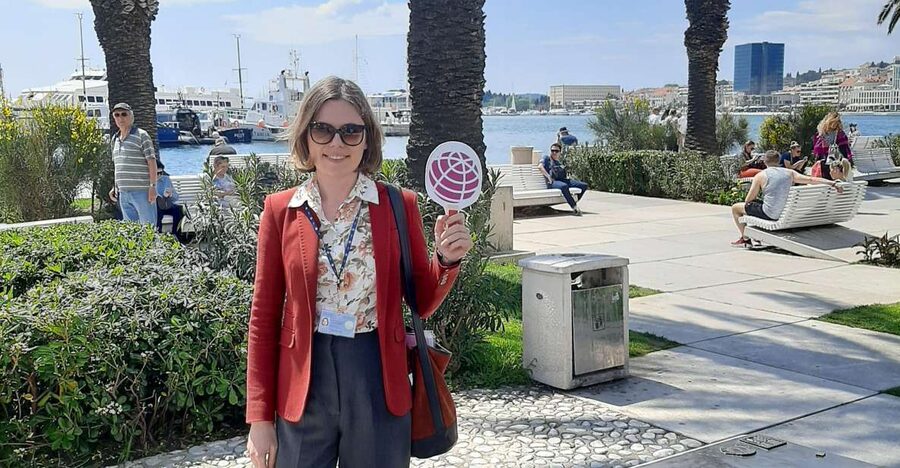
Sanja, also written as Sanya in some booking details, receives especially strong praise for her French and English explanations. French-speaking visitors appreciated her clear storytelling and her ability to connect Split’s past with their own culture. English-speaking guests also liked her calm style and said the private group of four made it easy to hear and follow her.
Key Points Before You Book
- A Roman palace still functions as Split’s old town: Diocletian’s Palace is not a fenced-off ruin. Streets, homes, shops, and religious buildings developed inside its walls.
- The Substructures cost extra: The palace basement is included in the route, but you pay the entrance fee separately.
- Sanja is praised for clear explanations: She guides in English, Italian, French, and Spanish, with a master’s degree and a professional local guide license.
- The private group helps with questions: The tour is available for your own party, with a maximum group size of 15.
- You see Split across several ruling periods: The route explains Roman, medieval, Venetian, French, Austro-Hungarian, and Yugoslav influences.
- The tour lasts 105 minutes: It gives you a useful first look at the old center, but you will need your own time afterward for longer museum visits and relaxed exploration.
Meeting the Guide by the Bronze City Model
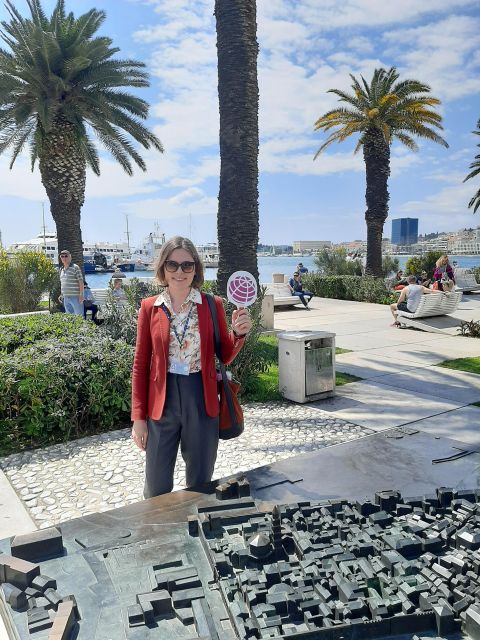
Your meeting point is easy to identify: the bronze model of Split’s historical core on the Riva promenade, beside the sea. It is in front of the south entrance to Diocletian’s Palace, so you begin right beside the city’s main historical zone.
This is a sensible starting place. The model gives you a quick visual sense of how the palace sits within the modern city. You can see the compact old center before walking into it, which helps when the narrow lanes begin to turn and overlap.
The tour lasts about one hour and 45 minutes. That is long enough to cover the main sights without taking over your entire day. I would book it early in your Split stay, as one English-speaking guest said the introduction helped with later independent exploration inside the palace walls.
Because this is a private tour, you are not tied to the questions or pace of a large group. A party of four should find it particularly comfortable. A group of 15 can still book privately, but the guide may need to pause in busy spots so everyone can hear.
More History Walking Tours in Croatia
- Walking Tour of Split with a ‘Magister’ of History
★ 5.0 · 1,122 reviews - Split Walking Tour with Professor of History
★ 5.0 · 926 reviews - Split: History and Heritage Walking Tour
★ 4.9 · 650 reviews
Diocletian’s Palace: A Roman Residence Turned City Center
The first major section focuses on Diocletian’s Palace, built in the fourth century for the Roman emperor Diocletian. Calling it a palace can give the wrong impression. This is a large fortified complex that became the core of modern Split, with later streets and buildings fitted into its Roman structure.
That mixture is the chief pleasure of the tour. You are not simply looking at isolated columns. You are walking through a living neighborhood where ancient walls support medieval houses and later buildings fill old Roman spaces.
Sanja explains how the palace changed over time and points out the different layers as you walk. This is where a local guide earns the fee. Without help, you can see stone, arches, and narrow passages, but it is harder to understand which parts belong to the Roman plan and which appeared later.
The tour includes the palace walls and its four gates. Each gate gives you a different sense of how the complex controlled movement in and out. The Golden Gate receives its own stop later in the route, offering one of the clearest views of the palace’s formal defensive design.
You will also see medieval houses once linked to noble families. Their presence shows how the Roman complex was reused instead of abandoned. The result is an unusual town center where imperial planning and ordinary daily life occupy the same small area.
The Substructures and the Palace’s Hidden Plan
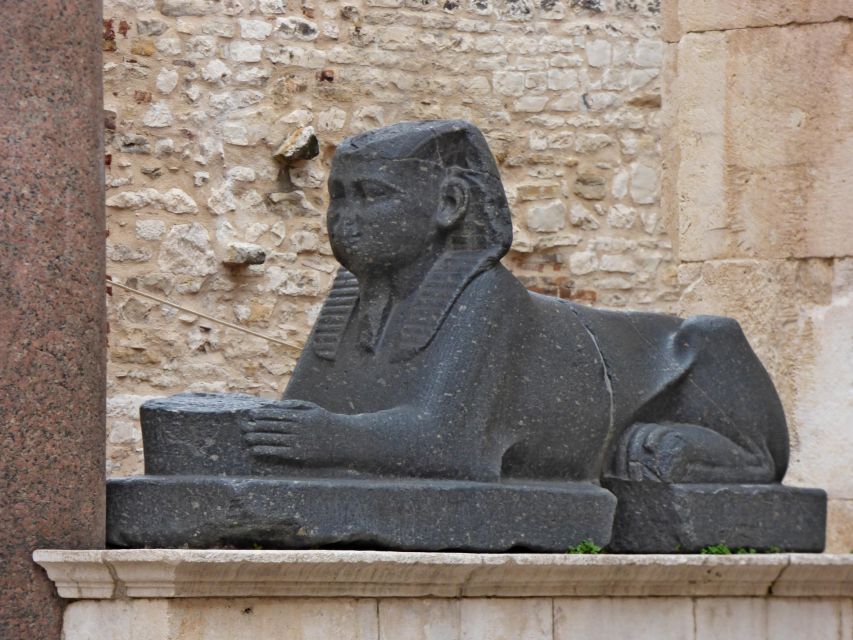
The Substructures, also called the palace basements, require a separate entrance fee. The ticket is not included in the tour price, so budget for this extra before you arrive.
This is one of the most useful stops for understanding Diocletian’s Palace. The lower level mirrors much of the layout above, helping you see how the original complex was organized. The spaces also give the guide a clear setting for explaining the palace’s construction and later development.
The exact amount of time spent inside depends on the walking pace and the rest of the group, but the listed route allows about 30 minutes for Diocletian’s Palace as a whole. That means this is an introduction rather than an extended archaeological visit.
If you enjoy ancient architecture, you may want to return to the Substructures on your own after the tour. The guided visit gives you the framework, while a second look lets you linger. If you are watching every euro, you can still learn a great deal from the palace streets and exterior sights without treating the basement ticket as essential.
Peristil: Split’s Grand Roman Stage
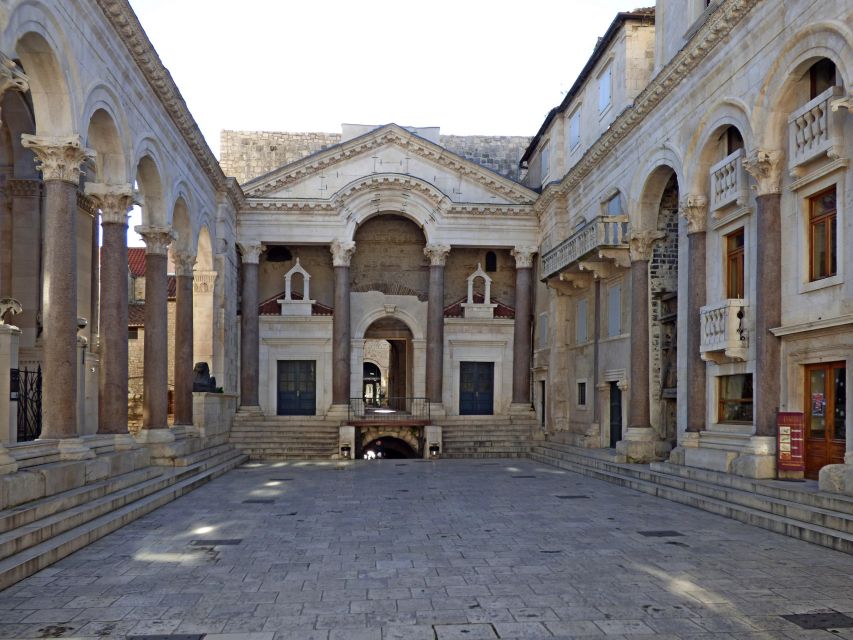
Peristil is the palace’s central square and one of the most striking places on the route. It is surrounded by Roman remains and later religious buildings, making it a compact lesson in how Split changed across centuries.
The square is planned on a scale that feels ceremonial. Diocletian’s Palace was designed for an emperor, and Peristil helps you sense that original purpose better than the smaller lanes do. Sanja can connect the square to the palace’s religious and political role, rather than leaving you with only a photo stop.
The tour allows about 10 minutes here. That is enough for an explanation and a look around, but not enough for long independent viewing. If you want photographs without rushing, take them after the guided portion or return later when you know where Peristil sits.
More Private History Tours in Croatia
- SPLIT-PRIVATE Walking Tour of Diocletian’s Palace & Old Town
★ 5.0 · 467 reviews - Private History Split Walking Tour in English
★ 5.0 · 159 reviews - Jewish Heritage & Diocletian’s Palace Private Split Tour
★ 5.0 · 80 reviews - Dubrovnik Jewish Heritage Private Walking Tour
★ 5.0 · 121 reviews
The Cathedral and Jupiter’s Temple
The Cathedral of Saint Domnius occupies the former mausoleum of Diocletian. That change is one of Split’s sharpest historical contrasts: an imperial tomb became a Christian cathedral. The tour includes a guided look and passes by the cathedral, but the information provided does not include a separate interior admission.
Nearby, Jupiter’s Temple now serves as the Baptistery. The tour makes an external visit and does not include an entrance fee for it. This is another small but telling example of changing religious use within the palace.
You have about 10 minutes for each of these stops. That works well for orientation and historical context. It is less suitable if you want to study every carving, enter every building, or spend quiet time inside. Think of the tour as a well-organized first pass, then choose what deserves a return visit.
The Golden Gate and the Palace Walls
The Golden Gate is one of the palace’s four main entrances and receives its own 10-minute stop. It helps you picture how the Roman complex faced the surrounding city and controlled access through its walls.
The gate is especially useful after seeing the interior. From the lanes and squares, the palace can feel like a jumble of old stone. At the Golden Gate, its defensive purpose becomes easier to read.
This is also the point where the guide’s wider historical approach helps. Split’s buildings reflect more than one era, and the route explains the changes brought by different rulers. You get a clearer sense of how Roman foundations remained useful under later governments.
Jewish Heritage Within the Medieval Quarter
The walk also reaches a small former Jewish ghetto with a synagogue that remains active. This is a brief but meaningful part of the route because it widens the story beyond emperors, churches, and ruling powers.
The stop reminds you that Split’s old center was not only a stage for official history. Families, religious communities, merchants, and noble households shaped the lanes too. The active synagogue adds a present-day connection to a neighborhood that might otherwise seem purely historical.
The supplied details do not promise an interior visit, so you should expect to see the area and hear its story rather than tour the synagogue itself. Treat it as a respectful exterior stop and listen to the guide’s explanation.
Pjaca and the Medieval Town Beyond the Palace
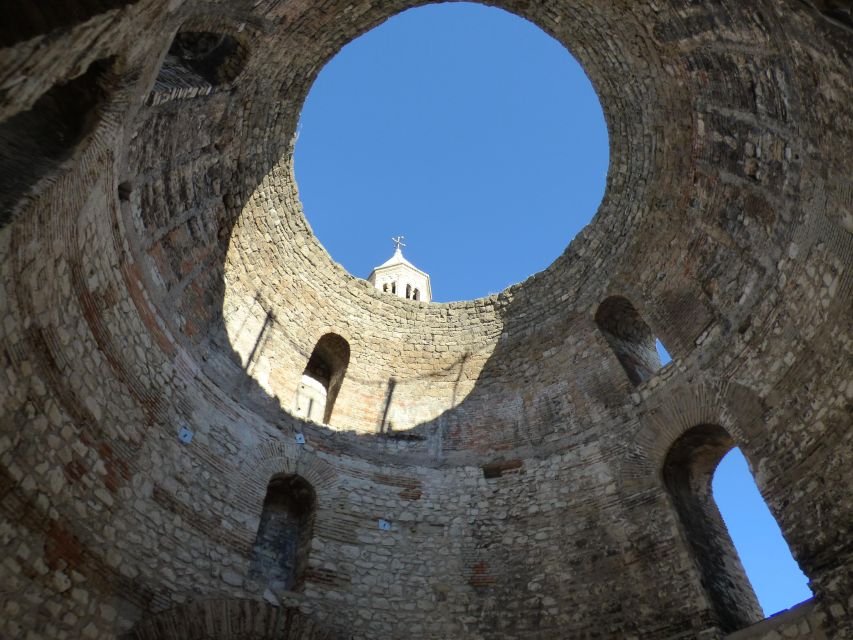
The second half moves outside the Roman palace into the medieval neighborhood. The change is subtle at first, but the street plan and squares show how Split expanded beyond Diocletian’s original walls.
People’s Square, known as Pjaca, receives about 15 minutes, making it the longest stop after the palace section. This is a good place to discuss how public life developed outside the Roman core.
You will hear about the political and social changes that shaped Split under Venetian, French, Austro-Hungarian, and Yugoslav rule. That sequence matters because it explains why the city does not look purely Roman or purely medieval. Each period left its own mark on government, building styles, and daily life.
The tour does not treat history as a list of dates. Instead, the guide uses the squares and buildings to show how power changed hands and how the town adapted. That approach earned strong praise for Sanja, especially from French-speaking guests who found her explanations clear and well connected to their own culture.
Fruit Square and Prokurative
Fruit Square, or Voćni trg, is another lively historical space on the route. Its name points to the everyday trade that once took place there, a useful contrast to the grand ceremonial spaces inside the palace.
This is where you can picture Split as a working town rather than an imperial monument. The tour gives you about 10 minutes, enough to place the square within the medieval neighborhood and understand its role in the city’s growth.
The route also includes Prokurative, a large square influenced by Venetian design. The supplied stop list gives more detail about Prokurative in the tour description than in the timed itinerary, but it is part of the walk through the later city.
Together, Pjaca, Fruit Square, and Prokurative show the outward spread of Split. You move from Roman power to medieval commerce and later public architecture in a fairly short distance. That compact sequence is one of the tour’s strongest features.
Ending on the Riva by the Sea
The tour finishes on the Riva promenade, with about 10 minutes devoted to the waterfront. This is a pleasant ending because it brings you out of the tight old lanes and back to an open view beside the sea.
The Riva is also a useful base for your own plans. From here, you can return toward the palace, continue along the waterfront, or use the guide’s suggestions to decide what deserves more time. The activity information also lists a return to the bronze city model, which is at the starting point near the south entrance.
The final section is not a long coastal walk. It is a closing orientation stop and a chance to ask for practical ideas for the rest of your day. Use that moment well. Ask about the palace areas you should revisit, the sights you want to enter, or the best way to retrace the route.
Is $153 Good Value for Your Group?
The price is $153 per group of up to 15 people. For the full group, that is excellent value at roughly $10 per person. For four people, it works out to about $38.25 each, which is reasonable for a private, licensed guide but not a bargain. For two people, the per-person cost is much higher.
The fee includes a professional local guide with a master’s degree, a private tour, and commission tax. It does not include the entrance fee for the Substructures. There is no separate transport cost because the route is on foot through the historical center.
I would consider the price worthwhile if you are short on time, care about context, or have a group large enough to spread the cost. If you prefer to wander without a schedule, you can see many exterior sights free of charge and skip the private guide.
The strongest value comes from the way the stops connect. You are not paying only to be shown the cathedral or a Roman gate. You are paying for an explanation of how one palace became a medieval and modern town.
Who Will Get the Most From This Walk?
This tour suits first-time visitors who want a clear map of Split before exploring independently. It also fits families and small groups that want their own guide instead of joining a large public walk.
History-minded visitors should appreciate the range of periods covered. The Roman palace gets the most attention, but you also hear about medieval noble families, the Jewish quarter, Venetian rule, French rule, Austro-Hungarian influence, and Yugoslav history.
French-speaking guests have a particularly strong reason to consider it, since Sanja receives repeated praise for her excellent French. English, Italian, and Spanish are also available.
The tour is less suitable if you use a wheelchair, need a fully accessible route, or want extensive time inside each monument. It is also not the best fit if your main goal is a slow food walk, shopping tour, or long museum visit.
Practical Verdict: Book It or Explore Alone?
I would book this tour early in a Split stay, especially for a group of four or more. Sanja’s clear explanations, strong language skills, and grasp of the city’s changing rulers make the walk useful beyond the 105 minutes. You finish with a better sense of where the Roman palace ends, where the medieval town begins, and what you want to see next.
I would skip it if you are traveling alone on a tight budget, dislike guided pacing, or only want to photograph the main squares. In that case, you can walk the old center yourself and spend the saved money on the Substructures or another entrance.
For most first visits, though, this is a smart orientation tour. It covers the essential sights, keeps the group private, and gives Split’s mixed architecture a clear story instead of leaving you to guess which century you are looking at.
FAQ
Where does the tour meet?
The meeting point is beside the bronze model of Split’s historical core on the Riva promenade by the sea, in front of the south entrance to Diocletian’s Palace.
How long does the walking tour last?
The tour lasts 105 minutes, or about one hour and 45 minutes.
Is this a private tour?
Yes. It is a private group tour for your own party, with a maximum group size of 15 people.
What languages are available?
The tour is available in English, Italian, French, and Spanish.
Is the guide a licensed professional?
Yes. The tour includes a professional licensed local guide with a master’s degree.
Is the entrance fee to the Palace Substructures included?
No. The entrance fee for Diocletian’s Palace Substructures, also called the Basements, is not included.
Does the tour enter Jupiter’s Temple?
The tour makes an external visit to Jupiter’s Temple, also called the Baptistery. No entrance fee is included for an interior visit.
Is the tour suitable for wheelchair users?
No. The activity is not suitable for wheelchair users.
Where does the tour finish?
The tour ends on the Riva promenade by the sea, with the listed return point at the bronze model of Split’s historical core.
Can I cancel for a full refund?
Yes. You can cancel up to 24 hours in advance for a full refund. You can also reserve now and pay later.
More Private History Tours in Split
- Private Historical Walking Tour of York
★ 5.0 · 1,324 reviews - Private Guided Historic Electric Cart Tour of St. Augustine
★ 5.0 · 1,194 reviews - Istanbul: Acemoglu Historical Turkish Bath w/Private Options
★ 4.6 · 1,190 reviews - From Cairo: Private Full-Day Tour of Historical Alexandria
★ 4.1 · 1,155 reviews
More History Walking Tours in Split
- Split: Local History and Culture 90-Minute Walking Tour
★ 5.0 · 194 reviews - Split: Walking tour of Split with a ‘Magister’ of History
★ 5.0 · 110 reviews - History & Cultural Walking Tour of Split and Diocletian’s Palace
★ 5.0 · 104 reviews - History Split Walking Tour in French -Small group
★ 5.0 · 41 reviews
Just added around Split
- Split Walking Tour with History Professor★ 5.0 · 23 reviews
- Split: Local History and Culture 90-Minute Walking Tour★ 5.0 · 194 reviews
- Split: Historical & Gastro Treasures Tour with Green Market★ 4.9 · 144 reviews
- Split: Walking tour of Split with a ‘Magister’ of History★ 5.0 · 110 reviews
- Experience Split History Walking Tour With Local Historian★ 5.0 · 28 reviews
- History Split Walking Tour in French -Small group★ 5.0 · 41 reviews
- Split History and Gastro Small-Group Tour with Food and Drinks★ 5.0 · 375 reviews
- Private History Split Walking Tour in English★ 5.0 · 159 reviews
History Walking Tours, compared.
History and Hauntings of Salem Guided Walking Tour
Read our review →
Freedom Trail History Small Group Walking Tour
Read our review →
Historic Charleston Guided Sightseeing Walking Tour
Read our review →
Tapas Walking Tour with Food, Wine, and History
Read our review →
Savannah History and Haunts Candlelit Ghost Walking Tour
Read our review →
A History of Terror – Belfast City Centre Walking Tour
Read our review →Browse the lists this tour appears in