
Review · SPLIT
History Split Walking Tour in French -Small group
Split’s ancient core rewards a good guide. This French-language walk makes the city easier to read, from the imperial Peristyle to the Riva harbor and the old Jewish quarter. I especially like the French-speaking guides and the clear route through Diocletian’s Palace. I also like that the tour combines major Roman remains with less obvious stories about Croatian language, Venetian rule, and Split’s Jewish community.
The main caution is the phrase small group. The official limit is 30 people, which is reasonable for a walking tour but not truly intimate if every place is filled. The advertised duration is about 90 minutes, yet several past participants describe tours lasting more than two hours, so you should leave room in your schedule.
Key points at a glance
- French-language history lesson: The guides are praised for clear French, strong preparation, humor, and patient answers.
- Seven central stops: You visit the Peristyle, Vestibule, Palace substructures, Golden Gate, Riva harbor, Fruit’s Square, and Split Synagogue.
- More than Roman ruins: The route covers Emperor Diocletian, Croatian literature, Dalmatian singing, Venetian defenses, and Split’s Jewish past.
- Good family choice: Children have enjoyed the storytelling, and the route gives families plenty of visual landmarks.
- No palace admission charge during the walk: The tour itself does not include a separate ticket for the stops listed, though the museum section of the substructures is not visited.
- Plan for uneven footing and steps: The experience is not recommended for people who have trouble with high steps.
Why a French tour helps in Split
Diocletian’s Palace is not a single building preserved behind a gate. It is part Roman palace, part medieval town, part working neighborhood, and part open-air museum. Streets pass through old walls, cafés occupy ancient spaces, and daily life continues inside the former imperial compound.
That mixture can be confusing if you simply wander around. A French-speaking guide gives you a way to connect the stones with the people who used them. The central question is especially good: how did Diocletian rise from an obscure background to become one of the most powerful men in the Roman world?
The strongest praise attached to this experience concerns the guides. Antonela is described as friendly, engaging, and well informed. Irene is praised for making the visit enjoyable for children. Another guide is described as a former diplomat with a scholarly approach. Those details suggest a tour that aims to explain, not just point at ruins.
You can also ask questions in French without worrying about losing the thread. The guide has been praised for handling unusual questions and for taking time to explain difficult points. That matters in a place where Roman, medieval, Venetian, Croatian, and modern layers overlap.
More History Walking Tours in Croatia
- Walking Tour of Split with a ‘Magister’ of History
★ 5.0 · 1,122 reviews - Split Walking Tour with Professor of History
★ 5.0 · 926 reviews - Split: History and Heritage Walking Tour
★ 4.9 · 650 reviews
Starting at the Peristyle, the palace’s great stage
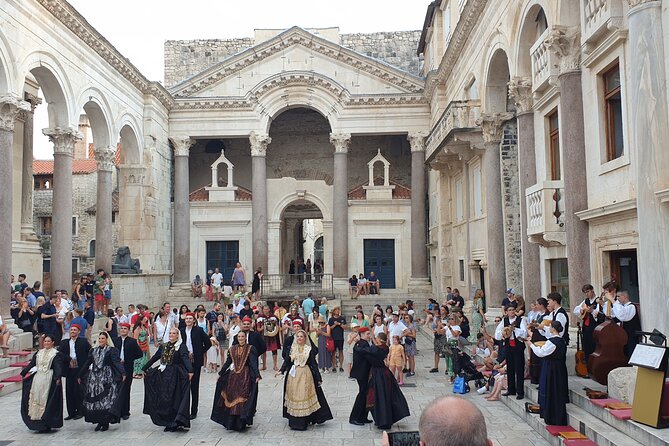
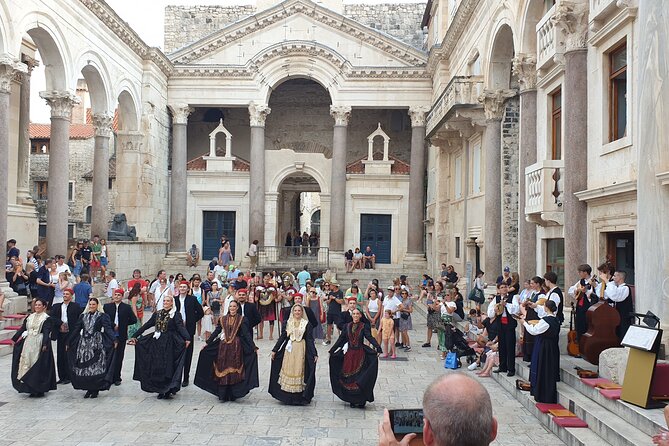
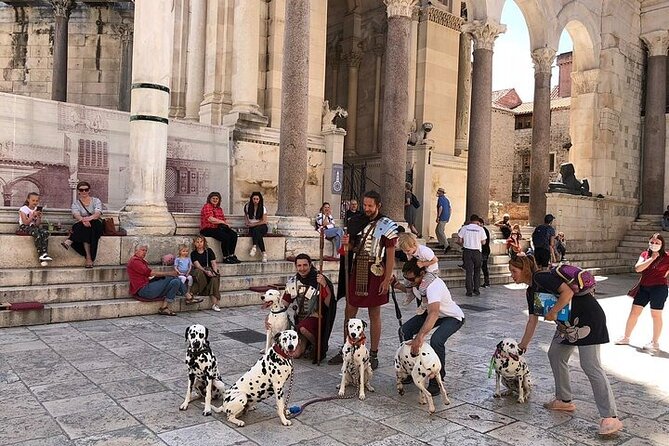
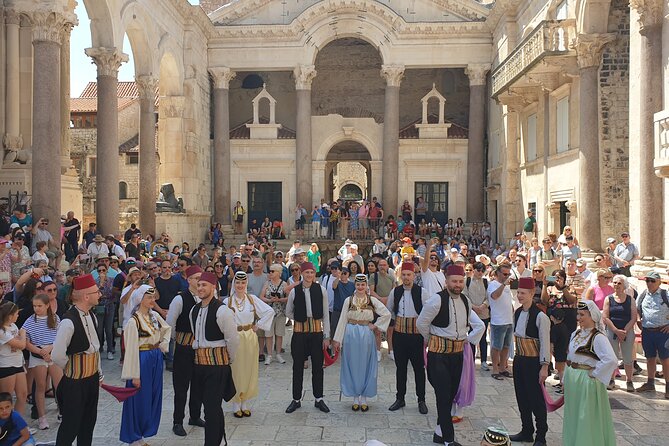
The meeting point is on Peristil Street, at the Peristyle, the central square of Diocletian’s Palace. This is the right place to begin because the square connects to much of the rest of the compound.
The Peristyle gives you an immediate sense of the palace plan. It was not simply a private home for the emperor. It was a formal imperial setting, designed to impress anyone approaching Diocletian. The guide uses this space to explain the emperor’s position and the way the palace worked.
You receive about 15 minutes here. That is enough for an overview, though not enough for every architectural detail. The square can be busy, and the hard surfaces can make it difficult to hear if the group is spread out. Stay close to the guide and arrive ready to begin on time.
The best part is learning to see the Peristyle as a stage for power rather than as a pretty square. Once that idea is in place, the rest of the walk makes more sense.
The Vestibule and the possibility of Dalmatian song
A short stop at the Vestibule follows. This was part of the route toward the emperor’s private rooms, and its round form gives it a very different feel from the open Peristyle.
You spend roughly five minutes here. The guide explains its purpose and history, and you might hear traditional Dalmatian singing. The possibility is not guaranteed, but it adds a local touch that a standard architecture lecture might miss.
This is one of the briefest stops, so do not expect a full performance or a long musical presentation. Think of it as a quick look at a striking space, with the chance of hearing a living tradition connected to the region.
Palace substructures and the practical side of Roman design
The substructures are among the most useful stops for understanding how the palace was built. You walk through the lower level and learn how these spaces supported the upper part of the complex.
The visit lasts about 10 minutes. The guide discusses both construction and later use, helping you understand that these rooms were not just dark corridors waiting for archaeologists. Their shape and layout reflect the engineering needs of the palace above.
The tour does not include the museum portion of the substructures. You can visit that separately after the walk, so anyone wanting displays or a longer archaeological visit should keep extra time available.
This arrangement can be good value. You receive a guided explanation of the structural remains without paying for an additional museum visit during the tour. On the other hand, if the substructures are your main interest, you may want to return later and see the museum at your own pace.
More Small-Group History Tours in Croatia
- Split History and Gastro Small-Group Tour with Food and Drinks
★ 5.0 · 375 reviews - Dubrovnik Old Town: Small-Group Walking Tour With A Local
★ 5.0 · 123 reviews - Dubrovnik: Game of Thrones and History Small Group Tour
★ 5.0 · 76 reviews - Dubrovnik: Small-Group Guided Old Town History Walking Tour
★ 4.9 · 37 reviews
The Golden Gate and Gregory of Nin
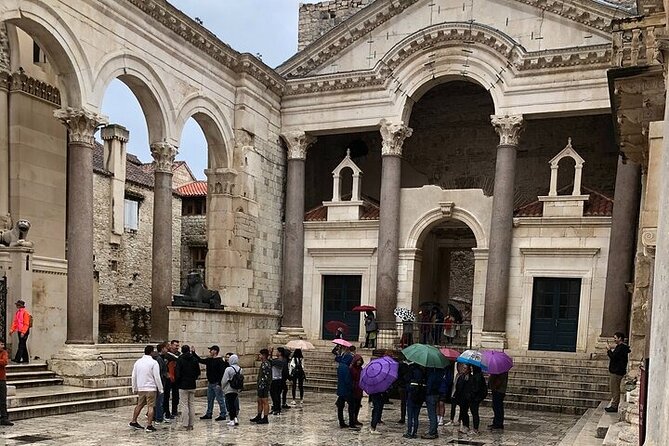
The Golden Gate is the palace’s main entrance and one of the most useful places to discuss how people moved through the complex. The stop lasts around 10 minutes.
Here you also see the statue of Gregory of Nin. The guide explains his importance to Croatian history and language, which takes the conversation beyond Roman emperors and military walls. This is a valuable shift. Split is not only an ancient Roman site, and the city’s later cultural story deserves attention.
The Golden Gate also helps you picture the palace as a controlled, formal complex. Entrances mattered. They shaped how people approached the emperor and how the city related to the palace over time.
This stop is likely to appeal to anyone interested in language and national identity. It gives you a reason to notice a monument that might otherwise be treated as a quick photo stop.
Riva harbor puts the palace beside modern Split
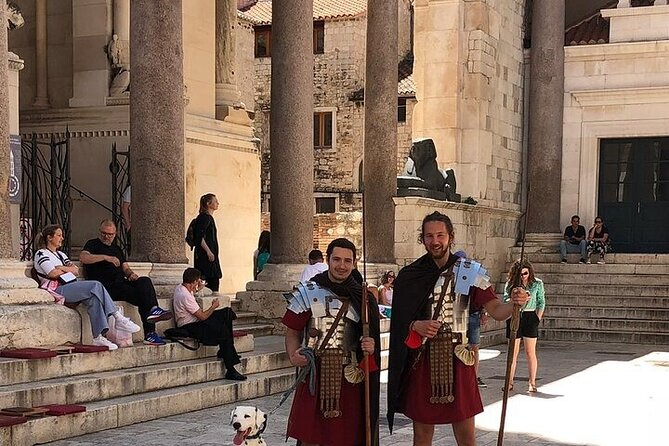
The walk continues to Riva harbor, Split’s famous waterfront promenade. You see a bronze model of Diocletian’s Palace and hear about the history of the Riva.
This 15-minute stop gives you a useful change of scale. Inside the palace, the walls can make the site feel enclosed. At the harbor, you can look back toward the historic core and understand its position in the wider city.
The bronze model is particularly helpful if you have struggled to picture the full palace layout. It can show how the entrance gates, central square, waterfront side, and interior spaces relate to one another.
The Riva is also a natural pause point, although it can be lively and noisy. If the group gathers near the promenade, stay within hearing range. The tour includes the harbor as a historic place, not as a separate sightseeing cruise or extended waterfront break.
Fruit’s Square, Venetian defenses, and Croatian literature
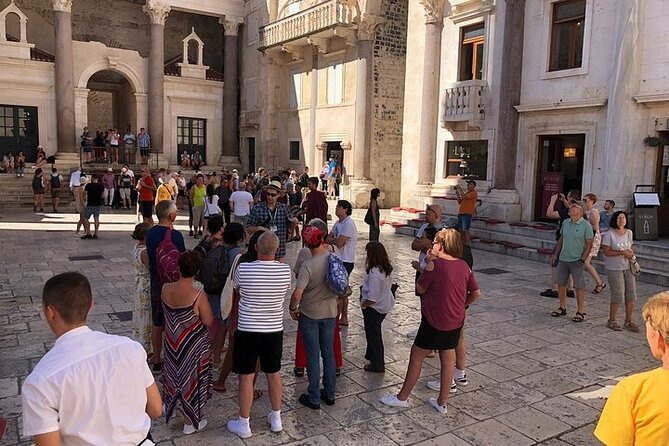
Fruit’s Square, also called Trg Brace Radic, brings in another period of Split’s story. The guide explains the 15th-century Venetian citadel and the role of Marko Marulic, often called the father of Croatian literature.
You spend about 10 minutes here. The square helps you see how Split changed after the Roman period. Venetian power left its mark on the city, while Marulic represents the growth of Croatian literary culture.
This is one of the tour’s strongest features. Many short palace walks remain fixed in the Roman era. This one moves across centuries and shows that Split is a living historic center rather than a frozen ruin.
The name Fruit’s Square may sound lighthearted, but the stop carries serious historical weight. You get military history, urban development, and literature in one compact section. For a 90-minute tour, that is a useful range.
Split Synagogue and the city’s Jewish story
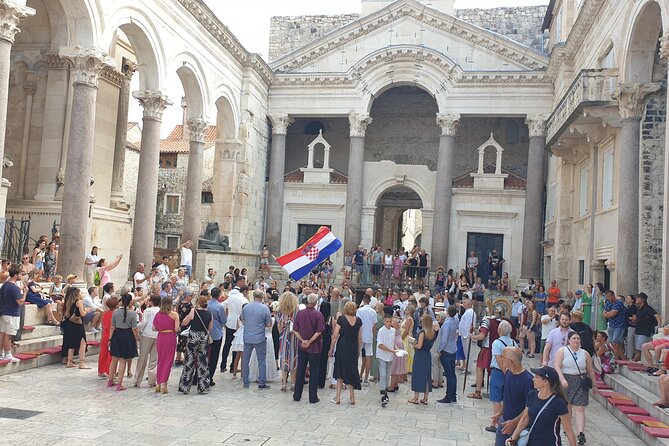
The final listed stop is the 16th-century Split Synagogue. You pass by the building and learn about the Jewish people who lived in the city.
The stop lasts about 10 minutes. Admission is not included, and the description indicates that the tour passes by the synagogue rather than offering a separate interior visit. That distinction matters if you expect a museum-style entry.
Still, the subject adds needed depth. A city tour should not only explain emperors, walls, and ruling powers. It should also make room for the communities that shaped urban life. This short section gives you a glimpse of that part of Split.
The tour ends back at the starting point. That makes the route easy to fit into a day of sightseeing, since you do not need to arrange transport back from a distant neighborhood.
How the timing works in real life
The stated duration is approximately one hour and 30 minutes. The listed stop times add up to about 75 minutes, leaving room for walking, questions, introductions, and changes between locations.
In practice, you should not book a tight connection immediately afterward. Several past accounts describe the walk lasting beyond two hours. That may reflect questions, a particularly detailed guide, or the pace of the group.
I see this as mostly positive if you enjoy history. A guide who stops to answer questions can make the tour better, but a longer visit may be inconvenient if you have a ferry, meal reservation, or timed admission elsewhere.
The pace should suit most people who can walk through the old center. The main physical warning concerns high steps. Service animals are allowed, public transportation is nearby, and most people can take part, but the route is not a good fit if steps are a major problem.
Group size, guide style, and the value of $69.14
At $69.14 per person, this is not the cheapest way to walk around Split. You can see many exterior sights without paying anything. The price makes more sense if you want a French-language explanation, a planned route, and a guide who can connect separate periods of history.
The tour advertises group discounts, which could improve the cost for families or parties booking together. A mobile ticket also makes arrival easier, especially if you are moving around Croatia and do not want to print paperwork.
The group limit is 30 people. That is a firm maximum, but 30 is a moderate-sized group rather than a tiny one. The small-group label should be understood as smaller than a large coach excursion, not as a private walk.
Ask yourself what you need. If you already know Roman architecture and prefer wandering alone, the price may not feel worthwhile. If French is your strongest language for history, the cost buys clarity and context that you may not get from signs or an audio guide.
The strongest feedback focuses on three traits: guides who speak French very well, guides who explain with enthusiasm, and guides who answer questions. That combination gives the tour its value.
Who will enjoy this French-language walk
I would recommend it most strongly to:
- French-speaking adults who want a clear introduction to Split
- Families looking for a short history activity with visual stops
- First-time visitors who want help finding the main palace landmarks
- People interested in Croatian language, literature, and local communities as well as Roman history
- Anyone who prefers a guide with a conversational, question-friendly style
Families receive a special advantage here. The tour keeps changing location, and the palace itself provides plenty to look at. Past descriptions specifically note that children enjoyed Irene’s presentation.
It may be less suitable for anyone who wants a slow archaeological study, a fully private experience, or a museum visit inside the substructures. It is also not ideal if you have difficulty with high steps or need a very strict end time.
Booking and cancellation details
Confirmation is sent within 48 hours of booking, subject to availability. You can cancel for a full refund if you do so at least 24 hours before the start time. Cancellations or changes made inside that window are not refunded or accepted.
The activity needs a minimum number of people to operate. If that minimum is not reached, you are offered another date or experience, or a full refund.
Meet at Peristil Street in Split. The walk returns to that same meeting point, and gratuities are not included in the price.
FAQ
Is this tour conducted in French?
Yes. The experience is designed as a French-language walking tour, and the guides are described as fluent in French.
How long does the tour last?
The advertised duration is approximately one hour and 30 minutes. Some past participants describe visits lasting more than two hours, so leave extra time afterward.
Where does the tour begin?
It begins on Peristil Street at the Peristyle of Diocletian’s Palace in Split, Croatia.
Where does the tour end?
The activity ends back at the meeting point.
Is admission to the palace included?
The listed stops have no separate admission charge during the walk. The museum portion of the Palace substructures is not included and can be visited afterward.
How many people can join the tour?
The maximum group size is 30 people.
Can I cancel for a full refund?
Yes, if you cancel at least 24 hours before the experience start time. Cancellations made less than 24 hours before the start time are not refunded.
Should you book the History Split Walking Tour in French?
Book it if you want Split explained in French rather than simply photographed. The route covers the essential palace landmarks, then adds the Riva, Venetian history, Croatian literature, and the city’s Jewish past. That range gives you a better sense of how Split grew beyond its Roman foundation.
I would be especially comfortable recommending it to families and first-time visitors. The guide quality appears to be the central strength, with Antonela, Irene, and other French-speaking guides praised for warmth, humor, strong preparation, and patient answers.
Skip it if you want a private tour, a guaranteed 90-minute finish, or a full museum visit in the substructures. Otherwise, $69.14 is a fair price for a French-speaking introduction to Split, provided you leave enough time for the guide to tell the story properly.
More Small-Group History Tours in Split
- London Small Group Tour of Historical Pubs
★ 5.0 · 10,422 reviews - Boston: Freedom Trail History Small Group Walking Tour
★ 5.0 · 6,450 reviews - Madrid Tapas & Taverns Small Group Food & History Tour
★ 5.0 · 2,664 reviews - Hidden Alleyways and Historic Sites Small-Group Walking Tour
★ 5.0 · 2,335 reviews
More History Walking Tours in Split
- SPLIT-PRIVATE Walking Tour of Diocletian’s Palace & Old Town
★ 5.0 · 467 reviews - Split: Local History and Culture 90-Minute Walking Tour
★ 5.0 · 194 reviews - Private History Split Walking Tour in English
★ 5.0 · 159 reviews - Split: Walking tour of Split with a ‘Magister’ of History
★ 5.0 · 110 reviews
Just added around Split
- Split Walking Tour with History Professor★ 5.0 · 23 reviews
- Split: Local History and Culture 90-Minute Walking Tour★ 5.0 · 194 reviews
- Split: Private Walking Tour in the Historical Town Center★ 5.0 · 25 reviews
- Split: Historical & Gastro Treasures Tour with Green Market★ 4.9 · 144 reviews
- Split: Walking tour of Split with a ‘Magister’ of History★ 5.0 · 110 reviews
- Experience Split History Walking Tour With Local Historian★ 5.0 · 28 reviews
- Split History and Gastro Small-Group Tour with Food and Drinks★ 5.0 · 375 reviews
- Private History Split Walking Tour in English★ 5.0 · 159 reviews
History Walking Tours, compared.
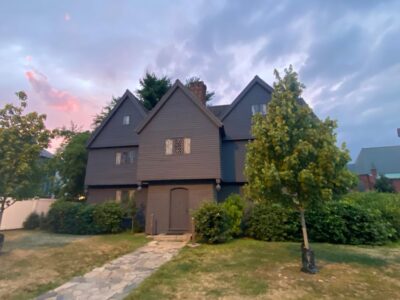
History and Hauntings of Salem Guided Walking Tour
Read our review →
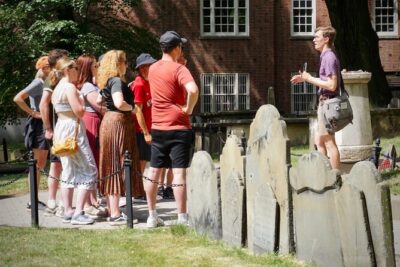
Freedom Trail History Small Group Walking Tour
Read our review →
Historic Charleston Guided Sightseeing Walking Tour
Read our review →
Tapas Walking Tour with Food, Wine, and History
Read our review →
Savannah History and Haunts Candlelit Ghost Walking Tour
Read our review →
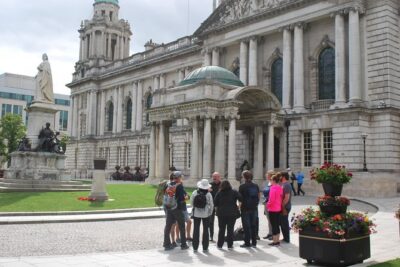
A History of Terror – Belfast City Centre Walking Tour
Read our review →Browse the lists this tour appears in