
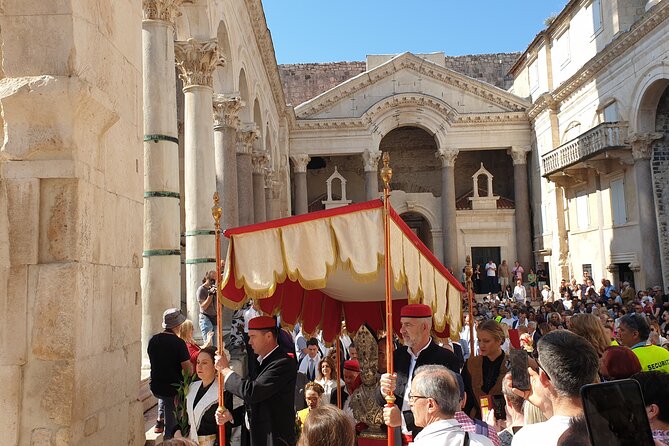
Review · SPLIT
History & Cultural Walking Tour of Split and Diocletian’s Palace
Ancient stones tell lively stories. I like this tour because it turns Diocletian’s Palace into a readable city rather than a jumble of old walls, and because its small-group limit of 15 allows real questions. The 90-minute route also gives you a useful first look at Split without taking up half your day.
I especially like the mix of grand Roman spaces and everyday city life, from the Peristyle to the Riva promenade and Fruit’s Square. Traditional klapa singing may add a memorable local note, too. The main drawback is that much of the experience is outdoors on uneven stone, and high steps may be difficult if you have mobility issues.
Key points to know before you book
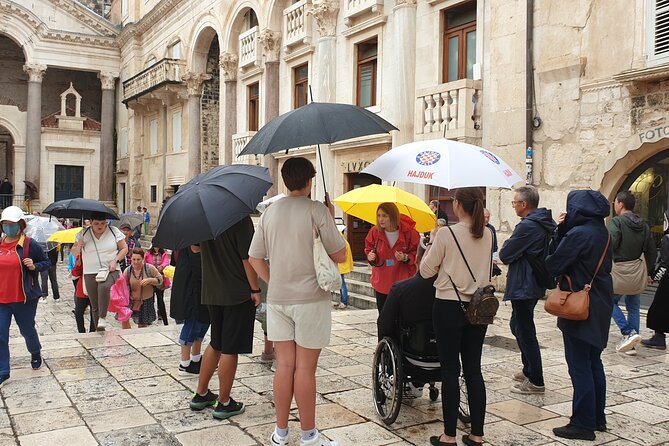
- The tour begins at the Peristyle: You start in the central square of Diocletian’s Palace, a smart place to get your bearings in Split’s old center.
- The route covers seven historic stops: You see the palace’s main square, vestibule, substructures, Golden Gate, Riva Harbor, Fruit’s Square, and the Split Synagogue.
- The group is capped at 15 people: That is small enough for questions and easier conversation with your guide.
- The substructures are not the full museum: You pass through the palace’s underground spaces, but the museum section is not part of this tour.
- Local culture is part of the story: You may hear traditional Dalmatian klapa singing and learn about Croatian literature, language, religion, and architecture.
- The price is modest for a city orientation: At $22.98 per person, the tour offers a practical introduction before you explore Split on your own.
Why this is a smart first look at Split
Split can be confusing at first. Roman walls have been absorbed into homes, shops, cafés, and streets, so the palace does not always look like a single monument. It feels more like a working old town built inside an ancient imperial residence.
That is exactly why a guide helps. You are not only looking at columns and stone blocks. You are learning how Emperor Diocletian’s retirement palace shaped the city that grew around it. The tour connects the Roman remains with Venetian defenses, Croatian language, Jewish history, and the modern waterfront.
I would take this walk early in a Split stay, ideally on the first day or evening. It gives you a clear map of the old center, then makes later wandering more rewarding. You will recognize places you have already seen and understand how they fit together.
The advertised duration is about 1 hour and 30 minutes, which is enough for a useful introduction without wearing out your feet. One morning group spent much longer with its guide, nearly three hours, so the pace can vary. Do not schedule a tight appointment immediately afterward.
More Castle and Palace History Tours in Croatia
- SPLIT-PRIVATE Walking Tour of Diocletian’s Palace & Old Town
★ 5.0 · 467 reviews - Split: Historical Tour of Salona, Klis Fortress and Trogir
★ 4.1 · 108 reviews - Jewish Heritage & Diocletian’s Palace Private Split Tour
★ 5.0 · 80 reviews
Meeting at the Peristyle of Diocletian’s Palace
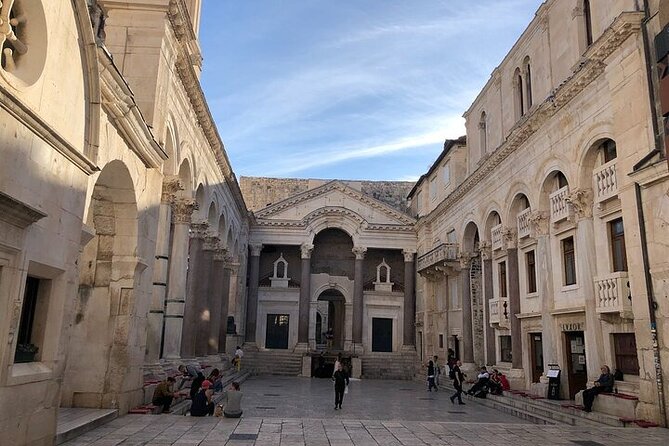
The tour starts on Peristil ulica, at the Peristyle, the palace’s central square. This is the right starting point because nearly every major section of the palace connects to it.
The Peristyle gives you the grand Roman opening act: stone, columns, and the sense of a ceremonial center built for an emperor. Your guide explains how the square worked within Diocletian’s palace and how the surrounding spaces connect. With this orientation, the rest of the walk becomes easier to follow.
The stop lasts about 15 minutes, and admission is included because the main square is part of the public old city. You will be standing on old paving and moving through an active urban area, not entering a quiet, fenced-off archaeological site.
That difference matters. Split’s old center is both an attraction and a neighborhood. People live, work, shop, and eat among the Roman remains. I prefer this kind of setting to a site that has been cleared of daily life, but it also means the atmosphere can be busy and the group may need to pause to let people pass.
The Vestibule and the sound of Dalmatia
From the Peristyle, the route continues to the Vestibule, the former entrance space of Emperor Diocletian. This brief stop lasts about five minutes, but it adds a strong sense of arrival to the palace.
The guide explains the Vestibule’s purpose and place in the imperial complex. You may also hear traditional Dalmatian singing here. The possibility of klapa singing is one of the tour’s most appealing cultural details, since it connects the old stone setting with a living local tradition.
Because the stop is short, do not expect a full musical performance every time. Still, if singing takes place during your visit, it can give the tour a human sound that no plaque can provide.
The guide quality matters especially here. Names associated with particularly well-received tours include Darko, Ante, also called Anthony in English, and Ivana. Darko was praised for his local knowledge and enthusiasm, while Ivana used questions and answers to keep the group involved. Those details suggest a tour that depends on the person leading it, as any walking tour does.
Inside the palace substructures
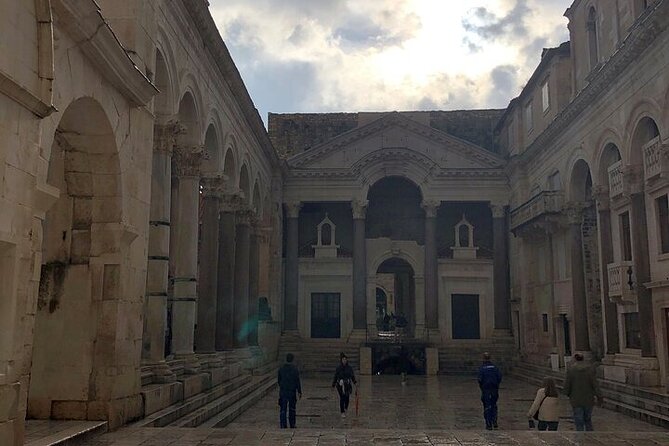
The underground substructures are among the most useful stops because they help you understand how the palace was built. You pass through these lower spaces while learning about their original function and the ways they were used over time.
This is not the museum section of the substructures. The tour does not include that part, though you can visit it afterward. That distinction is important if you want a full underground visit. The walking tour gives you an introduction, not every exhibit or chamber.
The stop lasts about 10 minutes. It is short, but the substructures help explain the layout above ground. Roman builders often used carefully planned foundations and lower rooms to support the spaces overhead. Here, your guide can show how the palace’s construction worked rather than simply pointing to a surviving wall.
I like this stop for practical reasons. Once you understand the lower level, the upper palace feels less like scattered ruins. You begin to see the whole complex as a planned imperial residence, even though later generations changed it heavily.
More History Walking Tours in Croatia
- Walking Tour of Split with a ‘Magister’ of History
★ 5.0 · 1,122 reviews - Split Walking Tour with Professor of History
★ 5.0 · 926 reviews - Split: History and Heritage Walking Tour
★ 4.9 · 650 reviews - Split: Local History and Culture 90-Minute Walking Tour
★ 5.0 · 194 reviews
The Golden Gate and Gregory of Nin
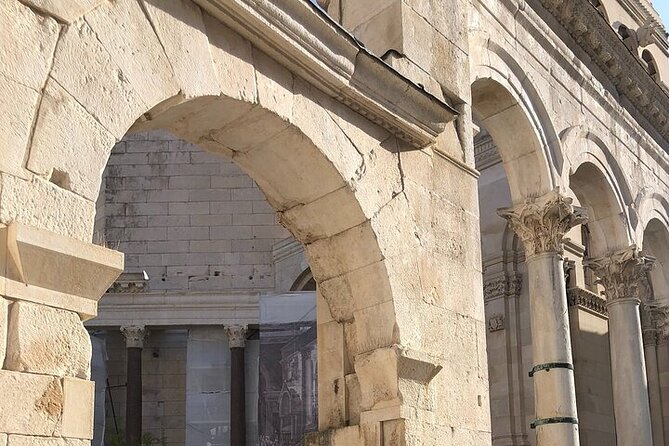
The Golden Gate was the palace’s main entrance, and it gives the tour a chance to move from imperial architecture into Croatian identity. The guide explains the gate and introduces the statue of Gregory of Nin.
Gregory of Nin is important to Croatian history and language, so this is more than a quick photo stop. You learn why the figure matters and how language became part of the country’s cultural story.
The visit lasts about 10 minutes. It is a useful place to ask questions, particularly if you want help understanding Croatia beyond the Roman period. The tour’s focus is not limited to Diocletian. It shows how different eras overlap in Split.
The Golden Gate also helps with orientation. Once you know where it is, you can use it as a landmark while exploring on your own. It is one of the palace’s main entrances, so you are likely to pass it again even after the formal tour ends.
Riva Harbor and Split’s waterfront life
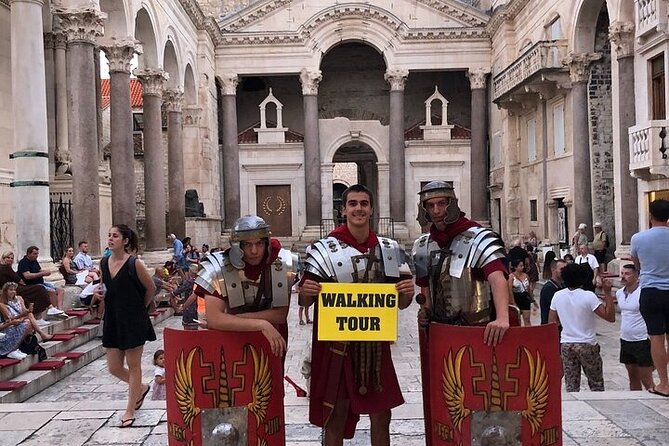
At Riva Harbor, the Roman palace gives way to Split’s famous promenade. The stop lasts around 15 minutes and includes a bronze model of Diocletian’s Palace.
The model is useful because it lets you see the complex as a whole. After moving through individual rooms, gates, and streets, you get a broader picture of the palace’s shape and position beside the water.
Your guide also explains the story of the Riva promenade. This is where the tour links ancient Split with the city you see today. The waterfront is not only a place for photographs. It is part of the city’s public life, and the walk helps explain why it matters.
I would pay attention to the change in mood here. The palace feels enclosed and monumental, while the Riva opens the view and gives you room to breathe. That contrast makes the route feel more varied than a continuous march through ruins.
It is also a good place to note the tour’s practical value. You learn where the old center ends and the waterfront begins, making it easier to plan a later meal, walk, or independent visit.
Fruit’s Square and the Venetian chapter
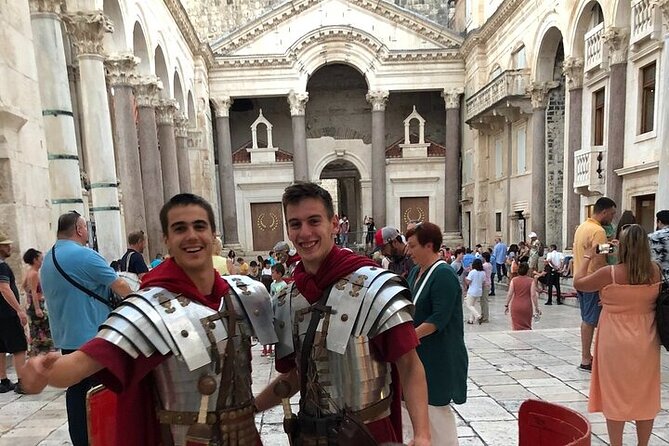
Fruit’s Square, or Trg Brace Radic, brings another period into the story. Here you learn about a 15th-century Venetian citadel and the importance of Marko Marulić, often called the father of Croatian literature.
This stop lasts about 10 minutes. It is a reminder that Split’s story did not stop with the Romans. Venetian influence, local defense, and Croatian literary culture all appear within a short walk of the palace.
Marko Marulić gives the guide a way to discuss Croatian identity through writing rather than monuments alone. That is valuable if you want more than an architectural tour. The route introduces the culture that developed in and around the palace, not only the empire that built it.
Fruit’s Square also shows how compact Split is. In a short distance, you move from an emperor’s residence to a Venetian fortification and a major figure in Croatian literature. I find that kind of layered history more useful than a long list of dates.
Passing the Split Synagogue
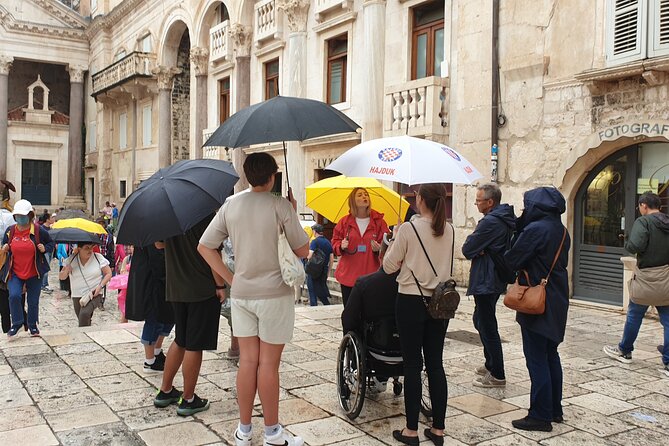
The final listed stop is the Split Synagogue, where you pass by the 16th-century building and learn about the city’s Jewish community. The tour does not include admission, and the stop is presented as an exterior visit.
It lasts about 10 minutes. That is enough for a short introduction, but not for a detailed study of the synagogue or Jewish life in Split. If this subject is especially important to you, ask the guide for suggestions about learning more after the walk.
Including the synagogue is a strength because it widens the story again. Split was not shaped by one ruler, one religion, or one century. The stop encourages you to notice communities and traditions that can be overlooked when the Roman palace takes all the attention.
The tour ends back at the meeting point. That makes it easy to continue exploring from the Peristyle, return to the waterfront, or revisit a place that caught your attention.
What the guide adds to the experience
The best part of this tour is the human explanation. Split’s old center can look impressive without making much sense. A good guide supplies the links between the stones.
The guides praised most strongly for this experience were described as friendly, clear, and engaging. Ante, known as Anthony in English, was singled out for going beyond the expected route and showing less obvious historic details. Darko was described as eager to share his city. Ivana used questions and answers to help the group remember the material.
That style suits a history walk. You are not required to memorize a lecture. You can ask about architecture, language, religion, or daily life and receive context as you go.
Several people also valued the humor used during the explanations. That matters during a palace tour because Roman dates and architectural terms can pile up quickly. A little humor keeps the walk from feeling like a school lesson, while the strong rating suggests the guides generally keep the balance right.
At 99 percent recommended and a five-star average from 104 ratings, the response is unusually strong. Still, the experience depends on your guide and on group conditions. A group of three may feel far more personal than a group of 15.
Price, group size, and timing
At $22.98 per person, this is a good value if you want an introduction to Split’s old center. You are paying for a guide who puts the palace into context, not for admission to a major museum or a long list of included attractions.
The small-group limit is one reason the price makes sense. A maximum of 15 people is not private-tour small, but it is more manageable than a large city walk. You should have a fair chance to hear the guide and ask a question.
The tour is offered in English and includes a mobile ticket. It is near public transportation, which makes the meeting point practical. You need to arrange your own gratuity, since tips are not included.
I would book it for a first visit, especially if you have only a couple of days in Split. An early start can help you see the old center with fewer people around, based on the experience of a 9 a.m. group. The tour is also a useful backup if another planned walk is canceled, since one group booked it at the last minute and still enjoyed the experience.
You can cancel for a full refund up to 24 hours before the local start time. Changes or cancellations inside that window are not accepted, and the tour requires a minimum number of participants. If the minimum is not met, you are offered another date or experience, or a full refund.
Who should choose this Split walking tour?
I would recommend it to first-time visitors who want a clear introduction before exploring alone. It also suits history fans, couples, families with older children, and anyone who wants Roman architecture explained in plain English.
It is a particularly good fit if you enjoy seeing how several periods overlap. The route covers the Roman palace, medieval and Venetian traces, Croatian literature and language, the Jewish community, and the modern Riva.
You should think twice if you dislike walking on old stone or have trouble with high steps. Most people can take part, and service animals are allowed, but the operator specifically warns people with high-step issues. The tour also may not satisfy someone who wants a full museum visit, since the museum section of the palace substructures is not included.
Should you book the History and Cultural Walking Tour?
Book it if you want a reasonably priced, small-group orientation to Split that combines major sights with cultural context. The route is short enough to fit into a busy day, yet it covers more than the usual Roman highlights.
I would choose an early time if available, then use the rest of the day to revisit the Peristyle, explore the substructures museum, or follow the Riva at your own pace. You should also leave some flexibility afterward in case your guide, like the one who spent nearly three hours with a small group, turns the walk into a longer conversation.
Skip it if you prefer to explore without a guide or want admission to every palace attraction included in one ticket. For most first-time visitors, though, the combination of history, local culture, and a manageable group makes this a strong way to get oriented in Split.
FAQ
Where does the tour begin?
It begins at Peristil ulica, at the Peristyle of Diocletian’s Palace in Split.
Where does the tour end?
The tour ends back at the meeting point.
How long does the tour last?
The scheduled duration is approximately 1 hour and 30 minutes. Some small groups have spent longer with the guide.
What language is the tour offered in?
The tour is offered in English.
How many people can join the tour?
The maximum group size is 15 travelers.
Is admission to the palace substructures included?
The tour passes through the substructures, but the museum section is not included. You may visit that section after the walk.
Is the Split Synagogue entrance included?
No. The tour passes by the 16th-century synagogue and discusses its history, but admission is not included.
Can I cancel for a full refund?
Yes. You can cancel at least 24 hours before the experience start time for a full refund. Cancellations or changes made less than 24 hours before the start are not accepted.
More Local Culture and Traditions Tours in Split
- Amsterdam Food and Cultural Tour with Tastings
★ 5.0 · 4,315 reviews - Sevilla Food Tour: Tapas, Wine, History & Traditions
★ 5.0 · 3,468 reviews - Tromsø: Reindeer Camp and Sami Cultural Tour with Lunch
★ 4.7 · 3,326 reviews - Half Day Dominican Republic Cultural Tour : Small Group
★ 4.5 · 1,862 reviews
More Castle and Palace History Tours in Split
- Edinburgh: Edinburgh Castle Guided History Tour with Tickets
★ 4.8 · 9,933 reviews - Madrid Essential: Historic Center, Plaza Mayor & Royal Palace
★ 5.0 · 6,416 reviews - Venice’s Best: Basilica, Doge’s Palace, Gondola & History Gallery
★ 4.5 · 2,478 reviews - Tokyo: Imperial Palace and Shogun Historical Walking Tour
★ 5.0 · 2,251 reviews
Just added around Split
- Split Walking Tour with History Professor★ 5.0 · 23 reviews
- Split: Local History and Culture 90-Minute Walking Tour★ 5.0 · 194 reviews
- Split: Private Walking Tour in the Historical Town Center★ 5.0 · 25 reviews
- Split: Historical & Gastro Treasures Tour with Green Market★ 4.9 · 144 reviews
- Split: Walking tour of Split with a ‘Magister’ of History★ 5.0 · 110 reviews
- Experience Split History Walking Tour With Local Historian★ 5.0 · 28 reviews
- History Split Walking Tour in French -Small group★ 5.0 · 41 reviews
- Split History and Gastro Small-Group Tour with Food and Drinks★ 5.0 · 375 reviews
Castle & Palace History Tours, compared.

Edinburgh Castle Guided History Tour with Tickets
Read our review →
Venice’s Best: Basilica, Doge’s Palace, Gondola & History Gallery
Read our review →
Imperial Palace and Shogun Historical Walking Tour
Read our review →
Saadian Tombs & Bahia Palace, Medina Guided Tour
Read our review →
Charleston historical walking tour with a Professor of History at The Citadel
Read our review →
Abu Dhabi Grand Mosque, Palace, and Heritage Village
Read our review →
Buda Castle District Dark History, Legends and Vampire Night Tour
Read our review →
Tokyo Castle & Imperial PalaceーShogun Walking Tour
Read our review →Browse the lists this tour appears in