
Review · MERSEYSIDE
Liverpool: Theatrical History Tour and The Dead House
Liverpool gets delightfully grim. This 90-minute walking tour turns the city’s oldest streets into a stage, mixing local history, dark comedy, audience participation, and a rare visit to the underground Dead House. I like the route’s variety, from the grand banking halls of Castle Street and Liverpool Town Hall to crooked lanes that feel far removed from the modern city. I also like the strong finale beneath the Church of Our Lady and St. Nicholas, where the tour enters a place closed to the public for more than a century.
The main consideration is comfort. The Dead House is underground, reached through a trapdoor, and entered at your own risk. You need to bring a torch, and the experience is not suitable for wheelchair users, people with limited mobility, visually impaired visitors, or anyone easily unsettled by grim subject matter. At $26 per person, it offers good value if you want theatre and unusual access, but less so if you prefer a quiet, strictly academic city walk.
Key points at a glance
- The finale is genuinely unusual: Enter Liverpool’s former subterranean morgue beneath the Church of Our Lady and St. Nicholas.
- The route follows the original seven streets: You see early Liverpool through narrow lanes, old churchyard spaces, and grand civic buildings.
- The guides perform rather than simply lecture: Expect costumes, character work, jokes, audience participation, and a few scares.
- The tour begins at Queen Victoria Monument: The meeting point is in Derby Square, a central place to reach on foot.
- Bring your own torch: The underground section is dark, and torches are not provided.
- The best fit is a curious, mobile adult or family group: Children are welcome when accompanied by an adult, but unaccompanied minors cannot join.
Why this Liverpool tour feels different
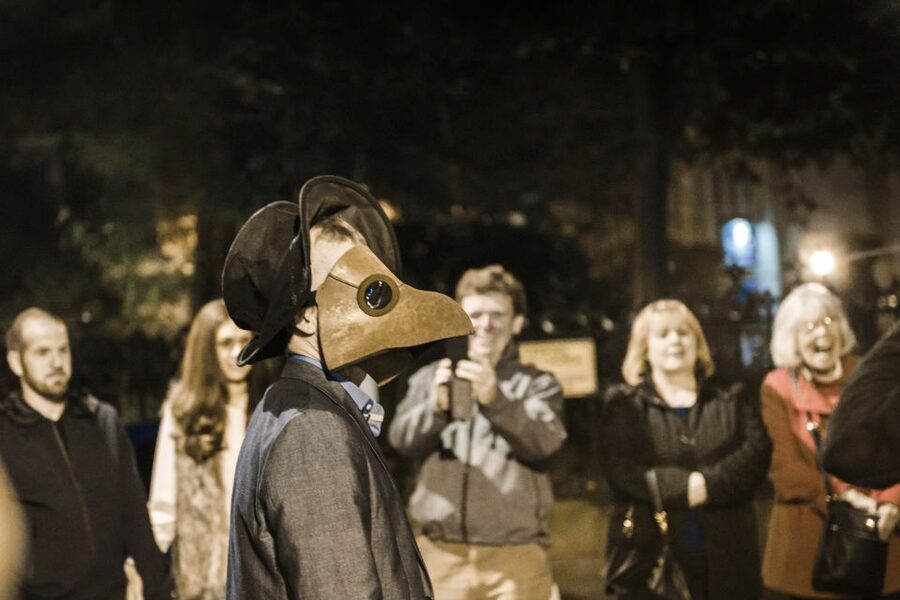
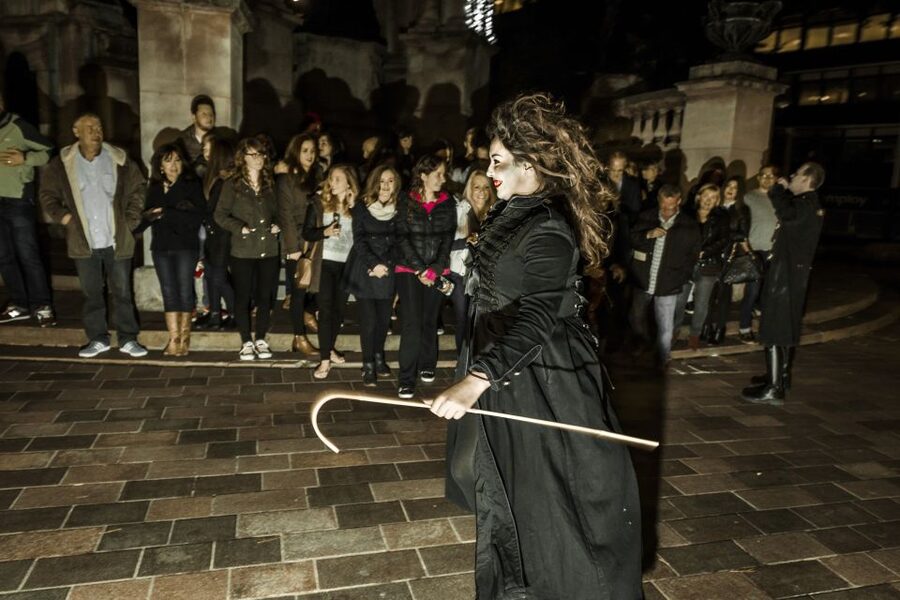
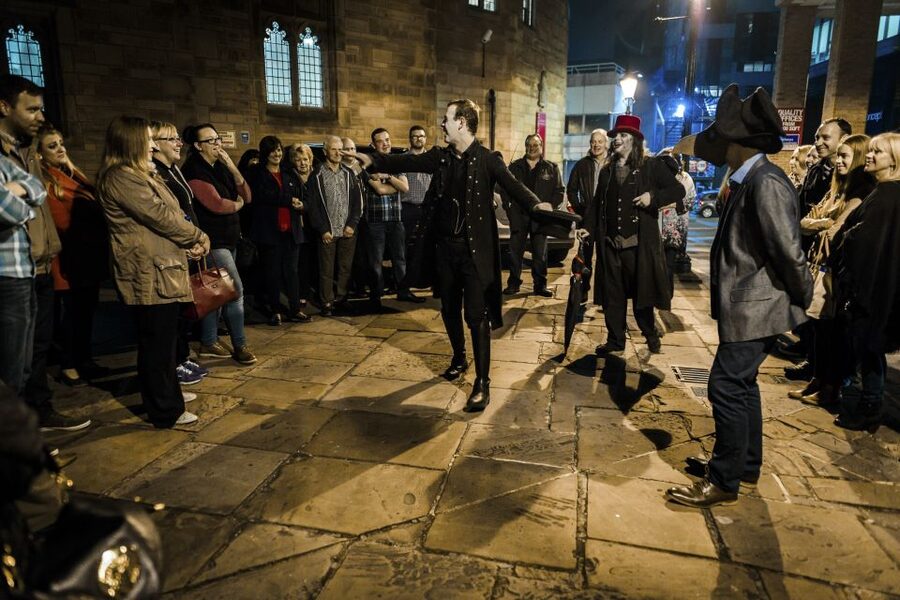
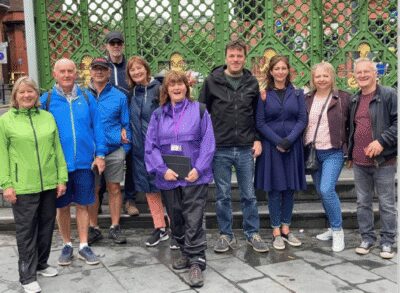
Many city walks give you dates, façades, and a steady stream of names. This one uses street theatre to make Liverpool’s past feel immediate. The guides act out scenes, tell grisly stories, and draw the group into the performance. You are not just listening while walking. You may be asked to take part.
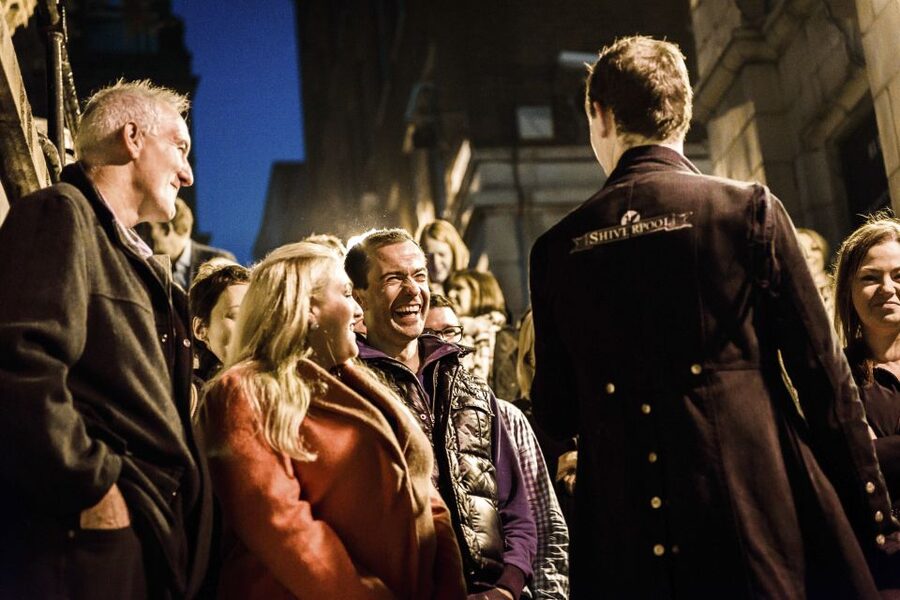
That style earns high praise for good reason. The guide team is described as funny, friendly, professional, and excellent at bringing stories to life. One particularly useful detail is the strong double act between the performers. They keep one another moving, tease the audience, and even leave random passersby looking bemused as the performance unfolds on public streets.
I like that the comedy does not replace the history. The tour still takes you through important parts of central Liverpool, including the original seven streets, Castle Street, the Town Hall, the Nelson Monument, and the churchyard at the end. You get a real orientation to the old city, only with darker jokes and more theatrical flair.
This is not a conventional ghost walk, though. The material has a spooky edge, but it is also about Liverpool’s civic growth, streets, buildings, policing, death, and public attitudes toward the deceased. If you are hoping for nonstop supernatural stories, you may find the historical material more prominent than the ghost stories.
A few more history tours around the UK worth a look
- London Small Group Tour of Historical Pubs
★ 5.0 · 10,422 reviews - Edinburgh: Edinburgh Castle Guided History Tour with Tickets
★ 4.8 · 9,933 reviews - A History of Terror – Belfast City Centre Walking Tour
★ 5.0 · 2,883 reviews
Starting at Queen Victoria Monument in Derby Square
The tour begins at the Queen Victoria Monument in Derby Square. This is a practical central meeting point, and it places you close to the early core of Liverpool. From here, the guide sets the tone before the group starts walking.
The opening section lasts about 15 minutes. Expect a theatrical introduction rather than a dry orientation talk. The guide uses the streets themselves as part of the stage, helping you picture Liverpool before the modern commercial center took shape.
The reference to the original seven streets matters. Liverpool’s early development is easier to understand when you look at the old street pattern rather than treating the city as one large, modern center. The tour uses that structure to show how the city grew and how everyday movement once worked through narrow lanes and alleys.
You should wear comfortable shoes. The total time is only 90 minutes, but it is a walking experience with several stops and changes of setting. The pace is designed for a group, so you will want to stay close and remain ready to move when the performance continues.
Castle Street and the grand public face of Liverpool
The route moves through Castle Street, known for its lofty banking halls. This gives the tour a change of mood. Instead of only focusing on old alleys and death stories, it points to Liverpool’s wealth, commerce, and formal civic architecture.
That contrast is one of the tour’s strengths. The city’s grand buildings are not presented as isolated monuments. They form part of a broader story about power and public life. The guides use the architecture as a backdrop while keeping the tone lively.
You can expect roughly 25 minutes of guided walking in this part of the route. That is enough time to cover ground without turning the experience into a long architectural lecture. The theatrical approach also helps if you are visiting Liverpool with children or companions who would normally switch off during a standard building tour.
Still, the route is best for people who enjoy a guide with personality. The performance includes humor, cajoling, and audience involvement. If you prefer to observe quietly and take photographs without interruption, this style may feel energetic.
Liverpool Town Hall and the city’s grand civic story
Liverpool Town Hall is one of the key stops. Its regal opulence provides another strong visual setting for the performance. The tour spends about 15 minutes here, using the building to explain more about the city’s public identity.
The stop works well because the theatrical presentation can make an impressive building feel less remote. You see the grandeur, but you also get stories and character work that connect it to ordinary human behavior. The guide’s role is not simply to point at a façade. The building becomes part of the drama.
This is also a good point to judge the tour’s balance. It does not only seek out the obscure or frightening. It includes familiar landmarks, then reframes them through lesser-known local stories. That approach is useful if you already know central Liverpool and want something beyond a basic sightseeing loop.
Same place, a different slice of the past:
- Edinburgh: Whisky Tasting with History and Storytelling
★ 4.9 · 2,451 reviews - Edinburgh: Old Town History and Tales Walking Tour
★ 4.8 · 2,361 reviews - Old Town Walking Tour History and Tales in Edinburgh
★ 5.0 · 2,168 reviews - Soho Music & Historic Pubs Tour
★ 5.0 · 1,993 reviews
The Nelson Monument and the turn toward darker streets
The route continues to the Nelson Monument, with around 10 minutes of guided walking in this section. By now, the tour has shifted between formal squares, grand buildings, and older streets. The changing settings help prevent the experience from feeling like one long story in one location.
The guide’s performance is central here. You may hear factual incidents, unusual local details, and stories with a spooky twist. The tone can move quickly from comic to solemn. That contrast is part of the appeal, especially for an evening outing or a group looking for something more memorable than a standard city walk.
One useful expectation to set is that the scares are part of the theatrical package, not the whole point. Some people want more ghost stories. Others appreciate the wider mix of local history, drama, and humor. I would choose this tour for its atmosphere and storytelling rather than for a strict focus on ghosts.
Back alleys, lamp-lit lanes, and audience participation
The tour includes crooked back alleys and lamp-lit lanes in the old commercial district. These spaces change how you see central Liverpool. The grand streets show civic confidence, while the narrow passages suggest a more crowded and uncertain past.
The theatrical guides make these sections feel active. The performances have been praised for their wit, costumes, dramatic moods, and audience involvement. You may find yourself responding to the guides rather than simply following behind them.
That interaction is a real strength for groups. Families, friends, hen parties, and visitors who enjoy live entertainment can get more from this tour than from a standard talk. It also explains why people describe the experience as funny and memorable even when the subject matter is grim.
The public setting adds an extra layer of fun. Passersby may pause or look puzzled as the actors perform in the street. You are not entering a purpose-built attraction with a controlled stage. The city itself remains part of the show.
The Dead House beneath the churchyard
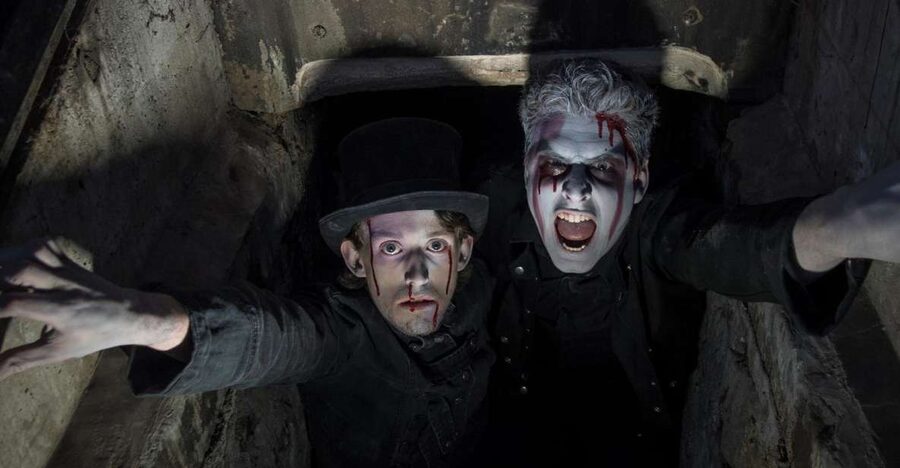
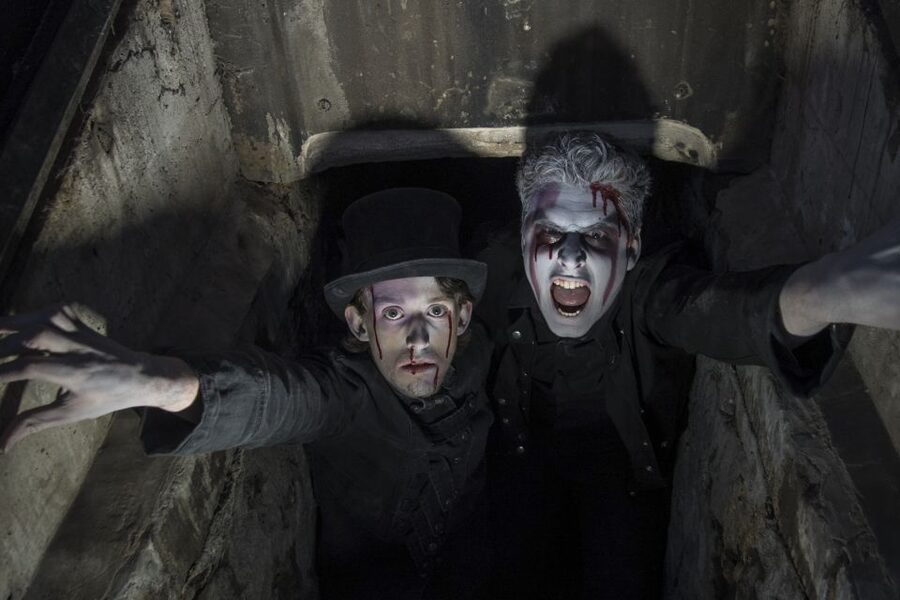
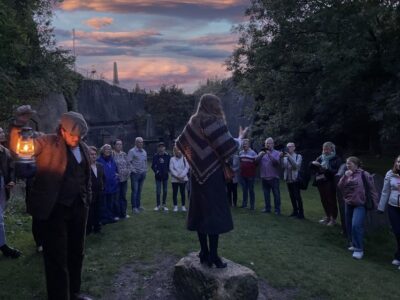
The finale takes place at 5 Old Churchyard, within the boundary of a medieval garden beneath a Gothic spire. Entry is through a trapdoor, leading down into the underground Dead House.
This is the most distinctive part of the experience. The site was named the Liverpool Dead House by American author Herman Melville because of its grim nature. During the 18th and 19th centuries, local people could peer through iron grates to look at the faces of the deceased. The space also served as a temporary police station during World War II.
Those details give the location more weight than a simple spooky set. You are visiting a place tied to the practical handling of death, public curiosity, local policing, and wartime use. The guides build toward the entrance, and the change from open streets to dark steps creates the strongest atmospheric moment of the tour.
The underground site has been closed to the public for more than 100 years, so the access is unusual. At the same time, it is not a polished museum room. You enter at your own risk, and you must bring your own torch. The provider does not supply torches, refreshments, or coffins, although the last item is best treated as a joke rather than a packing concern.
The ending can include a frightful theatrical moment. If you have a delicate disposition, or if enclosed, dark places make you uncomfortable, this is the part to consider carefully. The tour is family-friendly in its general classification, but the subject matter and setting may not suit every child.
What the $26 price gets you
At $26 per person, the tour is reasonably priced for a 90-minute guided experience that combines a walking route, live performance, and access to a normally closed underground location. You are paying for more than a city walk, but the value depends on whether you enjoy theatrical entertainment.
I think the price works best for first-time visitors who want a compact evening activity, and for Liverpool residents who already know the major sights but want a fresh angle. The route covers several recognizable places while adding streets and stories you may otherwise miss.
There are no refreshments included, so plan to eat or drink before or after the tour. The finish at 5 Old Churchyard also gives you a clear endpoint in central Liverpool, rather than leaving you somewhere remote.
The booking terms are helpful if your plans may change. You can cancel up to 24 hours ahead for a full refund, and the reserve-now, pay-later option lets you hold a place without paying immediately. Availability and start times should be checked when booking.
Who should book, and who should skip it
I would choose this tour if you like local stories told with humor, enjoy live performance, and want access to a place most people cannot enter. It also suits groups celebrating an occasion, since the guides encourage participation and create a shared experience.
It is a good fit for older children with an adult, but not for unaccompanied minors. Every child must be accompanied by an adult. The strict guide-dog-only policy also matters if you are visiting with an assistance animal.
You should skip it if you use a wheelchair, have limited mobility, or need a fully accessible route. The tour is not wheelchair accessible, and the underground section may be difficult for people with visual impairments. The supplier may try to accommodate mobility needs when possible, so tell them about any disability or mobility issue at booking, but do not assume the Dead House itself will be suitable.
Smoking, vaping, and e-cigarettes are not allowed. You also need to bring a torch. Those are small details, but forgetting the torch could make the final section much less comfortable.
My verdict on the theatrical Dead House experience
Book it if you want Liverpool history with a comic, spooky edge and an unusual finale. The guides are the heart of the experience, and the strongest praise centers on their humor, dramatic skill, friendliness, and ability to involve the whole group.
Do not book it expecting a quiet architectural walk or a pure ghost hunt. The tour mixes civic history, old streets, comedy, audience participation, and grisly storytelling. The Dead House is the memorable payoff, but the route leading there is what gives the ending its shape.
For $26, I see this as a strong-value choice for a central Liverpool evening, provided you are comfortable underground and mobile enough for the route. Bring a torch, wear sensible shoes, and arrive ready to play along. The more willing you are to accept the theatrical style, the more you are likely to enjoy it.
FAQ
Where does the Liverpool Dead House tour begin?
It begins at the Queen Victoria Monument in Derby Square, Liverpool.
Where does the tour finish?
The tour finishes at 5 Old Churchyard, Liverpool L2 8GW, within the area of the Church of Our Lady and St. Nicholas.
How long does the experience last?
The tour lasts 1.5 hours.
What language is the tour in?
The live tour guide speaks English.
Do I need to bring a torch?
Yes. You must bring your own torch because torches are not provided for the underground section.
Is the tour wheelchair accessible?
No. The experience is not wheelchair accessible and is not suitable for wheelchair users.
Can children join the tour?
Yes, the activity is family-friendly, but every child must be accompanied by an adult. Unaccompanied minors are not allowed.
What is included in the ticket price?
The price includes the theatrical walking tour and exclusive access to the Dead House. Refreshments, torches, and coffins are not included.
Just added around the UK
- Curious Cambridge – The History Tour that’s FUN!!!★ 5.0 · 80 reviews
- Birmingham Gangs Nighttime Historical Walking Tour with Pub Stops★ 5.0 · 53 reviews
- 2.5-Hours Walking Tour of Birmingham into Black Heritage Madiba★ 5.0 · 49 reviews
- Belfast Walking Tour: City Centre History, Troubles & Stories★ 5.0 · 39 reviews
- Award Winning Private 2 Hour Belfast Political Black Taxi Tour★ 5.0 · 53 reviews
- Belfast Political/history/troubles private taxi/cab tour★ 5.0 · 69 reviews
- Private Political History & Murals Tour Belfast★ 5.0 · 182 reviews
- Ancient Britain Tour – Private Day Trip from Bath★ 5.0 · 17 reviews
Liverpool History Tours, compared.
A Walk Through Time: History of Liverpool Walking Tour
Read our review →
Best Of Liverpool Heritage, History & Culture Guided Walking Tour
Read our review →
History Guided Tour of Liverpool and the Beatles
Read our review →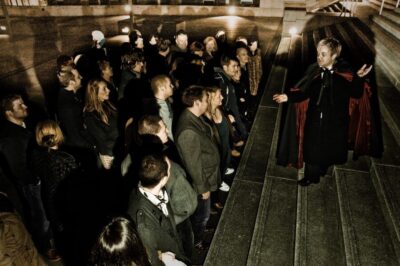
Browse the lists this tour appears in