
Review · BELFAST
Private Political History & Murals Tour Belfast
Belfast’s walls still carry the argument. This private tour makes the city’s political past easier to understand by linking its murals, neighborhoods, prison, and peace barriers to the people who lived through The Troubles. I especially like the small private format and the chance to leave the vehicle at the Peace Wall, where you can walk, read messages, and add your own good-luck note.
I also like the way the tour covers both sides of the divide, from Loyalist Shankill Road to Republican Falls Road. Guides such as Sean, Brian, Brendan, Thomas, Dan, and Michael have been praised for explaining painful events with warmth and humor. The main consideration is that the experience is brief, and the vehicle may not always be a traditional black cab, so you should book it for a focused introduction rather than a complete study of Northern Ireland’s past.
Key points at a glance
- Two communities in one short tour: Compare Loyalist Shankill Road with Republican Falls Road and hear how each area remembers The Troubles.
- A real stop at the Peace Wall: Get out, walk along part of the wall, read public messages, and sign your own note.
- Local guides shape the experience: Sean, Brian, Brendan, Thomas, Dan, Michael, and Michel have each been praised for personal insight and thoughtful answers.
- Private transport keeps the pace easy: You travel by air-conditioned vehicle between the main sites instead of joining a crowded bus.
- Good value for a first look: At $76.39 per person, the price is reasonable for private transportation and a guide focused only on your group.
- Allow about 90 to 105 minutes: The route is compact, emotional, and useful before exploring Belfast further.
Why this short Belfast tour matters
Belfast’s murals are not simply colorful street art. They mark allegiance, loss, identity, political demands, and memories that remain sensitive. A mural can look striking in a photograph, but without context you may miss why it matters to the neighborhood around it.
This tour gives you that context in a compact form. You move between the two main communities affected by The Troubles, with time to ask questions along the way. That private setting matters because the subject is not tidy. You may want to ask about a mural, a prison sentence, a paramilitary group, or the peace process, and a private guide can adjust the discussion to your interests.
The guides bring different personalities and experiences. Sean is praised for clear explanations and for having lived through the era. Brian is described as patient with long lines of questions. Brendan is noted for warmth, humor, and respectful treatment of everyone affected. Thomas has been praised for making difficult material engaging without losing its seriousness.
You should still expect different viewpoints. One guide may present events with a strong local or political interpretation, and one account describes the discussion as biased. That does not make the tour useless, but it is a reminder to listen carefully and treat this as one informed perspective rather than the final word on Northern Irish history.
More Private History Tours in the UK
- Private Historical Walking Tour of York
★ 5.0 · 1,324 reviews - Private Group: Historical Pub Walking Tour of London
★ 5.0 · 660 reviews - London: Private Landmark Tour with Professional Photographer
★ 4.7 · 91 reviews
Starting near Belfast City Hall
The usual meeting point is Ten Square Hotel at 10 Donegall Square South, beside Belfast City Hall. The tour returns to the same meeting point at the end.
Pickup is available from locations in Belfast and beyond, but there is an important cost detail. If your pickup is more than one kilometer from Belfast City Hall, a small fee may be added on the day, equal to the taxi fare, starting at £10 for the vehicle rather than per person. The operator confirms this by message, so check the pickup arrangement before setting out.
The vehicle is air-conditioned and private. That is a practical advantage in Belfast weather, especially when rain or wind makes long stretches outdoors less appealing. It also avoids the fixed rhythm of a large bus. You can stay focused on the guide, ask questions freely, and move between neighborhoods without spending much time finding the next stop.
The total duration is roughly one hour and 30 minutes to one hour and 45 minutes. That makes it easy to fit into a morning or afternoon, but it also means the guide must keep the story moving. You will receive a strong introduction, not every detail of the conflict.
The Peace Wall: ten minutes of reflection
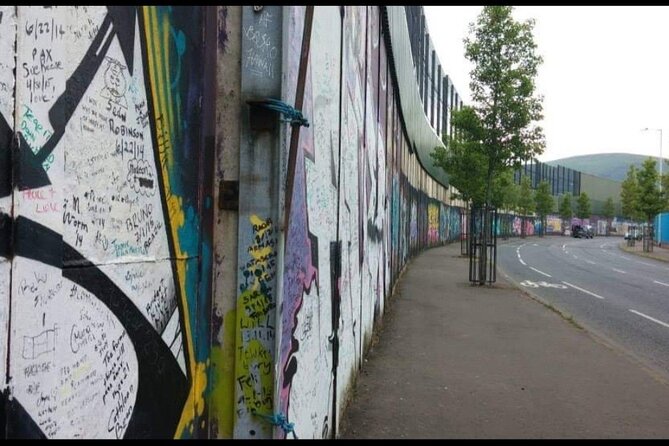
The Peace Wall is the first planned stop, with about ten minutes to get out and walk along it. You hear why the barriers were built and how they came to divide communities that remain close together geographically.
This is the moment when the subject becomes physical. From inside a vehicle, a wall can seem like another Belfast landmark. On foot, you can read the messages left by people from many places and see how a structure meant to separate communities has also become a place where people express hope, grief, anger, and support.
You can sign a good-luck message for future generations. It is a small act, but it gives the stop a personal edge. I would take a moment to read the existing notes before writing anything. The wall is not merely a photo backdrop, and a respectful attitude matters here.
Ten minutes is enough for a brief walk and a few photographs, though you should not expect a long visit. The guide’s explanation is the key part. Ask why the walls remain, how they relate to everyday life, and what the peace process changed. The tour’s strongest moments often come when you connect the concrete barrier with the people and events behind it.
Shankill Road and the Loyalist story
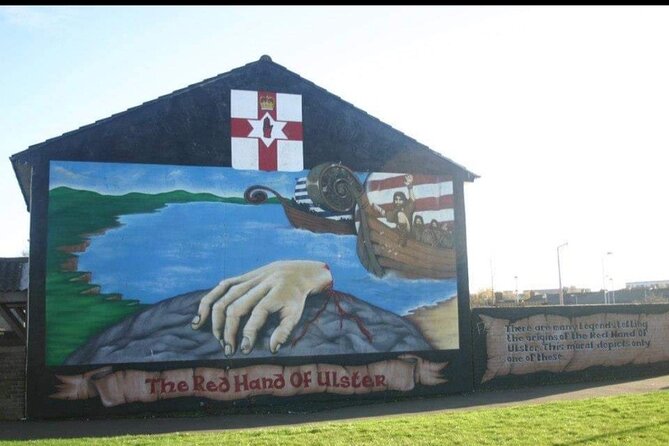
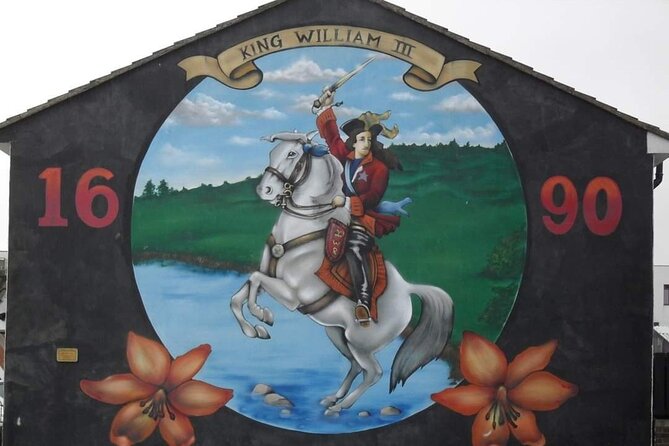
The tour then spends about 40 minutes exploring Shankill Road. This is one of the longer stops, and it gives the guide room to explain Loyalist paramilitary groups, local residents, and major events from The Troubles.
The value here is not just seeing murals from a moving vehicle. You learn how the images reflect community identity and political loyalty. The guide can also explain the difference between the people who lived in the area and the armed groups that operated there. That distinction is important. Neighborhood history and paramilitary history overlap, but they are not the same thing.
A private tour works well on Shankill Road because you can pause over details that catch your attention. If you know little about the conflict, ask for the basic timeline first. If you have already read about it, ask how local memory differs from the wider account. Sean has been praised for answering questions in a way that gives visitors a foundation for further reading, and Brian is noted for taking long question sessions patiently.
The subject can be unsettling. You may see memorials and murals that celebrate people or causes you find difficult. That is part of the point, but it also calls for restraint. Listen before judging, and ask the guide to explain the local meaning rather than rushing to a quick conclusion.
Same place, a different slice of the past:
- London Small Group Tour of Historical Pubs
★ 5.0 · 10,422 reviews - Edinburgh: Edinburgh Castle Guided History Tour with Tickets
★ 4.8 · 9,933 reviews - A History of Terror – Belfast City Centre Walking Tour
★ 5.0 · 2,883 reviews - Edinburgh: Whisky Tasting with History and Storytelling
★ 4.9 · 2,451 reviews
Falls Road and the Bobby Sands mural
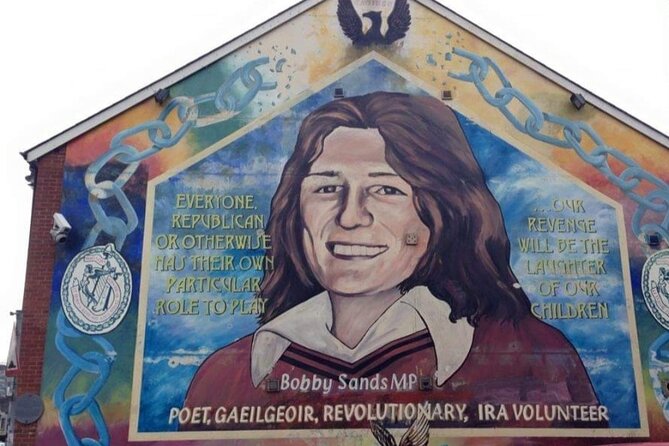
The tour gives another 40 minutes to Falls Road, where the guide discusses Republican paramilitary groups, the reasons behind the Republican uprising, local residents, and events from The Troubles. The Bobby Sands mural is the central visual marker here.
This stop balances the Shankill visit. You are not given only one community’s account. Instead, you see how Republican identity is expressed through murals and memorials, then hear about the people and political aims connected with that tradition.
Bobby Sands is a particularly important name in the story of the conflict, and the mural gives the guide a clear place to discuss imprisonment, protest, and the wider political struggle. The discussion can be emotional. Several guides have been praised for explaining the subject with care while still allowing room for humor and conversation.
I would use this stop to ask about language. Terms such as freedom fighter, terrorist, hunger striker, and political prisoner carry different meanings depending on who is speaking. A good guide can explain why those words remain contested. The tour does not promise a neutral textbook account, so keep an open mind and remember that local memory is often personal.
The murals also reward close attention. Look at the symbols, names, colors, and figures rather than taking only a quick photograph. Your guide can explain details that are easy to miss when you walk through the area alone.
Crumlin Road Gaol from the outside
The final stop is a short drive by Crumlin Road Gaol and the old Court House. You spend about five minutes seeing the buildings from outside and learning how they connect to arrests, trials, imprisonment, and sentencing during The Troubles.
You do not enter the prison on this tour. That limitation is worth noting, especially if you are considering a separate Crumlin Road Gaol visit. Here, the prison is a final piece of the story rather than a full attraction in its own right.
The brief stop works because it links the street-level murals with the formal system that held and sentenced people involved in the conflict. It also gives you useful background if you later tour the prison from inside. One guide specifically helped prepare a visitor for a later Crumlin Road experience, which is a good reason to schedule the two activities on separate parts of your trip if the prison interests you.
How much history fits into 90 minutes?
The tour covers a great deal quickly: the origins of The Troubles, events beginning in the 1960s, Loyalist and Republican communities, paramilitary groups, imprisonment, murals, and the peace process. A guide who grew up during the conflict can add personal detail that a printed sign cannot provide.
Still, you should set realistic expectations. Ninety minutes cannot explain every political party, ceasefire, organization, or historical argument. You may leave with a clearer framework and a longer reading list rather than a complete understanding. Sean has been praised for recommending books for people who want to continue learning, and that is exactly how I would use this tour.
The emotional effect can also be strong. One guide helped a visitor connect the visible walls and murals with the heavy feeling of Belfast’s recent past. You may laugh at local humor one minute and hear a painful personal story the next. That contrast is normal. The best guides keep the tour human without turning suffering into entertainment.
Is $76.39 per person fair?
At $76.39 per person, this is not the cheapest way to see Belfast’s murals. It can still be good value if you want a private vehicle, a dedicated guide, and the ability to ask questions without a large group around you.
The value improves when two or more people share the experience. You are paying for private transportation as well as interpretation, and the vehicle saves time between the Peace Wall, Shankill Road, Falls Road, and Crumlin Road. You also avoid the uncertainty of trying to locate each mural yourself.
A large bus may cost less, but it cannot offer the same flexibility. On this tour, you can ask to clarify a point, spend your attention on a particular mural, and keep the discussion suited to your group. If you are mainly looking for quick photographs, the price may feel high. If you want to understand what you are seeing, it is easier to justify.
One practical warning: do not assume a black taxi is guaranteed. Some people describe the vehicle as a black cab, while another account specifically says the vehicle was not one. The confirmed details are private transportation and an air-conditioned vehicle. If the traditional black-cab format matters to you, ask before booking.
Who will get the most from this experience?
This tour suits you if you are visiting Belfast for the first time and want a clear introduction before exploring independently. It also works well for families or mixed-age groups because the guide can adjust the pace and answer questions at the level your group needs.
It is especially useful if you have limited time. The route gives you the main political neighborhoods in under two hours, then returns you to central Belfast. It can fit neatly before lunch, after checking into a hotel, or on a day when rain makes a long walking tour less appealing.
You should choose another or additional activity if you want to enter Crumlin Road Gaol, spend a long time photographing murals, or study the peace process in academic detail. The tour is a starting point with local interpretation, not a full-day history course.
The subject also requires emotional maturity. The stories involve violence, imprisonment, political division, and people who may still feel the consequences. Guides generally treat the material with dignity, but you should not expect a light sightseeing ride.
Practical details before you book
Confirmation is provided when you book. The tour is offered in English, and service animals are allowed. It is near public transportation, and most people can participate.
The tour requires good weather. If poor weather forces a cancellation, you are offered another date or a full refund. For your own cancellation, you must cancel at least 24 hours before the start time for a full refund. Changes or cancellations within 24 hours are not accepted.
Give yourself a little flexibility around the start time, especially if you arrange pickup outside central Belfast. One account describes a pickup location being changed without notice and a 25-minute delay, while most of the available feedback praises punctual pickup. Confirm the exact meeting point and vehicle details in advance, particularly if you have a train, flight, or dinner reservation afterward.
The experience has a 4.8 out of 5 rating from 182 ratings, with 95 percent recommending it. That strong result matches the main strengths: friendly guides, clear explanations, local perspective, and a private format. The less favorable experiences focus on late pickup, difficulty understanding one accent, perceived political bias, or disappointment about the vehicle.
Should you book the Belfast murals tour?
I would book this tour if you want a focused, personal introduction to Belfast’s political history and prefer asking questions in a private group. The Peace Wall, Shankill Road, Falls Road, Bobby Sands mural, and Crumlin Road Gaol create a sensible route, and the guides bring the local connection that makes the sites meaningful.
Book it with the right expectations. You are getting about 90 to 105 minutes of concentrated history, not an all-day examination of The Troubles or guaranteed black-cab transportation. If you can accept that, the tour offers a thoughtful way to see Belfast’s divided neighborhoods and begin understanding the memories behind the murals.
FAQ
How long does the tour last?
The tour lasts approximately one hour and 30 minutes to one hour and 45 minutes.
Where does the tour start?
The usual meeting point is Ten Square Hotel, 10 Donegall Square South, Belfast BT1 5JD. The tour ends back at the meeting point.
Is pickup available outside the meeting point?
Yes. Pickup is available from locations in Belfast and further away. If the pickup point is more than one kilometer from Belfast City Hall, a small fee may be added, equal to the taxi fare and starting at £10 for the vehicle.
Is the tour private?
Yes. Only your group participates, and private transportation is provided in an air-conditioned vehicle.
Do you enter Crumlin Road Gaol?
No. The tour drives past the old prison and Court House and explains their connection to The Troubles, but you do not enter the jail.
Is the tour offered in English?
Yes. The experience is offered in English.
What happens if the weather is poor?
The experience requires good weather. If it is canceled because of poor weather, you are offered a different date or a full refund.
Just added around the UK
- Belfast Walking Tour: City Centre History, Troubles & Stories★ 5.0 · 39 reviews
- Award Winning Private 2 Hour Belfast Political Black Taxi Tour★ 5.0 · 53 reviews
- Belfast Political/history/troubles private taxi/cab tour★ 5.0 · 69 reviews
- Ancient Britain Tour – Private Day Trip from Bath★ 5.0 · 17 reviews
- Jane Austen’s Bath And History Trail★ 5.0 · 77 reviews
- Bath: Local Pubs & Historic Sights Walking Tour (3h)★ 5.0 · 31 reviews
- Aberdeenshire Private Half Day Castle & Historic Building Tour★ 5.0 · 18 reviews
- Dunnottar Castle and Coastal Heritage★ 4.5 · 20 reviews
Private History Tours, compared.

Private Guided Historic Electric Cart Tour of St. Augustine
Read our review →
Acemoglu Historical Turkish Bath w/Private Options
Read our review →
Private Full-Day Tour of Historical Alexandria
Read our review →
Private Tour of the Historic City in a Ford T Car
Read our review →
Madrid Historical Tour with Local Guide in Eco Tuk Tuk Private
Read our review →
Private Biblical Tour Ancient Corinth & Isthmus Canal from Athens
Read our review →
Private Kathmandu Sightseeing Tour | UNESCO World Heritage sites
Read our review →Browse the lists this tour appears in