Review · MADRID
Madrid Historical Tour with Local Guide in Eco Tuk Tuk Private
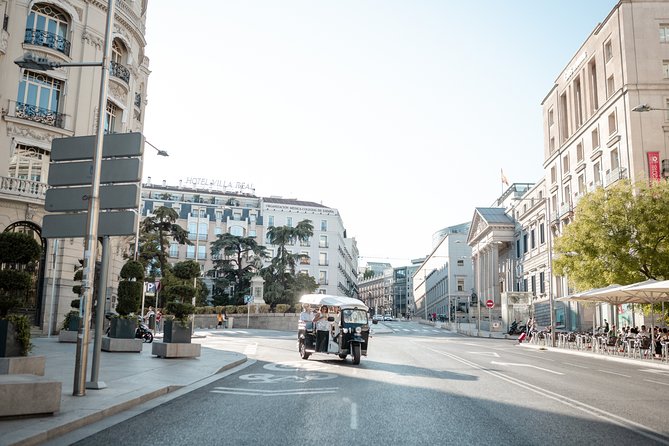
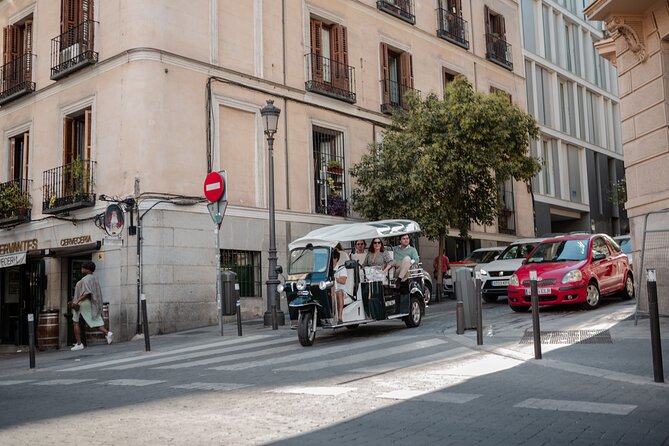
Madrid is easier from a tuk-tuk. This private electric ride gives you a quick, friendly introduction to the city, with local guide commentary and planned photo stops. I like the small-group feel, and I like that a two-hour outing can cover far more ground than a walking tour. The main drawback is that the route is fixed, and the pickup point beneath Plaza de Oriente can be tricky to find.
The tour works especially well at the start of a Madrid visit. Guides such as Carlos, Laura, Clara, Gloria, Fernando, Alejandro, Juan, and Nerea have earned praise for clear explanations, humor, personal recommendations, and safe driving. You should know, though, that the tuk-tuk holds no more than four passengers, so a larger party may need more than one vehicle.
Six useful things to know before booking
- A private ride for up to four people: Your group rides alone, with the price based on the number of tuk-tuks required.
- A fast city introduction: The route links the Royal Palace, Prado area, Cibeles, Atocha, the Temple of Debod, and other major sights.
- Electric and relatively quiet: The vehicle is fully electric, making it a pleasant way to move through central Madrid.
- The meeting point needs care: Look for Puerta del Príncipe and the underground bus station beneath Plaza de Oriente, not a street-level tuk-tuk rank.
- Guides make the difference: Carlos, Laura, Clara, Gloria, Fernando, Alejandro, Juan, and Nerea are praised for warmth, humor, history, and local tips.
- Weather protection is included: Blankets and rain or wind layers are available, but tours still run in rain and heat except under extreme conditions.
Why an electric tuk-tuk works well in Madrid
Madrid is large enough that a first visit can feel scattered. The Royal Palace sits near Plaza de España, the Prado Museum is farther east, Atocha lies beyond that, and the Temple of Debod occupies a hill to the west. Walking between all these places takes time and energy.
This tour connects them by road in a compact vehicle. You can see the broad shape of Madrid, note the places you want to revisit, and save your legs for museums, markets, and evening walks. I see it as a city orientation with wheels rather than a substitute for exploring each sight inside.
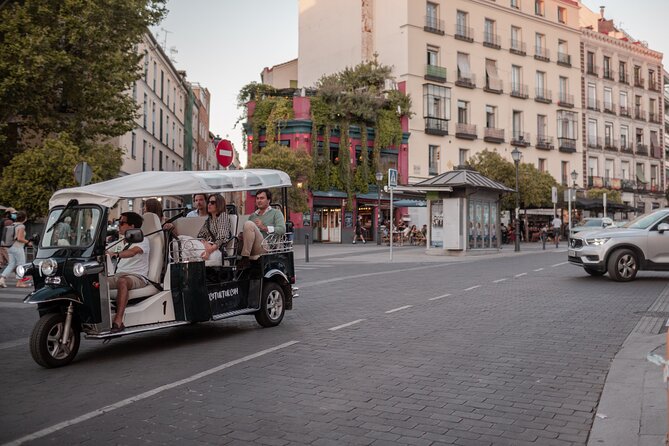
The electric motor is a real plus. You avoid the exhaust and engine rumble of a standard vehicle, while the open-sided design keeps you connected to the streets. It is still a road tour, so traffic and city noise are part of the experience. One review noted that the sound system was not always ideal, which is worth remembering if hearing every word matters to you.
The private format is more useful than it may first appear. You can ask about a building, a neighborhood, football traditions, food, or places to return later. Several guides are praised for making the tour feel conversational rather than scripted. Laura, in particular, is described as funny and proud of Madrid, while Carlos is repeatedly praised for history and practical recommendations.
More History Bike, Segway and Tuk-Tuk Tours in Spain
- Segway Private Tour in the Historic Center of Madrid
★ 5.0 · 310 reviews - Madrid: Tuk-tuk tour of the historic center and highlights
★ 4.7 · 20 reviews - Barcelona: 2.5-Hour Bike or E-Bike Historical Tour
★ 4.5 · 1,262 reviews
The first stop: a covered market with local flavor
The route includes a covered market dating from around 1916. It is associated with local food, delicatessen products, and events held in an elegant setting.
This is a useful contrast to the grand monuments. Madrid is not only royal buildings and museums. A market gives you a chance to think about how people eat, shop, and meet in the city. Depending on timing, you may get a quick look rather than a long food stop, since the tour includes many landmarks.
If you want to return for a meal or a closer look, ask your guide to help you identify its location and hours. The tour is better at pointing out possibilities than giving you a full market visit.
San Francisco el Grande and Madrid’s religious landmarks
The Basilica of San Francisco el Grande rises in the Palacio neighborhood, within Madrid’s historic center. Its official name is the Basilica of Our Lady of the Angels, and its prominent position helps explain the scale of Madrid’s old religious quarter.
You will mainly experience this stop from the vehicle or during a short planned pause. That is enough to appreciate the exterior and hear about its place in the city, but it does not amount to a full church visit. If the basilica is high on your list, plan a separate visit.
The route also passes the Almudena Cathedral, Madrid’s most important religious building. Pope John Paul II consecrated it in 1993, making it the first cathedral outside Rome consecrated by a pope. Its museum contains objects connected with the Madrid diocese, including mosaics, episcopal shields, and church ornaments.
The cathedral is close to the Royal Palace, so seeing both in one stretch gives you a strong sense of the city’s political and religious center. Again, the tuk-tuk tour provides context and an exterior view. Admission inside is not included as part of this experience.
Atocha and the city’s modern transport story
Atocha station is Madrid’s main railway complex and the busiest station in Spain. It sits near Plaza del Emperador Carlos V and links the capital with major destinations across the country.
The station matters because it shows another side of Madrid. The palace and museum areas tell the story of kings, churches, and art. Atocha shows Madrid as a working capital, where rail passengers arrive, depart, and connect with the rest of Spain.
The tour will not give you time to use the station as a transport hub or study it at length. Still, it is a useful landmark, especially if you are arriving or leaving Madrid by train. If Atocha is part of your own plans, this overview can help you recognize the area.
More Private History Tours in Madrid
- Madrid Historical in French (petit comité & private)
★ 4.8 · 228 reviews - Private: Madrid Historic Centre Food Tour with 10+ Authentic
★ 5.0 · 97 reviews
The Spanish Parliament and the lions of Congress
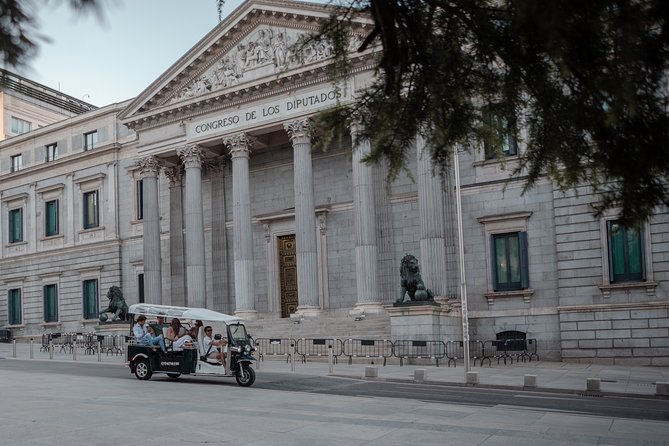
The Palace of the Spanish Courts occupies the site of the former convent of the Holy Spirit. The building served as the seat of Congress between 1834 and 1841, and its neoclassical front remains one of Madrid’s most recognizable civic facades.
Look for the grand staircase, the six fluted Corinthian columns, and the triangular pediment decorated with reliefs by Ponciano Ponzano. The two lions beside the entrance were made from iron taken from cannons captured during the war in Africa. The bronze door beneath the pediment opens only on important occasions.
This is exactly the kind of detail that can disappear if you pass by alone. A guide can point out the lions and explain why the building looks so formal and ceremonial. You will also hear about interior rooms such as the Session Room, the library, and the Conference Room, known as the Lost Steps Room.
The building is viewed from outside. Do not book this tour expecting a parliamentary interior visit.
Cibeles and the sporting geography of Madrid
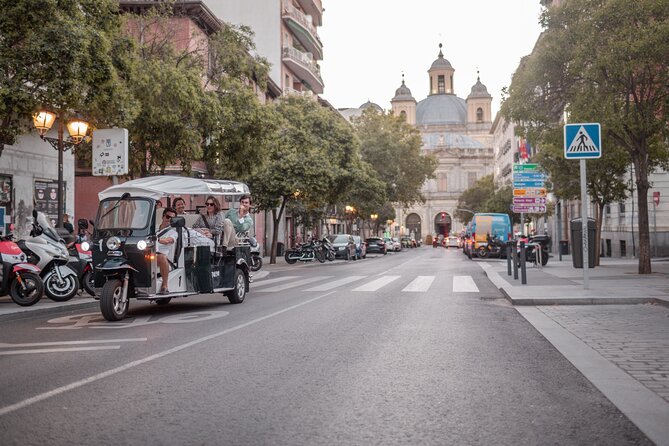
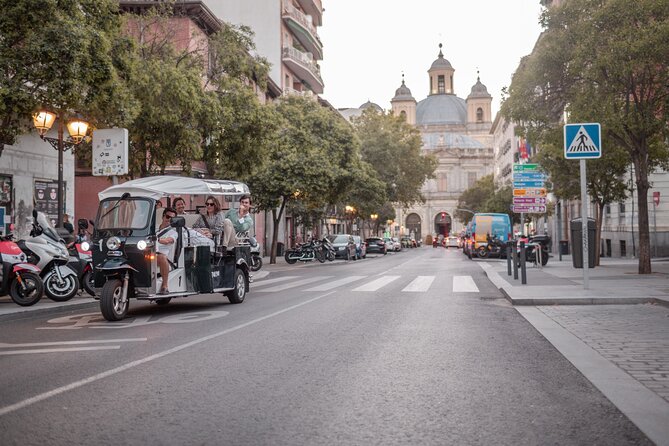
Madrid’s football rivalry appears in the route through two mythological figures. Neptune, associated with the sea, is linked with Atlético de Madrid celebrations in the Plaza del Dios del Mar. Cibeles, the goddess seated in her chariot, is where Real Madrid supporters celebrate victories.
This is a small but memorable piece of modern Madrid life. The fountains are not simply decorative monuments. They are meeting places tied to the city’s football identity, and the guide can explain the difference between them.
Cibeles is also surrounded by major buildings, including Buenavista Palace, Linares Palace, the Communications Palace, and the Bank of Spain. This makes the square one of the best places on the route to see how royal, military, civic, and financial power share the same urban space.
The stop is particularly good for photographs. A guide may time the pause so you can get a clear view, but the tour does not promise unlimited or improvised photo stops.
The Prado area and San Jerónimo el Real
The Prado Museum is one of Europe’s great collections of paintings from the 16th through the 19th centuries. Its works by European masters are so important that art historian Jonathan Brown called it possibly the most important museum in the world for European painting.
A tuk-tuk pass cannot replace time inside the galleries. What it can do is put the museum in context and help you decide how to spend a later visit. If you have only a short stay in Madrid, this is valuable. You can see where the museum sits, identify the surrounding sights, and return when you have the energy for a proper museum visit.
Next to the Prado is the Parish Church of San Jerónimo el Real, commonly called Los Jerónimos. The church is late Gothic, with Renaissance influences from the early 16th century. Centuries of repairs and remodeling mean that little of the original building remains untouched.
The church and museum make a fine pairing. One shows religious architecture and royal associations, the other displays painting on a grand scale. From the tuk-tuk, you get the connection between them without spending your whole morning indoors.
Puerta de Alcalá, a royal gateway to the east
Puerta de Alcalá was built under Carlos III to replace an earlier gate from the 16th century. The present monument opened in 1778.
It was once an actual entrance to Madrid. Today it sits in the middle of the city, but its role as a ceremonial gateway remains easy to understand. This is another planned photo stop, and its position makes it one of the easiest monuments to recognize later when you explore on foot.
The tuk-tuk gives you a quick look rather than a long architectural study. If you enjoy details about stonework, traffic patterns, and changing city design, ask your guide to point out the gate’s features while you are stopped.
Plaza de Santa Ana and the central neighborhoods
Plaza de Santa Ana lies in the Cortes neighborhood, in Madrid’s Centro district. The square dates from 1810 and has changed through several rounds of urban work.
This is a good reminder that Madrid is not a museum frozen in one period. Squares have been opened, redesigned, and adapted as the city changed. The guide’s local perspective is useful here because a short stop can tell you more about how the center functions today than a list of dates can.
The square is also a practical place to note for later wandering. The tour may give you only a passing view, so treat it as a suggestion for an evening walk rather than a complete visit.
The Royal Palace and Sabatini Gardens
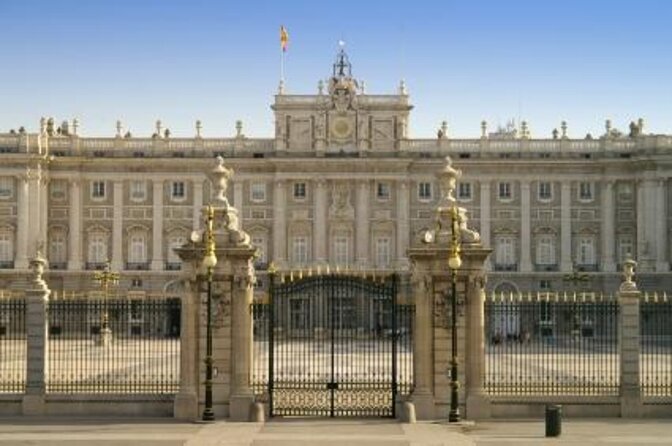
The Royal Palace, also called the Palacio de Oriente, is one of the main landmarks on the route. Construction began in 1738 and lasted seventeen years. Carlos III made it his usual residence in 1764, after the earlier Habsburg palace on the same site was destroyed by fire on Christmas Eve in 1734.
The palace is now used for receptions, ceremonies, and official events. Spain’s royal family lives at the Palace of Zarzuela, so the Royal Palace is not a private home in the everyday sense.
The setting matters as much as the building. The Campo del Moro gardens lie to the west, while the Sabatini Gardens sit on the north side. The Campo del Moro dates back to the Middle Ages and can be visited during the day. The Sabatini Gardens cover 2.66 hectares between Bailén Street and the San Vicente slope.
The tour begins near the palace, making this area easy to recognize at pickup. You should not assume that the tuk-tuk ticket includes entry to the palace or gardens. The main value here is the outside view, the historical explanation, and the chance to mark the palace for a later visit.
Temple of Debod and the best sunset-style viewpoint
The final listed stop is the Temple of Debod, an ancient Egyptian building now located west of Plaza de España beside Paseo del Pintor Rosales. It sits on a hill where the Cuartel de la Montaña once stood.
The temple is an unexpected sight in Madrid. Its presence adds an international layer to the route and gives you a break from palace facades, museums, and civic monuments. The stop includes about ten minutes and has no admission charge.
The short visit is enough for photographs and a quick look. If you want to spend more time around the temple, ask your guide when you should return, but the stated tour timing does not promise a long stop.
Choosing between one, two, three, or four hours
The advertised duration ranges from one to four hours, so check the exact option you select before paying. The shorter format can work as a quick introduction, while two hours appears to be the most practical balance for first-time visitors with limited time.
A three-hour tour gives you more room for commentary, photo pauses, and neighborhood views. One review describes three hours as a good amount of time for history, legends, food suggestions, and interesting stops. A longer option makes sense if you want a slower pace without walking long distances.
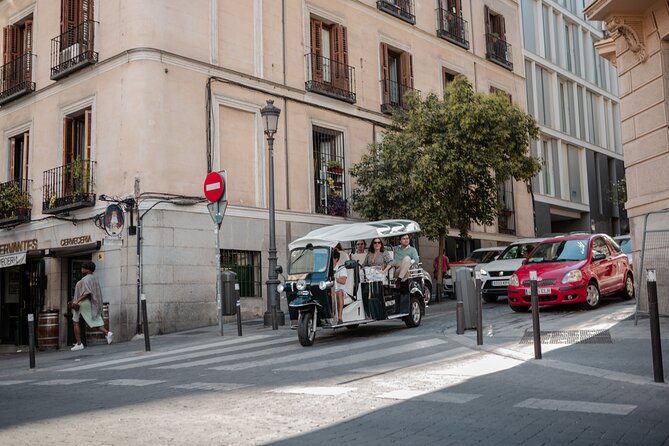
The route cannot be freely redesigned. Stops for photographs are arranged in advance, and roads may close because of demonstrations or other city events. Your guide may need to change the route on the day.
Price, comfort, and group size
At about $28.66 per person, the tour is fairly priced if you are sharing the private vehicle with several people. The calculation changes for a solo visitor or a couple, since the experience is private and the vehicle can carry up to four passengers. A larger party may need several tuk-tuks.
You are paying for transport, a guide, a private setting, and a broad city overview. You are not paying for museum or palace admissions. I see the strongest value for families, first-time visitors, older people who want to limit walking, and anyone with one free day in Madrid.
The vehicles are suitable for older people, and drivers can help with boarding. Children must be at least two years old, babies are not allowed, and a minimum weight of 9 kilograms applies. Pets are not permitted.
Blankets and protective layers for rain and wind are available. Tours operate in rain or heat and are cancelled only in extreme conditions, so dress for the forecast. The vehicle is designed for older passengers, but anyone with mobility concerns should contact the operator before arrival. The pickup area involves stairs from the underground station, though elevator help can be arranged by phone, WhatsApp, or email.
Finding the pickup point beneath Plaza de Oriente
This is the most important practical tip. The stated address is C. de Bailén, 4, but there is no visible number 4 on Calle Bailén. Search for Puerta del Príncipe or Calle Bailén 4 on Google Maps.
The actual meeting point is in the underground bus station beside the Royal Palace. Look opposite the Prince’s Gate for the stairs leading down, then follow the Eco Tuk Tuk signs. Do not simply wait beside other tuk-tuks on the street.
Arrive early. A delay of more than 15 minutes can cancel the activity without a refund, and a shorter delay reduces your tour time. The operator sends more detailed directions shortly before departure, so read them carefully.
Who should book this Madrid tour?
Book it if you want a fast orientation, prefer sitting to long walks, or are visiting Madrid for the first time. Families often benefit from the mix of movement, stories, and short stops, while solo visitors can get a private introduction without joining a large group.
It also suits visitors who enjoy personal recommendations. Guides have offered ideas for restaurants, neighborhoods, and places to revisit, which can help shape the rest of your stay.
Skip it if you want deep museum time, a fully flexible route, or long visits inside every landmark. The tour is an overview, not a replacement for the Prado, Royal Palace, Almudena Cathedral, or San Francisco el Grande.
For most first visits, I would choose the two-hour option and take it early in the trip. You will see the city’s main pieces, learn where they fit, and still have time to return to the places that catch your interest.
FAQ
How long does the Madrid electric tuk-tuk tour last?
The available duration is approximately one to four hours, depending on the option selected at booking.
How many people can ride in one tuk-tuk?
Each tuk-tuk has a legal maximum of four passengers. Larger groups may need more than one vehicle.
Is the tour private?
Yes. Only your group participates in the private activity.
Where does the tour start and finish?
It starts at the underground bus station beneath Plaza de Oriente, beside the Royal Palace, and returns to the same meeting point.
Is the Temple of Debod included?
Yes. The Temple of Debod is a listed stop, with approximately ten minutes there and no admission charge.
Are hotel pickup and drop-off included?
No. Hotel pickup and drop-off are not included, and transfers outside the tour route are not permitted.
What happens if I arrive late?
A delay reduces the tour time and may change the planned route. If you are more than 15 minutes late, the activity can be cancelled without a refund.
More History Bike, Segway and Tuk-Tuk Tours in Madrid
- Historical Singapore Bike Tour on Full-Sized Bicycles
★ 5.0 · 1,421 reviews - Charlotte’s Ultimate Southern Charm Historical City Cart Tour
★ 5.0 · 1,347 reviews - Asheville Historic Downtown Guided Electric Bike Tour with Scenic Views
★ 5.0 · 1,234 reviews - Private Guided Historic Electric Cart Tour of St. Augustine
★ 5.0 · 1,194 reviews
More Private History Tours in Spain
- Private Jewish Heritage Journey by Barcelona Dreaming
★ 4.8 · 383 reviews - Andorra Original History and Sightseeing Tour (Private, Pickup)
★ 5.0 · 350 reviews - Barcelona 1.5h Private Old Town, Gothic & Ramblas Walking Tour
★ 5.0 · 318 reviews
Just added around Madrid
- Madrid: Tour of the Historic City Center★ 5.0 · 87 reviews
- Madrid: Royal Palace, Prado Museum & Historic Center Tour★ 4.6 · 50 reviews
- Madrid: Tapas, Taverns & History Tour★ 4.7 · 71 reviews
- Madrid: Tuk-tuk tour of the historic center and highlights★ 4.7 · 20 reviews
- Madrid: Authentic Tapas Evening Tour with a side of History★ 4.9 · 37 reviews
- Madrid City Tour: Culture and History★ 5.0 · 29 reviews
- Madrid: Small-group historical walking tour★ 4.9 · 19 reviews
- Tapas Crawl in Madrid Historical Quarter for Lunch or Dinner★ 4.9 · 45 reviews
History Bike, Segway & Tuk-Tuk Tours, compared.
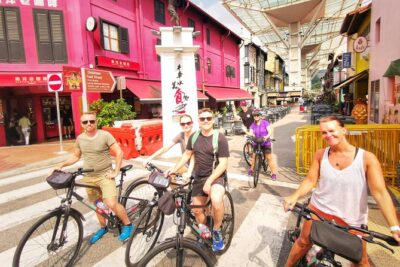
Historical Singapore Bike Tour on Full-Sized Bicycles
Read our review →
Charlotte’s Ultimate Southern Charm Historical City Cart Tour
Read our review →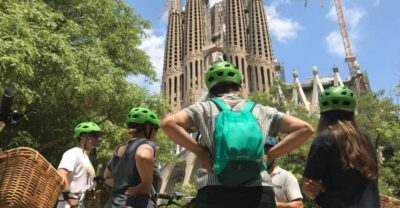
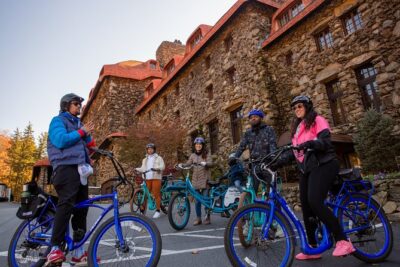
Asheville Historic Downtown Guided Electric Bike Tour with Scenic Views
Read our review →
Private Guided Historic Electric Cart Tour of St. Augustine
Read our review →
60-Minute Guided Segway History Tour of Savannah
Read our review →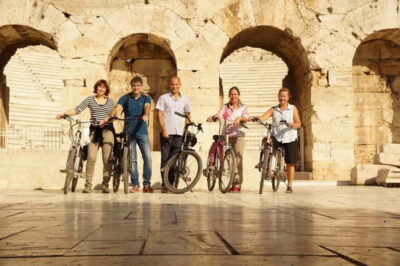
Historic Athens: Small Group Electric Bike Tour
Read our review →