
Review · MERSEYSIDE
Liverpool: Heritage, History & Culture Guided Walking Tour
Liverpool begins with stories. This two-hour walk links the city’s maritime past, slave-trade connections, grand waterfront, Beatles landmarks, and civic buildings in a clear route through the center. I especially like the mix of serious history and personal anecdotes, plus the chance to see major sights such as the Royal Albert Dock and Three Graces without spending a full day.
I also like that the tour moves beyond Beatles nostalgia. You will hear about Liverpool Castle, the first dry dock, the Titanic connection, and the city’s changing fortunes. The main consideration is pace: two hours covers a lot, and busy streets, cobbles, and group walking may be tiring for some people. The listed accessibility details also need careful reading, since the tour is described as wheelchair accessible but is separately marked unsuitable for wheelchair users and people with mobility impairments.
Key points about Liverpool’s two-hour city walk
- Begins at the Bluecoat: Meet outside the main gates at 8 School Lane, beside Castle Fine Art and near Liverpool One.
- Covers the waterfront essentials: The Royal Albert Dock and Three Graces receive generous attention, with time for photographs.
- Faces Liverpool’s difficult past: The guide discusses maritime trade and Liverpool’s role in the slave trade, rather than offering only a polished city story.
- Follows the Beatles trail: Mathew Street, the Cavern Quarter, and the Beatles Statue bring music history into the walk.
- Uses local guides: Guides including Mike, Allan, Pam, Carl, Karl, Colleen, and Alan have been praised for clear explanations, humor, warmth, and enthusiasm.
- Ends near the Eleanor Rigby Statue: The route finishes in the city center, leaving you well placed to continue sightseeing.
Starting at the Bluecoat and finding your bearings
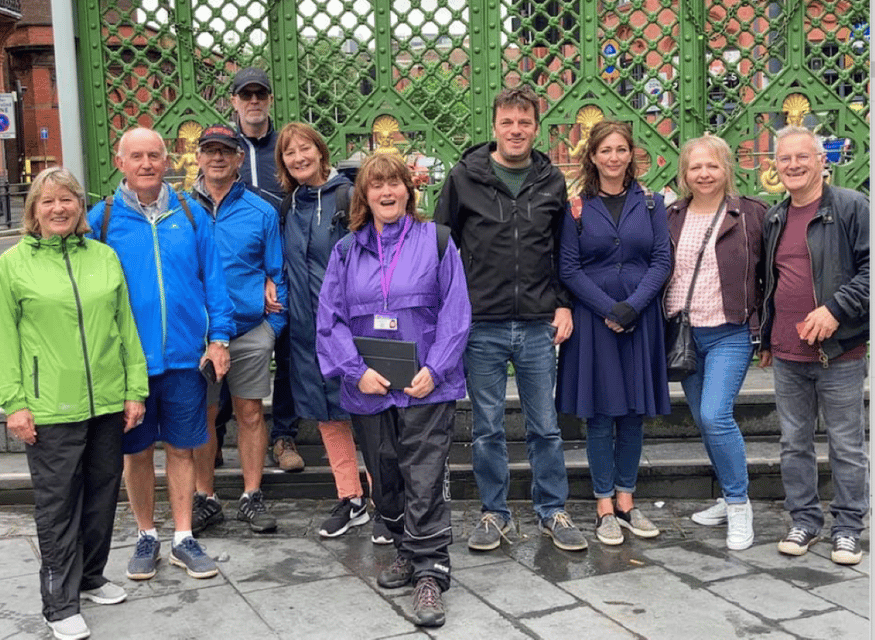
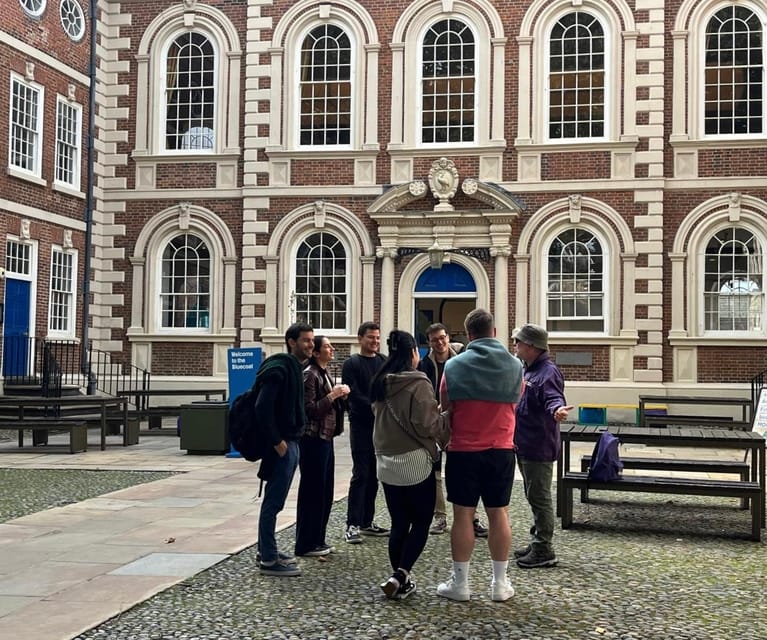
The tour starts outside the black metal railings at the main front entrance to the Bluecoat Chambers grounds, at 8 School Lane, Liverpool L1 3BX. This is the Bluecoat Chambers building, not the Blue Coat School.
A useful landmark is Castle Fine Art, directly opposite the meeting point. The supplied three-word location is Soccer Trial Cuts, which can help if your phone map takes you around the block. The Bluecoat building opens from 10 a.m. Tuesday through Saturday and has a café and toilets inside, but the tour departs from outside the front gates.
Starting here makes practical sense. You are already in the central shopping and cultural district, close to Liverpool One, so you can arrive early without needing a taxi or local bus. Wear shoes with good grip. The route is easy in general, but you will encounter cobbles and busy pedestrian areas.
The guide sets the tone with a broad story of Liverpool, from the reign of King John to the present day. You are not getting an hour-by-hour academic account. Instead, you get a brisk introduction to how the city developed, how its ground and buildings changed, and how its people shaped its identity.
That format suits a first visit. You can ask questions as you go, then return later to the places that catch your interest. Several guides have been praised for answering questions clearly and adapting the conversation to the group. Mike, Allan, Pam, Carl, Karl, Colleen, and Alan are among the guides named in the feedback, with Mike appearing particularly often as an engaging and passionate local voice.
More History Walking Tours in the UK
- A History of Terror – Belfast City Centre Walking Tour
★ 5.0 · 2,883 reviews - Edinburgh: Old Town History and Tales Walking Tour
★ 4.8 · 2,361 reviews - Old Town Walking Tour History and Tales in Edinburgh
★ 5.0 · 2,168 reviews
Liverpool One and the vanished castle
The early part of the walk passes through Liverpool One, with about ten minutes for guided sightseeing. This is a useful contrast to the older buildings ahead. You see how the modern retail district fits into the center of a city whose fortunes have shifted many times.
At Derby Square, the guide tells the story of Liverpool Castle, which once occupied this area. The castle is gone, but the site now has an imposing monument to Queen Victoria. This is exactly the sort of stop that can be easy to miss when you explore alone. You see a familiar square, perhaps pause for a photograph, and move on. With a guide, the missing building becomes part of the view.
The value here is context. Liverpool’s story is not only about surviving old walls. It is also about places that disappeared, uses that changed, and modern buildings built over earlier layers. A good guide helps you read the city rather than simply photograph it.
The walk also points out new and older architecture along the way. Because the route is in the center, you are not confined to one historical period. The effect is a quick visual lesson in how Liverpool has been rebuilt and reshaped.
The first dry dock and Liverpool’s maritime story
The route then heads toward the waterfront and the site of Liverpool’s first dry dock. A large water fountain marks the maritime connection. It is not just a decorative stop. The guide uses it to explain why docks mattered so much to the city’s growth.
This part gives the walk its strongest historical weight. Liverpool’s prosperity was tied to shipping, trade, port work, and the movement of people and goods. The guide also discusses the city’s role in the slave trade, an essential part of understanding how wealth and influence developed here.
That subject is handled as part of the city’s wider story, not as a footnote. I value that balance. A useful city tour should let you admire architecture while also explaining the human cost behind commercial success. You may not get every detail in a two-hour walk, but you get an honest starting point for further visits.
Near the waterfront, you can also see the oversized LIVERPOOL sign. Its colors change with the season or major events, making it a natural photo stop. It is a lighter moment after the more difficult history, and it gives you an easy souvenir picture without interrupting the main route.
Royal Albert Dock and the Titanic connection
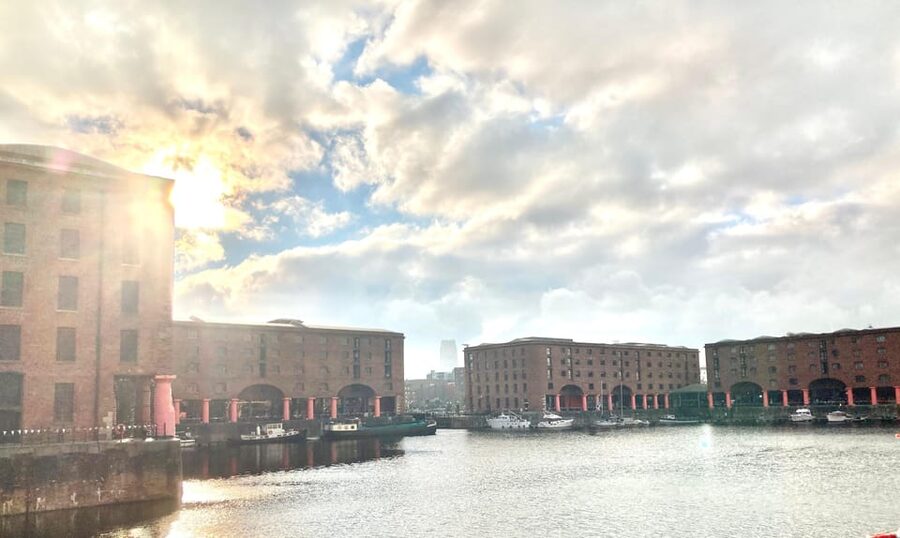
About thirty minutes are given to the Royal Albert Dock, making this the longest single stop. That timing matters. You are not merely passing the water and taking a quick snapshot. The guide explains how the dock helped shape Liverpool and how the waterfront has changed over time.
The dock is one of the city’s essential sights. Its brick warehouses, open water, and broad walkways create a strong sense of Liverpool’s port identity. The setting also gives you a break from the tighter streets of the center.
The Titanic story forms part of this section. Liverpool’s connection with the ship is woven into the city’s maritime heritage, and the guide explains why the Titanic remains part of local memory. You should expect interpretation rather than a museum visit. There is no admission to a Titanic exhibition included, and no food or drink is provided.
The thirty-minute pause should give you time for photographs and questions. It also helps the tour avoid becoming a nonstop march. Still, the group remains on a schedule, so save a longer visit to the dock for later if you want to explore its attractions in detail.
More Local Culture and Traditions Tours in the UK:
- Best Of Liverpool Heritage, History & Culture Guided Walking Tour
★ 5.0 · 539 reviews - Belfast: Best of Belfast History, Culture & Art Walking Tour
★ 4.9 · 158 reviews - Amsterdam Food and Cultural Tour with Tastings
★ 5.0 · 4,315 reviews - Sevilla Food Tour: Tapas, Wine, History & Traditions
★ 5.0 · 3,468 reviews
The Three Graces and the waterfront skyline
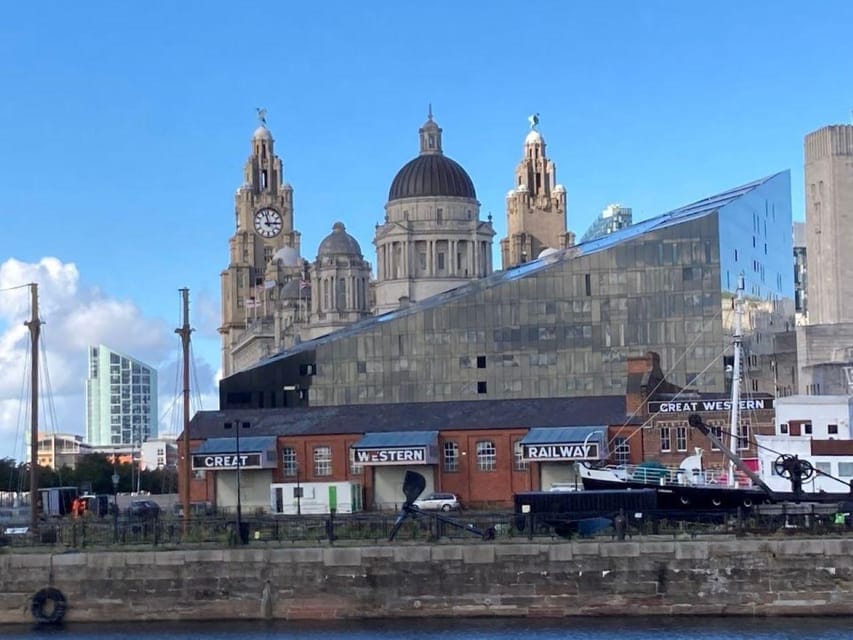
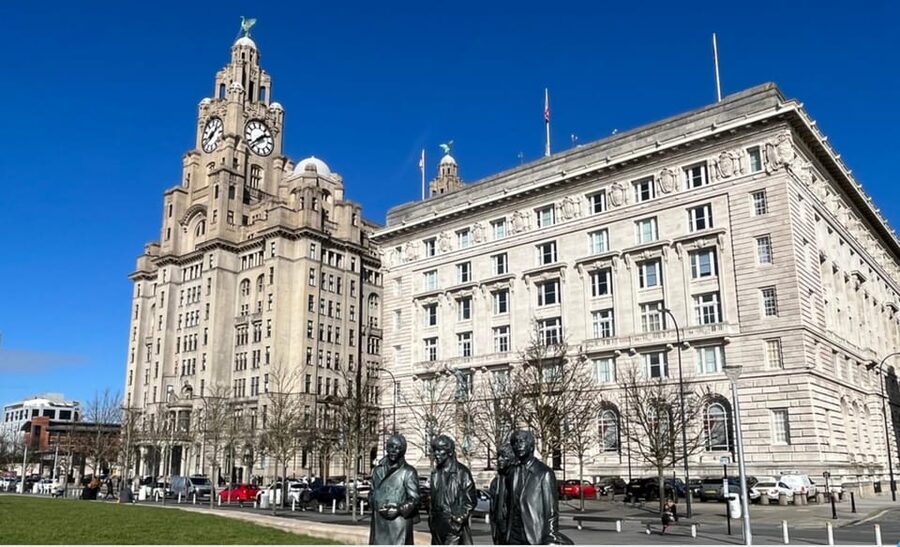
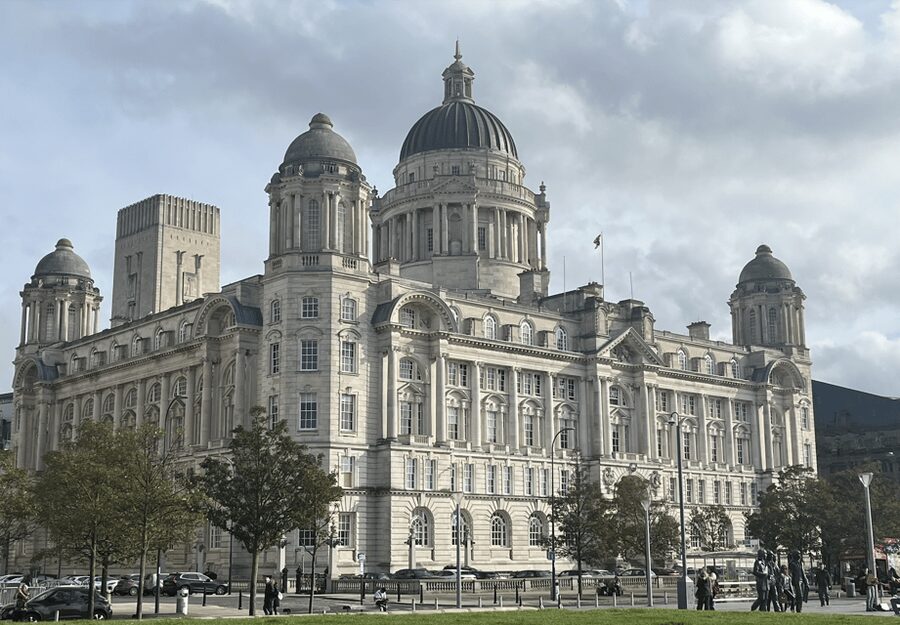
From the dock, the walk reaches the Three Graces, Liverpool’s celebrated trio of waterfront buildings: the Cunard Building, the Port of Liverpool Building, and the Liver Building.
All three are Grade II listed buildings, and they form one of the clearest architectural statements in the city. The guide explains their history and heritage while you view them together. The Liver Building is the most recognizable of the three, but the other two complete the waterfront composition.
This is one of the best parts of the tour for anyone who likes buildings but does not want a specialist architecture lecture. You get enough background to understand why these structures matter, along with time for photographs. The guide’s position is useful because the buildings are large and can be hard to appreciate when you are standing too close.
The route also passes Exchange Flags, a Grade II listed area whose buildings form a courtyard facing the Town Hall. This stop shows a different side of the city center. The Three Graces look out across the waterfront, while Exchange Flags turns inward toward a formal civic space.
The contrast is worthwhile. Liverpool’s identity is tied to both the port and the institutions that governed, financed, and organized the city.
The Beatles Statue and a quick Fab Four moment
The Beatles Statue provides another planned photo stop, with about ten minutes set aside. Sculpted by Andrew Edwards, it gives you a chance to pose with the Fab Four near the waterfront.
This is not a full Beatles tour, so keep your expectations in check. You will not spend two hours tracing every recording studio, childhood home, or concert venue. Instead, the music story is one thread within a wider account of Liverpool.
That is a strength for some visitors. If you want a first look at the city and enjoy the Beatles, the statue adds a memorable pause without taking over the experience. If you already know Liverpool mainly through its music, the broader historical sections may be more useful than the statue itself.
The guide then leads you toward Mathew Street and the Cavern Quarter, where the musical focus becomes stronger.
Mathew Street, the Cavern Club, and music history
Mathew Street is one of the most famous streets in Liverpool, and the tour allows about twenty minutes in the Cavern Quarter. This is where you walk in the footsteps of the Beatles and other major musical figures.
The Cavern Club is the key landmark. You pass by it rather than receiving an included club visit, so check your plans if you want to go inside separately. The tour explains why Mathew Street became linked so closely with Liverpool’s music identity.
The area can be busy, and its atmosphere is more energetic than the formal waterfront. Keep your group in sight and watch the cobbles. The setting is part of the experience, but it can make it harder to hear if the guide is speaking while foot traffic moves around you.
A strong guide is especially valuable here. Anyone can point at the Cavern Club. A local guide can connect it to the city’s wider culture and explain how the Beatles fit into Liverpool’s public identity without pretending they are the whole story.
Exchange Flags, the Town Hall, and Liverpool’s civic side
The later section brings you toward the current Grade I listed Town Hall. It is recognized as one of England’s finest surviving eighteenth-century town halls, and the guide also explains the history of its predecessors, dating back to the 1500s.
This stop adds balance to the tour. Liverpool is often presented through docks and music, but its civic buildings reveal another side of the city. The Town Hall reflects local government, trade, ceremony, and the long development of the center.
The route does not require you to enter the Town Hall, so the focus is exterior history and architecture. That makes the walk efficient, but you should plan a separate visit if interiors matter to you.
The tour finishes at the Eleanor Rigby Statue. Ending here keeps the Beatles thread alive while placing you close to more central sightseeing. The precise finish is useful because you can continue exploring on foot instead of having to find your way back to the starting point.
What the guides add to the experience
The clearest strength of this walk is the guide. The best feedback centers on enthusiasm, clear voices, humor, and the ability to make complicated history understandable in a short time.
Mike is described as witty, charming, patient, and deeply interested in the city. Allan is praised for being friendly, professional, and engaging. Pam is noted for mixing facts, personal views, humor, and anecdotes while keeping a steady pace. Karl is described as passionate about Liverpool and willing to include unusual places and extra stories.
Those details matter because a city walk depends heavily on the person leading it. The route itself is easy to follow, but the quality comes from the explanations. One guide even extended the tour beyond the planned time, while another gave a private-feeling experience when only one person attended.
You should expect an English-language tour. The guides use personal stories alongside dates and facts, which suits visitors who prefer a human account rather than a list of monuments.
Price, pace, and who should book
At $31 per person, the tour offers solid value if you want an organized introduction to central Liverpool. You see the main waterfront landmarks, the Beatles quarter, civic architecture, and several historical sites in two hours. A private guide for that length would usually cost far more, while exploring alone would leave you responsible for all the research.
The value is greatest on a first visit or during a short stay. You can quickly learn the city’s layout and mark places for a longer return. It is less useful if you want extended time inside museums, the Cavern Club, or the Town Hall, since none of those interior visits is included.
Bring comfortable shoes, water, and a camera. There is no food or drink included, but the route passes through central areas where you can arrange refreshments before or after the walk.
Dogs that behave well are welcome. Strollers and wheelchairs may manage some locations, but the group moves through busy areas and over uneven cobbles. The activity information gives conflicting accessibility signals: it says the tour is wheelchair accessible, then says it is not suitable for wheelchair users or people with mobility impairments. If that applies to you, contact Liverpool Famous Walking Tours, Purple Tours, before booking and ask about the exact route and pace.
Free cancellation is available up to 24 hours before departure, and you can reserve now and pay later. Starting times vary, so check availability for your date.
Should you book this Liverpool walking tour?
Book it if you want a well-rounded first look at Liverpool rather than a Beatles-only outing. The route gives you the docks, the Three Graces, civic buildings, difficult trade history, and music landmarks in a manageable two-hour format.
I would especially recommend it for first-time visitors, short-break planners, and anyone who likes local stories more than silent sightseeing. The guides are the main reason to choose it, with repeated praise for their warmth, humor, strong voices, and love of the city.
Skip it if you need long interior visits, dislike group walking, or have mobility concerns that make cobbles and busy streets difficult. For everyone else, $31 buys a useful orientation and a good list of places to revisit at your own pace.
FAQ
How long is the Liverpool walking tour?
The tour lasts two hours.
What language is the tour conducted in?
The live tour guide speaks English.
Where does the tour start?
It starts outside the main front gates of Bluecoat Chambers at 8 School Lane, Liverpool L1 3BX.
How can I identify the meeting point?
Castle Fine Art is opposite the meeting point. The three-word location is Soccer Trial Cuts.
Where does the tour finish?
The tour finishes at the Eleanor Rigby Statue.
Does the tour visit the Royal Albert Dock?
Yes. The Royal Albert Dock is included, with about thirty minutes for guided sightseeing and photographs.
Will I see the Beatles Statue?
Yes. The route includes a photo stop at the Beatles Statue, which was sculpted by Andrew Edwards.
Does the tour pass the Cavern Club?
Yes. The route passes through Mathew Street and the Cavern Quarter, including the Cavern Club area.
Is food or drink included?
No. Food and drink are not included.
Can I cancel for a refund?
Yes. You can cancel up to 24 hours in advance for a full refund.
Just added around the UK
- Curious Cambridge – The History Tour that’s FUN!!!★ 5.0 · 80 reviews
- Birmingham Gangs Nighttime Historical Walking Tour with Pub Stops★ 5.0 · 53 reviews
- 2.5-Hours Walking Tour of Birmingham into Black Heritage Madiba★ 5.0 · 49 reviews
- Award Winning Private 2 Hour Belfast Political Black Taxi Tour★ 5.0 · 53 reviews
- Belfast Walking Tour: City Centre History, Troubles & Stories★ 5.0 · 39 reviews
- Belfast Political/history/troubles private taxi/cab tour★ 5.0 · 69 reviews
- Private Political History & Murals Tour Belfast★ 5.0 · 182 reviews
- Ancient Britain Tour – Private Day Trip from Bath★ 5.0 · 17 reviews
Local Culture & Traditions Tours, compared.

Amsterdam Food and Cultural Tour with Tastings
Read our review →
Sevilla Food Tour: Tapas, Wine, History & Traditions
Read our review →
Tromsø: Reindeer Camp and Sami Cultural Tour with Lunch
Read our review →
Half Day Dominican Republic Cultural Tour : Small Group
Read our review →
Ultimate Melbourne Walking Tour: History, Laneways & Culture
Read our review →
Tromsø: Sámi Reindeer Sledding and Sami Cultural Tour
Read our review →
Kyoto Gion: 2-Hour Geisha Culture & History Walking Tour
Read our review →
Marrakech Historical and Cultural Tour – Half Day City Tour
Read our review →Browse the lists this tour appears in