
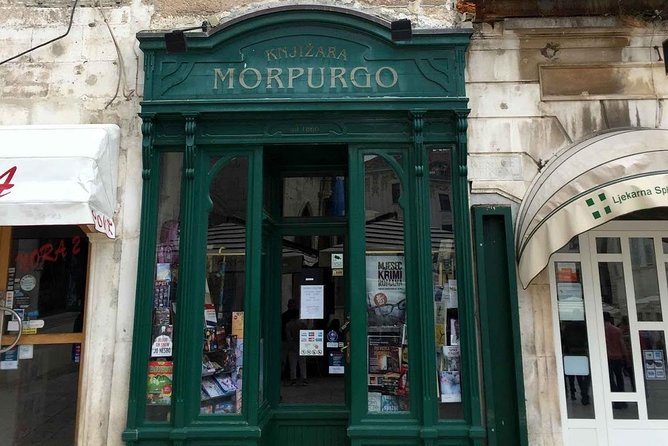
Review · SPLIT
Jewish Heritage & Diocletian’s Palace Private Split Tour
Split’s past is written in stone. This private tour links Diocletian’s Palace with the city’s Jewish story, taking you from Roman basements and imperial courtyards to a working synagogue and the old Jewish quarter. I especially like the chance to meet a member of the local Jewish community, and I like that a private guide can adjust the pace for your group. The main consideration is the price, $187.05 per person, which makes the tour a better fit for couples, families, or small groups than budget-minded solo visitors.
You’ll walk through Split’s Old Town for about two and a half hours, mostly on foot. Guides including Jelena, Emil, Vinka, and Pero are praised for clear storytelling, humor, patience, and their ability to adapt the route. Synagogue access may need arranging, so share your plans early, especially if you are arriving by cruise ship.
Key points to know before booking
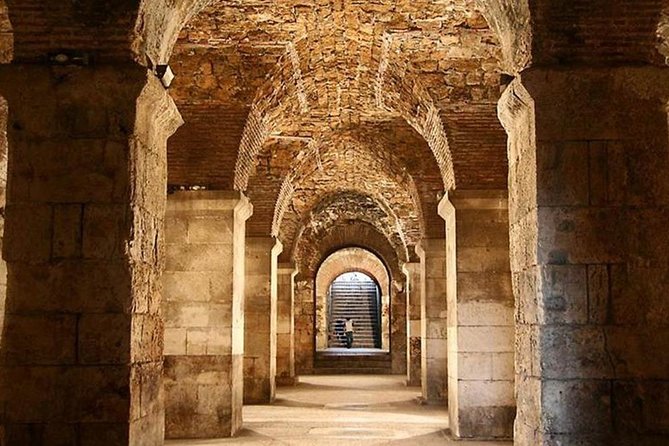
- Roman basements with Jewish carvings: The tour begins in the paid substructures of Diocletian’s Palace, where menorah carvings help connect Split to its early Jewish past.
- A private visit to Split’s synagogue: You may meet a member of the Jewish community and hear personal stories tied to the city’s Jewish population.
- A useful Old Town overview: The route covers the Vestibule, Peristyle, Golden Gate area near the Grgur Ninski statue, main squares, Riva, Prokurative, and Marmontova Street.
- A guide-led experience, not a scripted march: Guides adjust the pace, explain local details, and can respond to family interests or mobility needs.
- Good for cruise port days: Cruise ship pickup is offered at the port, with the guide meeting you near customs with your name.
- A thoughtful history tour: The Jewish story is not tacked onto the palace tour. It is tied to Roman Split, medieval neighborhoods, wartime loss, and the city today.
Why this Split tour feels different
Many tours of Split focus on the emperor, the palace walls, and the photogenic central square. This one uses those familiar sights as a doorway into a smaller and less visible part of the city’s past.
The Jewish Community of Split is among the oldest in Europe. Archaeological evidence from nearby Salona points to Jewish residents living alongside Romans sometime in the second or third century AD. When people from Salona fled attacks by outside forces and moved into Diocletian’s Palace, Jewish residents shared that difficult transition and began a new chapter in Split.
That long timeline gives the tour its shape. You are not simply looking at old stones. You are learning how a Roman palace became a living town, how communities adapted to changing rulers, and how a small Jewish population helped shape Split’s economic and civic life.
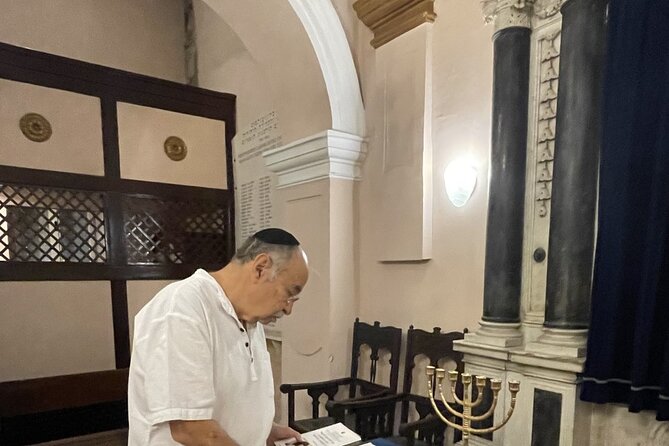
I also like the human part of the visit. Meeting Albert, a member of the Jewish community, has been a highlight for many guests, and it gives the synagogue stop a personal voice. A guide can explain dates and buildings, but a conversation with someone connected to the community gives the subject more weight.
More Castle and Palace History Tours in Croatia
- SPLIT-PRIVATE Walking Tour of Diocletian’s Palace & Old Town
★ 5.0 · 467 reviews - Split: Historical Tour of Salona, Klis Fortress and Trogir
★ 4.1 · 108 reviews - History & Cultural Walking Tour of Split and Diocletian’s Palace
★ 5.0 · 104 reviews
Starting beneath Diocletian’s Palace
The tour begins at the substructures of Diocletian’s Palace, with admission included. These underground rooms once supported the upper palace and now offer one of the clearest ways to understand the size and planning of the Roman complex.
Allow about 45 minutes here. Your guide explains the emperor’s palace, the lives of the people who worked there, and the way the rooms functioned. The setting is especially useful because the lower chambers preserve the palace’s layout in a way that can be harder to grasp above ground.
Look for the menorah carvings in the basement. They are small details, but they matter. They provide physical evidence of Jewish presence in Split during the early centuries and make the wider history feel tied to this exact place.
This part is indoors, which can help if the weather turns wet. One family had a rainy start, and guide Jelena adjusted the timing so the palace came first while the weather improved. That sort of flexibility is one of the practical benefits of booking privately.
The Vestibule and Peristyle explain Roman Split
Next comes the Vestibule, the former foyer of the palace. It takes only about 10 minutes, but your guide can show how this circular entrance introduced visitors to the imperial residence.
The Peristyle follows. This was the palace’s main Roman square, framed by columns brought from different parts of the empire. The palace was built in AD 305, and this open space still serves as one of Split’s main gathering points.
The useful lesson here is that Diocletian’s Palace is not a museum sealed off from daily life. It became the core of the Old Town, with homes, shops, cafés, religious buildings, and public spaces woven into the ancient structure. Your guide connects the Roman plan to the modern city instead of treating the palace as a single isolated monument.
Expect about 10 minutes at each of these stops. The short timings do not mean you rush through them. They are close together, and the guide fills the walk with context and anecdotes.
Grgur Ninski and the old streets
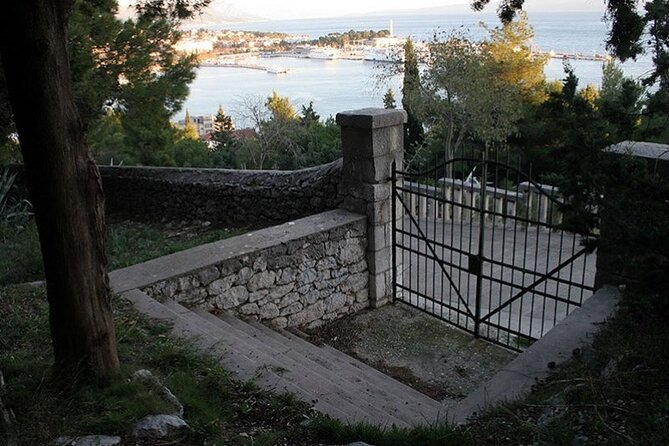
The route continues to the statue of Grgur Ninski, the medieval bishop whose large bronze figure was created by Croatian sculptor Ivan Meštrović. Your guide explains why Grgur Ninski remains such a well-known figure in Croatian history.
This is also a good place to notice how quickly Split’s story changes. Within a short walk, you move from Roman imperial power to medieval church history and then into the Jewish quarter. The city’s past is layered rather than neatly divided into periods.
You are walking through the Old Town, so surfaces can be uneven and streets can be crowded. The tour is described as suitable for most people, but anyone with mobility concerns should mention them when booking. Jelena has adjusted the pace and route for people with walking difficulties, and the private format makes that easier.
More Private History Tours in Croatia
- Private History Split Walking Tour in English
★ 5.0 · 159 reviews - Split: Private Walking Tour in the Historical Town Center
★ 5.0 · 25 reviews - Dubrovnik Jewish Heritage Private Walking Tour
★ 5.0 · 121 reviews
Inside Split’s synagogue and Jewish quarter
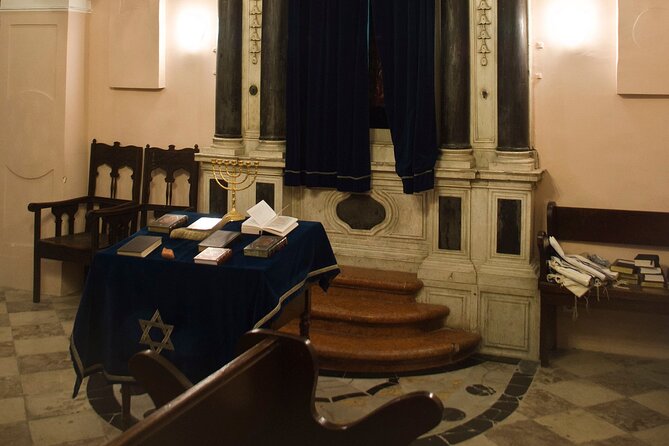
The synagogue is the emotional center of the experience. You walk through the former Jewish quarter and hear how Jewish residents lived and worked in Split. The community played an important role in the city’s economic and civic development, despite its small size.
The synagogue is still in use. The visit usually includes time with a community member, and Albert has helped explain the synagogue and local Jewish life to past groups. This is not just a quick doorway view. The aim is to give you a clearer sense of continuity, loss, and the effort required to preserve a small community’s identity.
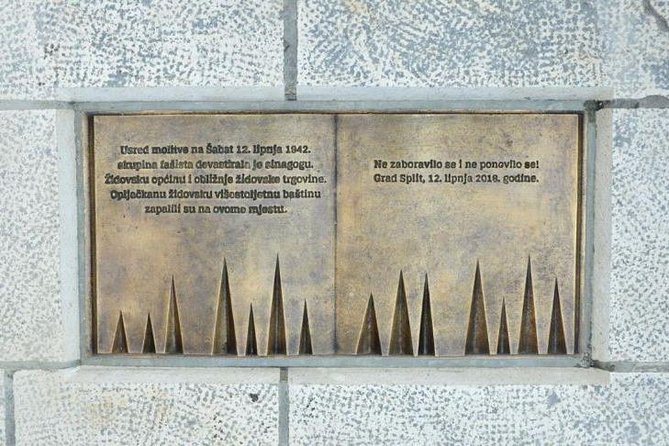
Plan on about 30 minutes here. That is enough time for explanation and conversation without making the tour feel heavy. The subject includes the destruction of synagogue objects and archives on June 12, 1942, a tragedy recalled by a bronze plaque at Narodni Trg.
Access is an important practical detail. The tour includes the synagogue and Jewish quarter, but the start time is arranged on request, and guides have opened the synagogue for scheduled visits. I would provide your preferred time as early as possible rather than assuming you can walk in.
Narodni Trg and the memory of 1942
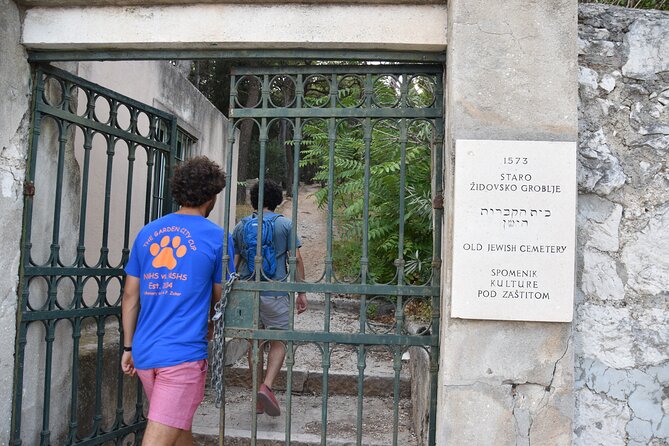
Narodni Trg, also called People’s Square, is one of Split’s main piazzas. Your guide points out the bronze plaque commemorating the destruction of precious synagogue items and archives during the Second World War.
The square is also a chance to look at Venetian architecture. This pairing is effective: you get the beauty of the buildings, but you are not asked to admire them without remembering what happened to the people and records connected to the city.
The stop takes about 10 minutes. It is a compact lesson, but it adds an important modern-era layer to the Roman and medieval material covered earlier.
Fruit’s Square and Marko Marulić
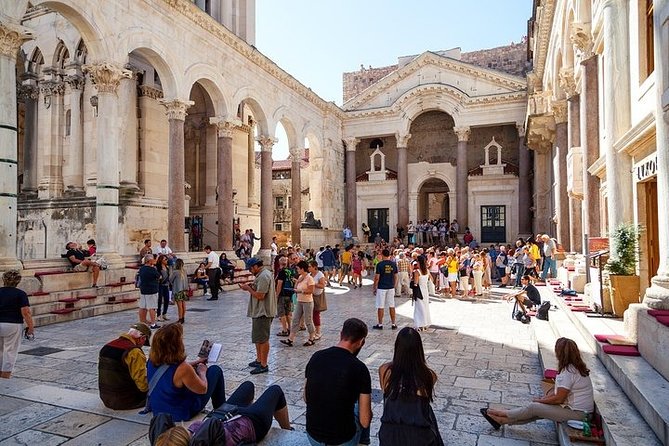
Fruit’s Square, officially Trg Brace Radic, sits just outside the palace. It is one of Split’s most appealing small squares, with the statue of Marko Marulić at its center.
Marulić is often called the father of Croatian literature. Your guide places him within the city’s cultural story and explains why the square matters beyond its attractive setting.
This is a brief five-minute stop. Think of it as a transition rather than a full lecture. The tour keeps moving, which helps the two-and-a-half-hour schedule feel full without becoming exhausting.
Riva, Prokurative, and local Split life
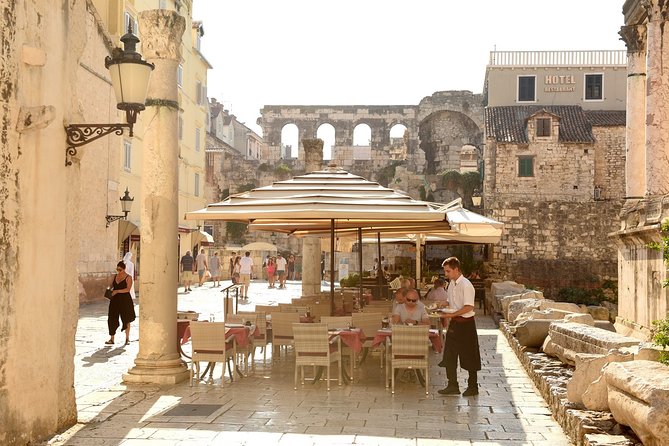
At Riva Harbor, your guide shifts from ancient and religious history to contemporary Split. Locals call Riva their living room, and the broad pedestrian waterfront is lined with cafés and restaurants.
This is where the city feels most social. You learn how residents use the waterfront for morning coffee, afternoon breaks, and evenings with friends. The stop gives needed balance to the historical material. Split is not only a place to study; it is a city where people eat, talk, stroll, and meet in the same spaces that visitors photograph.
The tour then reaches Prokurative, officially Republic Square. The neo-Renaissance buildings and arches recall Venice’s St. Mark’s Square, though this smaller space opens toward the harbor on its southern side.
Finally, Marmontova Street provides another look at everyday Split. It is a popular promenade, and you can stop at the fish market if you want to see where locals buy fresh Adriatic fish. The itinerary allows about 10 minutes at each of these final stops, so you should not expect a long market visit or a shopping break.
What the private format adds
The private setup is the strongest reason to choose this tour instead of a general group walk. Only your party takes part, so the guide can answer questions from a history-focused parent, slow down for older relatives, or adapt the emphasis for teenagers.
Jelena is repeatedly praised for warm delivery, humor, and a calm pace. Emil is described as charming and highly informed, while Vinka and Pero have also guided the tour. The useful point is not which name you receive, since guides may vary. It is that the company’s guiding style appears personal rather than rigid.
One group of 10 people in their seventies appreciated that the guide kept track of everyone physically and mentally. Another group found the tour suitable for teenagers and adults. That makes it a good choice for a mixed-age family, especially if people want different levels of historical detail.
A private tour also helps in bad weather. During one rainy morning, the guide used indoor time well, arranged umbrellas from a hotel, and shifted the outdoor portions until conditions improved. You should still bring sensible shoes and weather protection, but the schedule has some room to breathe.
Is $187.05 per person good value?
At $187.05 per person, this is not a low-cost walking tour. The value depends heavily on group size and your interest in Jewish history.
For two people, the cost is significant. For a family or small group splitting the attention of a private guide, it can make more sense. You receive the licensed guide, entry to the palace substructures, a synagogue and Jewish quarter visit, and a tailored Old Town walk. Meals, drinks, and taxis are not included.
The synagogue visit is what separates this from a standard Diocletian’s Palace tour. If you only want the Roman highlights, a cheaper group walk may be enough. If you want a careful explanation of Jewish life in Split, access to the synagogue, and time for questions, the added cost has a clear purpose.
The tour is also useful for cruise passengers. Pickup is available at the port, and the guide meets you after disembarkation near the customs gate with your name displayed. You must provide your ship name, docking time, disembarkation time, and departure time if those details have not already been arranged.
Who should book this experience?
I would choose this tour if you want history with a human voice. It suits couples, families, private groups, and cruise passengers who want a focused introduction to Split rather than a long list of monuments.
It is especially well suited to you if:
- You have a strong interest in Jewish history or religious heritage.
- You want to visit Split’s synagogue, not just see it from outside.
- You prefer asking questions and setting the pace.
- You are traveling with older relatives or a mixed-age family.
- You want Roman, medieval, Venetian, wartime, and modern stories in one route.
I would hesitate if your budget is tight, if you want a completely casual stroll, or if synagogue access is not available at your preferred time. The tour covers a lot in 150 minutes, so it offers an overview rather than a full academic study of Jewish Split.
The meeting point is on Riva at Obala Hrvatskog narodnog preporoda 23, by the bronze city map, unless another pickup is arranged. Old Town apartments can receive pickup, while people staying outside the Old Town generally meet at Riva. Free cancellation is available up to 24 hours before the start time.
Should you book the Jewish Heritage and Diocletian’s Palace tour?
Book it if the synagogue visit matters to you and you want Split explained through more than its Roman ruins. The palace substructures are worthwhile, but the lasting memory is likely to be the conversation at the synagogue and the way the guide links Jewish life to the city’s wider past.
For the best value, gather a small group and request the time that works for you. Tell the provider about mobility needs, cruise details, and your interest in synagogue access in advance. If you want a personal, thoughtful introduction to Split with a clear Jewish focus, this is a strong choice. If you only need the palace basics, spend less on a standard walking tour.
FAQ
How long does the Jewish Heritage and Diocletian’s Palace tour last?
The tour lasts approximately 2 hours and 30 minutes.
What is the price of the tour?
The listed price is $187.05 per person.
Is this a private tour?
Yes. Only your group participates in the activity.
What language is the tour offered in?
The tour is offered in English.
Does the tour include Diocletian’s Palace entry?
Yes. The fee for the substructures of Diocletian’s Palace is included.
Does the tour include a synagogue visit?
Yes. The experience includes the synagogue and Jewish quarter, with a visit to the synagogue arranged as part of the tour.
Where does the tour begin?
The usual meeting point is Obala Hrvatskog narodnog preporoda 23 in Split, by the bronze city map on Riva.
Is pickup available for cruise passengers?
Yes. Cruise passengers are met at the port near the customs gate after leaving the ship. You need to provide ship and timing details so the pickup can be arranged.
Can I cancel for a full refund?
Yes. You can cancel at least 24 hours before the experience start time for a full refund. Changes or cancellations made less than 24 hours beforehand are not accepted for a refund.
More Castle and Palace History Tours in Split
- Edinburgh: Edinburgh Castle Guided History Tour with Tickets
★ 4.8 · 9,933 reviews - Madrid Essential: Historic Center, Plaza Mayor & Royal Palace
★ 5.0 · 6,416 reviews - Venice’s Best: Basilica, Doge’s Palace, Gondola & History Gallery
★ 4.5 · 2,478 reviews - Tokyo: Imperial Palace and Shogun Historical Walking Tour
★ 5.0 · 2,251 reviews
More Jewish Heritage Tours in Split
- Budapest Jewish Heritage Memorial Walking Tour & Synagogue Entry
★ 5.0 · 568 reviews - Budapest: Jewish Heritage Guided Tour with Synagogue Ticket
★ 4.8 · 533 reviews - 3-Hour Porto Jewish Heritage Walking Tour with Local Guide
★ 4.5 · 396 reviews - Private Jewish Heritage Journey by Barcelona Dreaming
★ 4.8 · 383 reviews
Just added around Split
- Split: Local History and Culture 90-Minute Walking Tour★ 5.0 · 194 reviews
- Split Walking Tour with History Professor★ 5.0 · 23 reviews
- Split: Private Walking Tour in the Historical Town Center★ 5.0 · 25 reviews
- Split: Historical & Gastro Treasures Tour with Green Market★ 4.9 · 144 reviews
- Split: Walking tour of Split with a ‘Magister’ of History★ 5.0 · 110 reviews
- Experience Split History Walking Tour With Local Historian★ 5.0 · 28 reviews
- History Split Walking Tour in French -Small group★ 5.0 · 41 reviews
- Split History and Gastro Small-Group Tour with Food and Drinks★ 5.0 · 375 reviews
Castle & Palace History Tours, compared.

Edinburgh Castle Guided History Tour with Tickets
Read our review →
Venice’s Best: Basilica, Doge’s Palace, Gondola & History Gallery
Read our review →
Imperial Palace and Shogun Historical Walking Tour
Read our review →
Saadian Tombs & Bahia Palace, Medina Guided Tour
Read our review →
Charleston historical walking tour with a Professor of History at The Citadel
Read our review →
Abu Dhabi Grand Mosque, Palace, and Heritage Village
Read our review →
Buda Castle District Dark History, Legends and Vampire Night Tour
Read our review →
Tokyo Castle & Imperial PalaceーShogun Walking Tour
Read our review →Browse the lists this tour appears in