
Review · KYUSHU REGION
Fukuoka Essentials: History, Culture, & Charms
Fukuoka rewards curious walkers. This private tour links Kyushu’s oldest Zen temple with shrines, a traditional arcade, and a rooftop city view, giving you a useful first look at Hakata without the guesswork. I especially like the mix of quiet temple grounds and everyday shopping streets, plus the guide’s willingness to adjust the pace and focus. The main drawback is simple: three hours of walking can feel full, and transportation, food, drinks, and attraction tickets cost extra.
I also like the personal format. Guides such as Radim, Vadim, and Louise have been praised for clear English, friendly conversation, and tailoring the route to family interests, walking speed, and even temporary mobility limits. The tour is best for a first visit, though people wanting long visits inside each temple or shrine may find the schedule brisk.
Key points at a glance
- Kyushu’s oldest Zen temple: Shofukuji offers a quiet start and a strong sense of Fukuoka’s Buddhist past.
- A practical city introduction: You connect temples and shrines with real neighborhoods instead of seeing isolated monuments.
- Kawabata Arcade in the middle: You get time for snacks, small purchases, and a look at local daily life.
- A private guide who can adapt: The route and pace can change around your interests, family needs, and walking ability.
- Hakata Station rooftop finish: The final view gives you a clear sense of the city’s size and layout.
- Good value for orientation: At $58 per person, the tour makes the most sense when you want context, not just directions.
Starting beneath Hakata Station’s big clock
The meeting point is the CASETiFY STUDIO store in Amu Plaza Hakata, right beside the main entrance and under the large clock. That is a useful landmark in a busy station, though you should allow a few minutes to find the correct entrance if Hakata Station is new to you.
The standard route begins on foot. A central hotel pickup can be arranged on request, but the advertised experience is built around walking, and other transport costs extra. That matters because Fukuoka is easy to cover in pieces, yet the connections between its historic sights are part of the experience. You see the city change from station district to temple quarter, old shopping street, shrine grounds, and back to the modern station.
The tour is described as three hours, while available start times may show options from three to eight hours. Clarify the length you are booking, especially if you want a slower pace or more time for food and shopping. A private group gives you more room to ask questions than a large coach tour, and the host can shape the conversation around what interests you.
More Local Culture and Traditions Tours in Japan
- Kyoto Gion: 2-Hour Geisha Culture & History Walking Tour
★ 5.0 · 1,186 reviews - Nara: Half-Day UNESCO Heritage & Local Culture Walking Tour
★ 4.8 · 250 reviews - Tokyo: The Best of Izakaya in Shinjuku Food & Cultural Tour
★ 4.9 · 221 reviews
Shofukuji gives the morning a quiet beginning
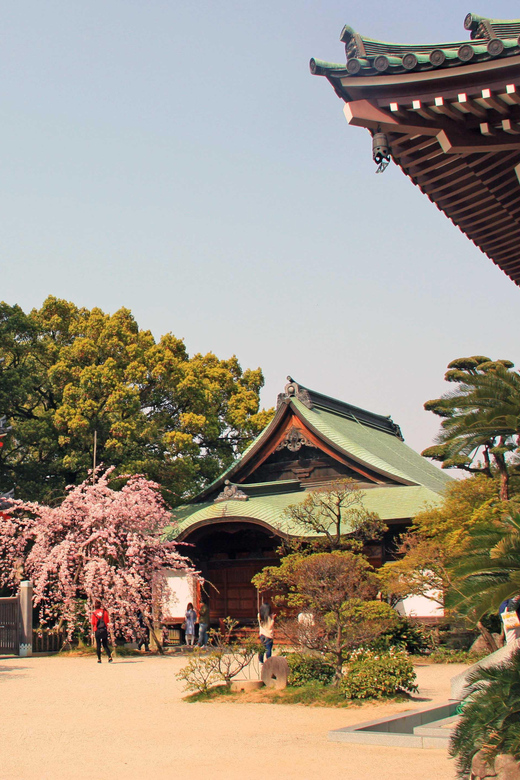
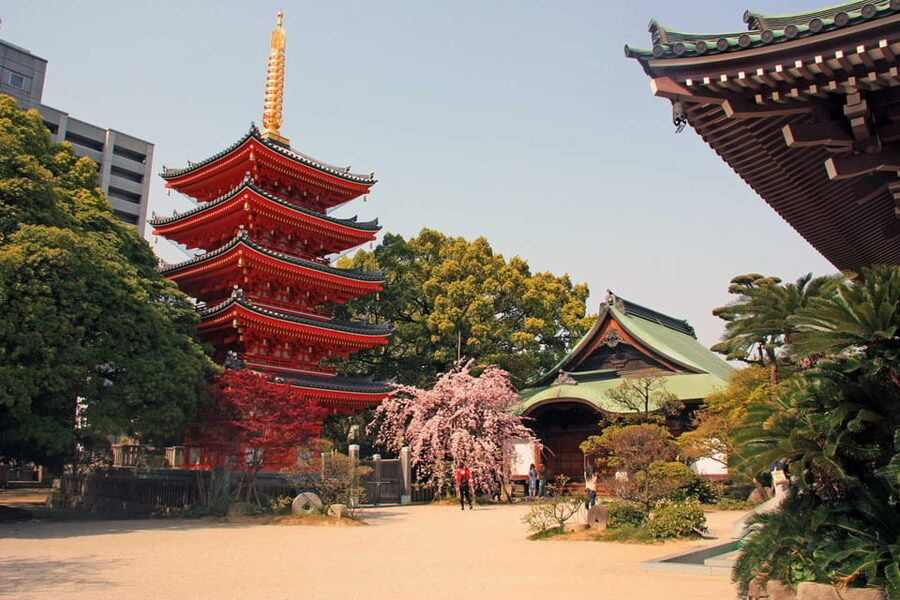
After about ten minutes on foot, you reach Shofukuji. This is the oldest Zen Buddhist temple in Kyushu, and that fact gives the first stop real weight. Its value is not only visual. The grounds provide an early lesson in how Zen Buddhism became part of Fukuoka’s story.
Expect a guided visit through peaceful temple grounds and a chance to look closely at the architecture. The setting is a useful contrast with the station area you have just left. Instead of traffic, shops, and crowds, you get a calmer space where the guide can explain what makes Shofukuji important.
I like beginning here because it slows the pace before the busier parts of Hakata. You are not simply collecting another temple photo. You are given a reason to care about the place. The guide can also help separate Shofukuji from Tochoji, which is known for its large Buddha statue. The emphasis here is on age, Zen tradition, and atmosphere.
There is one practical limit. Temple grounds are not the same as a museum with a long indoor exhibition. If you want an extensive architectural study or a prolonged period of quiet, you may need more time than this route allows. Still, as an introduction, Shofukuji is an excellent choice.
Tochoji adds scale and a famous Buddha
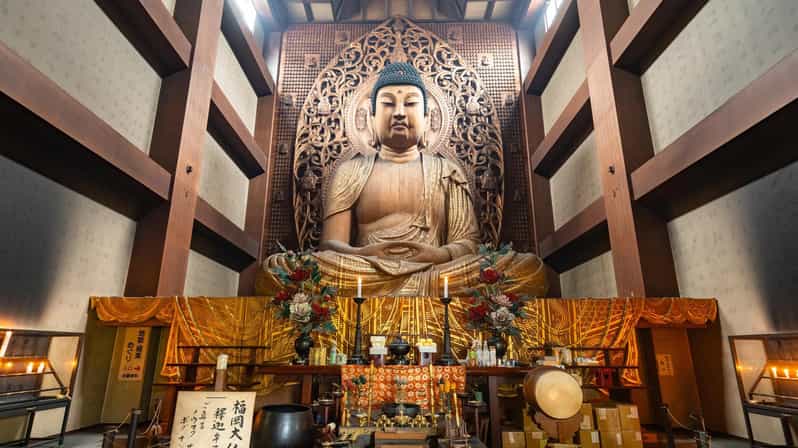
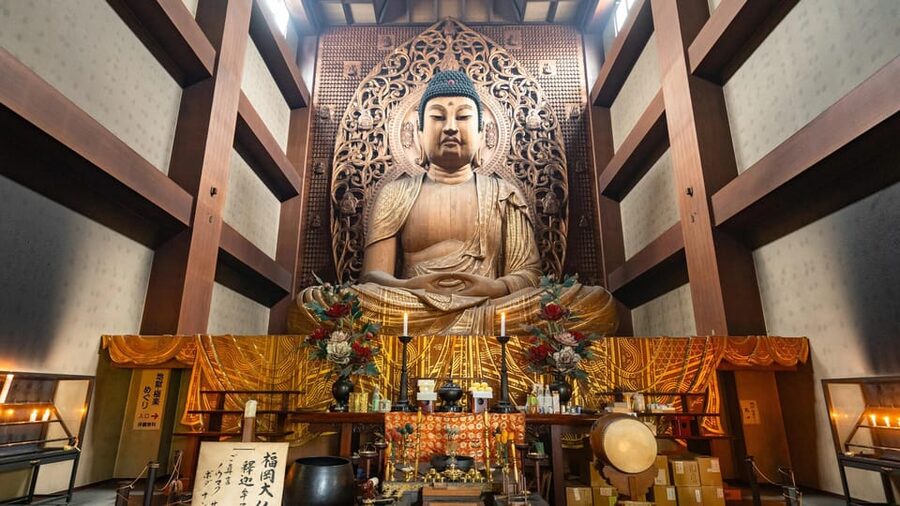
Tochoji follows Shofukuji as another guided temple stop. The tour uses the two places to show different sides of Fukuoka’s religious past. Shofukuji offers a more reflective setting, while Tochoji is associated with its impressive Buddha statue and a stronger sense of scale.
Your guide’s explanation is especially useful here. A large religious figure can be easy to photograph and just as easy to misunderstand. Context helps you see Tochoji as part of the city’s religious life rather than as a quick photo stop.
The route does not promise a long private visit or a special admission experience, and attraction tickets are not included. Check current conditions if entering paid areas matters to you. The supplied details confirm a guided stop, but not every access arrangement inside the temple complex.
Together, Shofukuji and Tochoji make a sensible pair. One gives you age and stillness. The other gives you a more striking visual landmark. That comparison is more useful than seeing either one without explanation.
Kushida Shrine connects religion with festival life
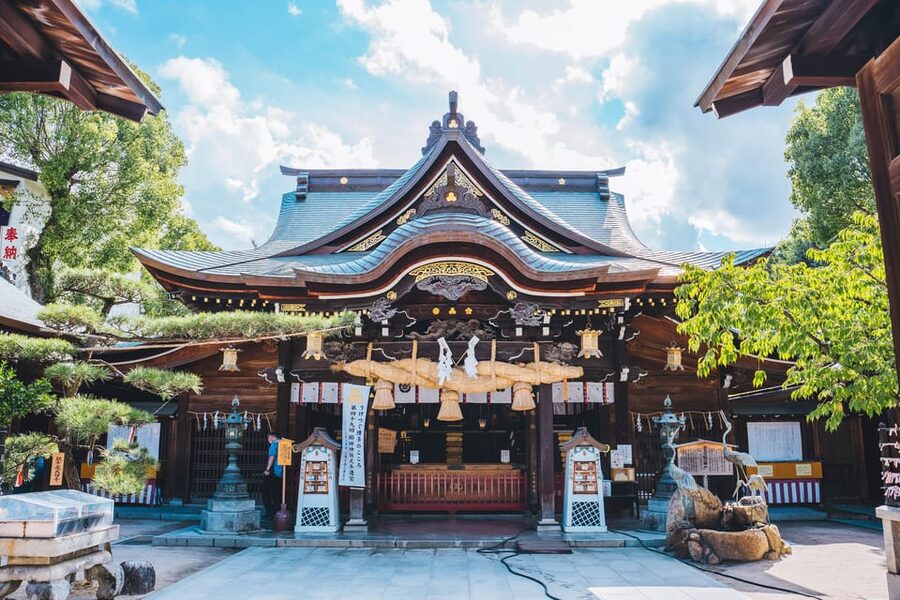
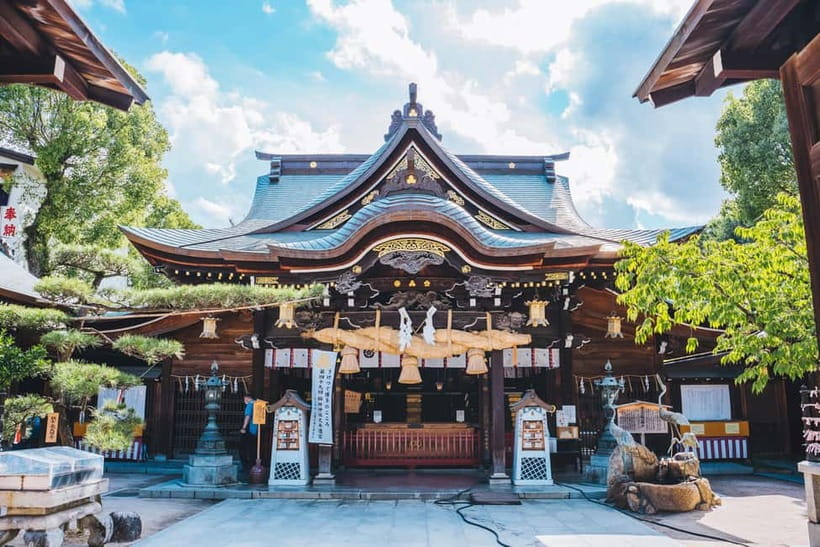
After another walk, you reach Kushida Jinja, widely treated here as Fukuoka’s main shrine. This is one of the strongest stops for understanding how religion and public celebration meet in Hakata.
The shrine is closely tied to the Hakata Gion Yamakasa festival, a major annual event with a strong place in local identity. Even if you visit outside festival season, the guide can explain why Kushida Shrine remains active and important throughout the year. Look at the buildings and their details, then listen for the stories that place the shrine in modern Fukuoka.
This is where the tour moves beyond temples as quiet historic sites. Kushida Shrine has a more public role. It helps explain the city as a place where traditions are not locked away in the past but continue through festivals and neighborhood life.
The visit is guided, so use the time to ask specific questions. You might ask how the festival affects the area, what details on the shrine buildings deserve attention, or how Shinto spaces differ from the Buddhist temples earlier in the walk. A good private guide can make those distinctions clear without turning the morning into a lecture.
Same place, a different slice of the past:
- Kyoto: Fushimi Inari, Kinkakuji, Bamboo Grove 1 Day Bus Tour
★ 4.8 · 4,316 reviews - World Heritage Shirakawa-go and Experience Tours from Kanazawa
★ 5.0 · 4,049 reviews - Tokyo: Imperial Palace and Shogun Historical Walking Tour
★ 5.0 · 2,251 reviews - World Heritage Kyoto & Nara Uji Authentic Matcha Experience
★ 5.0 · 1,573 reviews
Fifteen minutes in Kawabata Arcade
Kawabata Shopping Arcade is the most everyday stop on the route. This traditional covered street brings you back to shops, food, conversation, and local errands. You are given about 15 minutes of free time, so treat it as a short taste rather than a full shopping session.
The arcade is useful because it shows Fukuoka outside its headline sights. You can look at local goods, notice the food smells, and perhaps buy a snack or small souvenir. The short break also gives your feet a pause after the temple and shrine visits.
Fifteen minutes is not long. You will need to choose between browsing, eating, and shopping rather than attempting all three. If food is a major reason for booking, ask the guide ahead of time how the route can be adjusted. Food and drinks are not included, so bring a payment method and allow for your own purchases.
I like this stop because it keeps the tour grounded. You get a glimpse of how the city feels between formal sights. It is not staged as a special tasting session, and that is precisely its strength. You are seeing a working shopping street, not just a place designed for sightseeing.
Sumiyoshi Shrine brings a different mood
The walk to Sumiyoshi Jinja takes about 14 minutes. This shrine adds another layer to the route, with architecture that differs from the style found at many other shrines. Its connection to the sea also gives the stop a distinct meaning within an inland city walk.
The grounds offer another calm pause, but the atmosphere is not identical to Shofukuji. The guide can point out the architectural features and explain the shrine’s relationship with seafaring and protection. That connection gives you a better sense of Fukuoka’s position as a port city and a gateway in Kyushu.
By this point, the sequence of stops begins to make sense. You have seen Zen Buddhism, a major Buddha, Shinto festival tradition, local commerce, and a shrine linked to the sea. The tour is not built around one grand monument. Its strength is the way smaller pieces create a readable picture of Hakata.
The same caution applies here as at the other religious sites. You should not expect an extended specialist visit at every stop. If you prefer to sit quietly, take detailed photographs, or read every sign, the private host may need to shorten another part of the route.
Hakata Station’s rooftop is a smart final view
The final walk back toward Hakata Station takes about 13 minutes and offers scenic views along the way. The tour ends near the station rooftop, where you can look across Fukuoka and watch the city change as daylight fades.
This is a smart finish. After walking through older parts of Hakata, you get a modern overview that helps you place everything on a map. The city stretches out below, and the lights begin to appear as evening arrives. It is a simple viewpoint, but it gives the tour a clear ending rather than dropping you beside a random street corner.
The rooftop also helps you understand Fukuoka as a compact, connected city. You have crossed between historic sites and major transport facilities on foot, then returned to one of the city’s main hubs. If you are taking photographs, this is likely the best place on the route for a broad city view.
The tour returns to the CASETiFY STUDIO meeting point. From there, you are already in a convenient position for trains, shopping, or your next meal, though no meal is part of the experience.
What the private guiding adds
The strongest part of this experience is not the number of stops. It is the chance to ask questions as you go. Past guests have praised Radim for an easy, informative style, and one family found that he adjusted both the speed and subject matter to keep a teenager interested. Another guide, Louise, was praised for answering questions and shaping the visit around personal interests.
Those details matter because private tours can either feel genuinely personal or simply feel like a standard route with one extra person. Here, the format appears best suited to conversation. You can ask for more historical context, more practical advice, or recommendations for restaurants, shopping, and later activities in Fukuoka.
The guide can also respond to physical needs. One participant who was temporarily limited in mobility received a changed approach that kept the outing enjoyable. That does not mean the route is fully step-free or suitable for every mobility concern. It does mean you should explain your needs before starting, rather than hoping the route will adapt automatically.
Language support is available in English and Czech. The friendly, clear English praised in the feedback is important for a walking tour built around explanation. You are paying for interpretation and local judgment as much as for the route itself.
Is $58 a fair price?
At $58 per person, the value depends on how you use the guide. For a private three-hour walking introduction, the price is reasonable if you want a tailored route, historical explanation, and practical suggestions for the rest of your stay.
You are not paying for transportation, meals, or entry tickets. That keeps the advertised price clear, but your final spending may be higher if you buy food in Kawabata Arcade or pay for access to any attraction that requires a ticket. A solo visitor or couple who would otherwise spend hours finding these places may find the cost worthwhile.
The value is weaker if you already know Fukuoka well or prefer to explore religious sites alone. The route is easy to understand on paper, and independent visitors can reach the main locations. The guide earns the fee by saving you research time and linking the stops with local context.
For families, first-time visitors, and people with limited time, the private format makes the price easier to justify. You can ask for a slower pace, focus on specific interests, and receive ideas for what to do after the walk.
Who will enjoy this walk most?
I would recommend it to you if you want a first look at Fukuoka that balances history with ordinary city life. It suits couples, families, solo visitors, and private groups who prefer conversation over a fixed speech.
It is especially useful at the beginning of a stay. The guide can help you understand which parts of the city deserve more of your own time, where to shop, and what restaurants or activities may fit your plans.
You should think twice if you dislike walking, want a food tour, or expect long indoor visits at each temple. The route includes several walks of about 10 to 14 minutes, and the full experience is built around moving between sites. You should also confirm the booked duration if you need a slower schedule.
Cancellation is flexible up to 24 hours before the start for a full refund, and you can reserve now and pay later. Those terms are useful when your Fukuoka plans may change.
Should you book Fukuoka Essentials?
Book it if you want a private orientation with real local context, especially during your first days in Fukuoka. The mix of Shofukuji, Tochoji, Kushida Shrine, Kawabata Arcade, Sumiyoshi Shrine, and Hakata Station gives you more than a checklist. It shows how temples, festivals, shopping streets, sea connections, and modern city life fit together.
Skip it if you want a slow temple study, a dedicated food crawl, or a transport-based tour. For most first-time visitors who can comfortably walk for three hours, the $58 price is a fair trade for a flexible route and a guide who can answer questions as the city unfolds.
FAQ
Where does the tour begin?
It begins at the CASETiFY STUDIO store in Amu Plaza Hakata, beside the main entrance and under the large clock.
Can I meet the guide at my hotel?
Hotel pickup is available on request for central locations.
How long does the experience last?
The tour is described as a three-hour walking experience, with available booking times shown from three to eight hours. Check the selected option when booking.
Is the tour private?
A private group is available, and the experience includes private and personalized guiding.
Which languages are available?
Live guiding is available in English and Czech.
Is transportation included?
The experience is primarily on foot. Other transport can be arranged at an additional cost, and transportation expenses are not included.
Are food and drinks included?
No. Food and drinks are paid for separately.
Are attraction tickets included?
No. Tickets to attractions are not included.
Can I cancel for a full refund?
You can cancel up to 24 hours in advance for a full refund.
Where does the tour end?
The route returns to the CASETiFY STUDIO store at Hakata Station.
Just added around Japan
- From Tokyo: Private Nikko World Heritage Sights One Day Trip★ 4.7 · 52 reviews
- From Tokyo: Guided Day Trip to Nikko World Heritage Sites★ 4.8 · 51 reviews
- Shirakawa-go UNESCO Half-Day Tour from Takayama★ 4.6 · 47 reviews
- Authentic Sapporo: Nijo Market Seafood Lunch & History Tour★ 4.8 · 20 reviews
- Asakusa: A Big-picture History Walk to Know Japan★ 4.6 · 77 reviews
- Asakusa: 3.5-hour Big-picture History Walk★ 4.7 · 39 reviews
- 2.5-Hour Nagoya Tour: Castle History, Local Food & City View★ 4.5 · 36 reviews
- 1-Day Tour from Nagoya: Hiking the Historic Nakasendo Trail★ 4.9 · 34 reviews
Local Culture & Traditions Tours, compared.

Amsterdam Food and Cultural Tour with Tastings
Read our review →
Sevilla Food Tour: Tapas, Wine, History & Traditions
Read our review →
Tromsø: Reindeer Camp and Sami Cultural Tour with Lunch
Read our review →
Half Day Dominican Republic Cultural Tour : Small Group
Read our review →
Ultimate Melbourne Walking Tour: History, Laneways & Culture
Read our review →
Tromsø: Sámi Reindeer Sledding and Sami Cultural Tour
Read our review →
Kyoto Gion: 2-Hour Geisha Culture & History Walking Tour
Read our review →
Marrakech Historical and Cultural Tour – Half Day City Tour
Read our review →Browse the lists this tour appears in