Review · AMSTERDAM
Historical Walking Tour, private with local Dutch guide
Amsterdam’s story begins at the water. This private walk gives you a clear introduction to the city, from a medieval watchtower and old sea dike to Golden Age canals and the Jordaan. I like the private format, which lets your group ask questions and adjust the pace. I also like guide Anna’s personal touch, shaped by 25 years living in Amsterdam.
The main consideration is physical. You will walk and stand for about two hours, with no mobility aids available, and the route is not recommended for anyone using a walker. The tour costs $96.02 per person, so it offers good value for a small group wanting context and local guidance, but less so if you only want a quick list of landmarks.
Key points at a glance
- Starts at a medieval watchtower: Meet at Café the Schreiertower, beside one of Amsterdam’s few remaining traces of the Middle Ages.
- Covers the city’s early foundations: See the old dike street of Zeedijk, the medieval Waag, and the former Dutch East India Company offices.
- Connects trade with modern Amsterdam: The route explains the spice trade, early corporations, stock markets, architecture, and city growth.
- Finishes near the Anne Frank House: The walk ends at Westerkerk on the edge of the Jordaan.
- A genuinely private experience: Only your own group joins, with room for questions and personal interests.
- Strong local guiding: Anna is praised for clear English, dry wit, flexible planning, and useful ideas for exploring after the tour.
Why this walk works well on your first day
Amsterdam can feel confusing at first. The canals bend, bicycles appear from every direction, and the historic center is packed with buildings that look similar until someone explains why they are there. This tour gives you a map in your head, not just a collection of photo stops.
The route begins near Amsterdam Central Station and ends near Westerkerk and the Anne Frank House. That makes it useful early in a stay. You can learn the basic layout, then return later to the places that caught your interest.
The private setup is important. You are not trying to hear a guide over a large crowd, and you are not stuck with a pace that fits strangers. Anna has adjusted dates, times, and group numbers for guests in the past, and she is described as cheerful and helpful with those changes. Her approach seems relaxed without becoming loose or disorganized.
She also pays attention to personal interests. One tour included extra discussion of Amsterdam’s Jewish history beyond the Anne Frank House, while another included time for snacks and suggestions for the rest of the visit. These extras are not guaranteed parts of the published route, but they show how a private tour can become more than a fixed script.
More History Walking Tours in Amsterdam
- Amsterdam: Haunted History and Ghost Walking Tour
★ 4.5 · 488 reviews - Amsterdam History Walking Tour
★ 5.0 · 281 reviews - Amsterdam: Highlights & History Walking Tour
★ 4.8 · 266 reviews
From the Weeping Tower to Amsterdam’s beginnings
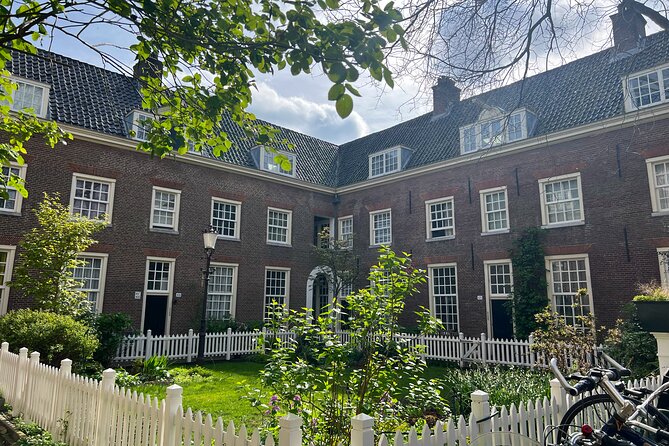
Your meeting point is Café the Schreiertower on Prins Hendrikkade, at the Weeping Tower. This medieval watchtower is one of the city’s few surviving reminders of the Middle Ages.
The opening talk places Amsterdam before the grand canals and merchant houses. You hear about the city’s origins and how its relationship with water shaped its growth. Five minutes is listed here, but the real value is the orientation. You start with a simple question: why did a city grow in this particular spot?
This is also a practical meeting point. It is near public transportation and close to the central station area. Still, allow a little time to find the café and guide, since Amsterdam’s busy streets can make even a short walk slower than expected.
Next comes Zeedijk, one of Amsterdam’s oldest streets. Its name points to its original job: it functioned as a sea dike, with locks helping protect the growing settlement from flooding.
This stop helps you see that Amsterdam was not simply built beside water. It was built in an ongoing argument with water. The street’s past as a defensive barrier gives meaning to the canals, bridges, and low-lying streets you see later.
The Waag and the machinery of an old city
The Waag was once part of Amsterdam’s defensive wall and moat system. Today, it is an attractive historic building in the center, but the tour explains its earlier role as a city gate.
This is where the city’s development becomes more physical. Walls, gates, dikes, and locks were not decorative features. They controlled movement, protected property, and helped Amsterdam manage its difficult setting.
You then reach the Oostindisch Huis, the former office and warehouse of the Dutch East India Company, founded in 1602. This is one of the most useful stops for understanding Amsterdam’s Golden Age.
The story here goes beyond spices on a shelf. You learn how long-distance trade helped shape the city and how the company’s structure contributed to the modern corporation and stock market. That connection gives the tour a wider reach. Amsterdam’s handsome merchant houses were tied to business systems that changed how capital and trade worked.
The stop is especially useful if you want more than architecture. A canal house can look lovely, but its design makes better sense when you understand who paid for it and how that money was made.
A tiny house and the heart of Dam Square
The smallest house in Amsterdam offers a welcome change of scale. After hearing about company offices, warehouses, walls, and trade, you pause at a building that is memorable precisely because it is so small.
You also see the nearby gate decorated with Amsterdam’s famous crest and other symbolic details. The stop is brief, but it adds a human touch to the larger story of commerce and civic power. Amsterdam’s historic center is full of grand claims, yet it also rewards attention to modest details.
Dam Square is the next major landmark. This was the old market square and remains the symbolic heart of the city. The Royal Palace faces the square, and the national Second World War monument provides another focal point.
The guide uses the square to connect Amsterdam’s past and present. You see the center as a place of markets, government, ceremony, memory, and daily urban life. It can be crowded and noisy, so this is not a quiet stop. That is part of its value. You are seeing the city’s central stage, not a preserved museum courtyard.
More History Walking Tours in the Netherlands
- Anne Frank and Amsterdam Jewish History Walking Tour
★ 5.0 · 259 reviews - Amsterdam: Ghost Walking Tour and Dark History
★ 4.8 · 118 reviews - Amsterdam: Iconic Canals & Historic Sights Walking Tour
★ 4.5 · 90 reviews - Amsterdam: Anna Frank and World War II History Walking Tour
★ 4.8 · 86 reviews
Canal Ring architecture, water, and houseboats
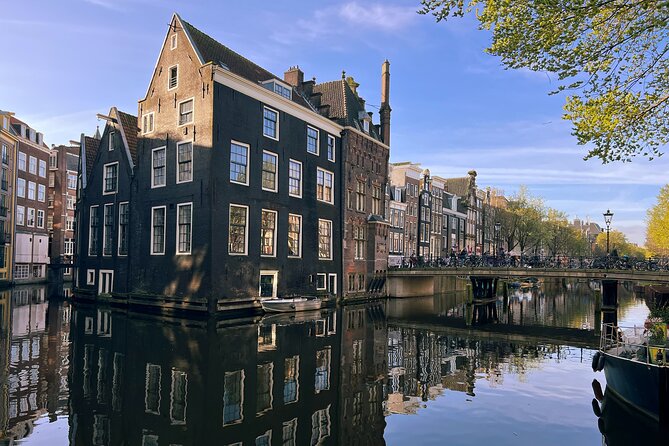
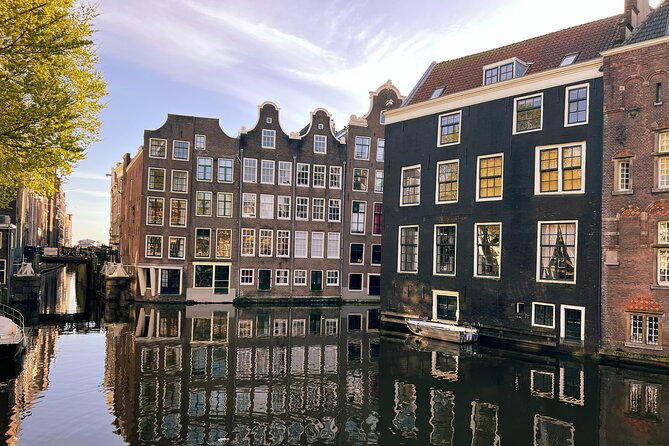
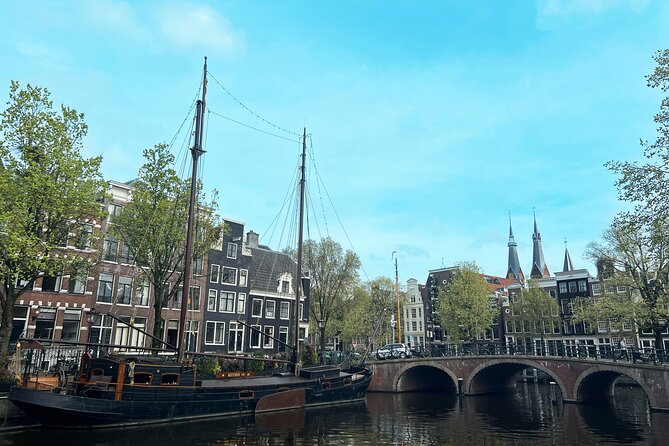
About thirty minutes of the route is devoted to the Canal Ring, the district built for wealthy merchants during the Golden Age. This is the section many people picture when they think of Amsterdam: narrow canal houses, bridges, water, and houseboats.
A guide adds what a postcard cannot. You hear why the canals were built and what the houses reveal about the city’s wealth and social order. The northern baroque style appears in some of the finest canal houses, while the variety of houseboats shows how the waterways remain part of everyday life.
The canal section is also where the private format pays off. You can stop to ask about architecture, city planning, or the way Amsterdam uses its water today. Anna’s dry wit and lively storytelling are repeatedly praised, and that tone seems well suited to a stretch where the scenery could otherwise become a parade of façades.
Pay attention to your footing and surroundings. Amsterdam’s center is shared by pedestrians, bicycles, and other traffic. The tour is not a slow museum visit. You need to remain alert while listening, especially when crossing streets and canals.
The Jordaan, Westerkerk, and the finish
The Jordaan receives another thirty minutes. This popular neighborhood is known for picturesque streets, traditional brown cafés, and distinctive boutiques.
The Jordaan gives the walk a softer, more residential feel after Dam Square and the commercial story of the Canal Ring. You see a side of Amsterdam built around smaller streets and local character. The route does not promise entry into cafés or shops, but the neighborhood is a good place to continue wandering after the guide leaves you.
The final stop is Westerkerk, the Dutch Protestant church with its stylish design and famous spire. Its landmark status is especially meaningful because it is said to be the city landmark most loved by locals.
The tour ends in the vicinity of Westerkerk and the Anne Frank House on Prinsengracht. This is a useful finish. You can continue exploring the area, visit the church if open, or use the location as a base for the next part of your day. The tour itself does not include admission to the Anne Frank House or other paid attractions, so plan those separately.
What Anna adds to the experience
The guide can make or break a historical walk. Here, Anna is the clear strength.
She has lived in Amsterdam for 25 years and is praised for explaining history in easy, direct English. Her style combines facts with humor, including the dry wit that several guests appreciated. That matters because Amsterdam’s past involves trade, religion, architecture, war, migration, and civic change. A good guide keeps those threads understandable without turning the walk into a lecture.
Anna also appears attentive to different personalities and interests. She has answered questions across a wide range of subjects, offered options for what to see, and helped groups feel comfortable before the walk even began. One group found her communication so warm before meeting that the tour already felt personal.
The most useful benefit is the local follow-up advice. Anna has suggested places to explore after the walk, and guests have used those ideas during the rest of their stay. If you arrive jet-lagged, this can save time. You get both a city orientation and a short list of next steps.
A related museum tour with Anna has also covered the Rijksmuseum, including Rembrandt, Vermeer, and naval battles. That is a separate booking, not part of this walk, but it may appeal to you if you want the same guide for Amsterdam’s art as well as its streets.
Price, timing, and the private-tour value
The listed price is $96.02 per person. That is not a bargain-priced group walk, but the comparison is not quite fair. This is a private activity, and only your own group participates.
For two people, the total cost is significant. For a family or small group, the per-person price may feel more reasonable, especially if you value a flexible pace and personal questions. Group discounts are available, though the exact discount is not provided.
The published duration is approximately two hours. One account describes a longer three-hour experience, which suggests that timing can stretch when the guide adapts the route, pauses for snacks, or follows a group’s interests. Treat the two-hour figure as the expected length, not a promise that every private booking will end at exactly the same minute.
All fees and taxes are included. Bottled water is not included, so bring your own. The route includes long periods of walking and standing, and the tour is not recommended for people who have trouble walking, use a walker, or need mobility equipment.
The tour is offered in English and includes a mobile ticket. Confirmation arrives at booking, and service animals are welcome. You can cancel for a full refund up to 24 hours before the local start time, but late cancellations and late changes are not accepted.
Who should book this Amsterdam walk
I would choose this tour if you are visiting Amsterdam for the first time and want the city to make sense quickly. It is also a good fit if you care about causes and connections: how water shaped the city, how trade financed architecture, and how old streets relate to present-day Amsterdam.
It suits couples, families, and small groups who like asking questions. A private guide is particularly useful when people in your group have different interests. One person may want architecture, another may want Jewish history, and another may simply want to know where to find a good neighborhood for later.
I would hesitate if you want a very gentle stroll, a quiet route, or a tour with frequent seated breaks. The city center is active, and the itinerary involves steady walking and standing. It also may not be the best value for someone who already knows Amsterdam well and only wants the major sights pointed out.
Should you book it?
Book this walk if you want an informed local guide, a private setting, and a strong first look at Amsterdam’s old center. Anna’s clear explanations, humor, flexibility, and practical suggestions are the best reasons to choose it.
Skip it if your budget is tight or if walking for two hours is difficult. For everyone else, the route offers a useful blend of medieval Amsterdam, merchant wealth, canal architecture, and neighborhood life. Start early in your stay, bring water, wear comfortable shoes, and leave room afterward to explore Westerkerk and the Jordaan at your own pace.
FAQ
How long is the historical walking tour?
The advertised duration is approximately two hours. Private tours may take longer if the group pauses, asks extra questions, or adds personalized stops.
Where does the tour begin?
The tour begins at Café the Schreiertower, at Prins Hendrikkade 95, 1012 AE Amsterdam. The meeting point is beside the Weeping Tower.
Where does the tour end?
The tour ends at Westerkerk, near Prinsengracht 279. The final area is close to the Anne Frank House and Westerkerk church.
Is this a private tour?
Yes. Only your own group participates in the activity.
Is the tour offered in English?
Yes. The experience is offered in English.
Are service animals allowed?
Yes. Service animals are welcome.
Is the tour suitable for people with limited mobility?
The tour is not recommended for anyone who has trouble walking and standing for two hours or who uses a walker. Mobility aids are not available.
More Private History Tours in the Netherlands
- Amsterdam: Private Pedicab Historical Sightseeing Tour
★ 5.0 · 41 reviews - Amsterdam: Private Anne Frank and Jewish History Tour
★ 5.0 · 26 reviews - Private Guided Historic Amsterdam Canal Cruise in a Salon Boat
★ 5.0 · 21 reviews
More Private History Tours in Amsterdam
- Anne Frank and the Jewish History of Amsterdam Private Tour
★ 5.0 · 307 reviews - Private Boat Tour Amsterdam – 90 Min incl. welcome drink on historic saloon boat
★ 5.0 · 82 reviews - Amsterdam Private Historical Walking Tour
★ 5.0 · 75 reviews - Historic Amsterdam 2-Hour Private Tour with Local Guide
★ 4.9 · 53 reviews
Just added around Amsterdam
- Amsterdam: Luxury Canal Cruise with Historic VR Experience★ 5.0 · 305 reviews
- Amsterdam Walking Tour: Urban Legends & History with local guide★ 5.0 · 39 reviews
- Amsterdam 3 hrs Bike Tour – live guide En/Fr/De/Nl/Sp★ 4.5 · 138 reviews
- Amsterdam Haunted History and Ghost Walking Tour★ 5.0 · 47 reviews
- Private Guided Historic Amsterdam Canal Cruise in a Salon Boat★ 5.0 · 21 reviews
- Anne Frank’s Amsterdam Jewish History WWII Exclusive Guided Tour★ 5.0 · 18 reviews
- LGBTQI+ History Tour of Amsterdam★ 5.0 · 123 reviews
- Ghost Walking Tour and Dark History in Amsterdam★ 5.0 · 32 reviews
History Walking Tours, compared.

History and Hauntings of Salem Guided Walking Tour
Read our review →
Freedom Trail History Small Group Walking Tour
Read our review →
Historic Charleston Guided Sightseeing Walking Tour
Read our review →
Tapas Walking Tour with Food, Wine, and History
Read our review →
Savannah History and Haunts Candlelit Ghost Walking Tour
Read our review →