
Review · NORTH HOLLAND
Amsterdam: Private Pedicab Historical Sightseeing Tour
Amsterdam is best seen at street level. This private pedicab tour covers the old centre, canal ring, Jewish quarter, Chinatown, Amstel River, and Museumplein in two hours, with local guide Bram de Haan explaining how the city grew. I especially like the small private format and the way the pedicab reaches streets that cars cannot. I also like the hotel pickup and warm blanket supplied in cool weather.
The main consideration is price: $230 per group of up to two is a serious outlay, though it becomes easier to justify if walking is difficult or you value a personal guide. The 200-kilogram combined passenger limit also matters, and the pedicab is not suitable for anyone over 100 kilograms.
Key points at a glance

- Bram de Haan leads the ride: He guides in English, Dutch, or German and uses maps and photographs to explain Amsterdam’s growth.
- The route covers several districts: You see Dam Square, Zeedijk, Chinatown, New Market, the Jewish quarter, the Amstel, the canal ring, and Museumplein.
- It is useful for limited walkers: You can see a wide spread of central Amsterdam without covering the entire route on foot.
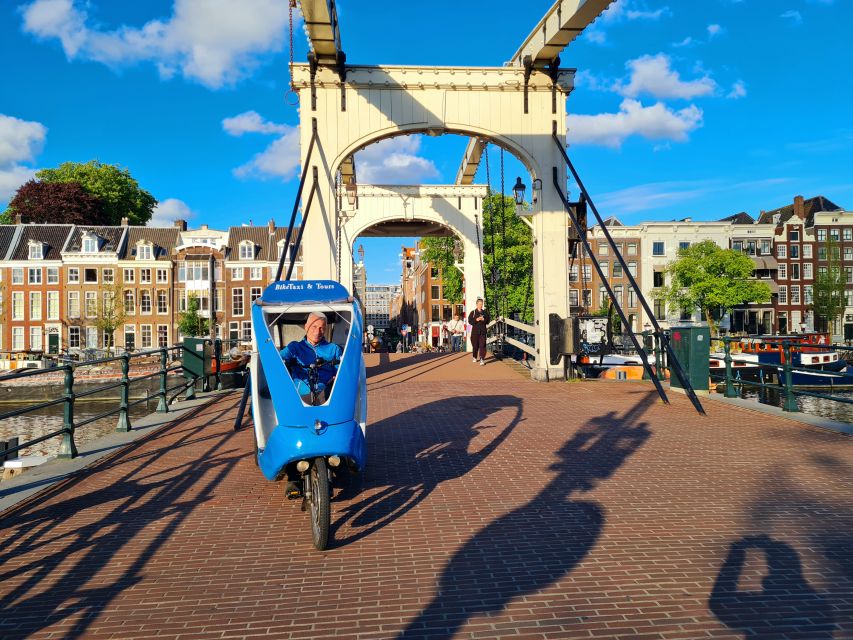
- The Skinny Bridge offers a photo stop: From here, you get a broad view along the canalized Amstel River.
- Hotel pickup and drop-off are included: You wait outside your hotel for the pedicab.
- Weather affects comfort: Bring warm clothing. A blanket is available when it is cold.
Why a pedicab works well in central Amsterdam

A pedicab gives you a middle ground between walking and a standard sightseeing vehicle. You are outside, close to the canals and houses, but you do not have to keep pace with Amsterdam’s cyclists or spend two hours on your feet.
That matters in the old centre, where streets can be narrow and full of turns. A pedicab can use routes that are inaccessible to cars, while your guide can point out details that are easy to miss from a larger vehicle. You also sit close enough to hear the explanation without depending on a large group audio system.
This is a private tour for up to two people, so the ride feels more like a moving conversation than a fixed lecture. You can ask questions, request photos, and arrange a preferred finish location in advance. One guest extended the ride to three hours, but the advertised tour lasts two hours, so confirm any longer arrangement when booking.
The pedicab is especially useful on a first visit. In two hours, you get an overview of several central districts and a clear sense of how the old city, canal ring, museum area, and Jewish quarter fit together. You will not explore each place in depth, but you will know where you may want to return later.
More Private History Tours in Amsterdam
- Anne Frank and the Jewish History of Amsterdam Private Tour
★ 5.0 · 307 reviews - Private Boat Tour Amsterdam – 90 Min incl. welcome drink on historic saloon boat
★ 5.0 · 82 reviews - Amsterdam Private Historical Walking Tour
★ 5.0 · 75 reviews
Starting at Dam Square, the city’s front door
The tour begins at Dam Square, the central point from which Amsterdam developed. This is a useful opening because the square gathers several major landmarks in one place: the Royal Palace, the New Church, and the National Monument.
Your guide uses the square to explain the city’s early growth. That context helps you read Amsterdam as you move through it. Instead of seeing canals and narrow houses as a pretty background, you begin to understand them as parts of a planned trading city.
Dam Square can be crowded, so do not expect a quiet introduction. Its value is historical rather than peaceful. It is the right place to set the scene, but the best photographs and calmer moments come later along the canals.
Zeedijk and Chinatown: Amsterdam’s old defensive edge
The next stop is Zeedijk. The name refers to the old sea dike that helped protect the early city. What is now a city street once marked part of Amsterdam’s defenses, so this short stretch gives you a direct reminder that water shaped nearly every part of the city.
You also pass the oldest surviving café with its original interior. The tour information does not promise a visit inside, so think of this as a sight to notice rather than a food or drink stop.
A little farther along, you get a glimpse of Chinatown. This is not presented as a long neighborhood walk, but it adds another layer to the route through the old centre. I like this stop because it keeps the tour from becoming a parade of only royal buildings and grand canals. Amsterdam’s central streets have changed uses and populations many times.
New Market and Montelbaanstoren
New Market Square brings you to one of the city’s most important old buildings, a 15th-century city gate located in the middle of the square. The setting gives your guide room to explain how Amsterdam expanded beyond its earliest core.
A few minutes later, the pedicab reaches Montelbaanstoren. This old watch and defense tower formed part of Amsterdam’s expanded defenses in the early 16th century. From here, you look toward the Oude Waal, where houseboats sit in front of 17th-century canal houses.
This is one of the more useful stops for understanding the city’s mixed character. You see defensive architecture, floating homes, and old merchant houses in one view. It is also a good example of why a local explanation helps. A tower may look like an isolated landmark until you learn what role it played in the city’s growth.
More Private History Tours in the Netherlands
- Historic Amsterdam 2-Hour Private Tour with Local Guide
★ 4.9 · 53 reviews - Amsterdam: Private Anne Frank and Jewish History Tour
★ 5.0 · 26 reviews
The Jewish quarter and difficult history
The Jewish quarter is the most serious part of the tour. You see the Big Synagogue, the first synagogue Jewish people were permitted to build in Western Europe more than 350 years ago, and the Portuguese Synagogue across the street.
Nearby, the Holocaust Names Monument contains 102,000 bricks bearing the names of Dutch Jewish victims of the Second World War. This is not a quick decorative stop. The monument asks you to slow down and recognize the scale of the loss.
Across from it, a row of 17th-century canal houses recalls the Sephardic Jewish immigrants who succeeded in the diamond trade. The contrast is important. In a short stretch, you see religious life, commercial success, persecution, and remembrance.
Bram has used photographs and maps during the tour to show how Amsterdam changed over time, including the period when the city was occupied by Hitler’s army. That kind of visual aid is valuable here because it links places you see now with events that are not obvious from the buildings alone.
The Hermitage and the Amstel River
The route then passes the Hermitage, housed in a large 17th-century widowhouse. Even if you do not enter the museum, the building itself helps explain the scale and wealth of Amsterdam’s canal-side institutions.
Next comes the Skinny Bridge, one of Amsterdam’s most recognizable bridges. Its narrow design and rows of light bulbs make it particularly attractive after dark, although the tour schedule does not specify an evening departure. During the day, the main reward is the wide view over the canalized Amstel River.
This is one of the best picture stops on the route. The Amstel is the city’s main and widest canal, and from the bridge you can frame the water, bridges, and canal houses together. Ask your guide to allow time for photographs if that matters to you. The route includes stops, but the exact amount of time at each one is not fixed.
The 17th-century canal ring
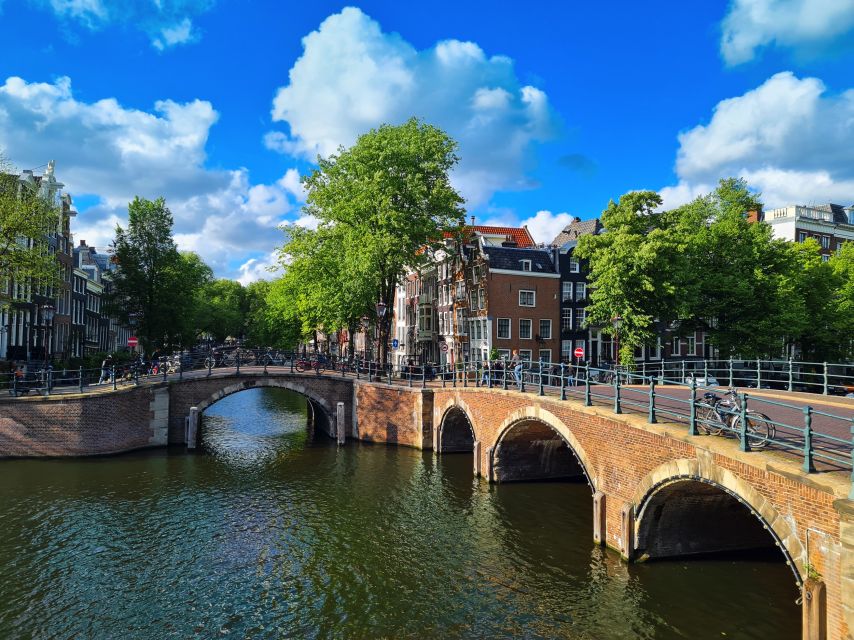
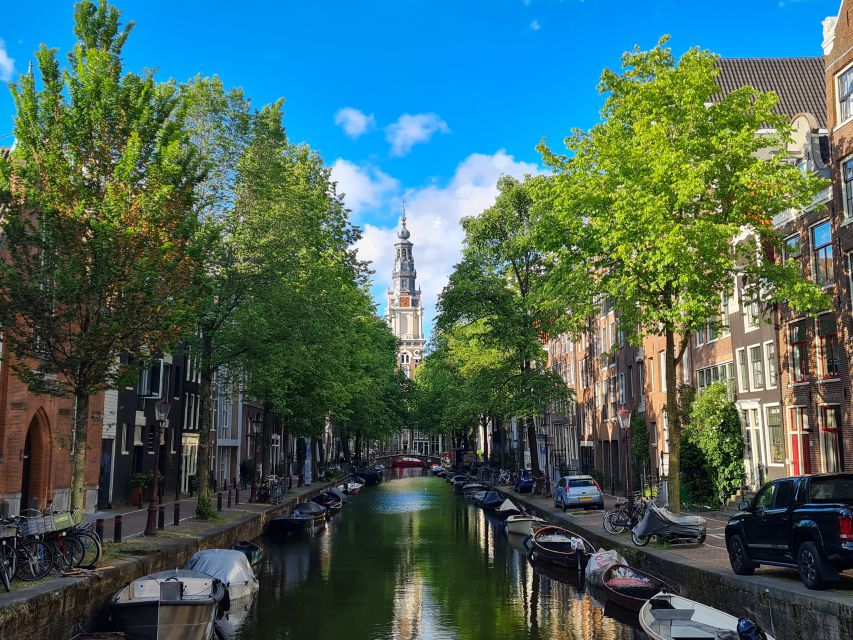
The pedicab continues through the canal district, the half-circle of waterways surrounding the old centre. This is the part of Amsterdam many people picture first: narrow canal houses, bridges, houseboats, and long rows of buildings beside the water.
The canal houses were once homes to successful merchants. They are not identical, and their differences can reveal something about when and how they were built. Your guide points out shared features and changes in design, helping you see more than a row of attractive facades.
I like this portion because the pedicab keeps you moving while leaving you close to the architecture. A walking tour can offer more detail, but it also requires more energy. A boat tour gives you a strong water-level view, but less access to the streets and neighborhoods. The pedicab sits between those two options.
The drawback is that two hours cannot cover every canal or explain every house. If you want a long architectural study, choose a dedicated walking tour or museum visit afterward. If you want a broad introduction with historical context, this route is well judged.
Museumplein and the Rijksmuseum tunnel
The final major stop is Museumplein, a large 19th-century green square surrounded by the country’s leading museums. The route includes the Rijksmuseum and Van Gogh Museum area, then passes through the Rijksmuseum tunnel before stopping in the middle of the square.
The tour does not include museum admission, and two hours is not enough for a museum visit. Instead, Museumplein works as a useful finish. You can continue on your own to one of the museums, arrange to finish near your hotel, or use the stop to plan the rest of your day.
The Rijksmuseum tunnel is also a memorable part of the ride. It gives you a different view of the building than you get from the square alone. If you have limited mobility, ending near Museumplein may be useful because it leaves you close to major cultural attractions without requiring a long walk from the old centre.
Bram’s guiding style and the private format
Bram de Haan is the guide named for this experience, and his strongest quality is his preparation. He has used visual aids, including photographs and maps, to explain Amsterdam’s development and its wartime past. That makes the tour more than a list of dates and building names.
His guiding also appears flexible. Stops for pictures are possible, questions are welcome, and the route can finish at a location you choose beforehand. The private setup gives you more control than a large group excursion, though you should speak up if you want extra time at a particular sight.
The tour is offered in English, Dutch, and German. If you book in English, you can expect historical and cultural explanations from a native Amsterdam guide rather than a purely scripted route.
Comfort, accessibility, and weather
The pedicab is a strong choice for seniors and people with limited walking ability. Several guests specifically used it to see the city without covering long distances on foot. It is not a replacement for a fully accessible vehicle, however, and the supplied information does not describe the exact step height or seating design.
The combined passenger weight limit is 200 kilograms, and anyone over 100 kilograms is listed as unsuitable. Two people who together approach the limit should confirm before booking.
Amsterdam weather can change quickly. Bring warm clothing, even if the forecast looks mild. A blanket is supplied in cold weather, and one cool, rainy-day ride was still described as warm and comfortable, but an open pedicab remains more exposed than a car or bus.
Food and drinks are not included. Plan to eat before or after the tour, especially if you want to use the full two hours for sightseeing rather than stopping for refreshments.
Is $230 good value for two people?
At $230 per group, this is not a budget city tour. For two people, the cost is $115 each, before any extra arrangements. You are paying for a private vehicle, hotel pickup and drop-off, a local guide, flexible conversation, and a route that covers a broad part of central Amsterdam.
The value is strongest if you have limited walking ability, only a short time in the city, or want personal historical guidance. It is also useful for couples who prefer not to join a large group.
The value is weaker if you are comfortable walking several hours and mainly want transportation between landmarks. Amsterdam has many lower-cost ways to see the canal ring, though they may not combine the same range of neighborhoods with a private guide.
Free cancellation up to 24 hours before departure and reserve-now, pay-later booking make the commitment less risky. Check the available starting times before planning museum tickets or dinner.
Who should book this Amsterdam pedicab tour?
I would choose this tour for a first visit, especially if you want orientation before exploring on your own. It suits couples, older visitors, and anyone who wants to reduce walking while still seeing the city from street level.
It also works well for people who enjoy history. The route includes Amsterdam’s founding square, old defenses, Jewish heritage, Holocaust remembrance, the canal ring, and the museum district. You get a broad civic story rather than only postcard views.
I would look elsewhere if you want museum entry, a food stop, a long evening ride, or a detailed neighborhood walk. The route is an overview, not a substitute for visiting the Rijksmuseum, Van Gogh Museum, Jewish Cultural Quarter, or individual synagogues.
Should you book it?
Book it if comfort, personal attention, and historical explanation matter more to you than finding the lowest price. The combination of hotel pickup, a private pedicab, and Bram’s map-and-photo explanations makes this a practical first look at Amsterdam.
Skip it if you are traveling alone, watching your budget closely, or happy to walk and research the city yourself. For two people with limited mobility, however, the cost can be fair because it replaces a great deal of walking while still giving you canals, monuments, neighborhoods, and museum views in one compact ride.
FAQ
How long is the Amsterdam pedicab tour?
The advertised tour lasts two hours. A longer three-hour ride may be possible by arrangement, but confirm this before booking.
How many people can join the private pedicab tour?
The tour is for a private group of up to two people.
What is the combined passenger weight limit?
The maximum combined passenger weight is 200 kilograms. The experience is listed as unsuitable for anyone over 100 kilograms.
Where does the tour begin?
The standard start is Dam Square, in the heart of Amsterdam’s old centre.
Is hotel pickup included?
Yes. Pickup and drop-off are included. Wait outside in front of your hotel for the pedicab.
Which languages are available?
The live guide can conduct the tour in English, Dutch, or German.
Does the tour include food or drinks?
No. Food and drinks are not included.
Can I cancel the booking for a refund?
You can cancel up to 24 hours before the tour for a full refund. You can also reserve now and pay later.
Just added around Amsterdam
- Amsterdam: Jewish Quarter and History Guided Tour★ 4.7 · 210 reviews
- Amsterdam Walking Tour:Anne Frank, History & Liberal Culture★ 5.0 · 18 reviews
- Skipping Lines & Sipping Beers: A History Tour of Amsterdam★ 5.0 · 22 reviews
- Amsterdam: Iconic Canals & Historic Sights Walking Tour★ 4.5 · 90 reviews
- Amsterdam: Historic Boat Cruise with open bar and nibbles★ 4.9 · 31 reviews
- Amsterdam: Luxury Canal Cruise with Historic VR Experience★ 4.7 · 31 reviews
- Amsterdam: Walking Tour of Historic Center★ 4.6 · 24 reviews
- Amsterdam: Ghost Walking Tour and Dark History★ 4.8 · 118 reviews
Private History Tours, compared.

Private Guided Historic Electric Cart Tour of St. Augustine
Read our review →
Acemoglu Historical Turkish Bath w/Private Options
Read our review →
Private Full-Day Tour of Historical Alexandria
Read our review →
Private Tour of the Historic City in a Ford T Car
Read our review →
Madrid Historical Tour with Local Guide in Eco Tuk Tuk Private
Read our review →
Private Biblical Tour Ancient Corinth & Isthmus Canal from Athens
Read our review →
Private Kathmandu Sightseeing Tour | UNESCO World Heritage sites
Read our review →Browse the lists this tour appears in