
Review · PIEDMONT
Historical walking tour of Turin (Private tour)
Turin rewards curious walkers. This private tour makes the city’s long story easy to follow, from Roman ruins and Savoy palaces to the birthplace of Italian unification and the grand Mole Antonelliana. I like the local point of view, and I like that Francesco Berto, a Turin native and history student, keeps the tour lively rather than turning it into a classroom lecture. The main drawback is the length: the advertised time can range from 150 minutes to four hours, so you should confirm the exact start and finish details before booking.
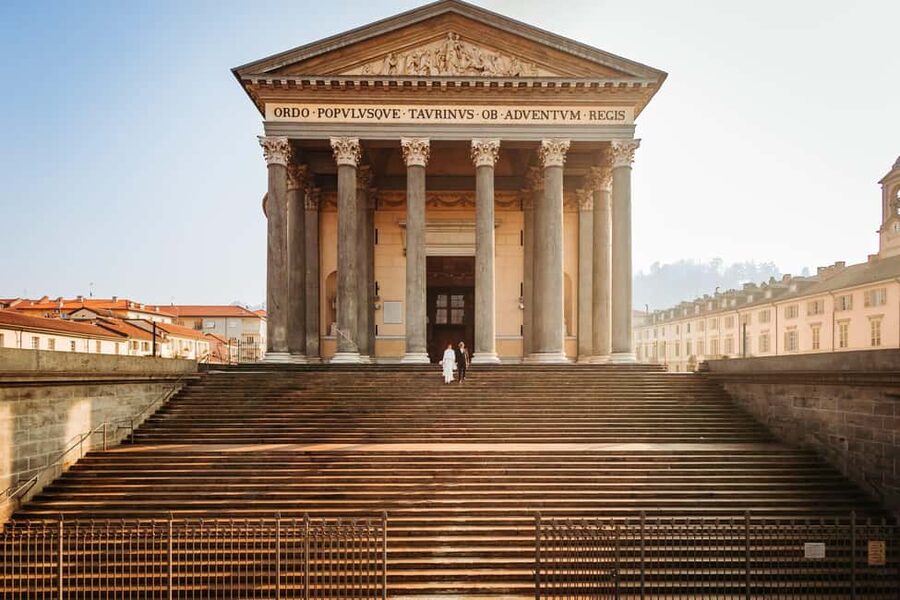
I also like the route’s useful ending at the Gran Madre, where you can continue toward the Capuchin church or simply enjoy Turin’s riverfront setting. The tour costs about $41 per person, which is fair for a private guide, though you will still pay separately for transport, food, drinks, and museum admission.
Key points about this Turin walking tour
- A Roman-to-modern route: Start at the Porta Palatina and walk through Turin’s Roman, medieval, Savoy, royal, industrial, and Italian national chapters.
- A local guide with academic training: Francesco Berto is a Turin native and a second-year student of Historical Sciences.
- Small discoveries along the way: The route includes major sights plus lesser-known corners, legends, and city anecdotes.
- A private experience: You can ask questions and shape the conversation more easily than on a large group walk.
- A useful first-day orientation: The guide offers suggestions for museums, restaurants, and activities for the rest of your stay.
- A long urban walk: Expect roughly two and a half hours, with the broader booking window listed as 150 minutes to four hours.
Why Turin makes a good history walk
Turin is not a one-period city. It began as a Roman settlement, later served as a Lombard stronghold and medieval commune, then grew under the House of Savoy. It became an important university and legal center, the first capital of unified Italy, and a major industrial city in the 20th century.
That sequence gives you a useful way to understand the streets. The city does not present its past in one tidy package. Roman remains sit near churches, royal squares, elegant arcades, cafés, and modern city life. A guide who connects those pieces can save you from seeing Turin as a collection of handsome buildings without understanding why they are there.
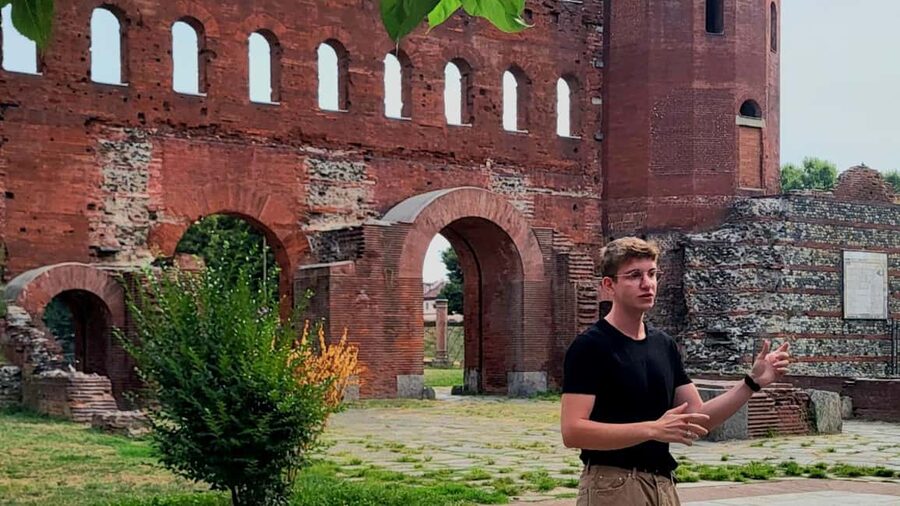
I especially like the idea of beginning at the Porta Palatina and finishing at the Gran Madre. You move from Turin’s earliest surviving urban evidence toward one of its most recognizable later monuments. In between, the walk covers the city center and crosses several periods of Piedmontese and Italian history.
Francesco’s background also suits this kind of tour. He is still studying history, but he is not presented as a formal professor. The aim is a light, enjoyable walk with clear explanations, unusual facts, and stories. That balance matters. A city tour should give you enough context to make the buildings meaningful without burying you under dates.
More History Walking Tours in Italy
- Venice: City Center Historical Guided Walking Tour
★ 4.2 · 1,873 reviews - Palermo: Street Food and History Walking Tour
★ 4.9 · 1,486 reviews - Verona: History and Hidden Gems Guided Walking Tour
★ 5.0 · 1,379 reviews
Starting beside the Porta Palatina
The meeting point is next to the statue of Julius Caesar, in front of the Porta Palatina. This is a practical place to begin because the gate is the main surviving reminder of Roman Turin.
The first stop is brief, about five minutes, but its role in the route is important. You are not beginning with a generic square or a modern meeting point. You start with the city’s Roman foundation, then walk forward through the centuries.
The route includes several short guided stops and walks before reaching the Cathedral of Saint John the Baptist. That pattern continues throughout the experience. You walk for a few minutes, pause for an explanation, then move on. The frequent changes help keep the tour moving, although you should expect to spend much of the time on your feet.
The meeting point can be reached by public transportation, but that cost is not included. Give yourself enough time to find the statue and the gate, especially if you are unfamiliar with Turin’s center.
The cathedral and Turin’s royal center
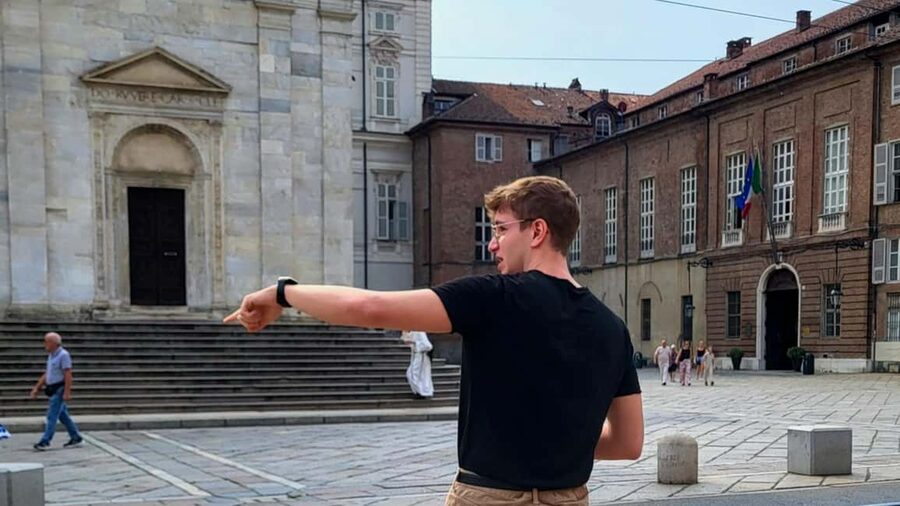
The Cathedral of Saint John the Baptist receives a longer stop, about nine minutes. It is one of the key religious landmarks on the route and an important part of Turin’s royal setting.
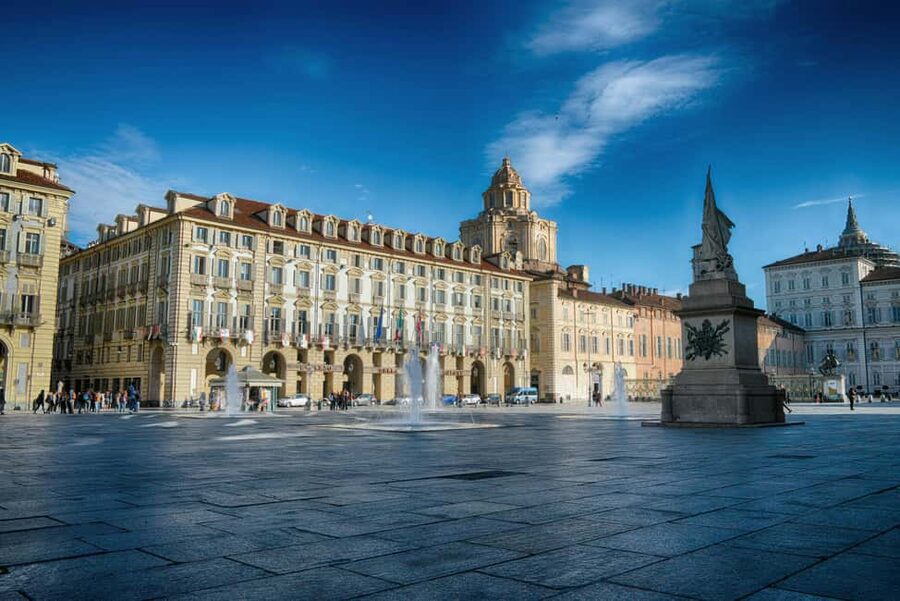
From there, the tour moves toward Piazza Castello. This square is central to Turin’s identity as the former capital of the Duchy of Savoy and later the first capital of the Kingdom of Italy. The guide’s role here is especially useful because the square brings together several layers of power: court life, religion, government, and public ceremony.
You should expect a short explanation at Piazza Castello, followed by another walk toward Piazza San Carlo. The route does not appear to include museum entry, so the value here comes from the guide’s interpretation of the spaces rather than from indoor collections.
That is worth keeping in mind if you want to see the interiors of royal buildings or museums. This experience gives you orientation and historical context, but it is not a substitute for a full palace or museum visit.
Piazza San Carlo and the elegant city center
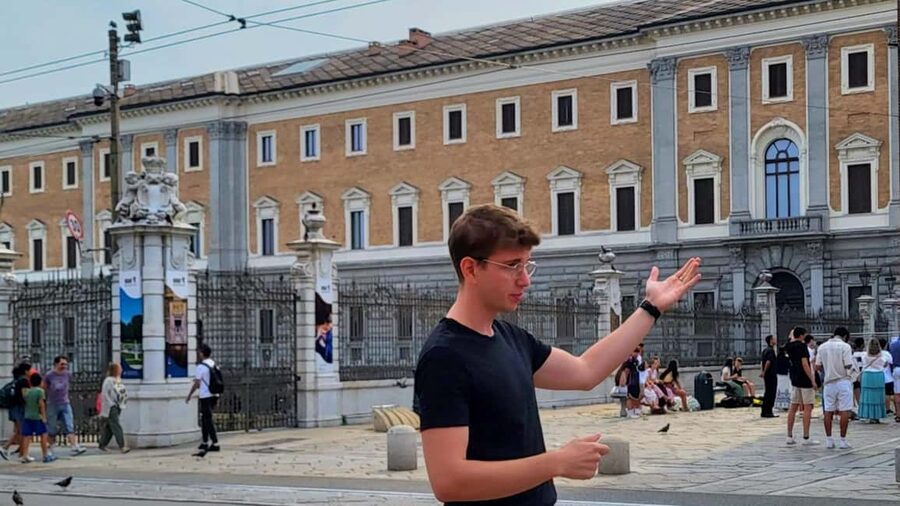
Piazza San Carlo is one of the most graceful stops on the walk. The guided explanation is short, followed by a photo stop. This gives you time to look around instead of listening without pause.
The square helps show another side of Turin. After the rougher Roman beginning and the political weight of Piazza Castello, you see the ordered, elegant city associated with Savoy rule and Turin’s reputation for refined architecture.
The walk then continues through the center, with more short guided stops before reaching Piazza Carignano. This is where the private format can be useful. If a building, political figure, or story catches your attention, you can ask Francesco to explain it rather than waiting for a fixed group schedule.
The route includes Galleria Subalpina for a photo stop. The gallery adds a covered architectural setting to the walk and gives you a change from open squares and busy streets. It also fits the tour’s larger theme: Turin’s identity is not only about monumental palaces. Its arcades, passages, cafés, and public interiors are part of how the city works.
More Private History Tours in Italy
- Ancient Ostia Antica Semi-Private Day Trip from Rome by Train with Guide
★ 4.5 · 579 reviews - Colosseum & Ancient Rome Semi-Private Tour
★ 5.0 · 208 reviews - Ancient Pompeii Private Tour: Skip the Line & Kid-Friendly Option
★ 5.0 · 167 reviews - Skip-the-Line Half-Day Private Tour Ancient Pompeii Highlights with Native Guide
★ 5.0 · 146 reviews
Piazza Carignano and the birth of modern Italy
Piazza Carignano receives about six minutes of guided attention, followed by a stop at Galleria Subalpina and additional explanations nearby. This part of the walk connects Turin’s royal and political past with the story of Italian unification.
Turin played a major role in the Risorgimento, the movement that led to the creation of the Kingdom of Italy. It was also the country’s first capital. You do not need to arrive with a detailed grasp of 19th-century Italian politics to benefit from this section. The guide’s job is to explain why these places mattered and how Turin’s role changed over time.
The reviews of Francesco’s guiding style repeatedly point to his ability to make complicated history clear. That is important here, since the Risorgimento can quickly become a parade of names and dates. The stated approach is more conversational, with anecdotes and legends added to the political story.
I would treat this section as a framework for later sightseeing. After the tour, you may look at Turin’s central buildings differently because you understand their connection to the city’s national role.
The Mole Antonelliana and Turin’s changing identity
The route continues on foot for about twelve minutes before reaching the Mole Antonelliana. The building is scheduled as an eight-minute photo stop, followed by further guided explanations.
The Mole is one of Turin’s defining symbols. Its presence also helps the tour move beyond royal and political history. Turin became one of Italy’s major industrial centers in the 20th century, and the city’s identity today includes cinema, manufacturing, design, food, and urban culture.
The tour does not include entry to the Mole or its museum. You will see it from outside and hear its place in Turin’s story. If you want a museum visit, plan that separately. The guide can recommend museums and other activities for the remainder of your stay, which makes this walk useful early in a Turin visit.
The timing here is sensible for a walking tour. You get enough time for photographs and explanation without turning the stop into a long building visit. If your priority is the interior rather than the city’s wider story, you will need a separate ticket and more time.
Finishing at the Gran Madre
The final section takes about nine minutes of walking before reaching the Church of the Gran Madre di Dio. The church is listed as a photo stop of about four minutes, and the tour finishes at Piazza Gran Madre di Dio.
This ending gives the route a clear sense of progress. You begin at the Porta Palatina, one of the clearest signs of Roman Turin, and finish at a major church on the far side of the city center. Along the way, you have crossed the royal center, the political heart of the old capital, elegant public squares, historic galleries, and the Mole.
Two drop-off points are provided: Piazza Gran Madre di Dio and the Church of Santa Maria del Monte dei Cappuccini. The second option is useful if you want to continue exploring that area, although the information does not promise a guided visit inside the church.
The end point also works well for planning. You can ask Francesco for suggestions about where to eat, what to see next, or which museums fit your interests. One practical note: a suggestion for a typical Piedmontese restaurant was not a good match for every participant, so I would treat dining recommendations as starting points and check the restaurant yourself before committing.
What the guide adds to the route
The strongest reason to choose this experience is Francesco Berto’s personal connection to Turin. He was born and raised in the city and studies Historical Sciences at the master’s level. That combination gives the tour both local familiarity and serious preparation.
The comments about his style are consistent: clear, energetic, passionate, and able to explain complex subjects without making the walk feel academic. You get more than a list of monuments. You get the small stories, legends, and details that help a place stick in your memory.
The private format adds another advantage. With your own group, you can ask about subjects that interest you, such as royal politics, Roman Turin, Italian unification, architecture, or local food traditions. You also avoid trying to hear a guide over a large crowd.
Still, the quality of a private tour depends heavily on the guide’s approach and on your own interests. If you prefer to explore silently or spend long periods inside museums, this may feel too talkative and too focused on outdoor interpretation. If you enjoy walking and asking questions, it should feel more personal.
Price, pace, and practical value
At about $41 per person, the tour offers solid value for a private 150-minute experience, especially if you are traveling with family or friends and can share the cost across a small group. You are paying for a local guide, a planned route, historical explanation, and personal recommendations, not for museum admission or transportation.
The listed duration ranges from 150 minutes to four hours, while the described route lasts about two and a half hours. Confirm the available starting time and expected duration when you book. The route includes several walks of five to twelve minutes, so comfortable shoes are sensible.
No food or drink stops are included. That keeps the tour focused, but it also means you should eat beforehand or plan a café stop after the walk. The guide may suggest places for a bicerin, Turin’s famous coffee and chocolate drink, or for a Piedmontese meal, but those purchases are your responsibility.
The tour is available in Italian and English, and some content may appear in its original language. It is listed as wheelchair accessible, though the route’s many walking sections mean you may still want to confirm the practical details for your particular needs.
Free cancellation is available up to 24 hours before the experience for a full refund. You can also reserve and pay later, which is useful when your Turin schedule is still taking shape.
Who should book this walk
I would choose this tour if you are visiting Turin for the first time and want a clear introduction before exploring museums on your own. It also fits anyone who likes architecture, Italian political history, local legends, and stories tied to actual streets.
It is particularly suitable for:
- Couples or families wanting a private pace
- History fans who prefer conversation over a formal lecture
- Visitors who want both major monuments and less familiar places
- People who need restaurant and museum suggestions
- Anyone who wants to understand Turin before choosing longer visits
I would hesitate if you dislike walking, want a food tour, or expect admission to the cathedral, Mole, or museums. This is an outdoor city overview with guided explanations and photo stops. Its strength is connection and context, not extended interior sightseeing.
Should you book Francesco Berto’s Turin tour?
Book it if you want Turin explained by a local who takes history seriously without making it heavy. Francesco’s energy, clear storytelling, and personal knowledge of the city are the main reasons to choose it. The route also gives you a useful first look at Turin’s Roman remains, royal center, national history, grand squares, and later cultural symbols.
Before booking, confirm the exact duration and meeting time, allow for public transportation to the Porta Palatina, and wear shoes suited to a long urban walk. If you do that, the $41 price is reasonable for a private introduction to Turin, especially when you use the guide’s recommendations to plan the rest of your stay.
FAQ
Where does the Turin walking tour start?
The tour starts beside the statue of Julius Caesar, in front of the Porta Palatina.
Where does the tour finish?
It finishes at the Church of the Gran Madre di Dio, with drop-off options at Piazza Gran Madre di Dio and the Church of Santa Maria del Monte dei Cappuccini.
How long does the tour last?
The main description gives an approximate duration of two and a half hours, or 150 minutes. The booking information lists a possible duration of 150 minutes to four hours, so confirm the exact timing when selecting a start time.
Is this a private tour?
Yes. It is offered for a private group.
Which languages are available?
The live guide is available in Italian and English. Some content may be presented in its original language.
Is the tour wheelchair accessible?
The activity is listed as wheelchair accessible.
Are museum tickets included?
No. Museum visits and admission costs are not included.
Is public transportation included?
No. The cost of public transportation to the Porta Palatina meeting point is not included.
Are food and drinks included?
No. The tour does not include stops for food or drinks. The guide does provide suggestions for restaurants and places to enjoy a bicerin.
Can I cancel the booking?
You can cancel up to 24 hours in advance for a full refund. The activity also offers a reserve-now-and-pay-later option.
Just added around Italy
- Historical and Spiritual Jorney in Papal Basilicas★ 4.7 · 34 reviews
- Historic Shops in Genoa: Tour Through Tradition and Flavours★ 4.4 · 47 reviews
- Montepulciano: Historical Cellars Guided Tour & Wine Tasting★ 4.4 · 83 reviews
- Alberobello: History Walking Tour★ 4.6 · 223 reviews
- Genoa: Historic Guided Tour of Christopher Columbus’ House★ 4.4 · 186 reviews
- Forte di Bard: history tour★ 4.5 · 31 reviews
- Florence Wine &Food: Taste Tuscan Flavors in Historic Cellar★ 4.6 · 31 reviews
- Florence: Medici Family History Tour★ 4.3 · 93 reviews
History Walking Tours, compared.
History and Hauntings of Salem Guided Walking Tour
Read our review →
Freedom Trail History Small Group Walking Tour
Read our review →
Historic Charleston Guided Sightseeing Walking Tour
Read our review →
Tapas Walking Tour with Food, Wine, and History
Read our review →
Savannah History and Haunts Candlelit Ghost Walking Tour
Read our review →
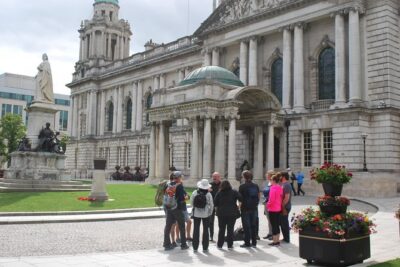
A History of Terror – Belfast City Centre Walking Tour
Read our review →Browse the lists this tour appears in