
Review · NAPLES
Private Walking Tour through the Historical City of Herculaneum
Ancient life survives here. This private Herculaneum walk gives you about two hours with an archaeology guide, taking you from Roman baths to painted houses, mosaics, charred furniture, and a preserved boat. I like the private format, which lets you ask questions and set the pace, and I like the carefully chosen route through the site’s best-preserved homes. The main catch is that the €16 park entrance fee is extra, so the total cost is higher than the headline price.
Herculaneum is smaller than Pompeii, but its surviving buildings often feel more intimate and complete. Guides such as Martina, Carmine, Francesca, Annalisa, Alessandro, and Ernesto have been praised for clear English, lively explanations, and patience with older family members, children, strollers, and people who walk slowly. Still, two hours passes quickly, especially if you want time for the museum displays and every major house.
Key points to know before booking
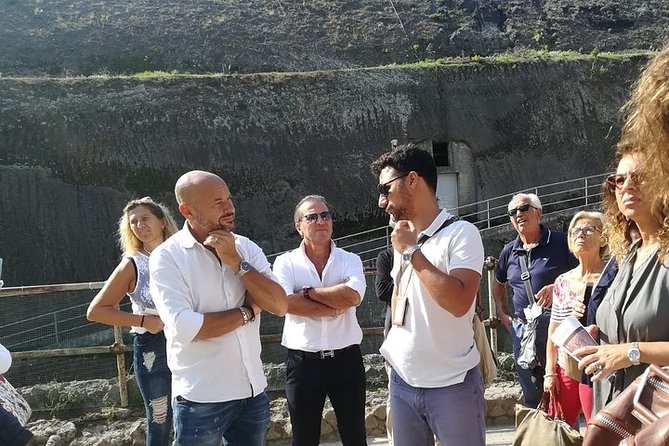
- The private guide changes the pace: Only your group takes part, so you can stop for questions or spend longer on a favorite mosaic.
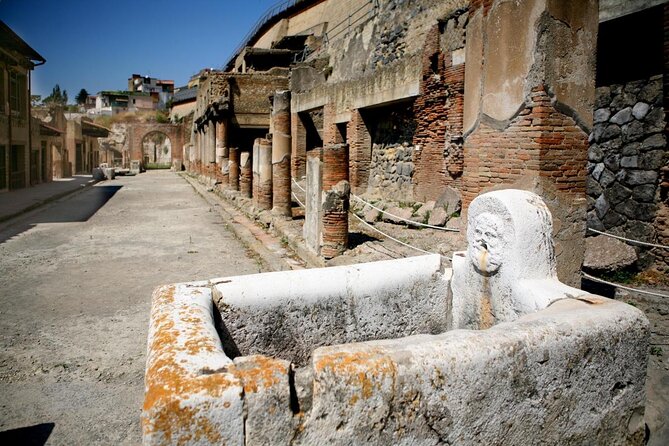
- Herculaneum feels unusually personal: Charred wood, household plumbing, jewelry, furniture, and painted rooms bring daily Roman life close.
- The route covers major highlights: You see the baths, several important houses, the Augustales, the ancient boat, and the Antiquarium.
- The €16 entrance ticket is extra: The tour price is $102.12 per person before admission, making group size important for value.
- Plan for a walking visit: Comfortable shoes, light clothing, a hat, and sunglasses are sensible, particularly on a hot day.
- The English-language guides earn strong praise: Carmine, Martina, Francesca, Annalisa, Alessandro, Ernesto, and others have been singled out for clear explanations and friendly care.
Why Herculaneum feels different from Pompeii
Herculaneum was buried by the eruption of Mount Vesuvius in AD 79, but its story feels different from Pompeii. Only part of the ancient town has been excavated. Much of it remains underground, while the open archaeological park is made up largely of imperial-era private homes.
That limited excavation gives the place a compact quality. You are not trying to cross a huge ancient city in one morning. Instead, you move from one remarkably preserved house to another, with the guide explaining how rooms worked, what decorations meant, and how wealthy Roman families used their homes.
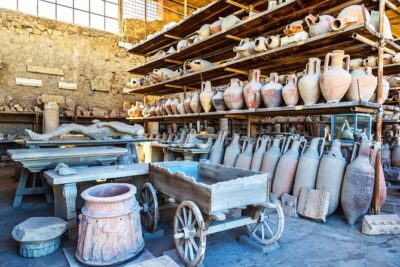
I particularly value the surviving domestic details. The site includes charred wood, plumbing, drainage, painted walls, mosaics, jewelry, statues, stone jars, and household fittings. These objects help you picture ordinary routines far better than a bare street grid would.
The private setting also matters. You can ask why one room has a black-painted hall, how a Roman bath was heated, or what a mythological figure meant in a wall painting. With a large group, those questions can be difficult. Here, the guide can adjust the explanation to your interests.
More History Walking Tours in Italy
- Naples Spanish Quarters Walking Tour Street Art, Folklore & Sweet
★ 5.0 · 797 reviews - Naples Panoramic Walking Tour: From the Hills to the Center
★ 5.0 · 298 reviews - Naples: Historic Center and Sansevero Chapel Walking Tour
★ 4.8 · 208 reviews
Meeting at Corso Resina and getting ready to walk
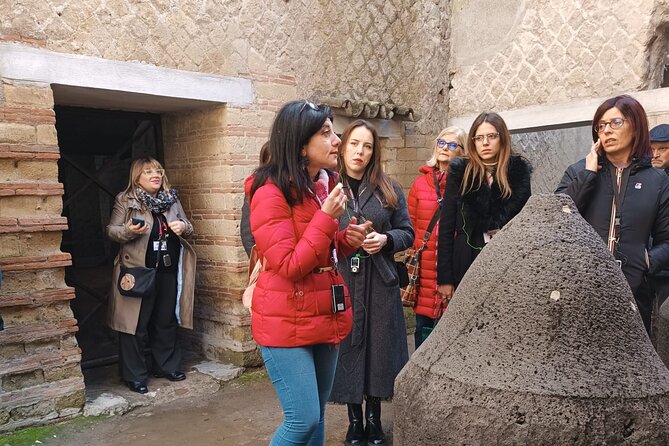
The tour begins at the Archaeological Park of Herculaneum, at Corso Resina 187 in Ercolano. It ends at the same meeting point. The site is near public transportation, and one family arranged a taxi from Naples and called the driver for the return trip.
If you are arriving from a cruise ship, allow enough time for the trip from the port and for any delay at the dock. One booking had to be canceled after bad weather delayed the ship, and a full refund was provided. That is useful reassurance for a shore visit, though you should still build in a sensible time cushion.
Wear shoes with good support. The tour is described as suitable for most people, and guides have adjusted the route for older parents, limited walking ability, and two strollers. Even so, this remains an archaeological site with steady walking and uneven ground, so tell the guide at the start if someone in your party needs a slower pace.
The tour is offered in English. Confirmation arrives within 48 hours, subject to availability, and the activity is often booked about 44 days ahead. If your dates are fixed, booking early makes sense.
Terme del Foro: Roman bathing in working order
The first main stop is Terme del Foro, the forum baths. The planned visit lasts about 15 minutes, enough to see the gym, changing room, and rooms used for warm and hot bathing.
This is a useful opening stop because Roman baths were not just places to wash. They were social spaces, and the layout helps you understand how a public bathing system worked. The guide can explain the sequence of rooms and the parts of the building that made the heat possible.
The baths are well preserved, but the stop is short. If this is the sort of place you enjoy most, use your private format to ask for a little more explanation here. The guide may need to keep the overall route moving, since several houses and the museum follow.
Casa del Tramezzo di Legno and its charred furniture
Next comes the Casa del Tramezzo di Legno, also called the House of the Wooden Partition. It is known for its preserved carbonized wood furniture and is one of the best-preserved homes on the route.
The wood is one of Herculaneum’s great surprises. Stone and plaster can survive in many ancient sites, but wooden household objects make the rooms feel more immediate. They hint at doors, partitions, furnishings, and the practical texture of Roman life.
You get about 15 minutes here. That is enough for a focused explanation, though not for a slow inspection of every room. Ask the guide to point out the details you would likely miss if you walked through alone.
More Private History Tours in Italy
- Skip-the-Line Exclusive Private Ancient Pompeii & Vesuvius Volcano Full Day Tour
★ 4.5 · 31 reviews - Private Walking Tour of Ancient Naples with an expert guide
★ 5.0 · 19 reviews - Private Tour of the Historic Center of Naples with a Local Guide
★ 5.0 · 17 reviews - Ancient Ostia Antica Semi-Private Day Trip from Rome by Train with Guide
★ 4.5 · 579 reviews
Casa di Nettuno e Anfitrite: mosaics with a mythological story
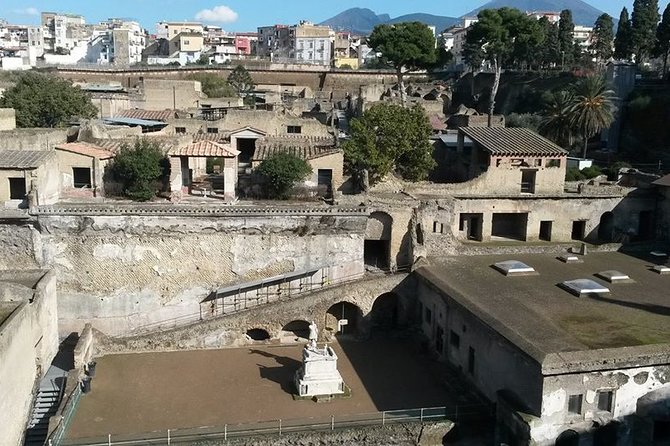
The House of Neptune and Amphitrite is one of the tour’s visual highlights. It contains one of the most attractive mosaics among the Vesuvian sites, with Neptune and Amphitrite at the center of the decoration.
The value here is not only the color and pattern. Roman mosaics often carried stories, status, and religious meaning into the home. A good guide helps you read the room rather than treating the mosaic as a pretty floor or wall.
The visit is scheduled for about 15 minutes. That gives you time to look closely and hear the story behind the imagery. If you are visiting with teenagers, this stop can be an easy way to connect ancient mythology with a real home.
Casa dei Cervi: polished marble and a Gulf view
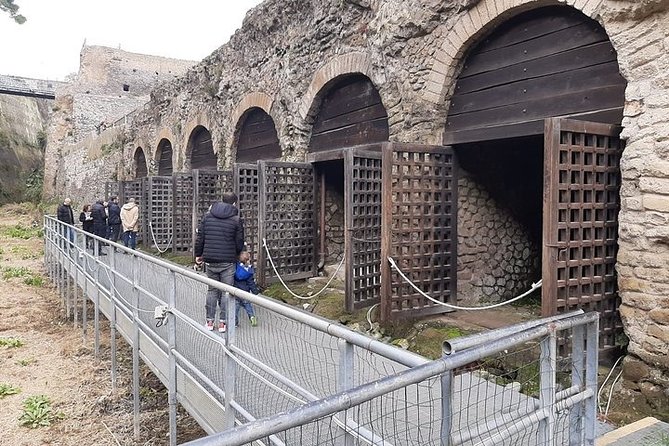
The House of the Deer occupies a striking position between the Gulf of Naples and Capri. Its name comes from the deer sculptures, and the house contains impressive polychrome marble.
This stop offers a useful contrast with the earlier homes. Here, decoration and setting point to a higher level of wealth. The marble is not merely practical. It helped display taste, money, and access to expensive materials.
You spend about 10 minutes here. The stop may feel brief if you enjoy architecture and views, but the guide can explain why the house was positioned so well and how its design differed from more modest Roman dwellings.
Casa Sannitica: an older home with early wall painting
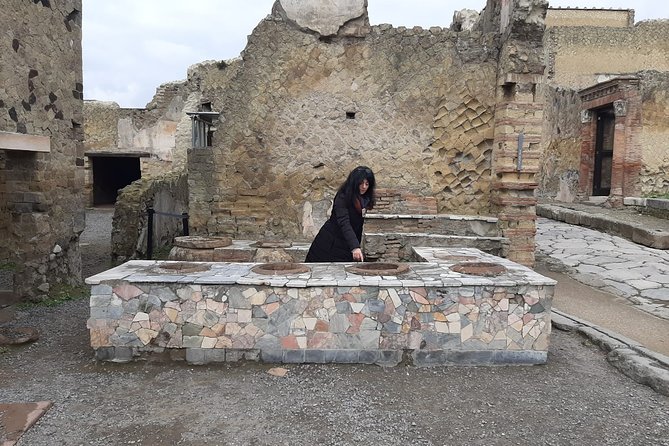
Casa Sannitica is among Herculaneum’s oldest houses. It is known for painted decoration in the First Pompeian Style, an early form of Roman wall treatment that imitates architectural elements.
This is a good stop for understanding that Herculaneum was not frozen in one moment of design. The houses reflect different periods, tastes, and building traditions. The ten-minute visit gives you a quick look at a style that predates some of the more elaborate later interiors.
I would listen closely here. The decoration may not have the instant impact of the Neptune mosaic or charred furniture, but it helps explain how Roman domestic art developed.
The Augustales: public religion and painted myths
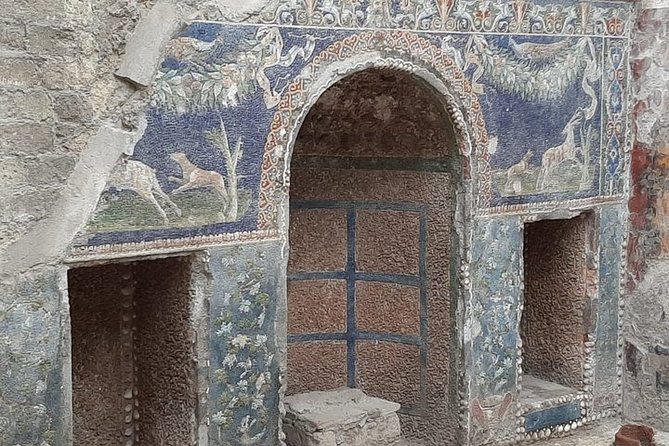
The College of the Augustales is one of the few excavated public temples open to visitors. Its mythological frescoes make it an important change of mood after several private houses.
The building gives you a look at public religious life rather than family space. The paintings also show how myth was used to decorate sacred buildings and shape the identity of the town.
The planned stop lasts 15 minutes. That is enough to hear the main story and study the frescoes, though you may want to ask the guide how this public building differed from the private homes you have already seen.
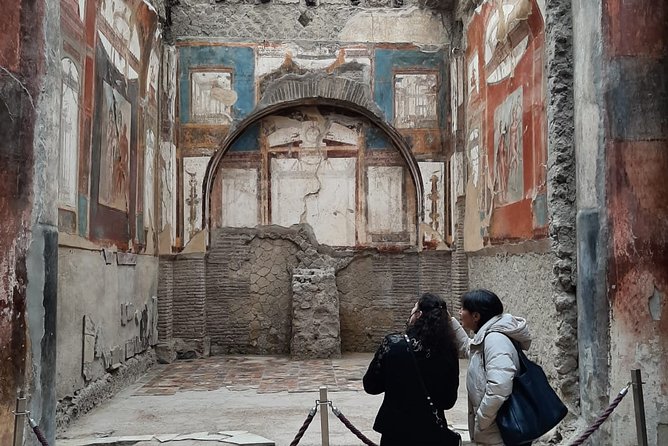
Casa del Salone Nero: a black hall with preserved frescoes
The House of the Black Hall faces the main street and follows the Vitruvian model, a Roman approach to house planning associated with the architect and writer Vitruvius. Its best feature is the condition of its frescoes.
This stop is especially useful if you want to understand how a Roman home was organized. The house is not just a collection of rooms. Its position, hall, decoration, and relationship to the street reflect ideas about movement, display, and status.
The visit lasts about 10 minutes. Since the frescoes are the reason to stop, let the guide direct your attention to the areas where the color and design remain clearest.
The ancient boat and the small museum
Outside the main archaeological area, a small museum displays an ancient charred Roman boat along with other finds. The boat is an unusual object and adds a human scale to the disaster. It also reminds you that Herculaneum was a coastal town with links to the sea.
The museum section is scheduled for about 15 minutes. You can see jewelry, everyday objects, statues, stone jars, skeletons, and charred wood furnishings. These items make a useful bridge between the buildings and the people who lived there.
This stop may be one of the most memorable for you if objects tell a stronger story than walls do. The possible drawback is time. The museum is small, and the tour has already covered many rooms, so you may need to choose what deserves your closest look.
Antiquarium di Ercolano: finish with objects and temporary displays
The Antiquarium holds permanent and temporary exhibitions. Visiting it is optional, so your guide can adjust the ending to your interests and available time.
The displays include jewelry, daily-use objects, and charred wood furniture. After seeing the houses, you can now connect those objects with the rooms where they belonged. That makes the museum more useful than a quick, disconnected collection of artifacts.
If you are short on time, you may prefer to finish with the main excavation area. If you enjoy small museums, ask to include the Antiquarium. The private format gives you a better chance of making that choice rather than simply following a fixed group schedule.
What the two-hour format delivers
The listed stops add up to about two hours, though the exact pace can change. The route is packed: baths, five private homes, a public temple, a boat museum, and the Antiquarium. You will see a lot, but this is not a slow archaeological study session.
That is where the guide earns the fee. Annalisa has been praised for skipping less interesting details and focusing on places that suit the group. Carmine has been praised for explaining Herculaneum alongside Pompeii and placing both towns within the wider Roman world. Martina has been praised for combining strong historical explanations with patience and humor for families.
You should expect interpretation, not just directions. Guides have explained plumbing, drainage, statues of Hercules, skeletons, jewelry, mosaics, and the circumstances of the eruption. The best moments come when a small object or room becomes evidence of how people actually lived.
The private format also helps families. A guide can keep teenagers involved, answer repeated questions without holding up strangers, or slow down for an older parent. It cannot remove all walking, but it can make the visit less stressful.
Is $102.12 per person good value?
The price is $102.12 per person, and the €16 Archaeological Park entrance fee is not included. Taxes and a licensed archaeology guide are included, as is the private tour. Group discounts are available, though the exact saving is not specified.
For one or two people, this is a sizable expense. For a family or small group, the value improves because you are paying for one private guide rather than joining a large mixed party. The real benefit is the time saved and the quality of explanation, not simply getting through the gate.
I would choose this tour if Herculaneum matters to you and you want the site explained well. I would skip it if you prefer to wander alone, have a very tight budget, or want to spend many hours examining every house at your own speed.
Cancellation is free up to 24 hours before the start time for a full refund. Changes or cancellations made inside that window are not accepted for a refund, and the cut-off uses local time.
Who should book this Herculaneum walk?
This tour suits families, couples, friends, first-time visitors, and anyone comparing Herculaneum with Pompeii. It is particularly useful if you have only a morning, a port day, or a limited amount of time in Naples.
It also suits anyone who wants context. Without guidance, you may admire the colors and walls but miss the plumbing, household objects, building plans, and clues about social rank. The guides have a clear record of making the site understandable in excellent English.
The tour is a good fit for people with limited mobility when the guide is told in advance and the group accepts a slower pace. Service animals are allowed, and most people can participate. Still, comfortable shoes and sensible clothing matter more here than stylish footwear.
Should you book it?
Book this private Herculaneum tour if you want a focused visit with a guide who can explain the houses, mosaics, baths, frescoes, and everyday objects in plain English. It offers a strong route through the most important remains and gives your group room to ask questions.
The cost is easiest to justify when several people share the private service. Add the €16 entrance ticket, allow about two hours for the walk, and consider extra time if you want the Antiquarium. For a short visit from Naples or a cruise port, this is a practical way to see Herculaneum without wasting your limited time.
FAQ
How long does the private Herculaneum tour last?
The tour lasts approximately two hours. The planned route includes several archaeological houses, the baths, the Augustales, the boat museum, and the Antiquarium at your discretion.
What is the price per person?
The listed price is $102.12 per person. Group discounts are available, but the €16 entrance fee for the Archaeological Park is extra.
Is the entrance ticket included?
No. The Archaeological Park entrance fee costs €16 per person. Admission is free for visitors under 18 with an identity document.
Is this a private activity?
Yes. Only your own group takes part in the tour.
What language is the tour offered in?
The tour is offered in English.
Where does the tour begin and end?
It begins at the Archaeological Park of Herculaneum, Corso Resina 187, Ercolano, Italy. It ends back at the meeting point.
What should I wear?
Comfortable shoes, comfortable clothing, sunglasses, and a hat are recommended.
Is the site near public transportation?
Yes. The meeting point is near public transportation.
Are service animals allowed?
Yes. Service animals are allowed.
Can people with limited mobility join?
Most people can participate, and guides have adjusted tours for people with limited walking ability. The tour remains a walking visit, so you should explain your needs when arranging the experience.
Can I cancel for a refund?
You can cancel at least 24 hours before the start time for a full refund. Cancellations or changes made less than 24 hours before the start time are not refunded.
More History Walking Tours in Naples
- Discover Naples: Guided 3-Hour Walking Tour Through Naples’ Heart
★ 5.0 · 79 reviews - Naples Walking tour of the Historical Center
★ 5.0 · 75 reviews - Naples: Historic City Center Guided Walking Tour
★ 4.7 · 38 reviews - Walking Guided History Tour of Naples and Bourbon Tunnel
★ 5.0 · 25 reviews
More Pompeii and Vesuvius History Tours in Naples
- Naples/Salerno Port: Pompeii Tour – Shore Excursion
★ 4.0 · 36 reviews - Skip the Line Ancient Herculaneum Walking Tour with Top Rated Guide
★ 4.5 · 32 reviews - Secret Herculaneum: The Hidden Treasure of Ancient Roman Civilization
★ 5.0 · 29 reviews - Pompeii the Ancient City (Tour+Transfer)
★ 4.5 · 17 reviews
Just added around Naples
- Visit of the Historic Center of Naples with an Expert Guide★ 5.0 · 17 reviews
- Skip-the-Line Exclusive Private Ancient Pompeii & Vesuvius Volcano Full Day Tour★ 4.5 · 31 reviews
- Spaccanapoli tour of the historical center of Naples★ 5.0 · 39 reviews
- Secret Herculaneum: The Hidden Treasure of Ancient Roman Civilization★ 5.0 · 29 reviews
- Skip the Line Ancient Herculaneum Walking Tour with Top Rated Guide★ 4.5 · 32 reviews
- Naples/Salerno Port: Pompeii Tour – Shore Excursion★ 4.0 · 36 reviews
- Private Walking Tour of Ancient Naples with an expert guide★ 5.0 · 19 reviews
- Pompeii the Ancient City (Tour+Transfer)★ 4.5 · 17 reviews
Pompeii & Vesuvius History Tours, compared.
Discover the Ancient Ruins of Pompeii: Day Trip from Rome
Read our review →
Small-Group Rome to Pompeii & Amalfi: Day of History & Sea
Read our review →Ancient Pompeii Private Tour: Skip the Line & Kid-Friendly Option
Read our review →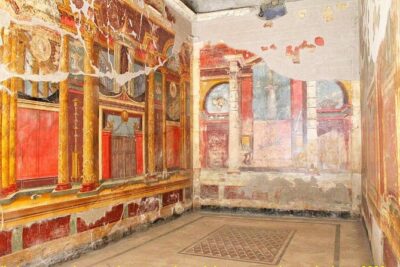
Skip-the-Line Half-Day Private Tour Ancient Pompeii Highlights with Native Guide
Read our review →
Naples/Salerno Port: Pompeii Tour – Shore Excursion
Read our review →
Discover Herculaneum: A guided tour of the ancient Roman city
Read our review →
Skip the Line Ancient Herculaneum Walking Tour with Top Rated Guide
Read our review →
Skip-the-Line Exclusive Private Ancient Pompeii & Vesuvius Volcano Full Day Tour
Read our review →Browse the lists this tour appears in