
Review · BOSTON
Walk the Historic Freedom Trail with Costumed Guide
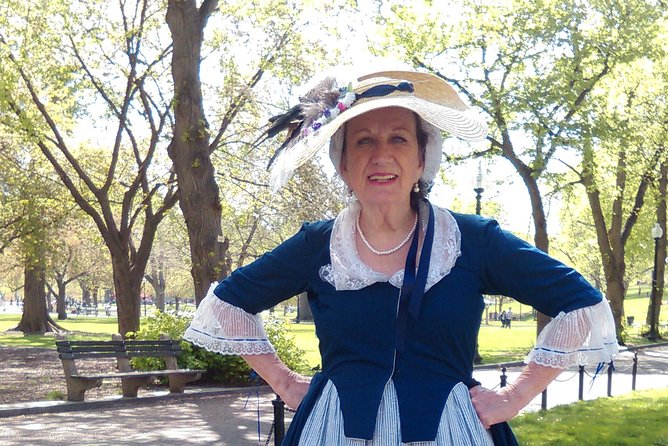
History feels close to the sidewalk here. This 90-minute walk takes you from Park Street Church to Faneuil Hall, with a costumed guide explaining the people, arguments, protests, and tragedies that shaped Boston. I like the short route, which covers the key downtown sights without asking you to spend half a day on your feet. I also like the period dress and lively storytelling, especially from guides such as James Otis, Thomas, Steven, Jeff, and Samuel Gray. The main drawback is practical: city traffic, construction, and a group of up to 45 people can make it hard to hear at times.
You will walk less than a mile, but you will spend plenty of time standing. The pace is gentle and the route is mostly easy, yet this is still an outdoor city tour, not a seated talk. I would wear comfortable shoes, dress for the weather, and stay near the guide if you have trouble hearing.
Key things to know before you book
- A compact Freedom Trail route: You see about 11 of the trail’s 16 historic sites in roughly 90 minutes.
- A costumed storyteller: Guides use period clothing, humor, and character to make the events easier to follow.
- A strong downtown introduction: The walk links Boston Common, the State House, Granary Burying Ground, Old South Meeting House, and Faneuil Hall.
- A good choice for a busy day: Morning and afternoon departures leave room for museums, lunch, or a longer visit to the North End.
- An outdoor walking experience: Expect sidewalks, street noise, and standing at nearly every stop.
- A reasonable price for a focused tour: At $30 per person, it offers a useful orientation without the cost or time of a private tour.
Why this 90-minute walk works
Boston’s Freedom Trail is easy to follow on the pavement, but a red line alone cannot explain why each building matters. The value of a guide is the connection between places. A church leads to abolition. A meeting house leads to protest. A graveyard leads to the people who helped shape the new country.
This tour keeps that connection moving. You begin near Boston Common and finish at Faneuil Hall Marketplace, a useful endpoint for continuing your day. Along the way, you hear about colonial government, religious change, the Boston Massacre, the Boston Tea Party, and the leaders who pushed Boston toward revolution.
I like the route because it does not try to cover every inch of the Freedom Trail. The complete trail takes much longer, while this version gives you a strong first look in about an hour and a half. If you have limited time, it is a sensible way to get your bearings before choosing which sites deserve a second visit.
The experience is listed at $30 per person. That is fair if you value clear storytelling and want context rather than simply walking past historic buildings. You are paying for the guide’s interpretation, not for a long list of interior admissions. The listed stops include admission, but the tour itself is primarily an outdoor walk with brief pauses.
More History Walking Tours in Boston
- Boston: Freedom Trail History Small Group Walking Tour
★ 5.0 · 6,450 reviews - Boston: Freedom Trail History Small Group Walking Tour
★ 4.9 · 1,590 reviews - Boston Pizza Lovers Food and History Walking Food Tour
★ 4.5 · 1,082 reviews
Starting at Park Street Church and Boston Common
The meeting point is at 139 Tremont Street, close to Park Street Church and Boston Common. This is a central location near public transportation, so it is practical to reach from other parts of Boston.
Park Street Church is the first stop. The tour connects the church with the shift from early Puritan beliefs toward Protestant abolitionism. That is an important opening because it reminds you that Boston’s story is not only about battles and political speeches. Religious ideas shaped public life, reform movements, and arguments about human freedom.
You then move into Boston Common, where the guide sets out the early story of Boston. The common is a broad public space, and the stop helps place the city in its colonial setting. I find this kind of beginning useful because it gives you a sense of scale before the route tightens around the old government buildings and burial grounds.
The Boston Common stop lasts about 10 minutes. You should expect to stand while listening rather than walk continuously. This is also one of the easier places to keep track of the guide, but city noise can still be present.
The State House and the argument over consent
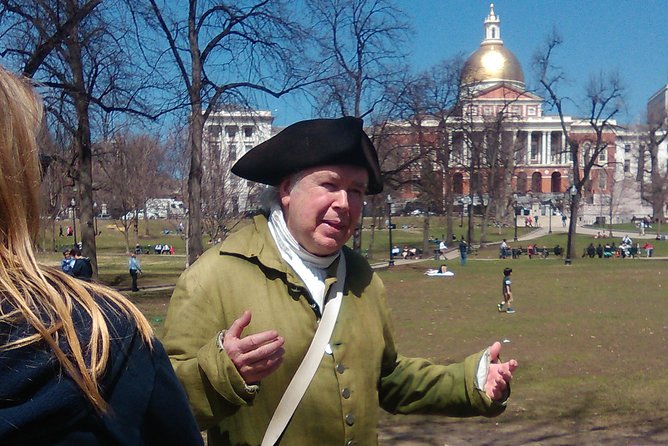
The Massachusetts State House comes next. Built in 1795, it represents the idea that government is not legitimate without the consent of the people. That political principle gives the tour a useful link between Boston’s colonial past and the government that followed independence.
The stop is short, about five minutes, so the guide has to keep the explanation focused. You will not get a lengthy architectural tour. Instead, the building works as a visual reminder of the political changes taking place around you.
This part of the walk is especially useful if you want more than a parade of famous names. The Freedom Trail is full of stories about conflict, but this stop helps explain the ideas underneath the conflict. It gives you a reason to pay attention to the words being used, not just the dates.
Granary Burying Ground and Boston’s early leaders
Granary Burying Ground is one of the longer stops, at about 15 minutes. More than 350 years old, it contains the graves of major figures from Boston’s early story. The site is also associated with more signers of the U.S. Constitution than any other burial ground in America, according to the tour description.
I think this is one of the most valuable pauses on the route. A burial ground slows the tour down and puts names onto the political story. Instead of hearing only about institutions, you encounter the people connected with them.
The tradeoff is that 15 minutes can feel long if graveyards are not your main interest. One dissatisfied response specifically found the burial-ground stop too lengthy. I would still keep it on the route, but you should know that the tour spends real time here rather than rushing through.
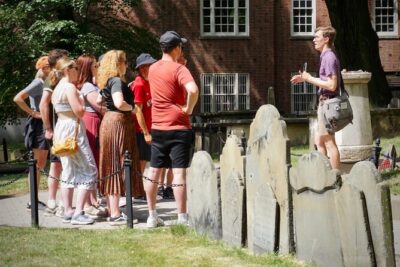
Granary Burying Ground also illustrates the limits of a city walk. You are outside, standing on uneven urban surfaces, listening while other people move nearby. The guide may use a microphone, and staying close is helpful, especially for anyone with hearing concerns.
More History Walking Tours in the USA
- Boston History Tour: Scenic Walk Through Time & Landmarks
★ 5.0 · 627 reviews - Boston’s North End Food and History Walking Tour
★ 5.0 · 459 reviews - Boston Seafood Lovers Food and History Walking Tour
★ 5.0 · 208 reviews - Downtown Freedom Trail Walking Tour – History & Architecture
★ 4.5 · 194 reviews
King’s Chapel and the Boston Latin School
King’s Chapel offers a look at Boston’s religious past from another angle. It began as a Church of England congregation and was originally built around 1688. After hearing about Park Street Church and Protestant abolitionism, you now see a different part of the religious divide that shaped colonial Boston.
The stop lasts about 10 minutes. The building gives the guide a chance to explain how religious affiliation could reflect political loyalties and social divisions. Even if you do not go inside, the exterior and surrounding streets help show how tightly packed the old city was.
The route then passes Boston Latin School, founded in 1635 and recognized as the oldest public school in the United States. The stop is brief, about five minutes, but the date makes it memorable.
This is a good example of the tour’s approach. It does not linger at every building. Instead, it gives you a quick fact, explains why the place matters, and keeps you moving toward the larger revolutionary story.
Old South Meeting House and the Boston Tea Party
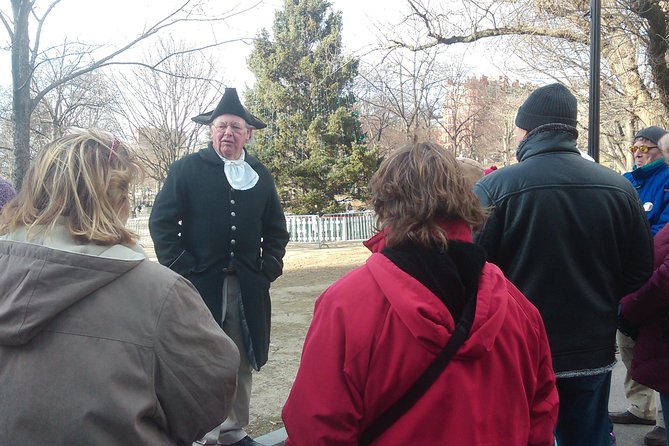
Old South Meeting House is one of the most important stops for understanding how protest worked in Boston. Famous meetings took place here, including a gathering just before the Boston Tea Party in 1773.
The guide’s job here is to turn a familiar textbook event into a physical scene. You are standing near the place where people gathered, argued, and made decisions that carried serious consequences. The building is not simply an old church. It was also a meeting space where public opinion could gather force.
The tour allows about 10 minutes. That is enough for a clear explanation, but not enough for a detailed interior visit or a full lecture on the Tea Party. If this event is central to your interest, you may want extra time elsewhere after the walk.
This is also where a good guide makes a difference. Several guides have been praised for using humor without making the subject silly. Thomas, in particular, was singled out for quick wit and strong command of the city’s past. Guide styles can vary by departure, but the experience clearly depends on a guide who can keep political history lively.
Old State House and the Boston Massacre site
The Old State House, built in 1713, represents a direct shift in power. It first served under British control, then was taken over by Americans in 1775. The building makes the political conflict visible because the argument is attached to a specific place, not just a date in a book.
The stop is about five minutes. Again, the tour favors a sharp explanation over a long building inspection. You will hear about the building’s changing role as Boston moved from colonial rule toward American control.
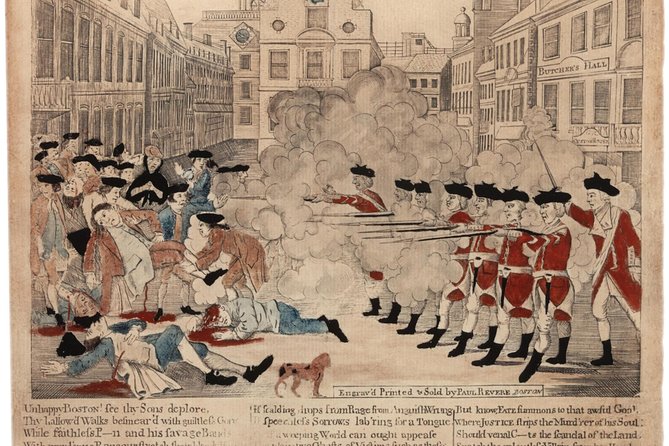
Nearby, the Boston Massacre site receives about 10 minutes. In 1770, five Americans were killed by British soldiers here. Paul Revere later made a famous engraving of the event, helping spread the image and outrage far beyond Boston.
This is one of the strongest storytelling points on the walk. The event itself was violent and tragic, but the guide can also explain how images, public speeches, and political messaging shaped opinion. That broader point is valuable because it shows how the Revolution was fought with information as well as weapons.
The drawback is sound. Downtown traffic, construction, and nearby pedestrians can make a soft voice difficult to follow. One guide was praised for being easy to hear despite street noise, while other accounts specifically wished for stronger headsets. If you have hearing difficulty, arrive ready to stand near the front.
Ending at Faneuil Hall Marketplace
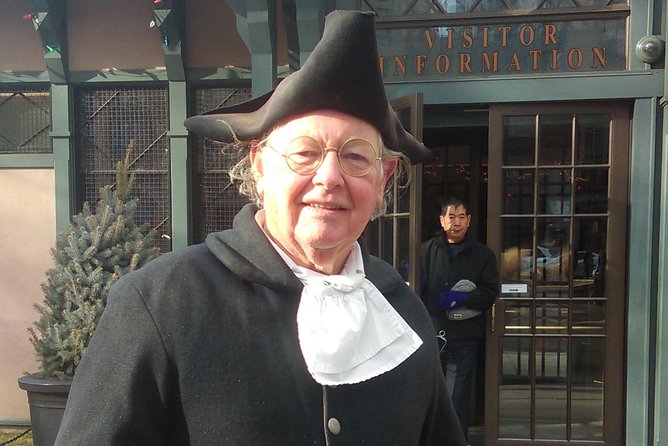
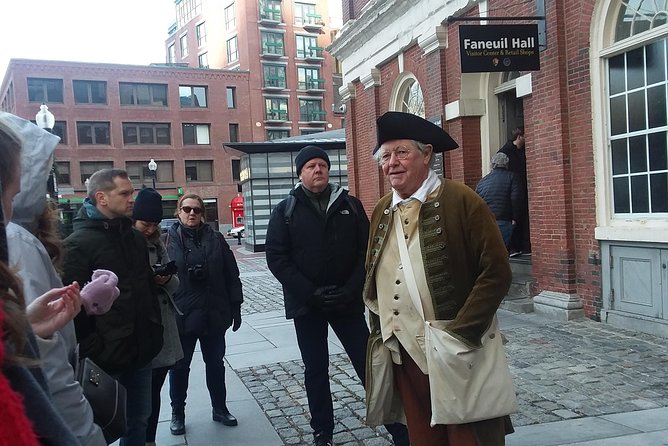
The walk ends at Faneuil Hall Marketplace, where the guide discusses the famous marketplace building and the statue of Samuel Adams. This is a useful finish because it places you in an area with plenty of options for continuing your day.
The endpoint is close to the North End, though the route described here does not cover the full neighborhood. You can use the end of the tour as a practical decision point: stop for food, explore more historic sites, or continue along the Freedom Trail independently.
I like ending at Faneuil Hall rather than back at the starting point. A point-to-point walk saves you from retracing your steps, and the location gives you more freedom after the tour. The only catch is that you need to plan your route back to your hotel or next activity.
The guide’s style and the size of the group
The period costume is more than a photo opportunity. It gives the guide a role to play and helps separate the tour from a standard street lecture. The best moments seem to come when the guide combines accurate facts with character, humor, and a few lesser-known details.
Names associated with especially well-liked departures include James Otis, Thomas, Steven, Jeff, Samuel Gray, and Adri. James Otis has been described as presenting the tour for many years, while Thomas was praised for humor and practical suggestions about food and places to visit. You cannot assume a particular guide will lead your departure, but these examples show the style to expect: informed, theatrical, friendly, and conversational.
Group size needs a careful note. The formal capacity is up to 45 people, while provider responses in the supplied material also refer to caps of 30 or 35 on some departures. Either way, this is not a private walk. A larger group can make street crossings and gathering around a guide less relaxed.
The benefit of a group is the lower price. The cost is less personal attention and a greater chance of sound problems. If you want a private experience or a full three-hour route, a private tour is the better fit.
Timing, comfort, and who should book
Morning and afternoon departures make this easy to fit into a Boston schedule. A morning walk works well if you want an introduction before exploring museums or historic interiors. An afternoon departure can help you make use of the cooler part of the day, depending on the season.
The walk is described as gentle, less than a mile, and without major hills. Still, you should not confuse short distance with no effort. You will stand at ten or more stops, and city sidewalks can be tiring if you are wearing poor shoes.
I would recommend it for:
- First-time visitors who want a quick orientation
- Adults interested in American political and religious history
- Families with older children or teens who respond well to stories and humor
- People with only a morning or afternoon in Boston
- Anyone who wants a guided introduction before walking more of the trail alone
It may not suit you if you want a quiet, small-group experience, extensive interior access, or a full explanation of all 16 Freedom Trail sites. It also requires good weather. If poor weather cancels the tour, you are offered another date or a full refund.
The cancellation policy is simple: cancel at least 24 hours before the start for a full refund. Changes or cancellations within 24 hours are not refunded. Service animals are allowed, and most people can participate, but the outdoor format means you should plan around weather and standing.
Should you book this Freedom Trail walk?
I would book this tour if you want the main downtown story in a manageable 90-minute package. The strongest reasons are the easy pace, the costumed guide, the clear route, and the number of important sites covered for $30.
I would skip it only if you already know Boston’s central historic district well or prefer to explore alone at your own speed. For most first visits, it is a useful beginning rather than a complete history lesson. Listen closely, stay near the guide, and leave yourself time afterward at Faneuil Hall or along the rest of the trail.
FAQ
How long does the Freedom Trail tour last?
The tour lasts approximately 1 hour and 30 minutes.
How much does the tour cost?
The price is $30 per person.
Where does the tour begin?
It begins at 139 Tremont Street, Boston, Massachusetts 02111, near Park Street Church and Boston Common.
Where does the tour end?
The tour ends at Faneuil Hall Marketplace in Boston, Massachusetts 02109.
How many Freedom Trail sites does the tour cover?
The route covers about 11 of the 16 Freedom Trail sites.
Is the tour suitable for people who do not want a strenuous walk?
The walk is described as gentle, less than one mile, and without hills. You should still expect a lot of standing and wear comfortable shoes.
Is the tour offered in English?
Yes. The tour is offered in English and uses a mobile ticket.
Can I cancel for a refund?
Yes. You can receive a full refund if you cancel at least 24 hours before the scheduled start time. Cancellations within 24 hours are not refunded.
Just added around Boston
- Haunted Boston’s Historic Streets Walking Guided Tour★ 4.5 · 184 reviews
- Boston: Votes for Women History Tour of Back Bay★ 5.0 · 49 reviews
- Boston: Freedom Trail History Tour and Brewery Taste★ 5.0 · 38 reviews
- Self Guided “Historic Boston Downtown Freedom Trail” Audio/GPS Walking Tour★ 4.0 · 22 reviews
- Boston: Food and History of The Freedom Trail Private Tour★ 5.0 · 159 reviews
- Boston Seafood Lovers Food and History Walking Tour★ 5.0 · 208 reviews
- A Taste of the Freedom Trail: Boston’s Iconic Food & History Tour★ 5.0 · 32 reviews
- Downtown Freedom Trail Walking Tour – History & Architecture★ 4.5 · 194 reviews
History Walking Tours, compared.

History and Hauntings of Salem Guided Walking Tour
Read our review →
Freedom Trail History Small Group Walking Tour
Read our review →
Historic Charleston Guided Sightseeing Walking Tour
Read our review →
Tapas Walking Tour with Food, Wine, and History
Read our review →
Savannah History and Haunts Candlelit Ghost Walking Tour
Read our review →
A History of Terror – Belfast City Centre Walking Tour
Read our review →Browse the lists this tour appears in