
Review · BOSTON
Boston: Votes for Women History Tour of Back Bay
Boston’s old streets tell a newer story. I love the way this small-group walking tour connects polished Back Bay buildings with the women who fought over voting rights, and I like that an expert guide such as Maura brings both passion and useful detail. The main drawback is simple: you will stand and walk for about two and a half hours, and the tour depends on good weather.
For $35, you get a focused lesson in Boston and national history, not just a stroll past pretty buildings. The group is limited to 15 people, which gives you a better chance to ask questions. Bring comfortable shoes, and do not expect costume guides or museum admissions.
Key points at a glance
- Pauline A. Shaw’s home: See where a major financier of Boston’s suffrage movement lived at 6 Marlborough Street.
- Two sides of the debate: The route includes homes linked to both pro-suffrage and anti-suffrage women.
- Back Bay landmarks: Walk from the Public Garden through Copley Square, the Boston Public Library, and Commonwealth Avenue.
- A compact route with many pauses: The tour covers about 0.8 miles, but frequent stops stretch the experience to roughly 2 hours 30 minutes.
- A strong guide matters: Maura has been praised for making complex stories clear, lively, and inspiring.
- A useful finishing point: The tour ends at the Boston Women’s Memorial, close to central Back Bay and within walking distance of Downtown Boston.
Why Boston’s women’s history deserves its own tour
Boston is famous for revolutionaries, ministers, merchants, and the Freedom Trail. That familiar story can leave women in the margins. This tour corrects the balance by showing how women organized, raised money, wrote, spoke in public, made political arguments, and fought one another over the vote.
I like the way the tour avoids treating the suffrage movement as a single united cause. You hear about women who worked for voting rights, but you also visit the homes of anti-suffragists. That contrast makes the period feel more real. Political change rarely arrives with everyone marching in the same direction.
The route also shows how national history grew from local places. A home on Marlborough Street, a former office building, a meeting hall, and a public square may look ordinary at first glance. With the right explanation, each becomes part of the long campaign for women’s political power.
The experience receives a perfect five-star rating from 49 published ratings, with 100 percent recommending it. That is a strong signal, especially because the most praised feature is not simply the route. It is the guide’s ability to tell stories and handle questions.
A few more history tours around Boston worth a look
- Boston: Freedom Trail History Small Group Walking Tour
★ 5.0 · 6,450 reviews - Tour of Historic Fenway Park, America’s Most Beloved Ballpark
★ 4.5 · 3,013 reviews - Boston Food & History: Pizza, North End & Freedom Trail
★ 5.0 · 1,772 reviews
Starting with ducks, gardens, and George Washington
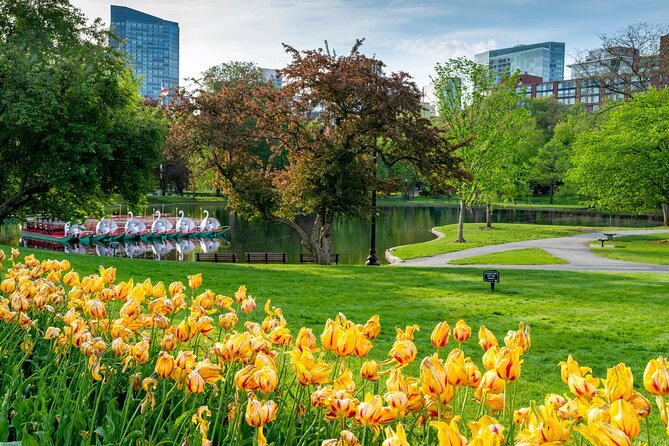
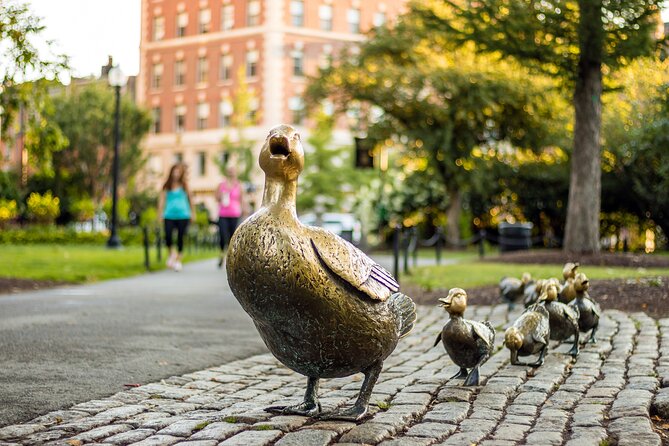
Meet at Make Way for Ducklings, the Nancy Schön sculpture at 4 Charles Street. The sculpture is based on Robert McCloskey’s classic picture book and gives you an easy, recognizable starting point near the Boston Public Garden.
The garden opened in 1837 as the first public botanical garden in the United States. You will spend about 10 minutes here, with no admission charge. It is a pleasant beginning because the setting feels relaxed, while the subject ahead is more serious.
The route also includes the equestrian statue of George Washington by Thomas Ball. It was commissioned in 1859. The statue offers a useful visual reminder of the political world women were trying to enter. Men occupied the public monuments and formal power structures. Women had to build influence through clubs, publications, fundraising, speeches, and organized campaigns.
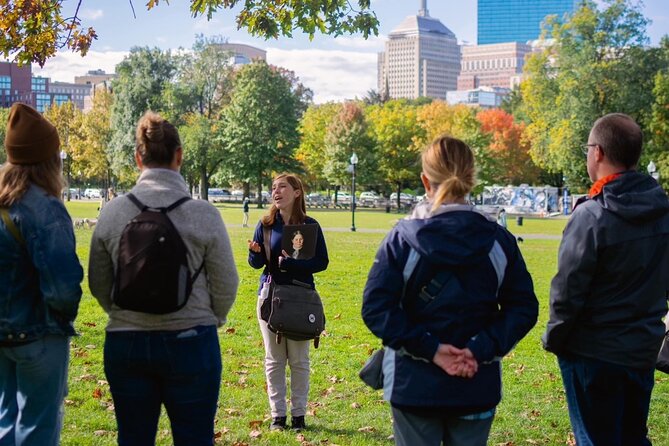
You should expect the guide to do most of the historical work while you look at the places around you. This is not a tour built around entering grand rooms or viewing a large collection of objects. Its strength is the connection between people, addresses, and public spaces.
Marlborough Street and the money behind suffrage
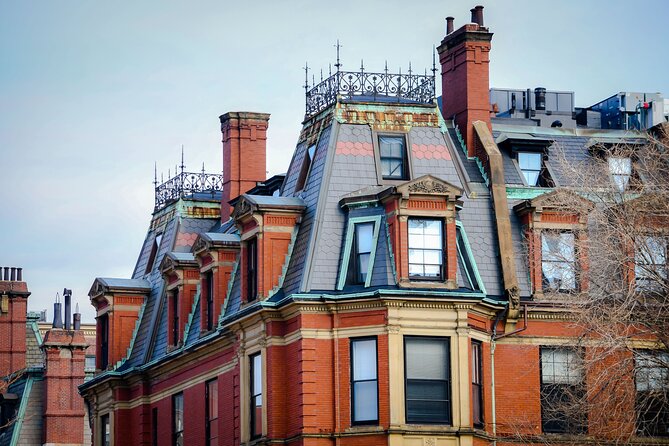
At 6 Marlborough Street, you learn about Pauline A. Shaw. She financed Boston’s women’s suffrage movement and founded the Boston Equal Suffrage Association for Good Government.
That detail matters. Political movements need money, offices, print material, events, and people who can keep a campaign moving. Shaw’s home represents the less visible side of reform work, the planning and funding behind speeches and demonstrations.
The tour then links several Back Bay homes with women who took different positions. Elizabeth Putnam, an anti-suffragist, lived at one of these addresses and was the first woman to preside over a state electoral college. Julia Ward Howe also lived along the route. Her name connects the walk with the broader intellectual and political life of nineteenth-century Boston.
You also learn about Blanche Ames, a pro-suffrage cartoonist and early advocate for birth control. Her work shows that the movement was not limited to voting alone. Women’s political rights were tied to questions about public speech, personal freedom, health, and control over one’s own life.
The Ames family story adds another layer. The Ames Mansion was linked to the family fortune and to political activity through both Mary Shreve Ames, an anti-suffragist, and Blanche Ames, a suffragist. I find this especially useful because it keeps the history from becoming a simple procession of heroes. Two women from the same family could take opposing positions on a major national question.
The College Club and women building institutions
The College Club of Boston is another important stop. Founded as the first women’s college club in the United States, it reflects the growing number of educated women creating institutions for themselves.
A club like this offered more than social contact. It gave educated women a place to meet, exchange ideas, and take part in public life at a time when access to formal political power was limited. The stop helps explain how women developed networks before they could vote in the same way as men.
The experience includes the Back Bay neighborhood and women’s rights landmarks, but admission inside museums is not included. You should not book this expecting extended interior visits. The value comes from hearing the connections between the addresses and the campaign.
That format suits people who like urban history. If you prefer long museum visits, displays, or original objects, you may want to pair this with another Boston attraction rather than rely on this tour alone.
Same place, a different slice of the past:
- Boston: Freedom Trail History Small Group Walking Tour
★ 4.9 · 1,590 reviews - City Cruises Boston Historic Sightseeing Harbor Cruise
★ 4.5 · 1,388 reviews - Boston Pizza Lovers Food and History Walking Food Tour
★ 4.5 · 1,082 reviews - Boston Freedom Trail History Pub Crawl Small-Group Tour
★ 5.0 · 996 reviews
A former museum and Katherine McCormick’s protest
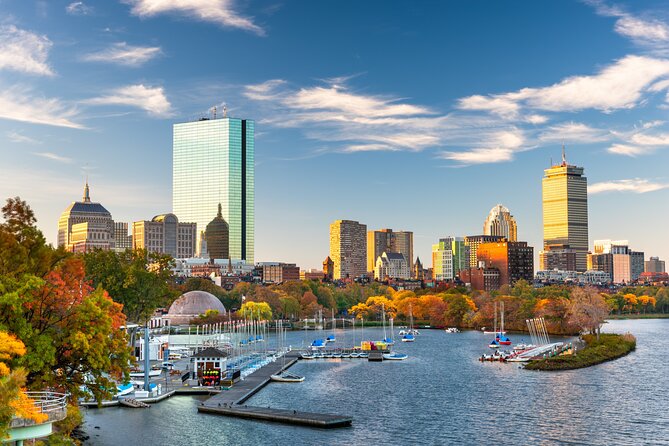
The route reaches RH Boston, The Gallery at the Historic Museum of Natural History. The building housed the Museum of Natural History from 1864 to 1951, and the stop lasts about 10 minutes.
This is a good example of the tour’s method. A building that now serves another purpose once had a different public role. Its past becomes part of the story of how Boston’s institutions changed over time.
Nearby, the tour points out the former location of an MIT laboratory where Katherine McCormick protested against popular fashion as part of the suffrage movement. The detail is unusual and memorable. It shows that protest could take creative forms and that campaigners used public attention to challenge expectations about how women should look and behave.
You also see a building constructed in 1877 that members of the American Association of Architects considered one of the top ten buildings in the country. The supplied information does not identify the building by name, so your guide’s explanation will be especially useful here.
These stops work best when you pay attention to the surrounding architecture. You are not only listening to a story about suffrage. You are learning how the city’s buildings, clubs, laboratories, and public spaces formed the setting for that story.
Copley Square and the Boston Public Library
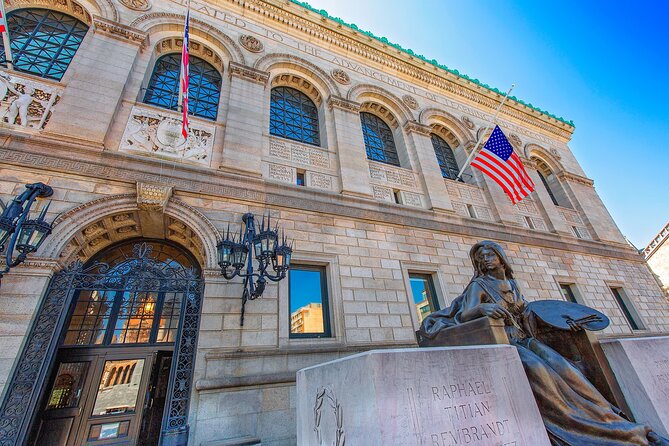
Copley Square was designed as a cultural center of Boston. Today, it gives the tour a broad public setting after several stops at private homes and former offices.
The square helps show the shift from private influence to public presence. Women who once organized in homes and clubs increasingly claimed space in the city’s cultural and political life. The guide can make that transition clearer than a sign or plaque usually can.
The Boston Public Library is another major stop. Founded in 1848, it is now the third-largest public library in the United States. You spend about 10 minutes here, with no admission ticket included or required for the walking stop itself.
A library belongs in this story because access to information and education helped women organize and argue their case. It also gave the public a place to encounter ideas. If you are already planning to visit the library separately, this stop can help you see it through a different lens.
The tour then points out the former Chauncy Hall location, where several pro-suffrage organizations had offices. These included the Massachusetts Woman Suffrage Association and The Women’s Journal. You also learn about the Kensington Building, demolished in 1967, which once housed the Massachusetts Association Opposed to Further Extension of Suffrage to Women.
That pairing is one of the route’s strongest teaching choices. You see the addresses tied to both campaigns, including the organized opposition. Since the Kensington Building is gone, the guide’s description carries the story. It is a useful reminder that cities erase history as they rebuild.
The Commonwealth Avenue Mall and a fitting finish
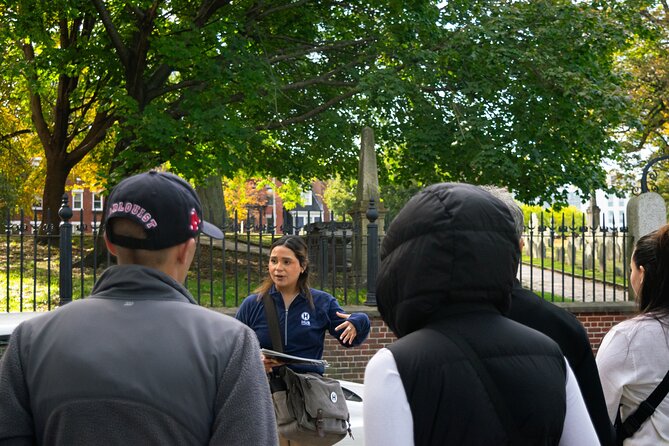
The walk continues along the Commonwealth Avenue Mall, a long avenue with trees, grassy areas, benches, and statues. The route also passes the finish line of the Boston Marathon and Newbury Street, known for shopping, restaurants, and luxury brands.
These details may seem separate from women’s suffrage, but they place the historic stops in the modern city. You can see how the same streets now serve recreation, commerce, sports, and public memory.
The route also includes a former Spiritualist Temple, a place where women were allowed to lead public meetings. That stop is particularly revealing. Public speaking was a major barrier for women, and spaces that permitted women to lead meetings offered a way to gain practice, confidence, and an audience.
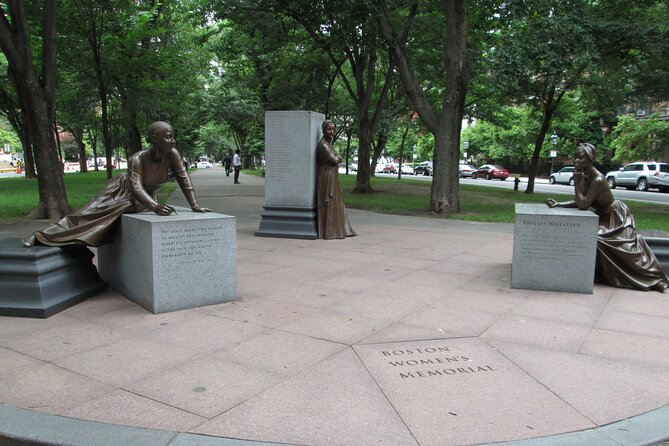
The tour ends at the Boston Women’s Memorial at 256 Commonwealth Avenue. The memorial depicts Abigail Adams, Phillis Wheatley, and Lucy Stone. It is a strong endpoint because it brings together women from different periods and backgrounds, including an early advocate for women’s rights and a major Black poet of colonial Boston.
The finish is about 0.8 miles from the starting point. From there, you are in the center of Back Bay, with Downtown Boston to the east and the Fenway neighborhood to the west. That makes it easy to continue sightseeing after the tour.
What the $35 price gets you
At $35 per person, this is a fair price for a 2-hour-30-minute guided walk, especially with a maximum group size of 15. You are paying for a focused subject, a prepared route, and a guide who can explain why the buildings matter.
The value is strongest if you would not otherwise know where to find Boston’s women’s rights stories. A self-guided walk could take you past many of these addresses without revealing their connection to the movement. The tour supplies the links and the sequence.
It is less useful if you mainly want to enter historic buildings. Museum admission is not included, and the tour does not promise access to private interiors. You are paying for interpretation in the streets, not a package of admission tickets.
There is no need to pay for a costumed guide. Guides in period clothing are specifically not included, and that is unlikely to matter here. The subject benefits from clear explanation more than theatrical presentation.
Walking comfort, weather, and group size
The walk is not long in mileage, but the frequent stops mean you will be on your feet for much of the time. A moderate level of physical fitness is recommended, and the experience is not suitable for people who have trouble standing for extended periods.
Wear comfortable shoes and check the forecast. The tour requires good weather, so poor conditions can lead to a different date or a full refund. You can cancel for a full refund up to 24 hours before the start time. The tour also requires a minimum number of participants, so a cancellation is possible if that minimum is not reached.
The 15-person limit is a real benefit. A small group makes it easier to hear on city streets and gives you more room to ask about people such as Maura, Shaw, Blanche Ames, or Katherine McCormick. One particularly strong account of the tour praised Maura for encouraging questions and making the subject inspiring rather than dry.
The experience is offered in English and uses a mobile ticket. Service animals are allowed, and the starting point is near public transportation.
Who will get the most from this walk
I would recommend it to anyone interested in women’s history, American politics, Boston architecture, or social reform. It is also a good choice if you have already seen the Freedom Trail and want a different way to understand the city.
The tour suits older children and young people who can manage the walking and standing. The story has clear human conflicts, including family members who took opposite sides. That makes it easier to follow than a string of dates and legislation.
It is also a smart choice for solo visitors. The group format gives you company, while the focused topic provides more substance than a general city orientation walk.
I would hesitate if your mobility makes standing difficult, if rain would ruin your day, or if you want a tour packed with interior visits. You may also find the route less satisfying if you have no interest in political history. Back Bay is attractive, but the buildings are the setting rather than the main attraction.
Should you book the Votes for Women History Tour?
Book it if you want to see Boston beyond the standard revolutionary story. For $35, you get a compact, well-focused walk through Back Bay, with important addresses, opposing viewpoints, and a strong final stop at the Boston Women’s Memorial.
The best reason to go is the guide-led storytelling. Maura has been praised for making the subject clear and inspiring, and the tour’s design gives her plenty of material: Pauline A. Shaw’s financial support, Blanche Ames’s cartoons, Mary Shreve Ames’s opposition, public meeting spaces, and the organizations that fought on both sides.
Skip it if you need frequent seating, indoor attractions, or a longer distance covered in less time. For most people who enjoy history and can handle two and a half hours on city streets, this is a thoughtful and worthwhile addition to a Boston visit.
FAQ
How long is the Votes for Women History Tour?
The tour lasts approximately 2 hours and 30 minutes.
How much does the tour cost?
The price is $35 per person.
Where does the tour begin?
It begins at Make Way for Ducklings, the Nancy Schön sculpture at 4 Charles Street in Boston.
Where does the tour end?
It ends at the Boston Women’s Memorial at 256 Commonwealth Avenue.
How far is the end from the beginning?
The tour ends approximately 0.8 miles from the starting point.
What time does the tour start?
The listed start time is 10:00 am.
How large is the group?
The tour has a maximum of 15 participants.
Is the tour offered in English?
Yes, the tour is offered in English.
Are museum admissions included?
No. Admission inside museums is not included.
Can I cancel for a refund?
Yes. You can cancel at least 24 hours before the start time for a full refund. Changes or cancellations made less than 24 hours before the start time are not accepted for a refund.
Just added around Boston
- Haunted Boston’s Historic Streets Walking Guided Tour★ 4.5 · 184 reviews
- Boston: Freedom Trail History Tour and Brewery Taste★ 5.0 · 38 reviews
- Boston: Food and History of The Freedom Trail Private Tour★ 5.0 · 159 reviews
- Walk the Historic Freedom Trail with Costumed Guide★ 4.5 · 329 reviews
- Self Guided “Historic Boston Downtown Freedom Trail” Audio/GPS Walking Tour★ 4.0 · 22 reviews
- Boston Seafood Lovers Food and History Walking Tour★ 5.0 · 208 reviews
- A Taste of the Freedom Trail: Boston’s Iconic Food & History Tour★ 5.0 · 32 reviews
- Downtown Freedom Trail Walking Tour – History & Architecture★ 4.5 · 194 reviews
Boston History Tours, compared.
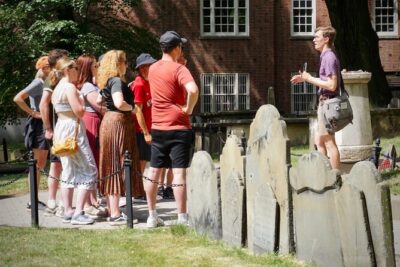
Freedom Trail History Small Group Walking Tour
Read our review →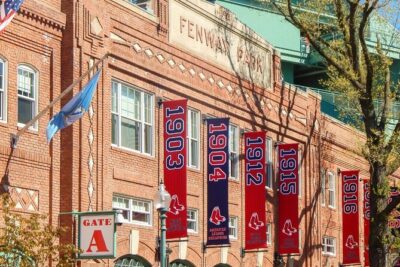
Tour of Historic Fenway Park, America’s Most Beloved Ballpark
Read our review →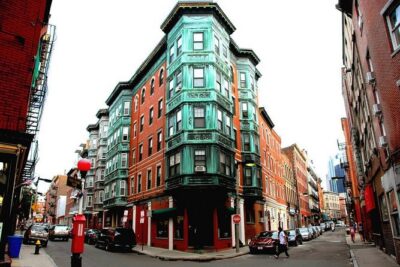
Boston Food & History: Pizza, North End & Freedom Trail
Read our review →Freedom Trail History Small Group Walking Tour
Read our review →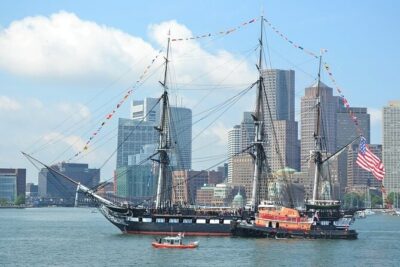
City Cruises Boston Historic Sightseeing Harbor Cruise
Read our review →
Boston Pizza Lovers Food and History Walking Food Tour
Read our review →
Boston Freedom Trail History Pub Crawl Small-Group Tour
Read our review →
Boston City View Bicycle Tour: History and Landmarks
Read our review →Browse the lists this tour appears in