
Review · LISBON
Historical Walking Tour of Lisbon
Lisbon tells its story one square at a time. This 2-hour-45-minute walking tour links Rossio, Praça do Comércio, Chiado, and Largo do Carmo, giving you a useful first look at the city’s past and present. I especially like the route’s clear sense of place and the guides’ lively storytelling. Logan, Nuno, Constança, André, Bruno, Kiara, and others have been praised for making dates, battles, writers, and revolutions easy to remember. The main drawback is the walking itself: Lisbon’s beautiful cobblestones and uphill streets can be hard work.
I also like the practical ending. You finish near the Carmo Archaeological Museum with a view over central Lisbon and a set of suggestions for food, viewpoints, shops, and things to do next. At $3.62 per person, it offers remarkable value, though you should confirm the tour is running because one booking was canceled without notice.
Key points to know before you go
- A central Lisbon route: Walk from Rossio Square through Rua Augusta, Praça do Comércio, Chiado, and Largo do Carmo.
- A strong history focus: Hear about the city’s early settlers, the 1755 earthquake, the Age of Discovery, royal conflicts, and the 1974 Carnation Revolution.
- The guides make the difference: Logan, Nuno, Constança, André, Bruno, Kiara, and other guides are praised for warmth, humor, storytelling, and useful advice.
- The route ends uphill: The finish near Carmo gives you a fine view over downtown, but the walk includes uneven pavement and inclines.
- Small-group setting: The tour has a maximum of 20 people, which should make questions and conversation manageable.
- Bring the basics: Wear comfortable shoes and carry water and sunscreen, especially in warm weather.
Starting in Rossio, where Lisbon’s story begins
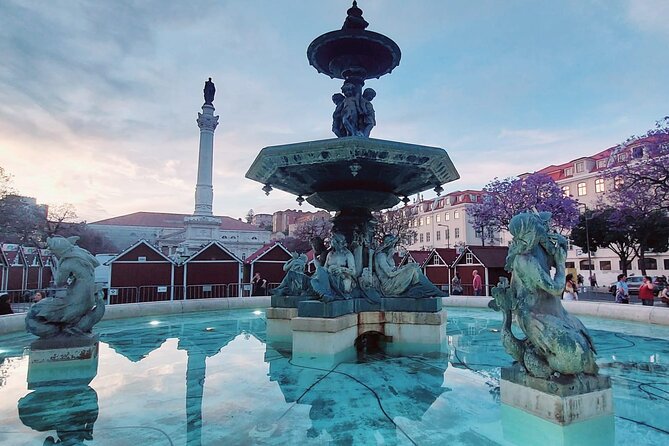
The tour starts in Rossio Square, officially Praça Dom Pedro IV. This is an easy meeting point in the middle of downtown, close to public transportation and surrounded by the patterned paving that gives Lisbon so much of its character.
The opening talk reaches back about 3,000 years to the first people who settled in the area. That broad time span helps you see Lisbon as more than a city of grand churches and tiled streets. Its story begins long before Portugal’s maritime empire.
Rossio is also a good place to begin because the square is busy with everyday city life. You can look at the wave-patterned pavement, the statue of Dom Pedro IV, and the surrounding buildings while the guide explains how the city developed around this central zone.
I would pay attention here even if you are eager to move on. The guide sets up several themes that return later, especially Lisbon’s position beside the Tagus River, its role as a gateway, and its repeated need to rebuild after disaster.
More History Walking Tours in Lisbon
- Lisbon: History, Stories and Lifestyle Walking Tour
★ 4.8 · 10,902 reviews - Lisbon: Private Dark History Walking Tour with Drinks
★ 4.8 · 387 reviews - Lisbon Essential Walking Tour: History, Stories and Lifestyle
★ 5.0 · 316 reviews
Praça da Figueira and the struggle for the crown
A short walk brings you to Praça da Figueira, or Fig Tree Square. This open square once held Lisbon’s largest public hospital, which was destroyed in the 1755 earthquake.
That fact gives the square a useful connection to the city’s greatest catastrophe. The earthquake, fire, and tsunami destroyed much of central Lisbon, and the story of reconstruction becomes one of the main threads of this walk.
The guide also uses Praça da Figueira to explain the battles over Portugal’s crown and the pressure exerted by neighboring powers. This section is useful if Portuguese politics are new to you. The tour does not treat Lisbon’s past as a simple parade of kings and explorers. It shows a country shaped by conflict, ambition, disaster, and rebuilding.
The stop is scheduled for about 15 minutes. That is enough time for an explanation and a look around, but not enough for a detailed visit to every surrounding building. Think of this tour as a city orientation with historical depth, not a museum tour.
Rua Augusta and the city rebuilt by reason
From Praça da Figueira, you walk along Rua Augusta, Lisbon’s main downtown artery. The street leads toward the river and is one of the clearest places to see the ordered style of the rebuilt city.
The architecture here reflects the Enlightenment ideas that shaped Lisbon after the earthquake. Streets were laid out with greater order, buildings followed a more regular plan, and the city was designed with practical concerns in mind.
This is where a good guide can make an ordinary stroll more meaningful. Without explanation, Rua Augusta can look like a pleasant pedestrian street lined with shops and cafes. With the historical context, its straight lines and rebuilt facades become evidence of a major urban project.
The walk through Rua Augusta also provides a natural change of pace. You are no longer standing in one square listening to a long explanation. You are moving through the city, seeing how the major spaces connect. Keep an eye on the pavement, since Lisbon’s stone sidewalks can be uneven.
Praça do Comércio and the Tagus gateway
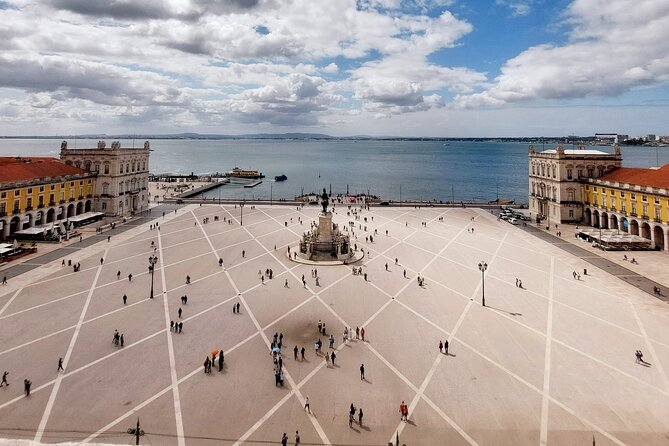
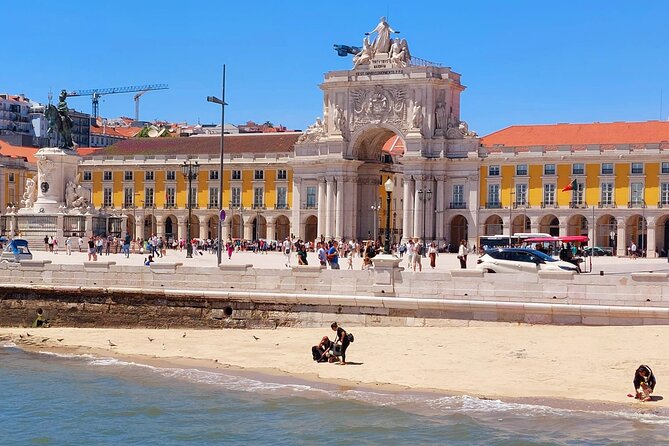
Praça do Comércio, also called Terreiro do Paço, is the grandest open space on the route. Its broad yellow buildings face the Tagus, and the square has served as an entry point to Lisbon for thousands of years.
The location explains much about the city. Goods, people, rulers, and news all arrived through this riverside gateway. The square’s position also connects Lisbon to the Age of Discovery, when Portuguese ships traveled far beyond Europe.
The guide covers the earthquake here, along with the rebuilding effort and the people who directed it. This is one of the most valuable parts of the walk because you can see the scale of the new city while hearing why it was planned that way.
Allow about 30 minutes at Praça do Comércio. That longer stop is welcome. There is enough space to look across the river, study the triumphal arch and surrounding buildings, and take photographs without feeling rushed.
You should also expect a story-driven explanation rather than a formal architectural lecture. The strongest guides on this tour, including Logan, Nuno, and André, are praised for using memorable stories and answering questions. That style suits this square, where the setting is dramatic but the details can otherwise blur together.
More History Walking Tours in Portugal
- Historic Walking Tour Through Lisbon’s Oldest Neighborhood
★ 5.0 · 233 reviews - Lisbon: 3-Hour The Slave Trade – An Historical Walking Tour
★ 4.9 · 179 reviews - Lisbon Fado History Cultural Walking Tour
★ 5.0 · 118 reviews - Lisbon: Historical Walking Tour with Jeronimos Monastery
★ 4.5 · 71 reviews
Chiado, books, cafes, and Lisbon’s writers
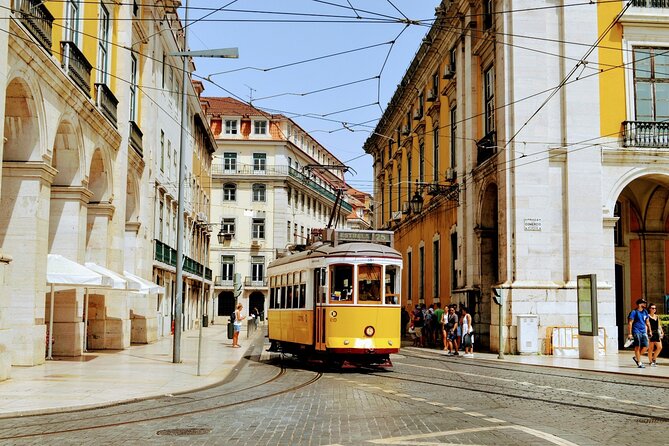
The route continues uphill toward Chiado, Lisbon’s art district. This area is linked with cafes, theaters, bookshops, nightlife, and the city’s writers and poets.
Chiado changes the tone of the tour. The earlier stops focus heavily on political power, disaster, and urban planning. Here, the guide shows how Lisbon’s cultural life took shape in streets where people gathered to read, debate, perform, and socialize.
A highlight is the chance to visit the world’s oldest bookshop. The stop is brief, so you should not expect a long browse or a detailed literary tour, but it adds a memorable detail to the walk.
The guide also introduces the stories of important Portuguese poets and writers. If you enjoy literature, this part may be one of your favorites. If you are mainly interested in monuments, you might find the stop less essential, but it still gives you a better feel for how Lisbon’s identity extends beyond royal buildings and maritime history.
Chiado is also a practical area to learn about early in your stay. You may want to return later for its cafes, bookshops, theaters, and evening atmosphere. The tour’s local suggestions can help you decide where to spend more time after the group separates.
Largo do Carmo and the Carnation Revolution
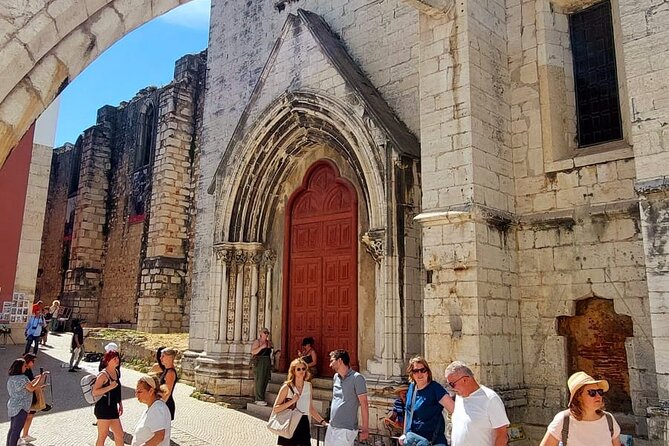
Largo do Carmo is one of the most memorable stops. The square is home to the Convento do Carmo, described as the second-oldest building in Lisbon. Its roofless ruins survived the 1755 earthquake and now create one of the city’s most striking historic spaces.
The convent offers a visual reminder of the earthquake that you cannot get from a rebuilt street plan alone. Broken arches and open sky make the damage visible, while the surrounding square shows how Lisbon continued to live and change around it.
Largo do Carmo also played a major role in the 1974 Carnation Revolution. This peaceful military coup ended Portugal’s authoritarian regime and is often remembered for the carnations placed in rifle barrels. The square connects the country’s medieval past, its twentieth-century politics, and its modern identity in one compact stop.
The scheduled time here is about 30 minutes, making it another place where the guide can tell a full story rather than rush through a name and date. Constança has been praised for explaining the city’s history with energy while adjusting the pace for people of different ages. That matters on this uphill section, where a thoughtful guide can make the group more comfortable.
Santa Justa and the final city view
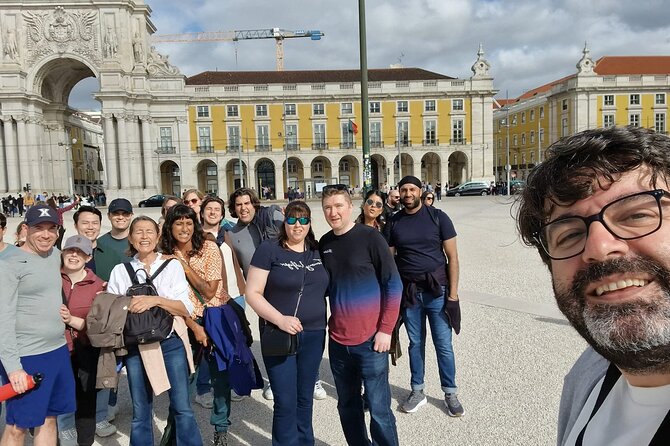
The tour includes a break near the Elevador de Santa Justa. This famous iron lift links the lower downtown streets with the higher Carmo area and is one of Lisbon’s best-known landmarks.
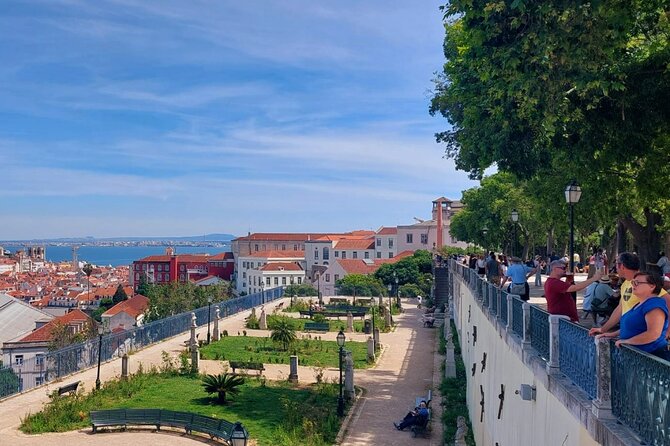
The stop is planned as a chance to enjoy a birds-eye view over central Lisbon and gather practical suggestions. You may hear about local food, viewpoints, and other places to visit during your stay.
The wording matters here. The experience includes a break and a view near the lift, but it does not say that a ride on the elevator is included. If riding Santa Justa is high on your list, treat that as a separate plan and check the arrangements on the day.
This is a sensible place to end. You are no longer at street level in the main shopping district, and the nearby Carmo Archaeological Museum provides a clear endpoint. From there, you can continue exploring the upper part of downtown or follow the guide’s advice about food and other sights.
What the guide adds to the experience
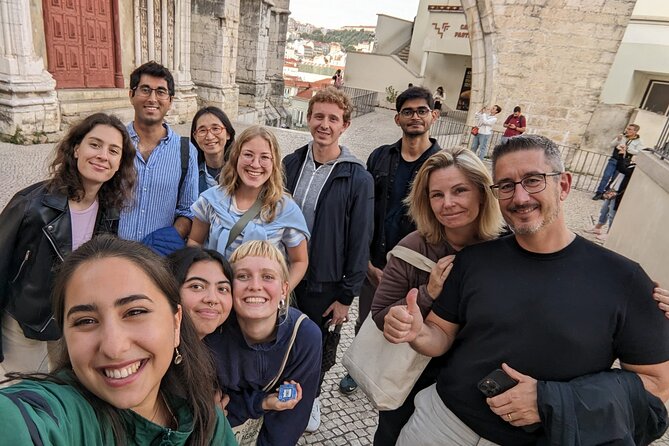
The route is strong, but the guide shapes the experience. The most praised qualities are clear storytelling, a friendly manner, the ability to answer questions, and practical suggestions for the rest of your visit.
Logan is repeatedly praised for animated stories and for covering a lot of ground in two hours. Nuno is described as engaging and especially good at making Lisbon and Portuguese history memorable. André is noted for checking that everyone could keep up and hear properly, which is a small but important sign of a well-run walk.
Bruno is a good choice for visitors who want more detail. Kiara is praised for adding cultural context, while Constança is described as energetic, thoughtful, and attentive to different ages and walking speeds. Other guides, including Antonio, Maria, Tomàs, and Constance, have also been credited with humor, warmth, and strong local advice.
You should not assume you will receive a specific guide unless your booking confirms one. Still, the pattern is clear: this tour works best when you enjoy asking questions and listening to stories, not just taking photographs at famous places.
Walking conditions, group size, and timing
This is a city walk, not a gentle flat stroll. You will cover several downtown areas, climb toward Chiado and Carmo, and walk over beautiful but sometimes uneven cobblestones.
Wear comfortable shoes. Bring water, and use sunscreen when the weather is bright. One particularly useful tip is to allow extra time and energy for the hills, especially if you are traveling with children, older family members, or anyone who dislikes uneven ground.
The group can include up to 20 people. That is large enough to create a social atmosphere but small enough for questions if the guide manages the group well. A smaller group would feel more personal, but the stated limit is still reasonable for a city introduction.
The total duration is approximately 2 hours and 45 minutes. The planned stop times add up to about 125 minutes, with the remaining time used for walking between places and explanations along the route. You should plan for the full period rather than expecting a quick one-hour overview.
The tour is offered in English and uses a mobile ticket. Most people can participate, and service animals are allowed. It requires good weather, so a poor-weather cancellation may lead to another date or a full refund.
Is $3.62 good value?
At $3.62 per person, this is unusually inexpensive for a guided introduction to central Lisbon. The value comes from the amount of orientation packed into one walk: major squares, the city’s rebuilding after 1755, the Age of Discovery, writers and bookshops, the Carnation Revolution, and practical advice for the rest of your stay.
The price is especially good if you are arriving in Lisbon with little background. A guide can show you how the downtown areas fit together, then point you toward places worth revisiting on your own.
There are limits. Admission tickets are not listed for the stops, so this is not a ticketed attraction tour. The walk focuses on outdoor sites and brief visits, and you should not expect extended time inside the Convento do Carmo, the archaeological museum, or other attractions.
The main concern is reliability. One booking was reported as canceled without notice, despite the customer arriving at the meeting point. That appears to be an isolated problem within otherwise very strong feedback, but I would still check your messages before leaving for Rossio Square.
Who should book this Lisbon walk?
I would choose this tour for a first or second day in Lisbon. It gives you a mental map of central neighborhoods and leaves you with ideas for meals, viewpoints, shops, and further sightseeing.
It is a good fit if you enjoy history, storytelling, and walking through a city rather than only entering major attractions. Families can enjoy it too, especially when the guide keeps the stories lively. One young teenager reportedly enjoyed the tour enough to share the historical details with family afterward.
You may want a different experience if you have limited mobility, dislike cobblestones, or want a flat route. The walk includes uphill streets and a fairly long period on foot. It is also less suitable if you want an in-depth museum visit or a specialist architectural tour.
Should you book it?
Yes, if you want an inexpensive, story-led introduction to Lisbon. The route covers the essential downtown sights, the guides receive unusually strong praise for warmth and storytelling, and the final recommendations can help shape the rest of your trip.
Book it early in your stay, wear sturdy shoes, and keep your schedule flexible enough to revisit the places that catch your attention. I would also check for any cancellation message before heading to Rossio Square. For the price, this is a practical way to get oriented, understand the city’s turning points, and begin exploring with better context.
FAQ
How long does the Historical Walking Tour of Lisbon last?
The tour lasts approximately 2 hours and 45 minutes, including walking between the main stops.
Where does the tour begin?
It begins at Rossio Square, officially Praça Dom Pedro IV, at Praça do Rossio, 1100-200 Lisboa, Portugal.
Where does the tour end?
The tour ends at the Carmo Archaeological Museum on Largo do Carmo, in the upper part of central Lisbon.
What places are included on the route?
The route includes Rossio Square, Praça da Figueira, Rua Augusta, Praça do Comércio, Chiado, Largo do Carmo, and the Elevador de Santa Justa area.
Is the tour offered in English?
Yes. The tour is offered in English and uses a mobile ticket.
How many people can join the tour?
The maximum group size is 20 people.
Are service animals allowed?
Yes. Service animals are allowed, and the tour is near public transportation.
Can I cancel for a full refund?
Yes, if you cancel at least 24 hours before the experience start time. Cancellations made less than 24 hours in advance are not refundable. If poor weather causes the tour company to cancel, you will be offered another date or a full refund.
Just added around Lisbon
- Porto Heritage & Wine: Exclusive Private Day Trip from Lisbon★ 5.0 · 26 reviews
- Private Evora Heritage and Alentejo Wine Tour from Lisbon★ 4.5 · 31 reviews
- Private tuk tuk tour through the historic center of Lisbon★ 5.0 · 31 reviews
- Lisbon in One Day Historic Small-Group Tour★ 4.5 · 110 reviews
- Obidos Medieval Village World Heritage Private Tour★ 5.0 · 34 reviews
- Special Guided Tour of Tuk Tuk Lisbon Historic 2 Hours★ 5.0 · 201 reviews
- Óbidos historic village and Mafra Palace Private Tour★ 5.0 · 34 reviews
- 2 Hours Private Hills Historical Tour in Lisbon★ 5.0 · 28 reviews
History Walking Tours, compared.
History and Hauntings of Salem Guided Walking Tour
Read our review →
Freedom Trail History Small Group Walking Tour
Read our review →
Historic Charleston Guided Sightseeing Walking Tour
Read our review →
Tapas Walking Tour with Food, Wine, and History
Read our review →
Savannah History and Haunts Candlelit Ghost Walking Tour
Read our review →
A History of Terror – Belfast City Centre Walking Tour
Read our review →Browse the lists this tour appears in