
Review · RIO DE JANEIRO
Rio's city walking tour: a glimpse of history and olympic legacy (Our Review)
Rio’s downtown tells a different story. This four-hour tour brings you into Old Rio, where grand churches, imperial buildings, market streets, museums, and broad public squares explain how the city grew. I like the focus on São Bento Monastery and the Church of Our Lady of the Candelaria, two of the city’s most impressive buildings. I also like the chance to see Mauá Square and the Olympic-era museums alongside older landmarks.
The tour costs $60.77 per person and includes pickup and return transport from most hotels in São Conrado, Leblon, Ipanema, and Copacabana. The main thing to consider is that the experience can feel more like a guided city introduction than a pure walking tour. Traffic, group size, and the guide can affect how much time you spend on foot.
Guides such as JB, also called Juan Bautista, Melanie, André, and Jean-Baptiste have earned praise for their warmth, local knowledge, and willingness to adjust the route. One guide was criticized for rushing and using his phone, so the quality of the experience depends heavily on who leads your group.
Key points to know before booking
- São Bento Monastery is the artistic high point: Its paintings and gilt carvings make the short visit especially worthwhile.
- The route links old and new Rio: Imperial squares and churches sit alongside Mauá Square, the Museum of Tomorrow, and Cobra’s huge street murals.
- Hotel transfers save time: Pickup and return are included from most hotels in São Conrado, Leblon, Ipanema, and Copacabana.
- The pace can be flexible: Smaller groups and private departures have allowed guides to change the route around personal interests.
- It is best for city orientation: You get a useful first look at downtown, with tips on markets, food, transport, and places to revisit.
- Expect moderate physical effort: The tour covers several downtown areas and may involve a fair amount of walking, though some groups spend more time in vehicles than expected.
What this Old Rio tour is really about
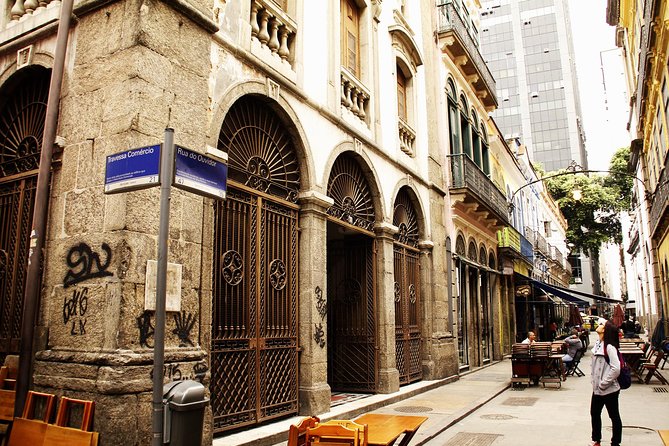
This is a history-and-architecture walk through central Rio, not a beach tour and not a broad survey of every major attraction. The route begins around the old port and imperial center, then moves through churches, squares, cultural buildings, market streets, and the cathedral area.
The tour starts at 1 p.m. and lasts about four hours. That timing gives you an afternoon introduction to downtown, though you should not expect every stop to receive a long visit. The listed visits to Candelaria, São Bento, Confeitaria Colombo, and the Metropolitan Cathedral are brief, often around 10 to 20 minutes each.
That short-stop format works well if you want a first look and plenty of background. It works less well if you hope to study every painting, museum display, or interior at length.
The group may include up to 35 people, but some departures have been much smaller. A few have turned into private tours, which gave the guide room to adjust the route. A small group can make a large difference in a city walk, especially when you want to ask questions or stop for photos.
More History Walking Tours in Rio de Janeiro:
- Rio de Janeiro: Little Africa Heritage Walking Tour
★ 4.9 · 177 reviews - Learn the History of Rio with an Unforgettable City Center Walking Tour
★ 5.0 · 82 reviews - Historical Downtown and Lapa – Walking Tour
★ 5.0 · 44 reviews
Candelaria Church and São Bento Monastery
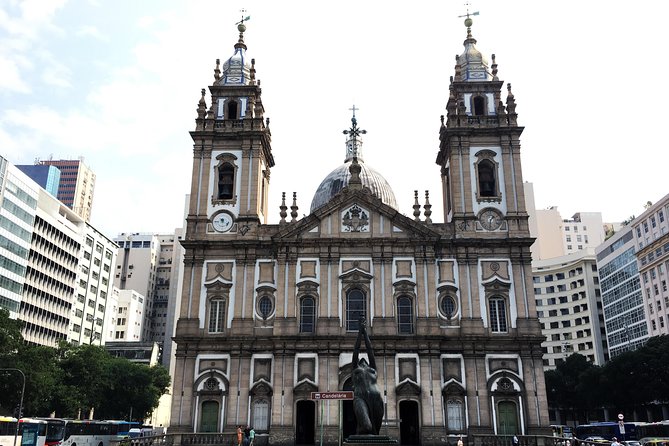
The Church of Our Lady of the Candelaria is one of the tour’s first major sights. Construction began in 1630 and finished in 1775. Its neoclassical design reflects the importance of Rio during the colonial period, when the city was growing into a major Portuguese center.
The visit is short, but the church gives you an immediate sense of the scale and ambition of old Rio. Look up and take your time with the details, since a quick guide explanation can pass over features you may want to examine yourself.
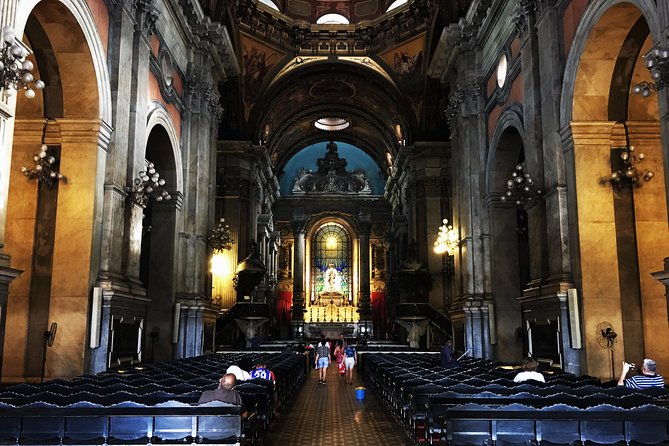
São Bento Monastery is the stronger stop for many people. Founded in 1590 by two monks from Bahia, it is considered one of Brazil’s important architectural treasures. Inside, paintings and gilded carvings create a striking contrast with the plain streets outside.
I would pay close attention here, even if the visit feels brief. The monastery’s interior is the kind of place that can justify much of the tour price on its own for visitors interested in religious art, Portuguese design, or Brazil’s early colonial period.
The monastery also offers useful city views. One guide pointed out the Museum of Tomorrow from there, giving the group a photo angle that is easy to miss if you visit each attraction separately.
Mauá Square and Rio’s Olympic legacy
The route then moves toward Mauá Square, an area reshaped by Rio’s Olympic legacy. The renewal created a new cultural center for downtown, with the Rio Art Museum, the Museum of Tomorrow, and large Cobra murals.
This part of the tour adds an important modern layer. You are not only looking at old churches and government buildings. You are also seeing how Rio has tried to turn its waterfront and former port area into a place for art, public gatherings, and museums.
The Museum of Tomorrow is viewed from outside. That is useful for orientation and photographs, but you should not expect an interior museum visit unless your guide specifically changes the plan. The same applies to some of the cultural centers along the route. You may pass or pause outside rather than receive a full museum tour.
The Cobra murals are a memorable visual break from the older architecture. Their scale helps you understand the size of the renewed public space, while the nearby museums show how the city’s cultural identity has changed.
Traffic can affect this section. One departure involved more driving than walking because of heavy traffic, while other groups spent much of the afternoon on foot. If walking is important to you, ask at the beginning how much of the route will be walked that day.
Imperial Square and Paço Imperial
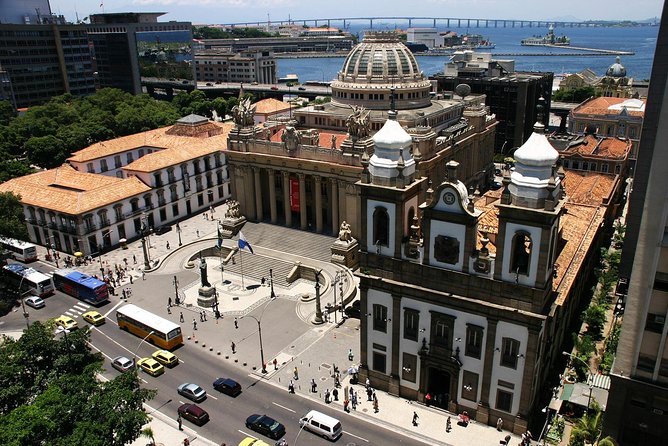
Praça XV de Novembro is one of the key historical spaces on the route. Brazil’s emperors were crowned here in the 1800s, and the square has witnessed major events in the country’s political story.
The square is valuable because it connects Rio’s architecture with the people and institutions that shaped Brazil. Your guide can explain the role of the monarchy, the Portuguese court, and the changing status of Rio as the country developed.
The Paço Imperial, or Imperial Palace, is another important stop. It was built in the 1700s as a residence and workplace for the governors of the captaincy. It later served as a home for the Portuguese Royal Family when it arrived in Brazil.
The building’s Portuguese style makes it easy to recognize, but the setting matters just as much. You are seeing a former seat of government in the middle of a district now filled with pedestrians, shops, markets, and city traffic.
Some visitors find that downtown Rio contains fewer preserved buildings than they expected. That is a fair point. This tour is strongest when your interest is in selected churches, squares, and public buildings, not in a continuous old quarter with untouched streets at every turn.
A few more history tours around Rio de Janeiro worth a look
- Rio de Janeiro: Historic Rio and Santa Teresa Half-Day Tour
★ 4.4 · 228 reviews - Ancient Rio and Santa Teresa Tour with Hotel pick-up and drop-off
★ 4.5 · 154 reviews - Olympic Boulevard, Museum of Tomorrow & Historical Rio
★ 4.5 · 66 reviews - Rio: Olympic Boulevard, Museum of Tomorrow & History Tour
★ 4.1 · 47 reviews
Uruguaiana Street, markets, and Tiradentes Palace
Uruguaiana Street takes you through one of the commercial parts of central Rio. The route passes famous market streets, giving you a look at ordinary downtown activity beyond the formal monuments.
This is a useful part of the afternoon because it breaks up the grand architecture. You see how the same central district serves shoppers, workers, residents, and visitors. The tour is not confined to polished museum spaces.
The market area near the cathedral can also be useful for a later snack or meal. A guide may suggest less tourist-focused places nearby, and one experienced guide offered practical advice on local food, transport, and ways to save money.
Tiradentes Palace is seen from outside. It adds another political landmark to the route, but do not plan on a full interior visit based on this experience alone.
The tour also includes a stop at Confeitaria Colombo, the famous bakery and café. You have about 20 minutes there, with admission listed as free, though food and drinks are not included. The ornate setting makes it a pleasant pause, but you will need to pay for anything you order.
One caution: a previous group felt that spending roughly 30 minutes in a beautiful tea shop reduced the time available for other sights. If Confeitaria Colombo matters to you, enjoy the stop. If you would rather walk farther, say so politely and early.
The Metropolitan Cathedral and Carioca Square
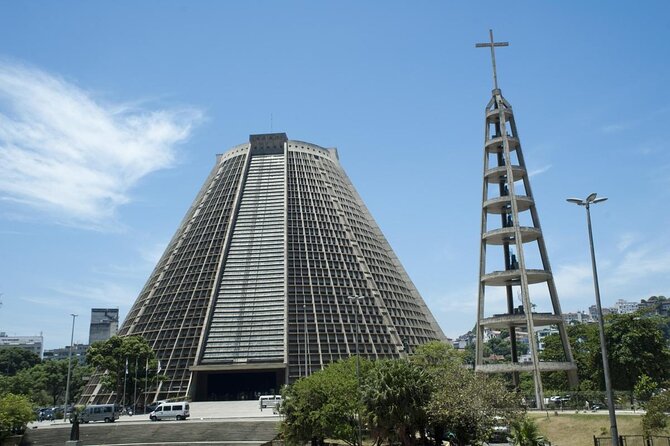
The final major sight is the Metropolitan Cathedral of Saint Sebastian, a large conical structure that looks unlike the older churches on the route. Its interior diameter is about 96 meters, with an external diameter of 106 meters and an overall height of 75 meters.
The cathedral’s unusual shape is the point. Instead of the traditional facade and long nave found at Candelaria or São Bento, you enter a vast modern space organized around a circular form. The contrast gives the tour a clear ending: colonial and imperial Rio gradually gives way to modern Brazil.
The tour concludes around the cathedral and Carioca Square. From there, you may continue exploring independently or take the return ride to your hotel, depending on the arrangements for your departure.
Check the exact ending with your guide. One group found that the tour stopped a block short of some planned sights, then continued independently later. The written route includes the Metropolitan Cathedral, but the actual finish can shift with traffic, timing, and group preferences.
How the guides affect the experience
The strongest part of this tour is often the guide rather than the transport or the schedule. JB, or Juan Bautista, is frequently described as energetic, warm, and passionate about Rio. He has been praised for explaining buildings passed during the drive as well as the main stops.
Melanie has also received warm praise for her friendly manner and for handling more than one language during a group. André was described as punctual, attentive, and willing to add places that matched the group’s interests.
Jean-Baptiste has guided private departures where he adjusted the route around places already visited. That kind of flexibility can turn a standard city walk into a more personal afternoon.
Still, the experience is not guaranteed to feel personal. One departure was criticized because the guide appeared distracted by his phone and rushed through the checklist. Another began with a pickup problem involving the wrong hotel and timing confusion.
I would confirm your hotel name, pickup point, and start time in advance. If you are meeting at a hotel where you are not staying, go inside to reception rather than waiting outside. One guide looked for the group there.
Walking, transport, and physical effort
The experience is advertised as a walking tour, but hotel pickup and downtown transfers are included. The balance between walking and driving can change.
Most of the route is described as a relaxed walk through the center, but traffic may force the vehicle to cover more ground. Other groups have walked briskly for much of the four hours. One visitor called the pace comfortable, while another described the guide as fast-moving and suggested avoiding the tour if you cannot walk for long periods.
A moderate fitness level is required. Wear comfortable shoes and expect to be on your feet around churches, squares, streets, and cultural sites. There is no need to treat it like a strenuous hike, but this is not a coach tour where you step off only for photographs.
The smaller the group, the easier it is to slow down or ask for an adjustment. With up to 35 people, the guide may need to keep a tighter schedule.
Is $60.77 a fair price?
At $60.77 per person, the price is reasonable if you value hotel pickup, a guide, and a structured introduction to downtown. The cost includes the walking tour and transport from most hotels in São Conrado, Leblon, Ipanema, and Copacabana.
The value is strongest on your first or second day in Rio. You get a map in your head, an explanation of the old center, and ideas for places to revisit on your own. The guide may also help with restaurants, market areas, transport, and other parts of the city.
The price feels less attractive if you are mainly seeking long interior visits or a slow architectural study. Food and drinks are extra, and several stops are viewed from outside or handled quickly.
You should also consider the pickup convenience. A local walking tour without hotel transport may cost less, but the included transfers can save time and reduce the stress of reaching central Rio on your own.
Who should book this Rio walking tour?
I would recommend it to first-time visitors who want an organized introduction before exploring downtown independently. It suits people who enjoy churches, architecture, city history, public squares, and local commentary more than those who want shopping or nightlife.
It is also a good choice for anyone who feels unsure about navigating central Rio alone. A local guide can help you understand the layout and move through the route with more confidence.
Couples, solo visitors, and small friend groups can all benefit, especially if the departure is small enough for questions and route changes. History fans should ask about São Bento, Paço Imperial, Praça XV, and the monarchy before the tour begins.
I would hesitate to book it if your main goal is the Museum of Tomorrow, since the museum is viewed rather than fully visited. I would also think twice if you have limited walking ability or dislike changing plans because of traffic.
Free cancellation is available up to 24 hours before the start time. Poor weather or too few bookings can also lead to a changed date or a full refund. The tour normally needs at least a minimum number of participants, so keep that possibility in mind when planning a tight itinerary.
Should you book it?
Book this tour if you want a practical first look at Old Rio, especially São Bento Monastery, Candelaria, the imperial center, Mauá Square, Confeitaria Colombo, and the Metropolitan Cathedral. Its best guides add stories, local advice, and flexibility that you may not get from a fixed route.
Skip it if you want long museum visits, a strictly pedestrian experience, or a guaranteed private guide. For most first-time visitors, though, the tour offers a useful afternoon of orientation and enough memorable architecture to point you toward the parts of downtown worth exploring again.
FAQ
How long is Rio’s city walking tour?
The tour lasts approximately four hours.
What time does the tour begin?
The scheduled start time is 1 p.m.
Is hotel pickup included?
Yes. Pickup and return are included from most hotels in São Conrado, Leblon, Ipanema, and Copacabana.
What is the price?
The listed price is $60.77 per person.
What sights are included?
The route includes the Church of Our Lady of the Candelaria, São Bento Monastery, Mauá Square, the Museum of Tomorrow from outside, Praça XV de Novembro, Paço Imperial, market streets, Tiradentes Palace from outside, Confeitaria Colombo, and the Metropolitan Cathedral.
Are food and drinks included?
No. Food and drinks are not included. The Confeitaria Colombo stop is included, but you pay separately for anything you order.
How much walking is involved?
You should expect a moderate amount of walking through downtown Rio. The exact balance can change because traffic may lead to more driving on some departures.
What size can the group be?
The tour can have a maximum of 35 travelers, though some departures have been much smaller or private.
Can I cancel for a full refund?
Yes, if you cancel at least 24 hours before the local start time. Cancellations made less than 24 hours in advance are not refunded.
Just added around Rio de Janeiro
- Rio Jewish Heritage Half-Day Tour★ 5.0 · 35 reviews
- Imperial Petrópolis – Historic Tour + Teresa Street and Lunch★ 4.5 · 44 reviews
- Historic Petrópolis From Rio: The Imperial City –Palaces, Architecture & Culture★ 5.0 · 32 reviews
- Historical Downtown and Lapa – Walking Tour★ 5.0 · 44 reviews
- Learn the History of Rio with an Unforgettable City Center Walking Tour★ 5.0 · 82 reviews
- Petropolis Bohemia: Historic tour and visit to the Bohemian Brewery★ 4.5 · 45 reviews
- Centro Historico and Lapa – Santa Teresa Walking, Historical and Bohemian Tour★ 5.0 · 44 reviews
- Explore the history and culture of Favela da Rocinha★ 5.0 · 30 reviews
History Walking Tours, compared.
History and Hauntings of Salem Guided Walking Tour
Read our review →
Freedom Trail History Small Group Walking Tour
Read our review →
Historic Charleston Guided Sightseeing Walking Tour
Read our review →
Tapas Walking Tour with Food, Wine, and History
Read our review →
Savannah History and Haunts Candlelit Ghost Walking Tour
Read our review →
A History of Terror – Belfast City Centre Walking Tour
Read our review →Browse the lists this tour appears in