
Review · QUEBEC CITY
Old Québec & French Canada Private History Walking Tour: Rated 5 out of 5
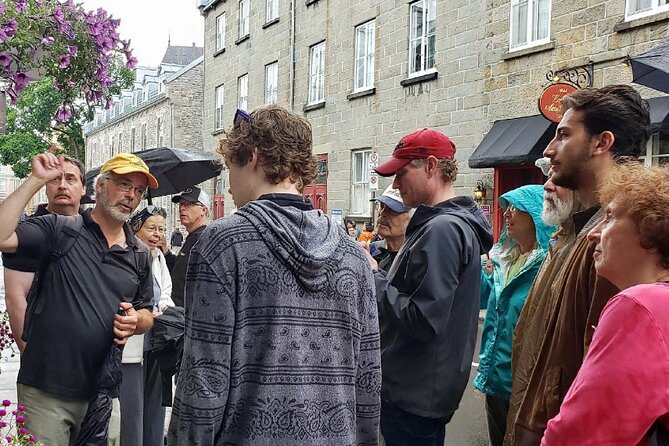
Quebec City tells its story in layers. This private walking tour links French settlement, British rule, the American invasion of 1775, and modern Canadian identity in one focused route through Old Québec. I especially like the way the guide connects local events to American history, and I like that the tour uses maps, timelines, and historic images along with the streets and buildings around you.
The main consideration is pace. In about two and a half hours, you cover roughly a mile and pass a remarkable number of sites. That gives you a strong first look, but some stops are explained from the outside rather than explored at length. You should also be ready for stairs, slopes, and uneven pavement.
Key points at a glance
- A private group of up to 10: You get a more personal walk than on a large city tour, with room for questions and changes in emphasis.
- French and American history together: The tour explains Quebec’s role in the French and Indian War, the 1775 American invasion, and the Treaty of Paris.
- About one mile through Old Québec: The route covers Upper Town, Lower Town, the old walls, Place Royale, Petit-Champlain, and the Old Port.
- Maps and visual aids: Guide Michel Perron carries timelines, maps, and historic pictures that help make complicated events easier to follow.
- A native local guide: Michel was born and raised in Quebec and brings a personal Canadian view to the relationship between Quebec, Canada, France, Britain, and the United States.
- Useful before a longer stay: The tour is a strong orientation for first-time visitors who want to know which streets, museums, and monuments deserve more time later.
Why this short history walk works
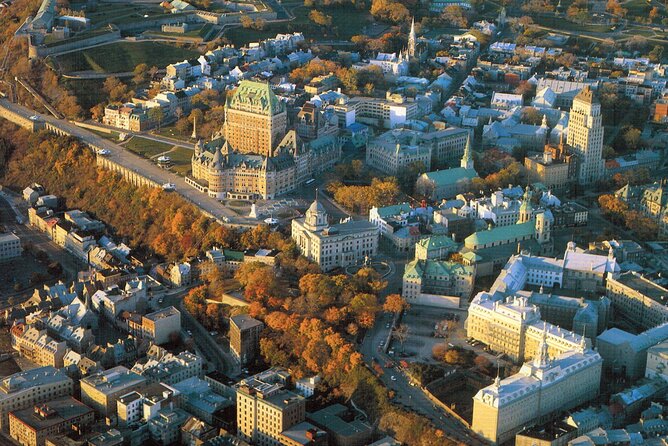
Quebec City can feel like several cities at once. You have a French colonial center, British military defenses, a provincial capital, a major Catholic center, and a port tied to the interior of North America. The buildings are handsome, but without context, it is easy to see only attractive streets and stone walls.
This tour gives those places a timeline. You move from the early French settlement to the British conquest, then to the failed American attack of 1775 and the development of modern Canada. I like that the story does not treat Quebec as an isolated old town. It explains how events in Quebec connect with the American Revolution, the Louisiana Purchase, the War of 1812, and the Treaty of Paris.
The private format matters here. A group of up to 10 can stop for questions without holding up a large crowd. The guide can also adjust the explanation to the people in front of him. One family found the tour engaging for a 7-year-old, a 13-year-old, and two adults, while couples and solo visitors appreciated the more detailed historical discussion.
Michel Perron is the guide most often identified with this experience. He is described as warm, flexible, energetic, and deeply familiar with the city. He uses printed material from his backpack, including maps, timelines, and old images. Those tools are especially useful when he explains fortifications that have changed or buildings that now serve a different purpose.
More History Walking Tours in Canada
- Gastown Historic Walking Food Tour
★ 5.0 · 1,863 reviews - Vancouver: Gastown Historical Walking Food Tour
★ 4.8 · 539 reviews - Quebec City: Old Quebec Historical Walking Tour
★ 4.8 · 409 reviews
Starting with Canada’s battles and defenses
The opening part of the route focuses on military history. You learn about the early French settlers and the major battles that shaped Quebec City through 1776. This is a good beginning because military geography is central to understanding the city. Quebec controlled access along the St. Lawrence River, so its high ground and defensive walls mattered far beyond the town itself.
The route includes a museum devoted to Canada’s military past and the battles around Quebec City. The tour does not appear to be built around a long museum visit, so think of this stop as historical framing rather than a full indoor museum tour. If military history is your main interest, ask the guide how much time is available at this point.
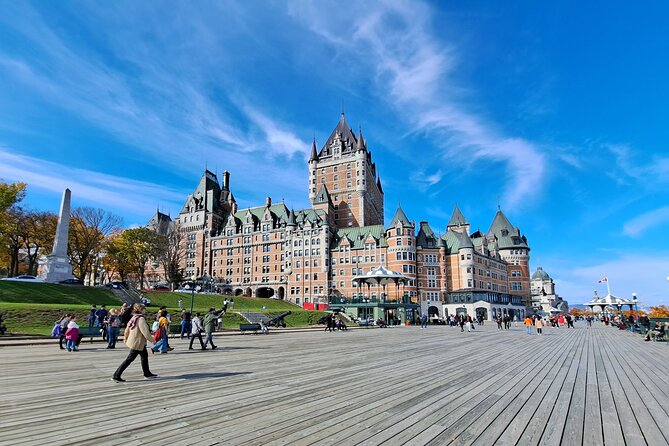
You then reach the great hotel that began life in 1893 as a Canadian Pacific Railway project. Today it is the Fairmont Le Château Frontenac, one of Quebec City’s best-known buildings. Its importance is not only architectural. The hotel represents the railway era and the effort to link Canada from coast to coast. That gives you a useful bridge from colonial Quebec to the creation of modern Canada.
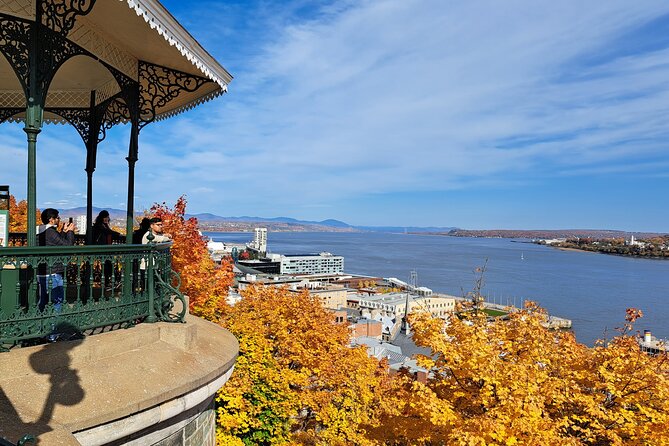
The boardwalk near the hotel brings together royal memory, scenic views, and buried history. It was built after modern Canada took shape, while the forts and Château Saint-Louis National Historic Site lie below it. The former castle served as the residence of French governors until the French and Indian War. You can look out over the river while standing above layers of political and military history.
From the French and Indian War to British Quebec
A war monument recalls the French and Indian War in Canada. The wording can be confusing for American visitors because the conflict is part of the larger Seven Years’ War, yet its meaning in Quebec is direct: French power in Canada was defeated, and the 1763 Treaty of Paris transferred Canada to Britain.
The tour then reaches a structure associated with British Quebec, built in the year of the Louisiana Purchase, 20 years after American independence. This stop helps place Quebec in the wider North American story. The city was not simply reacting to events in Europe. It was part of a changing continent where borders, empires, and trade routes were being redrawn.
A later fortification was added after the War of 1812, when the American threat again shaped Quebec’s defenses. This is one of the stronger parts of the tour for anyone interested in how cities respond to danger. The walls and military works were not built only for appearance. They reflect fears of invasion and the strategic value of the St. Lawrence corridor.
The Plains of Abraham provide the central battlefield stop. This is where the British defeated the French in the key battle of the French and Indian War. Unlike Yorktown or Chalmette, where American history is often the main frame, this battlefield explains why Canada became British after the 1763 Treaty of Paris.
The guide’s Canadian perspective is useful here. Several visitors specifically valued his explanation of the relationship between Quebec and the United States, including the events of 1775 and 1776. If you know the American side of the Revolution but not the Canadian side, this is likely the most rewarding part of the walk.
Walking the walls and entering Upper Town
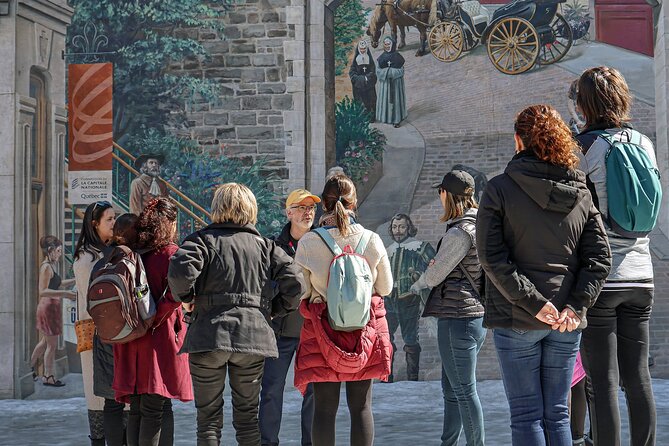
The French and British ramparts protected a strategic outpost that controlled the St. Lawrence route toward the center of the continent. Walking beside them gives you a clear sense of why Quebec City looks different from most North American cities. The walls are not decorative ruins. They define the old center and mark the military importance of the site.
The Upper Town portion mainly covers the UNESCO World Heritage area inside the walls. It contains a dense run of sites from roughly 400 years of history. That density is both the pleasure and the challenge. You can see major landmarks within a short distance, but the amount of information can become a lot to absorb.
You pass the Quebec legislature, where the province’s government meets. Quebec is Canada’s only French-speaking province, and Quebec City remains its capital even though Montreal is larger and more populated. This stop adds present-day political context to the older military and religious story.
The route also includes the first school for girls in North America and a major museum connected with French art and Catholic education. It is one of the important French heritage institutions in Old Québec. You may want to return for a longer visit if the school’s history, religious art, or education interests you.
Another major institution is the first hospital in North America, now connected with wellness services and a museum. Like the girls’ school, it shows how French Catholic institutions shaped daily life in the colony. The tour gives you the background, while a separate indoor visit would allow time for the exhibits.
The founding cathedral of Catholicism in French America is another major stop. Its diocese once covered an enormous area, extending from Quebec City toward New Orleans. That fact alone explains the scale of Quebec’s religious influence in French North America.
The route also reaches a school that trained French Catholic missionaries sent across French territories in North America. Today the buildings include the School of Architecture of Université Laval and a high school. Seeing a former missionary institution in its present use is a good reminder that historic buildings in Quebec are not all frozen in the past.
Same place, a different slice of the past:
- Victoria Guided Food and History Tour
★ 5.0 · 2,015 reviews - Evening Gourmet Tour 5 Course Dinner – History and Food in Old Quebec City
★ 5.0 · 496 reviews - Peggy’s Cove & Halifax Historic Tour
★ 4.5 · 375 reviews - Montreal History Guided Sightseeing Cruise
★ 3.5 · 363 reviews
Lower Town, Place Royale, and the birthplace of Canada
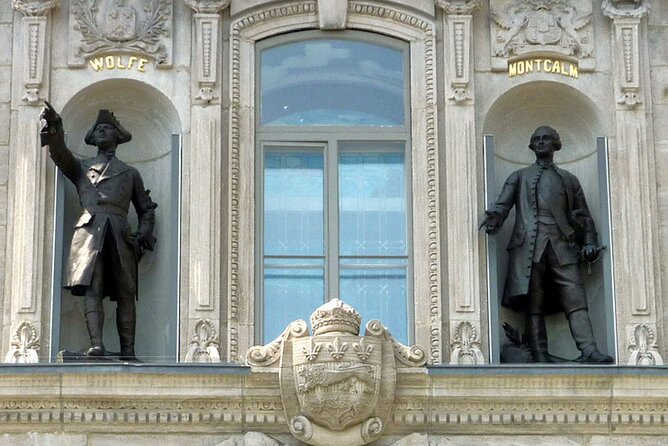
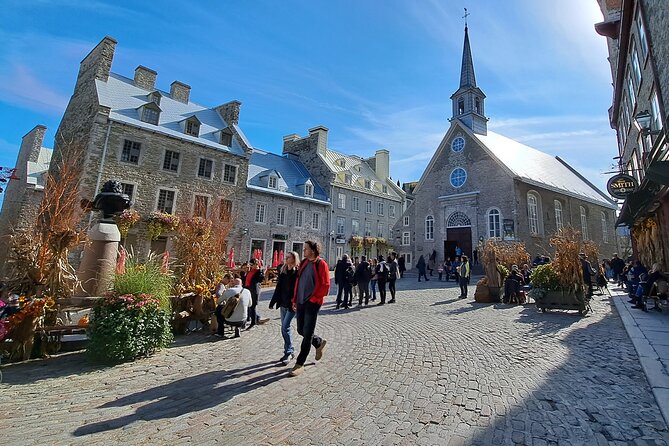
The walk descends toward Lower Town, which includes Place Royale, Petit-Champlain, and the Old Port. This section has a different feel from Upper Town. It is closer to the river, trade, early settlement, and the city’s commercial life.
The site where Samuel de Champlain founded Quebec City in 1608 is described as both Canada’s Jamestown and Williamsburg on the same ground. It has been continuously occupied since then. That makes this one of the essential stops, even if the later buildings around it attract most of the attention.
The same area was once part of a proposed museum district project from the 1970s that was never completed. That unfinished plan adds a modern layer to the story. Old Québec is not only a preserved colonial setting. It has also been shaped by changing ideas about tourism, museums, conservation, and urban renewal.
One shopping area in Lower Town grew from a 1980s project led by two local architects. Their goal was to bring high-end artisan shops into a declining part of the Old Port. Today, the area is among the top shopping zones in Old Québec. This is a useful stop for understanding how historic districts can be revived without losing their visual identity.
A major museum in the area focuses on the history of Canada and Native peoples. It is considered one of the leading museums in Old Québec, but the two-and-a-half-hour walk does not leave much room for a full visit. I would treat the tour as a way to decide which museum deserves your own afternoon.
The American invasion and the old financial district
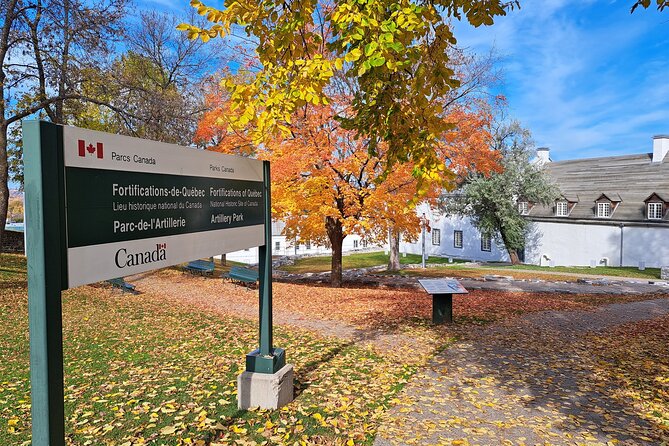
The tour pays unusual attention to the failed American invasion of Canada in 1775. Benedict Arnold and Richard Montgomery led separate efforts, and both were defeated. For American visitors, this is an important correction to the familiar Revolutionary War story. The campaign did not end with Canada joining the rebellion.
The sites connected with that invasion occupy land reclaimed from the water during French, British, and Canadian periods. This same area became an old financial district and is now associated with art and antique shops. The shift from military target to commercial quarter gives the stop several layers of meaning.
The guide’s maps and timelines are especially useful here. The geography of the attack, the river, the walls, and the old port can be hard to picture while standing among later buildings. Visual material helps turn a complicated campaign into something you can follow.
Gates, stairs, and the city’s vertical character
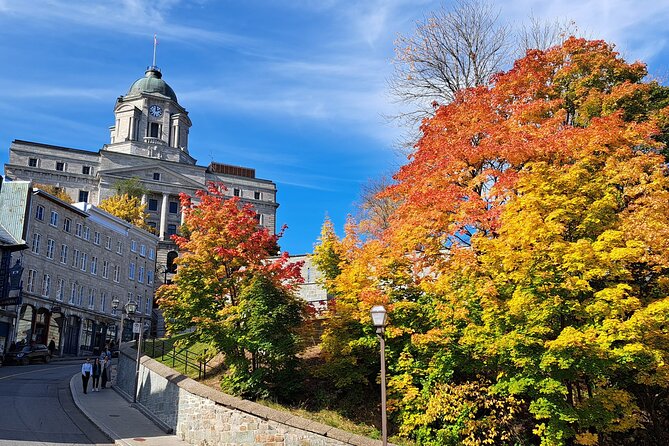
One of the old gates in the French rampart appears on the route. The original military structures had narrow openings and doors, but later versions were rebuilt to look more medieval. This change came during Lord Dufferin’s 1875 improvement plan and reflects the historicist taste of the period.
That detail is worth hearing because it complicates the idea of Old Québec as a perfectly untouched colonial town. Some features are original. Others were restored, rebuilt, or reshaped to present a particular image of the past. A good guide helps you separate those layers.
The Breakneck Stairs link Petit-Champlain and Upper Town. The name tells you something about the climb. You should expect stairs and a noticeable change in elevation, even though the total walk is only about a mile. The stairs are an important part of understanding the city’s layout, but they may be tiring for anyone with limited mobility.
The route also includes a cannon platform added during King William’s War, when Frontenac defeated invaders from Boston led by William Phips. This earlier conflict adds another chapter to the long pattern of attacks aimed at Quebec. The military story here is not limited to one famous battle.
What the pace and price mean
The price is $213.92 per group for as many as 10 people. For a full group, that is a strong value, especially because the price is shared rather than charged per person. Even a smaller group may find it worthwhile if you want a private guide and a history lesson shaped around your questions.
The value depends on how you use the tour. It is not designed as a relaxed stroll with long stops at every attraction. It is an orientation walk with a lot of ground covered in a short time. I would schedule it near the start of your stay, then return to the museums, churches, ramparts, and shopping areas that catch your interest.
The tour lasts about two hours and 30 minutes. Hotel pickup is offered if your hotel is in Old Québec, with the guide meeting you in the lobby five minutes before the start. If you stay outside Old Québec, the guide will suggest an easy meeting point.
The tour is offered in English and is private for your group. Confirmation arrives within 48 hours, subject to availability. Service animals are allowed, and the route is near public transportation. You should have moderate physical fitness for the walk, stairs, and changes in elevation.
Free cancellation is available up to 24 hours before the start time for a full refund. Changes made less than 24 hours before the tour are not accepted, so check your plans before that cutoff.
Who should book this tour?
I would choose this tour if you are visiting Quebec City for the first time and want a clear framework before exploring on your own. It also suits families, couples, solo visitors, and anyone interested in the connection between Canadian and American history.
History fans will get the most from it, especially if you want more than architectural photographs. Families may appreciate the private format because the guide can adjust the explanations to different ages. The walk is also a good fit for people who prefer a focused introduction rather than a full-day program.
I would hesitate only if you want extensive indoor museum time, a slow photography walk, or a route with very little climbing. The tour covers many places, but the reward is breadth and context, not long visits inside each institution.
Should you book it?
Book this private walk if you want Quebec City explained as a living place shaped by French settlement, British conquest, American attack, religion, trade, and modern Canada. Michel Perron’s maps, timelines, local background, and flexibility add real value to the short route.
If you have only one day in Quebec City, this is an efficient way to get oriented. If you already know the city well or prefer to explore at your own pace, you may find the schedule too packed. For most first visits, though, the combination of private attention, strong historical focus, and access to both Upper and Lower Town makes the price sensible.
FAQ
How long is the Old Québec walking tour?
The tour lasts approximately two hours and 30 minutes.
How large can the private group be?
The private tour is available for groups of up to 10 people.
What language is the tour offered in?
The tour is offered in English.
Is hotel pickup available?
If your hotel is in Old Québec, the guide will meet you in the hotel lobby five minutes before the tour. If your hotel is outside Old Québec, the guide will suggest an easy meeting point.
How physically demanding is the walk?
You should have a moderate level of physical fitness. The route covers about one mile and includes stairs, including the steps linking Petit-Champlain with Upper Town.
Is the tour suitable for children?
Yes. The private format allows the guide to adjust the discussion to the group, and the tour has been enjoyed by families with children aged 7 and 13.
Can I cancel for a full refund?
Yes. You can cancel at least 24 hours before the experience start time for a full refund. Cancellations or changes made less than 24 hours before the start are not accepted.
More Private History Tours in Canada
- Old Quebec City Private Walking Tour : History and Nature
★ 5.0 · 104 reviews - Private Montreal City Tour by Car, History & Hidden Gems
★ 5.0 · 22 reviews - Private Historical Walking Tour of York
★ 5.0 · 1,324 reviews - Private Guided Historic Electric Cart Tour of St. Augustine
★ 5.0 · 1,194 reviews
Just added around Canada
- Immersion Quebec: Virtual Reality Experience of Quebec City’s History★ 4.5 · 51 reviews
- 5-course Progressive Dinner on Grande-Allée and History Tour★ 5.0 · 27 reviews
- Old Quebec City Private Walking Tour : History and Nature★ 5.0 · 104 reviews
- Historical Lower Town & Neighborhoods Bike Tour★ 5.0 · 70 reviews
- Mi’kmaq Heritage Path Tour★ 5.0 · 23 reviews
- Admission 1 person – Visit of the Acadian Historic Village★ 4.5 · 40 reviews
- Private Montreal City Tour by Car, History & Hidden Gems★ 5.0 · 22 reviews
- Rabbis, Writers and Radicals: Montreal Jewish History Walking Tour★ 4.5 · 52 reviews
History Walking Tours, compared.
History and Hauntings of Salem Guided Walking Tour
Read our review →
Freedom Trail History Small Group Walking Tour
Read our review →
Historic Charleston Guided Sightseeing Walking Tour
Read our review →
Tapas Walking Tour with Food, Wine, and History
Read our review →
Savannah History and Haunts Candlelit Ghost Walking Tour
Read our review →
A History of Terror – Belfast City Centre Walking Tour
Read our review →Browse the lists this tour appears in