
Review · DRESDEN
Walking Through Dresden’s Past with Dr. Fraser Macdonald
Dresden rewards a closer look. This two-hour walk with Dr. Fraser Macdonald links the Elbe, Neustadt, and Altstadt while showing how religion, war, politics, and rebuilding shaped the city. I like the route because it covers major sights without treating Dresden as a string of pretty façades. I also like Fraser’s human approach, shaped by his anthropology background and praised for connecting old events with modern Dresden.
The main drawback is simple: admission fees are not included, and the tour does not enter the museums, Dresden Castle, or Dreikönigskirche. You will see and discuss these places from outside, then return on your own if you want to go in. The roughly one-mile walk is manageable, but good weather matters and the group can reach 30 people.
Key points to know before booking
- A cross-city route: Begin at the Golden Rider in Neustadt, cross Augustus Bridge, and finish at Theaterplatz in the Altstadt.
- History with a human angle: Fraser connects Dresden’s buildings to the people, beliefs, languages, and political forces behind them.
- A useful first-day tour: The route gives you a clear sense of the city and helps you choose museums and sights for the rest of your stay.
- Major sights plus less obvious stops: You see the Frauenkirche and Dresden Castle, but also the lost Sophienkirche site and the former Altendresden district.
- Two hours, not a full sightseeing day: The short format works well if you have limited time or want room for museums afterward.
- Plan for extra costs: Museum für Sächsische Volkskunst costs €5, Dreikönigskirche costs €5 to climb the tower, and Dresden Castle costs €14.
Why this short Dresden walk works so well
Dresden can be confusing at first. The Elbe divides the city, the grand Baroque center sits south of the river, and Neustadt has a separate identity and story. This walk gives you a physical map as well as a historical one.
You begin in Neustadt at Neustädter Markt, beside the Golden Rider. You finish on Theaterplatz, surrounded by some of Dresden’s most important cultural buildings. In between, the route moves from early settlement to monarchy, religious change, wartime destruction, the German Democratic Republic period, and later rebuilding.
That range is the tour’s real value. You are not only looking at restored churches and royal buildings. You are learning why they were built, what happened to them, and what their condition says about Dresden at different points in time.
Fraser’s strongest quality appears to be his delivery. The praise is unusually consistent: people describe him as friendly, engaging, funny, and easy to follow. His anthropology background adds a useful perspective, especially when the subject shifts from architecture to language, identity, religion, or the treatment of earlier communities.
The tone is also personal rather than formal. Fraser has been praised for taking time to speak with people individually, answer questions, and offer suggestions for the rest of a Dresden visit. That matters on a compact tour because there is little time for long pauses or side trips.
More History Walking Tours in Germany
- Leipzig: 1.5-Hour Historical Walking Tour in German
★ 4.7 · 2,217 reviews - Berlin: History of the Third Reich Guided Walking Tour
★ 4.7 · 791 reviews - Trier: Guided Old Town Highlights and History Walking Tour
★ 4.7 · 687 reviews
Starting beside the Elbe at Köpckestraße
The first stop is on the riverbank along Köpckestraße, where Dresden was first permanently settled. This is an effective beginning because it starts with people rather than palaces.
Here, you consider the culture, language, and eventual displacement of the people who lived in the area before Dresden became the royal city most visitors know. The stop lasts about 15 minutes and has no entrance fee.
Do not expect a major interior sight at this point. The value is the setting and the framing. Standing beside the Elbe helps you understand why the river matters to Dresden’s layout and identity. It also prevents the city’s story from beginning too neatly with Saxon rulers and grand architecture.
This opening suits anyone who wants more than dates and building names. It also gives families and history-focused visitors a useful question to carry through the rest of the walk: who had power here, and who did not?
The former monastery behind the folk-art museum
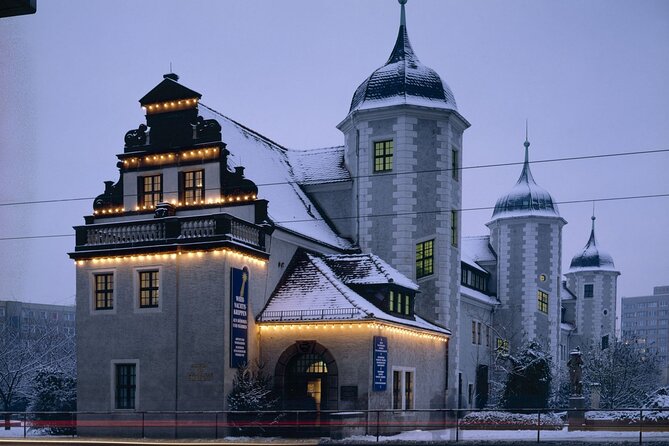
The route continues to the Museum für Sächsische Volkskunst mit Puppentheatersammlung. You do not enter the building as part of the tour, but Fraser explains how the site changed over time.
Its story begins in the 15th century as a wealthy Augustinian monastery. After Luther’s Reformation, the monastery was demolished and the site became a royal hunting lodge in the 16th century.
That sequence neatly captures Dresden’s religious and political shifts. The change was not simply architectural. It reflected the loss of Catholic institutional power, the spread of the Reformation, and the growing authority of the Saxon court.
The stop lasts about 15 minutes. If folk art or puppetry interests you, you can return later and pay the €5 entrance fee. The tour itself does not include that ticket, so you can decide based on your interests rather than being pushed through another museum during the walk.
Dreikönigskirche and the story of Altendresden
At Haus der Kirche, also called Dreikönigskirche, the focus turns to the former Altendresden district. The church is now a beautiful Baroque landmark, but the important point is the long story beneath its current appearance.
Fraser covers the site’s history from the early 15th century and explains its role in this part of the city. You do not enter the church or climb the tower during the guided portion. The stop takes about 15 minutes.
The tower is an optional extra. Climbing it costs €5, and you can do that later at your own pace. Since the walk crosses the river afterward, you may prefer to save the climb for another time, especially if you want to keep the group moving.
This is one of the places where the tour’s outside-only format can be both useful and limiting. You get context before deciding if the interior or tower deserves part of your afternoon. But if you hoped for a guided look inside every church, this experience will not provide that.
Same place, a different slice of the past:
- Leipzig: City History Canal Sightseeing Tour on a Motorboat
★ 4.7 · 7,671 reviews - Berlin: 3-Hour World Heritage Cruise to Potsdam
★ 4.5 · 1,569 reviews - Heidelberg: Night Watchman Historic Adventure Tour
★ 4.7 · 1,186 reviews - The Local Tour of Hamburg Historic Centre
★ 5.0 · 1,058 reviews
Crossing Augustus Bridge into the royal city
From Altendresden, you cross Augustus Bridge toward the Altstadt. This is more than a convenient connection between stops. It gives you a clear shift in setting, from the north bank and former Altendresden to the grand center associated with the Saxon court.
The bridge also creates one of the walk’s best opportunities to understand Dresden’s layout. You can look back toward the Neustadt side, then ahead toward the domes, towers, and palace buildings of the historic center.
Several people who took the walk singled out the route and its views. The appeal is easy to understand: a bridge crossing gives you room to pause, take photographs, and see how the river organizes the city.
Frauenkirche: seven centuries beneath a Baroque dome
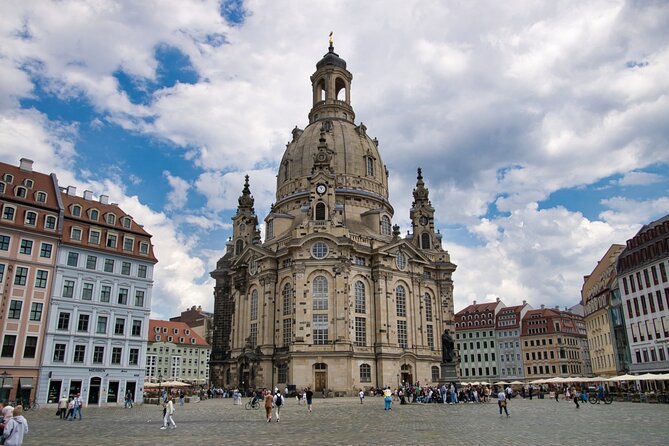
The Frauenkirche receives about 20 minutes of attention. The church is famous for its Baroque form, but Fraser places it within a 700-year story.
You learn about the church’s earlier phases, its construction in the Baroque period, and the structural and religious changes it witnessed. The guided tour does not enter the building or its museums, although you are free to return later.
This stop works best when you look beyond the finished exterior. Dresden’s center can seem almost too polished, especially around the Frauenkirche. The longer timeline helps you see the building as a changing institution, not just a rebuilt landmark.
The stop also gives Fraser room to address difficult parts of Dresden’s recent past. Questions about the Second World War bombing often arise here, and his ability to explain that subject has been specifically praised. If wartime destruction and reconstruction matter to you, this is likely one of the most useful parts of the walk.
Holy Cross Church and Reformation-era Dresden
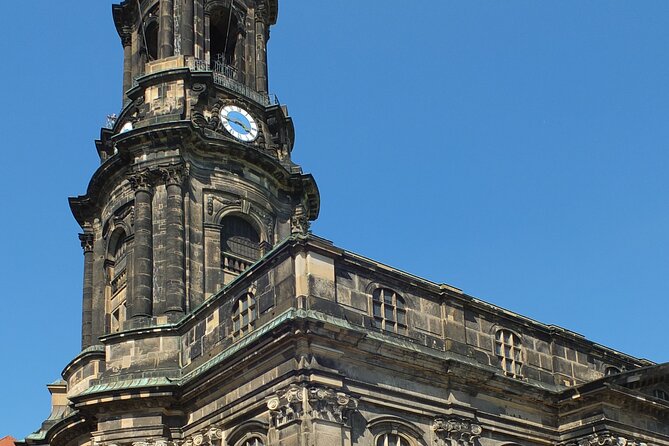
The next stop is Holy Cross Church, or Kreuzkirche. The discussion reaches back to the church’s original construction in the 13th century and follows its repeated destruction over time.
You also hear about its connection to key moments in the Reformation. That makes it a good counterpoint to the Frauenkirche. Instead of seeing one famous church as an isolated masterpiece, you begin to recognize how Dresden’s religious buildings were repeatedly altered by fire, conflict, politics, and changing forms of worship.
The stop lasts about 15 minutes and has no additional admission cost. The tour does not promise an extended interior visit here, so expect an exterior-focused explanation rather than a church service, museum visit, or architectural lecture.
Denkraum Sophienkirche and a church that disappeared
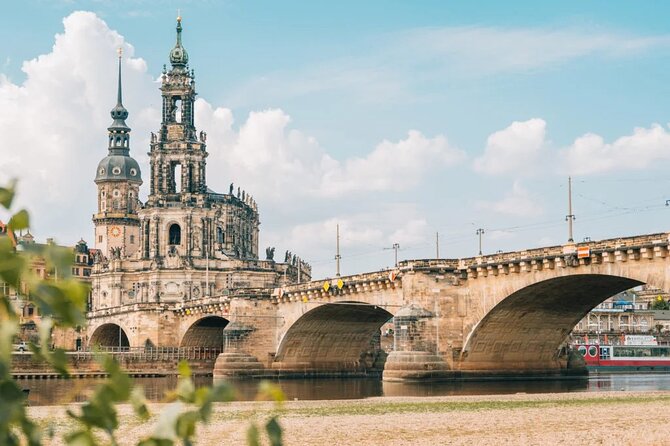
Denkraum Sophienkirche is one of the route’s most distinctive stops. It tells the story of Dresden’s first Franciscan monastery, originally built in the 13th century, and the later Sophienkirche that rose from that religious history.
The church was eventually lost, but its story did not vanish. Fraser uses the site to explain how Dresden’s political and religious currents changed over time. Among the stops, this one may offer the strongest sense of absence. You are thinking about a major church that is no longer part of the city’s visible skyline.
The stop lasts about 20 minutes. That is a generous amount of time for a place that many people could easily walk past without knowing what once stood there.
This is also where the route moves furthest from a standard highlights walk. You still see the famous center, but you also learn how much of Dresden’s past survives through fragments, memory, and interpretation rather than intact buildings.
Dresden Castle and the rise of Saxon power
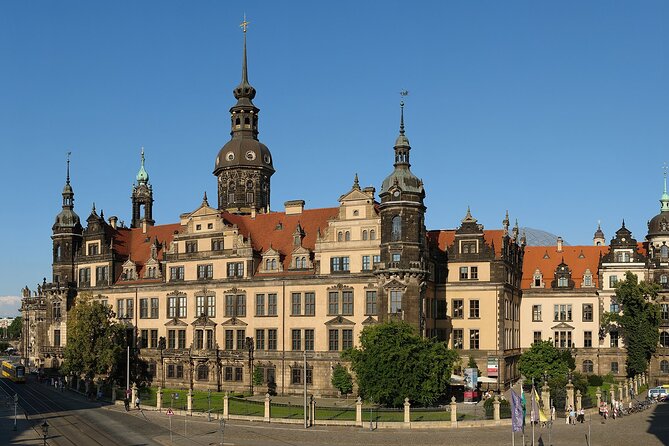
The final stop is Residenzschloss, or Dresden Castle. The castle helps explain how Dresden grew from a relatively small city into one of the most important centers in the Holy Roman Empire.
Fraser discusses the palace as a residence for the Electors and Kings of Saxony, then uses its transformations to show how royal ambition changed the city. The stop takes about 20 minutes.
You do not enter the castle or its museums during the walk. The separate admission fee is €14, which makes this a place where you may want to plan another visit rather than squeeze in a rushed entry at the end.
The castle is an especially useful final stop because it gathers many of the tour’s themes in one place: religion, court power, wealth, architecture, political status, destruction, and rebuilding. You finish with a better sense of why Dresden’s center looks the way it does.
Finishing at Theaterplatz
The tour ends at Theaterplatz, a practical and attractive place to stop. From here, you can explore the Zwinger, Semperoper, Dresden Castle, and the surrounding Altstadt at your own speed.
You can also take a tram to your next destination. That makes the ending flexible. You are not left at an isolated meeting point or forced to retrace the entire route.
Theaterplatz is a good launch point for a longer afternoon. You might continue into a museum, return to the Frauenkirche, or simply walk through the central district with the historical framework now in place.
Price, pace, and what you really receive
At $60.34 per person, this is not the cheapest way to get a quick orientation. The price makes more sense if you value a live guide who can connect Dresden’s buildings to long political and cultural changes.
The walk lasts about two hours and is described as roughly a mile. That is a strong fit for a first morning, a short stop in Dresden, or anyone who wants time afterward for museums. The pace has been praised as steady without feeling rushed, and the route covers enough ground to show both Neustadt and Altstadt.
The maximum group size is 30. That is not an intimate private walk, though the experience may feel more personal if the group is smaller on your date. If you prefer quiet conversation and plenty of time for questions, check the expected group size when possible.
Budget for optional admissions:
- Museum für Sächsische Volkskunst: €5
- Dreikönigskirche tower: €5
- Dresden Castle: €14
You do not need to pay for any of these to take the walking tour. That is useful if you want an affordable overview, but less useful if your main goal is a guided interior visit.
Who should book this Dresden experience?
I would choose this walk if you are visiting Dresden for the first time, have only a day, or want a clear introduction before tackling the museums. It also suits history fans who care about religious change, the Second World War, the German Democratic Republic period, and the way architecture reflects political shifts.
You will get the most from it if you enjoy listening, asking questions, and looking closely at places that do not always appear on a short list of top attractions. Fraser’s style appears especially well suited to people who want stories and connections, not just a list of construction dates.
Families can take part, and most people can manage the route. Service animals are allowed, and the meeting point is near public transportation. Since the walk depends on good weather, bring suitable clothing and keep a little flexibility in your schedule.
The main limitation is the lack of included interior access. If you want to spend most of your time inside Dresden’s churches and museums, you will need to add those visits yourself.
Should you book it?
Book this tour if you want a thoughtful two-hour orientation that joins Dresden’s famous sights with overlooked sites and difficult chapters. Dr. Fraser Macdonald’s strongest contribution appears to be his ability to make architecture feel connected to real people, religious change, political power, and modern identity.
Skip it if you want a private tour, extensive interior visits, or a full-day museum program. For most first-time visitors, though, the route gives you a useful map, solid historical context, and plenty of ideas for the hours that follow. Its best value is not the number of sights packed into two hours. It is the clearer understanding you carry into the rest of Dresden.
FAQ
Where does the Dresden walking tour begin?
It begins at the Golden Rider, Neustädter Markt 14, 01097 Dresden, Germany.
Where does the tour finish?
The tour ends at Theaterplatz, 01067 Dresden, Germany.
How long does the tour last?
The walk lasts approximately two hours.
What language is the tour offered in?
The tour is offered in English.
Is the tour suitable for first-time visitors?
Yes. It is designed as an introduction to Dresden’s history and culture and covers both Neustadt and Altstadt.
Does the tour enter Dresden Castle?
No. The guided walk discusses Dresden Castle from outside. You may visit the castle and its museums independently, with admission listed at €14.
Are church and museum admissions included?
No. Entrance to Dreikönigskirche, its tower, and the Museum für Sächsische Volkskunst is not included. Each of those listed admissions costs €5.
How many people can join the tour?
The experience has a maximum group size of 30 people.
Can I cancel for a full refund?
Yes, if you cancel at least 24 hours before the experience’s start time. Cancellations made less than 24 hours in advance are not refunded. If poor weather or an insufficient minimum number of participants causes cancellation, you will be offered another date or experience, or a full refund.
Just added around Germany
- Historic Dresden Private Walking Tour★ 5.0 · 32 reviews
- Historic center of Berlin – Tour in Italian★ 5.0 · 143 reviews
- Berlin Food & Cultural Tour: Must-Try German & Berliner Classics★ 5.0 · 51 reviews
- Small-Group Historical Bike Tour in Berlin★ 4.5 · 103 reviews
- Private Berlin WWII and Cold War History Tour with Local Expert Guide★ 5.0 · 28 reviews
- Private Tour: Jewish Heritage Walking Tour of Berlin★ 5.0 · 29 reviews
- East Berlin Food & History Tour with Eating Europe★ 5.0 · 204 reviews
- Explore Berlin History and Highlights Sightseeing Walking Tour★ 5.0 · 81 reviews
History Walking Tours, compared.
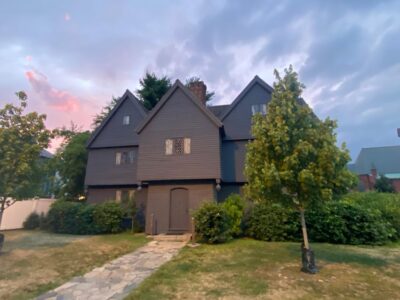
History and Hauntings of Salem Guided Walking Tour
Read our review →
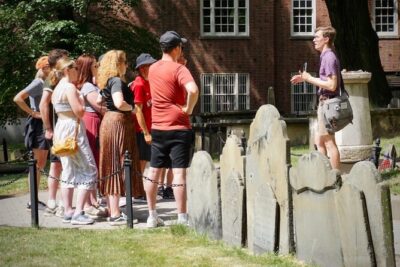
Freedom Trail History Small Group Walking Tour
Read our review →
Historic Charleston Guided Sightseeing Walking Tour
Read our review →
Tapas Walking Tour with Food, Wine, and History
Read our review →
Savannah History and Haunts Candlelit Ghost Walking Tour
Read our review →
A History of Terror – Belfast City Centre Walking Tour
Read our review →Browse the lists this tour appears in