
Review · BUCHAREST
Guided Walking Tour of Historical Bucharest
Bucharest tells its story in layers. This three-hour private walk links medieval ruins, grand avenues, Orthodox churches, and the scars of Ceaușescu’s rule, giving you a useful first look at Romania’s capital. I like the route’s wide reach and the chance to hear personal insight from guides such as Alina, who is praised for her energy and command of Romanian history. The main drawback is the pace: expect a long walk, possibly around 17,000 steps, with plenty of standing and listening.
I also like the value. At $30.77 per person, a private experience with hotel pickup and drop-off included can be a sensible way to get oriented before exploring alone. Still, this is not a light stroll through pretty streets. The route can run longer than three hours, and the discussion sometimes leans heavily toward politics, recent history, and the guide’s own views.
Key points to know before you book
- The route covers two very different Bucharests: the medieval Old Princely Court and Lipscani meet the massive socialist boulevards built under Ceaușescu.
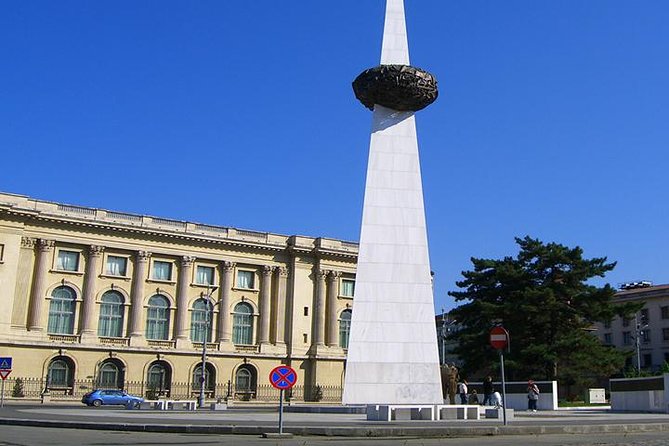
- The 1989 Revolution receives serious attention: you see the former Communist Party headquarters, Ceaușescu’s final-speech balcony, and the Memorial of Rebirth.
- This is a private tour: only your group takes part, so you can ask questions and set the pace to some degree.
- Alina is the guide most often singled out: her lively delivery, personal memories, and strong opinions shape the experience.
- Come prepared to walk: comfortable shoes, water, and protection from the weather matter, especially in summer or winter.
- The tour is best early in your stay: it provides a city map in your head and ideas for food, drinks, and further sightseeing.
Starting at Manuc’s Inn in Bucharest’s Old Town
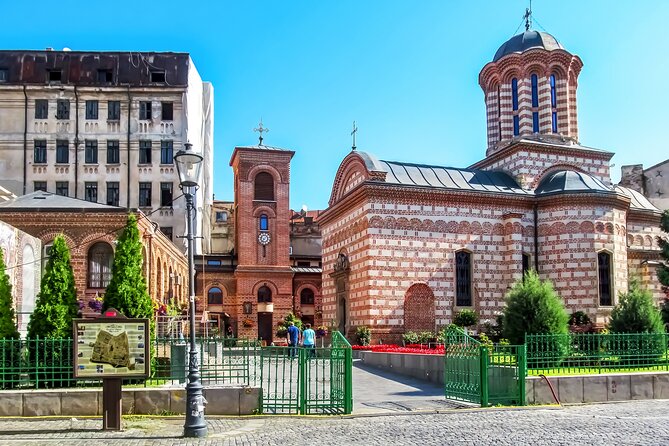
The meeting point is outside the main entrance of Manuc’s Inn, at 62 Strada Franceză. This is a fitting place to begin. The inn is one of Bucharest’s oldest and best-known establishments, and its courtyards and historic atmosphere introduce you to the city before the walking really gets going.
From here, the guide explains the old inn and St. Anton Orthodox Church, once the coronation church of Wallachian rulers. That pairing gives you an early lesson in Bucharest’s character: trade, religion, politics, and royal power have long occupied the same few streets.
The opening section is not just a march from one photo stop to another. It sets up the city’s older identity, before later rulers and governments reshaped it. You will hear about buildings and institutions as well as the people who used them.
More History Walking Tours in Romania:
- Bucharest: Communism and History Guided City Walking Tour
★ 4.9 · 918 reviews - Roma Culture, Realities and Slavery History, Walking tour
★ 4.9 · 52 reviews - Half-Day Jewish Heritage Walking Tour in Bucharest
★ 5.0 · 20 reviews
Old Princely Court and the story of Vlad the Impaler
The first major stop is the Old Princely Court, where the ruins of the former palace of Wallachian rulers remain. It is one of the oldest surviving sites in Bucharest and is linked with Vlad the Impaler, the historical figure later associated with Dracula.
Do not expect an intact castle. The appeal is in the fragments and the stories attached to them. A short stop here helps you connect modern Bucharest with the medieval principality of Wallachia. Admission is listed as free, and the planned visit lasts about five minutes, though the guide may spend longer explaining the site.
This is a good example of the tour’s method. It uses a modest physical remain as a doorway into a much larger story. If you want a long archaeological visit, this stop will feel brief. If you want context while walking through the center, it works well.
Union Square and the socialist boulevard
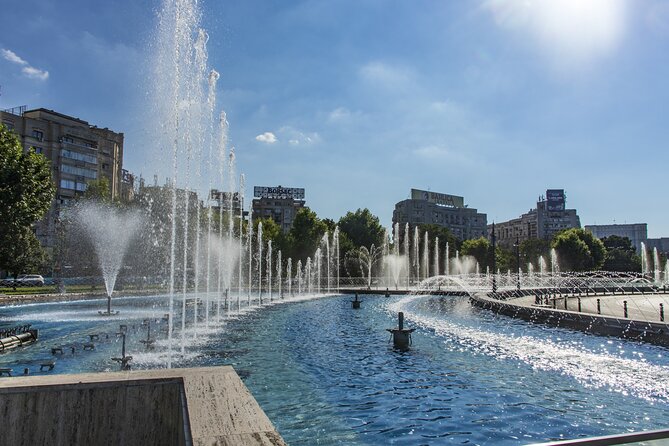
The route then reaches Piata Unirii, the heart of central Bucharest. Its refurbished fountains provide one of the better photo stops, but the square matters for more than appearance. It is a major urban space where old central Bucharest meets the huge city planning projects of the communist period.
From here, you walk along Bulevardul Unirii, once called the Boulevard of Socialist Victory. Its nickname, Romania’s Champs-Élysées, tells you something about the ambition behind it. The broad avenue was designed to project state power and ceremonial grandeur.
The scale can be startling. This is not the intimate Bucharest of narrow lanes and old inns. The avenue was built to frame the Palace of Parliament and to serve political display. Your guide explains how Ceaușescu’s dictatorship altered the city, including the way older areas were cleared and monumental spaces were imposed on the urban core.
You will probably pause often for photographs. The stated stop at the boulevard is short, but the view toward the Palace of Parliament gives the route one of its clearest visual moments.
Palace of Parliament and Constitution Square

The Palace of Parliament dominates the next part of the walk. From the boulevard, you continue toward Piata Constitutiei, the large square directly in front of the parliament building.
The tour focuses on exterior views and photo opportunities rather than an interior visit. That distinction matters. The building is so large that even a short explanation helps you understand its role, but you should not book this walk expecting a guided tour inside the palace.
Constitution Square gives you room to take in the building’s scale. It also reinforces the contrast between the palace and the older city you saw earlier. The route moves from medieval Wallachia to a twentieth-century dictatorship in only a few blocks.
This section can feel exposed in hot or cold weather. Bring water and dress for the forecast. One person reported walking more than 17,000 steps without moving at a fast pace, so the open spaces and long avenues add up.
More Guided Tours in Romania:
- History and Hauntings of Salem Guided Walking Tour
★ 5.0 · 14,564 reviews - Edinburgh: Edinburgh Castle Guided History Tour with Tickets
★ 4.8 · 9,933 reviews - Historic Charleston Guided Sightseeing Walking Tour
★ 5.0 · 6,216 reviews - Rome: Colosseum with Arena, Roman Forum and Palatine Guided Tour
★ 4.0 · 5,598 reviews
Churches, CEC Palace, and Victoria Avenue
After the monumental avenues, the walk turns back toward older central streets. You hear about a church built in 1724 and the history of the CEC Palace, one of Bucharest’s most recognizable historic buildings.
The CEC Palace is especially useful for understanding the city’s architectural mix. Bucharest does not present one tidy style. You see Orthodox churches, nineteenth-century civic buildings, grand commercial architecture, communist blocks, and newer repairs all close together.
Part of Victoria Avenue brings shops and elegant façades into the picture. This section is less about ticking off a single famous attraction and more about noticing how the city changes from block to block.
I like this part because it keeps the tour from becoming only a lesson about dictatorship. You get religion, finance, commerce, and urban design in the same walk. If your main interest is architecture in a technical sense, ask questions early. The tour’s strongest emphasis is usually the history behind the buildings, not a detailed breakdown of every architectural feature.
Lipscani, Macca-Villacrosse, and the National Bank
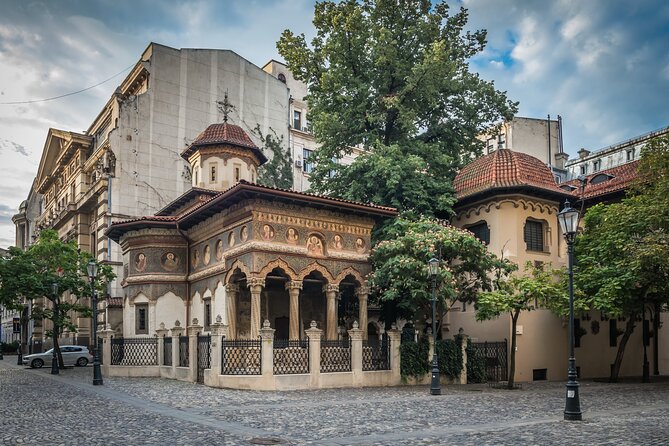
The walk enters Bucharest’s old center, an area with more than 500 years of urban history. This is where the streets become more intimate and the atmosphere shifts again.
You pass through the Macca-Villacrosse Passage, an ornate covered passage with its own past, and see the National Bank of Romania. You may also enter or look into restored old inns, restaurants, and other historic interiors along the way.
These smaller spaces help explain why Bucharest is often called a city of contrasts. A grand bank can be near a worn church, a polished passage, or a building that has survived several political eras. The route gives you enough background to see these places as part of a continuing city rather than as disconnected photo stops.
The old center is also where orientation can become tricky. Narrow streets and alleyways do not always make it obvious where you are in relation to the previous stop. Keep your phone map available if you want to retrace the route later, and ask the guide to point out how the streets connect.
University Square and the city’s public institutions
University Square brings you to one of Bucharest’s major civic areas. The University of Bucharest was founded in 1864 under Alexandru Ioan Cuza, and the square has long been tied to education, public debate, and political change.
Nearby, you see Suțu Palace, now the History Museum of Bucharest and formerly the residence of Costache Suțu. You also pass Colțea Hospital and Church, the National Theatre, and other central institutions.
The National Theatre has gone through several design changes, which makes it a useful example of how Bucharest has repeatedly rebuilt and revised itself. Colțea adds another layer, linking medicine, religion, and public life in the center.
This part is valuable if you want more than famous monuments. The guide connects places that still function as part of daily Bucharest with the political events discussed later. You are not simply looking at façades. You are learning why these streets became important gathering points.
The 1989 Revolution at Revolution Square
The most serious section of the walk takes place around the area where the Romanian Revolution of 1989 began. Here you see Biserica Kretzulescu, the former Communist Party headquarters, the University Library, King Carol I’s equestrian statue, and the balcony where Nicolae Ceaușescu gave his final public speech.
The Memorial of Rebirth rises 25 meters above the square. It commemorates the struggles and victims of the Christmas 1989 Revolution. The monument has a striking and sometimes puzzling form, so the explanation matters more than a quick photograph.
This is where the tour’s focus on recent political history becomes most useful. You hear how the dictatorship affected the city and how the events of 1989 changed Romania. Guides may also draw on memories of life under communism, which can make this part more personal than a standard monument tour.
You should know what you are signing up for. Politics is not a brief side note here. It is central to the route. One guide, Alina, is admired for her passion and personal perspective, but some people have found her political opinions too prominent or her discussion of controversial claims uncomfortable. If you prefer a strictly neutral presentation, ask at the start for a focus on documented events, buildings, and social history.
The Military Circle and the final stretch
The last part includes the Military Circle and the Sărindar Fountains. These provide another look at formal civic architecture and carefully designed public spaces.
You also see a historic building and gardens created for the people of Bucharest more than a century ago. The final stops help round out the city beyond the medieval quarter and communist monuments. They show how Bucharest’s public identity has also been shaped by civic pride, military institutions, gardens, and older urban improvements.
The activity is listed as ending back at the meeting point. Hotel pickup and drop-off are also offered, so confirm the exact arrangement when booking if you want transport rather than simply meeting in the Old Town. One group found the return journey confusing after the tour, so it is sensible to clarify where you will finish and how you plan to get back to your hotel.
What the guide adds to the walk
The guide can make or break a history walk, and Alina receives especially strong praise for her enthusiasm, humor, personal stories, and ability to make events feel immediate. She has been described as lively, attentive to questions, and willing to suggest places for lunch, dinner, and drinks.
Her approach is not a memorized list of dates. You may hear about Romanian society, family memories, religion, the communist era, monarchist rule, and Romania’s place between Eastern and Western Europe. That broad view is one reason the tour can feel like a half-day experience even though it is scheduled for roughly three hours.
There are tradeoffs. English was occasionally difficult for one participant to follow, and another found the political discussion too strong. The tour also sometimes runs longer than planned. If you have a fixed lunch reservation or an afternoon train, allow extra time.
Is $30.77 good value?
At $30.77 per person, the price is reasonable for a private three-hour walk that covers a large part of central Bucharest. You are paying for a guide, route planning, historical explanation, and the flexibility of a tour limited to your own group.
The value is strongest if you are new to the city and want a broad orientation. You see the Old Town, major squares, the Palace of Parliament from outside, University Square, Revolution Square, churches, banks, theatres, and old passages in one outing.
The value is weaker if you want extended time inside museums or monuments. Several stops are brief, and admission to interiors is not the central feature. This is a city overview with historical storytelling, not a museum program.
The tour has a 4.8 rating from 84 published ratings, with 94 percent recommending it. Those numbers fit the experience’s main strengths: strong guide engagement, wide coverage, and a lively explanation of Bucharest’s past.
Who should book this Bucharest walk?
I would choose this tour early in a Bucharest stay if you enjoy history, political change, architecture, and personal storytelling. It suits adults, couples, families with older children, and anyone who wants to understand why the city looks so uneven and varied.
You should have moderate physical fitness. Comfortable shoes are essential, and water is a smart addition. Summer heat can make the route demanding, while winter conditions can make a three-hour walk feel longer.
I would not choose it if you want a slow café walk, a purely architectural tour, or a carefully neutral account of twentieth-century politics. I would also avoid scheduling it immediately before another fixed appointment.
Should you book it?
Book it if you want a strong first orientation to Bucharest, especially one that connects the Old Town with Ceaușescu’s monumental city and the 1989 Revolution. The route covers a lot, and the private format gives you room to ask questions.
Skip it if long walks wear you down or if you would rather explore a small number of sites in depth. For most history-minded visitors, though, the price, coverage, and guide-led storytelling make this a useful introduction. Free cancellation is available up to 24 hours before the start time, and poor weather can lead to a new date or a full refund.
FAQ
How long is the Guided Walking Tour of Historical Bucharest?
The tour lasts about three hours, although it can run longer depending on the guide and the questions asked.
Where does the tour start?
It starts outside the main entrance of Manuc’s Inn, Hanul lui Manuc, at Strada Franceză 62 in Bucharest’s Old Town.
Where does the tour finish?
The activity is listed as ending back at the meeting point. Hotel pickup and drop-off are also offered, so confirm the details for your booking.
Is hotel pickup available?
Yes. Hotel pickup and drop-off are included as an offered feature, while the stated meeting point is Manuc’s Inn.
Is the tour private?
Yes. Only your group participates in the activity.
How much walking is involved?
A moderate level of physical fitness is advised. One account described more than 17,000 steps during the walk, so comfortable shoes and water are recommended.
Can I cancel for a full refund?
Yes. You can cancel at least 24 hours before the local start time for a full refund. Poor weather may result in a different date or a full refund.
Just added around Romania
- Private Tour – Food, Culture, History & Traditions★ 5.0 · 18 reviews
- Half-Day Jewish Heritage Walking Tour in Bucharest★ 5.0 · 20 reviews
- Bucharest Historical Food Tour in Old Center★ 5.0 · 21 reviews
- Bucharest Jewish Heritage | Holocaust Memorial | Private Car Tour★ 5.0 · 38 reviews
- Bucharest Heritage City Tour – The Last Days of Communism★ 5.0 · 20 reviews
- Experience the History of Bran Castle and Saxon Fortifications in Burzenland★ 5.0 · 19 reviews
- Roma Culture, Realities and Slavery History, Walking tour★ 4.9 · 52 reviews
- Private Bucharest: History & Food with Traditional Meal★ 5.0 · 34 reviews
History Walking Tours, compared.
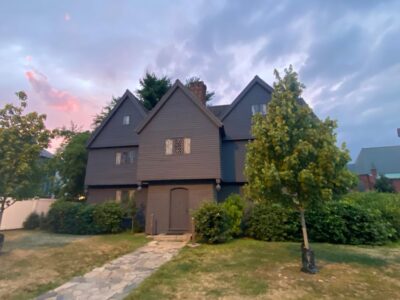
History and Hauntings of Salem Guided Walking Tour
Read our review →
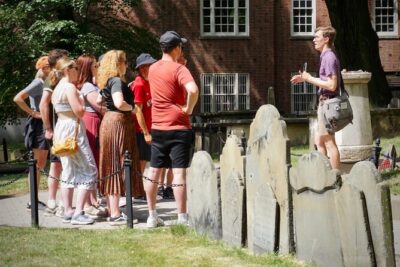
Freedom Trail History Small Group Walking Tour
Read our review →
Historic Charleston Guided Sightseeing Walking Tour
Read our review →
Tapas Walking Tour with Food, Wine, and History
Read our review →
Savannah History and Haunts Candlelit Ghost Walking Tour
Read our review →
A History of Terror – Belfast City Centre Walking Tour
Read our review →Browse the lists this tour appears in