Review · ATHENS
Ancient Corinth, Mycenae, Epidaurus, Nafplio Full Day Private Tour From Athens
History comes alive across the Peloponnese. This private day trip from Athens links Ancient Corinth, Mycenae, Epidaurus, and Nafplio in one long but rewarding outing, with pickup from your Athens accommodation and transport in a luxury car or minivan. I especially like the private format, which lets your group adjust time at each stop, and the mix of major ruins with a pleasant seaside town.
The main drawback is the pace. Nine to ten hours on the road and at archaeological sites makes for a full day, and admission fees are extra. You also get a driver with historical knowledge rather than a licensed guide inside the ruins, so visitors who want detailed on-site interpretation should request a guide in advance.
Key points to know before booking
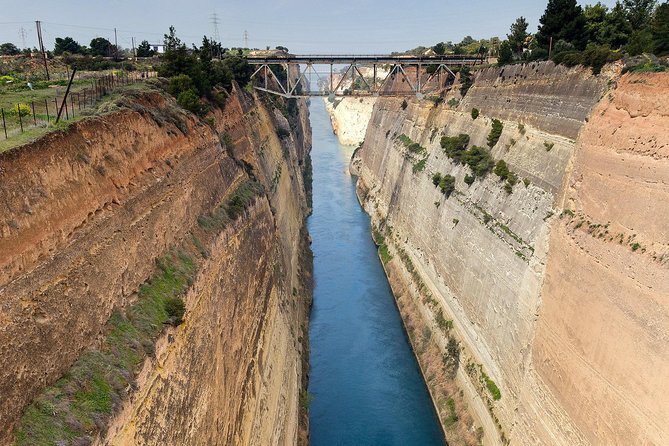
- The Corinth Canal is a quick but memorable opening stop, with a high view over its steep limestone walls and passing boats.
- Private transport keeps a complicated route simple, especially when connecting four separate destinations from Athens.
- Mycenae and Epidaurus are the main archaeological prizes, while Corinth adds strong links to Saint Paul and Roman Greece.
- Nafplio gives the day a welcome change of rhythm, with harbor views, Venetian buildings, cafés, shops, and the water castle of Bourtzi.
- Admission costs are not included, with listed fees of €15 for Corinth, €20 for Mycenae, and €20 for Epidaurus.
- The driver matters greatly, and the strongest experiences came with drivers such as George and Dimitris, who kept the day moving while sharing historical facts.
Why this private route works from Athens
The Peloponnese highlights are spread across a large area. Reaching Corinth, Mycenae, Epidaurus, and Nafplio by public transport in a single day would be awkward, and trying to arrange every connection yourself would leave little room for wandering. Here, you are picked up at your Athens accommodation at 8:00 am and returned after the long circuit.
The private setup is the biggest practical advantage. Your group alone takes part, so you are not tied to the interests or walking speed of a large coach party. You can spend more time at Mycenae, for example, and less time at a smaller stop if that suits your group.
The vehicle is air-conditioned, and bottled water is included. The package also includes a culinary gift, though the information provided does not specify what that gift contains. Food and drinks are not included, so plan to pay for lunch and refreshments in Nafplio.
The listed price is $259.03 per person. That is not a budget excursion, but the value depends on group size and priorities. You are paying for a private vehicle, hotel pickup, a full day of driving, flexibility, and four major destinations. A small group that values comfort and time savings may find it fair. A solo visitor or couple focused mainly on low cost may find the additional archaeological fees and lunch push the total higher than expected.
More Ancient History Tours in Athens
- Athens: Ancient Greek Theater Performance
★ 4.7 · 2,481 reviews - Historical Delphi One Day Tour with Arachova Stop & Expert Guide
★ 4.5 · 1,247 reviews - From Athens: Ancient Corinth Day Trip with Canal & VR Guide
★ 4.6 · 1,073 reviews
The Corinth Canal is a sharp ten-minute introduction
The first stop is the Corinth Canal, a man-made cut through the narrow Isthmus of Corinth. The canal links the Gulf of Corinth with the Saronic Gulf and separates the Peloponnese from mainland Greece in a way that makes the peninsula feel almost like an island.
You have about ten minutes here, so this is a viewpoint stop rather than a full visit. From above, the canal’s straight line and steep limestone walls make the engineering easy to understand. You may also see vessels moving through the narrow channel below.
The canal is 6.4 kilometers long and only 21.4 meters wide at its base. That narrow width limits the size of ships that can use it, but from the viewpoint, the proportions are what catch your eye. I like this early stop because it gives you a clear sense of the geography that shaped Corinth’s importance.
Do not expect much time for a leisurely walk or extended photography. Keep your camera ready, listen to the short explanation, and enjoy the view before moving on.
Ancient Corinth connects archaeology with Saint Paul
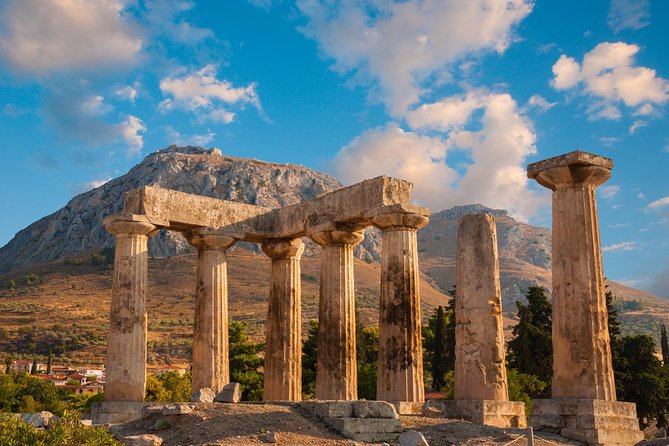
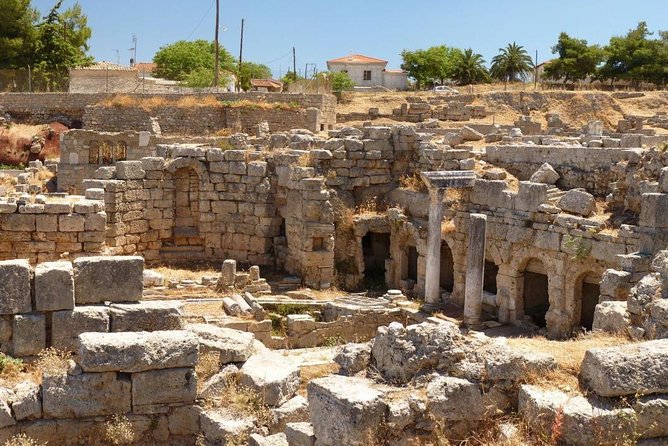
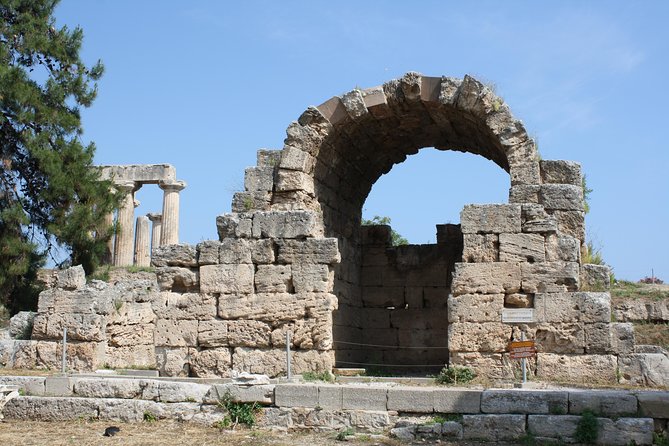
Ancient Corinth is one of the most meaningful stops for understanding the ancient Greek and Roman worlds. The city sat on the isthmus between the mainland and the Peloponnese, a valuable position for trade, travel, and military control. The modern city lies about five kilometers away.
You get about an hour at the ruins, followed by thirty minutes in the archaeological museum. The site helps explain the city’s long history. Corinth was a major Greek city with a population estimated at 90,000 around 400 BC. Rome destroyed it in 146 BC, then rebuilt it in 44 BC. Under Roman rule, it became the provincial capital of Greece.
For Christian visitors, Corinth has an extra layer of meaning. Saint Paul visited the city, and the New Testament letters First and Second Corinthians connect the ruins to familiar biblical texts. Walking through the ancient city can therefore feel less like looking at isolated stones and more like placing a well-known story on a real map.
The archaeological museum sits within the site and was built in 1931 and 1932 to display finds from the excavations. The museum stop is useful because objects and sculptures can fill in details that are hard to read from foundations alone.
The admission fee for the Corinth archaeological area is listed as €15 per person. That fee is separate from the tour price. Your driver can provide background during the journey, but the driver is not licensed to accompany you inside the archaeological sites unless you arrange a licensed guide, subject to availability.
Mycenae brings Bronze Age Greece into focus
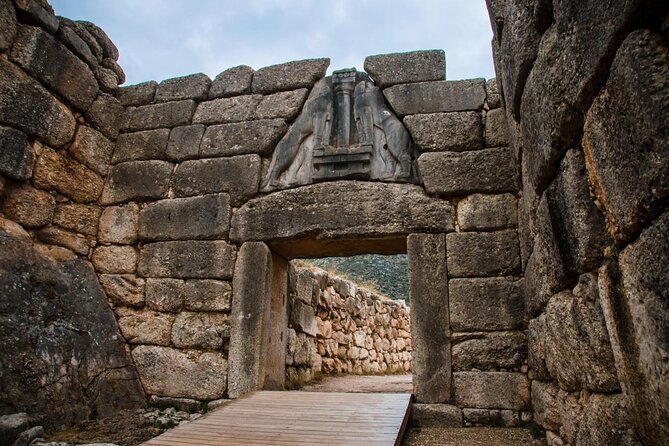
Mycenae is the emotional high point for many people on this route. The fortified citadel gave its name to the Mycenaean civilization, which shaped Greek culture from about 1600 to 1100 BC. The site is tied to the legendary King Agamemnon, although the archaeological evidence and later myths do not always line up neatly.
You have about an hour at the citadel and another thirty minutes in the museum. The ruins sit on high ground, with massive Cyclopean walls that later Greeks believed were too large for ordinary humans to build. The Lion Gate is the famous entrance, and it remains one of the most recognizable monuments of Bronze Age Greece.
The site also includes the Tomb of Clytemnestra and other remains connected with the royal center. At its height around 1350 BC, the citadel and lower town covered about 32 hectares and had an estimated population of 30,000. That scale helps you picture Mycenae as a working power center rather than a lonely ruin.
The Archaeological Museum of Mycenae is only a short walk from the Lion Gate. It gives you a closer look at objects found during excavation and helps make sense of the site before you continue.
The Treasury of Atreus, also called the Tomb of Agamemnon, is a separate ten-minute stop near the citadel. This large beehive-shaped tomb dates to about 1250 BC. Its stone lintel above the entrance weighs about 120 tons, an astonishing piece of Bronze Age engineering.
The listed admission fee for Mycenae is €20 per person. The tour information also describes the citadel stop as free, but the inclusion section clearly identifies a €20 archaeological-site fee, so confirm the current charge when booking. This is one of the practical details that can affect your final budget.
More Ancient History Tours in Greece
- Acropolis, Parthenon & Athens Old City Heritage Walking Tour
★ 4.5 · 876 reviews - Private Biblical Tour Ancient Corinth & Isthmus Canal from Athens
★ 5.0 · 762 reviews - Athens: Ancient Corinth & Nafplio Full Day Trip with Swim
★ 4.8 · 531 reviews - Athens Skip the Line: Open Air Ancient Greek Theatre Performance
★ 4.5 · 520 reviews
Epidaurus offers the day’s great acoustic moment
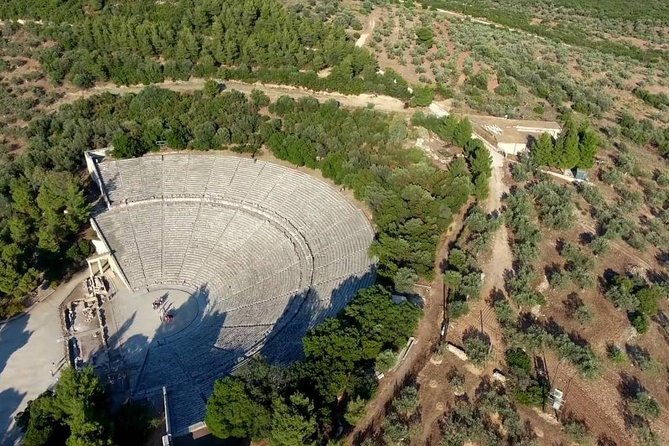
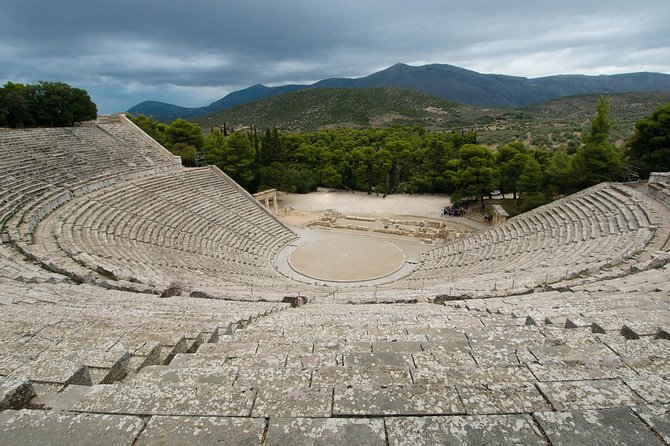
The Ancient Theatre of Epidaurus is one of the most polished stops on the route. It forms part of a sanctuary dedicated to Asclepius, the ancient Greek god of medicine. The theater is praised for its design and acoustics, and it retains the main parts of a Hellenistic theater: the seating area, orchestra, and stage building.
You have about an hour at the theater. That gives you enough time to walk through the seating, look across the curved rows, and appreciate how carefully the structure fits the hillside. The theater was not altered during the Roman period, which helps preserve its original Greek character.
This is a place where a simple demonstration can help. Someone near the center may speak softly while another person listens from higher up, though your exact experience will depend on conditions and other visitors. Even without a formal demonstration, the shape of the theater makes its design easy to appreciate.
The Sanctuary of Asclepius receives another twenty minutes. The temple was built in the early fourth century BC, and the wider sanctuary was a major healing center that competed in importance with sites such as Olympia and Delphi.
The Epidaurus admission fee is listed as €20 per person. Since the theater and sanctuary are part of the same archaeological visit, allow enough time to see more than just the famous seating. If theater acoustics are your main interest, you may prefer to linger there and move more quickly through the surrounding remains.
Nafplio gives you two hours to slow down
After a morning of ruins, Nafplio feels like a welcome reset. The town spreads along the Argolic Gulf, with cobbled streets, Venetian architecture, harbor views, and old fortifications. It served as the capital of the newly independent Greek state from 1821 until 1834, before the capital moved to Athens.
You have about two hours here, usually enough for lunch, coffee, shopping, and a walk by the water. This is the least structured part of the day, which is a strength. You can choose a meal, browse the back streets, or simply sit near the harbor and watch the town move at a slower pace.
Look across the water toward Bourtzi, the small Venetian castle built on an island in Nafplio’s harbor. The view from the harbor side makes an easy photo stop. The town’s position also gives you a chance to see how Venetian, Ottoman, and Greek periods left different marks on one place.
The tour also includes a view of Acronauplia, the oldest part of Nafplio. It was once a separate town and later became part of the city’s fortifications. The area was also used as a prison, and a hotel complex was eventually built there to take advantage of the views.
Palamidi Castle adds a demanding final viewpoint
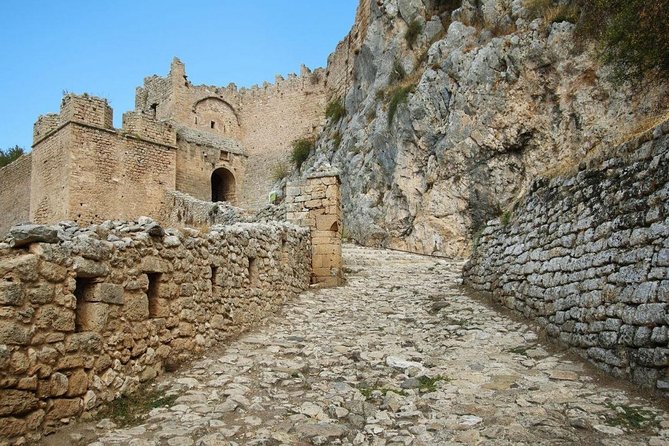
Palamidi Castle sits on a 216-meter hill above Nafplio. The Venetians built the fortress during their second period of control, from 1686 to 1715. Its position gives you broad views across the town, the Argolic Gulf, and the surrounding countryside.
The route from town is famous for its many steps. The winding stairway is commonly described as having 913 steps, while the climb to the upper parts of the fortress is often called more than 1,000 steps. Local tradition gives the number as 999.
The itinerary allows thirty minutes here, so this is a short look rather than a full exploration of every wall and bastion. If you have mobility concerns or simply want to save energy, ask how far the vehicle can take you and how much walking remains. The tour information says most people can participate, but it does not provide detailed accessibility information.
Palamidi is worth including for the view alone, though the time is tight. If your group has already spent a full day walking through ruins, the climb can feel like a final test. I would treat it as an optional priority within the day and make sure your driver knows if your group prefers more time in Nafplio instead.
Your driver shapes the quality of the day
This is a driver-led experience, not a standard guided tour with a licensed archaeologist walking beside you at every stop. The driver provides historical facts during the rides and helps manage the timetable, but cannot officially guide inside the sites unless a licensed guide is requested and available.
That distinction matters. A strong driver can make the long road time useful, explain what you are about to see, and adjust the schedule without making you feel hurried. George received especially warm praise for making the day educational, fun, and flexible. Dimitris was also credited with sharing plenty of information and keeping the route on schedule.
There is one important caution. One poor experience involved unwanted discussion of personal religious beliefs and suggestive remarks directed toward a young family member. The issue was reported to the company, which responded that the driver had been discussing the role of religion in Greek society and said it would be more careful about conversation topics.
You should feel free to set boundaries early. If you prefer conversation to stay focused on archaeology, local life, and practical sightseeing, say so at the start. Professional conduct is essential on a private tour, since you spend most of the day in close contact with one driver.
Timing, costs, and practical planning
The tour runs about nine to ten hours and begins at 8:00 am. That early start is sensible because the route covers a lot of ground. You should expect a full day rather than a relaxed outing, with several hours split between driving, walking, and sightseeing.
Pickup is offered from any accommodation in Athens. Airport or airport-area pickup and drop-off cost extra, so check that surcharge before paying. The tour includes private transportation, air conditioning, bottled water, the culinary gift, and the driver’s historical commentary.
You pay separately for food, drinks, and archaeological admission. The listed entrance fees total €55 per person: €15 for Corinth, €20 for Mycenae, and €20 for Epidaurus. Add lunch in Nafplio and any airport transfer charge to understand the real cost.
The experience has a 4.9 rating from 25 ratings, with 96 percent recommending it. That is a strong signal, but the smaller sample and the one serious complaint are reasons to read the inclusions carefully and communicate your expectations.
Free cancellation is available up to 24 hours before the start time. Changes or cancellations inside that window are not accepted for a refund. The tour also depends on good weather, with a different date or full refund offered if poor weather causes cancellation.
Who should book this day trip?
I would choose this tour if you have limited time in Athens and want to see several Peloponnese highlights without renting a car. It suits couples, families, and small groups that value a private vehicle and the ability to adjust the day.
It is also a good match if you care about Saint Paul and Roman Corinth, Bronze Age Mycenae, ancient theater design, and Nafplio’s later Venetian and Greek history. The route gives you a broad introduction to the region rather than a slow, specialist study of one site.
I would hesitate if you dislike early starts, long drives, or quick visits. You may also prefer another format if a licensed archaeologist is essential. In that case, request one before booking and confirm availability, since it is not automatically included.
Should you book it?
Book this private tour if you want a convenient, history-heavy day with your own group and can accept extra entrance fees. The best reasons are the efficient route, private transport, flexible pacing, and the range of places covered.
Skip it if you want a slow holiday day, a low-cost excursion, or extensive time inside every site. For the right group, though, it is a practical way to connect Corinth, Mycenae, Epidaurus, and Nafplio in one memorable sweep from Athens.
FAQ
What time does the tour begin?
The tour begins at 8:00 am.
Is pickup available from Athens hotels or accommodations?
Yes. Pickup is offered from any accommodation in Athens. Pickup and drop-off at the airport or airport area cost extra.
How long does the tour last?
The experience lasts approximately nine to ten hours.
Are archaeological admission fees included?
No. The listed fees are €15 per person for Corinth, €20 for Mycenae, and €20 for Epidaurus.
Is a licensed guide included at the archaeological sites?
No. The driver provides historical facts but is not licensed to accompany you inside the sites. A licensed guide may be requested, depending on availability.
Can I cancel for a full refund?
Yes, if you cancel at least 24 hours before the experience start time. Poor-weather cancellations offer a different date or a full refund.
More Private History Tours in Greece
- Athens: The History of Greek Mythology Private Tour
★ 4.7 · 53 reviews - Private Athens Walk: Ruins, Markets & Local Stories
★ 5.0 · 41 reviews - From Athens: Ancient Corinth Half-Day Private Tour
★ 4.8 · 30 reviews - From Athens: Ancient Olympia Full-Day Private Tour
★ 4.8 · 22 reviews
More Private History Tours in Athens
- Private Tour of Apostle Paul’s Footsteps in Ancient Corinth
★ 5.0 · 275 reviews - Ancient Athens for Kids 4-Hour Private Walking Tour
★ 5.0 · 66 reviews - Semi-private Historical & Contemporary Segway Tour in Athens
★ 5.0 · 56 reviews - Ancient Olympia full day private tour from Athens
★ 4.9 · 54 reviews
Just added around Athens
- Ancient Corinth★ 5.0 · 29 reviews
- Segway Journey: Athens Tour From The Ancient Past To The Present★ 5.0 · 62 reviews
- Acropolis, Parthenon and Ancient Agora Guided Tour with entrances★ 5.0 · 29 reviews
- Semi-private Historical & Contemporary Segway Tour in Athens★ 5.0 · 56 reviews
- Herakleidon Museum of Ancient Greek Technology: Entry Ticket★ 3.5 · 19 reviews
- Ancient Olympia full day private tour from Athens★ 4.9 · 54 reviews
- From Athens: Half-Day Ancient Corinth Tour★ 4.4 · 59 reviews
- From Athens: Explore Ancient Greece 4-Day Tour★ 4.7 · 73 reviews
Ancient History Tours, compared.
Colosseum: Underground and Ancient Rome Tour
Read our review →
Colosseum & Ancient Rome with Arena Floor Option I Max 6 People
Read our review →
Colosseum, Ancient Rome Tour or AudioGuided Tour
Read our review →
Colosseum Underground & Ancient Rome Guided Tour
Read our review →
Taormina: Ancient Theater Skip-the-Line Ticket & Audio Guide
Read our review →
Discover the Ancient Ruins of Pompeii: Day Trip from Rome
Read our review →