Review · ATHENS
Private Tour of Apostle Paul’s Footsteps in Ancient Corinth
Paul’s Corinth still feels surprisingly close. This private half-day trip from Athens connects the Corinth Canal, ancient ports, the Agora, and Acrocorinth with the places tied to Paul’s ministry, all in a comfortable air-conditioned vehicle. I like the private format, which lets you set the pace, and I like the blend of biblical connections with Greek, Roman, Byzantine, Frankish, Venetian, and Ottoman history. The main caution is simple: your driver is not a licensed guide inside the archaeological sites, and entrance fees cost extra.
The tour earns a strong 4.9 rating from 275 reviews, with 99 percent of participants recommending it. Guides such as Giannis, Nick, Ruslan, George, Johnny, and Fotis are praised for safe driving, patience, historical knowledge, and kindness toward older family members. Still, this is not a church tour from start to finish. It is a broad Corinth excursion with a Christian focus, so you should expect ruins, archaeology, and Greek history alongside Paul’s story.
Key points to know before booking
- Paul’s Corinth comes with a full archaeological setting: You visit the Bema, Agora, Temple of Apollo, ancient port of Kenchreai, and Apostolos Pavlos Church.
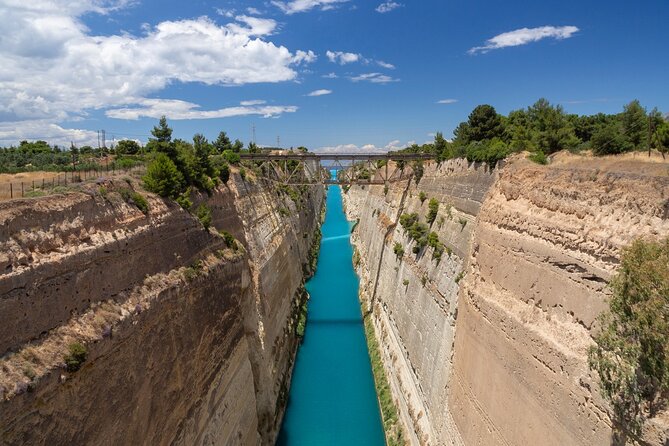
- The Corinth Canal is an impressive opening scene: Steep limestone walls and blue water show how modern engineering cut through the Isthmus.
- Acrocorinth is the physical highlight: The fortified summit offers broad views, but comfortable shoes matter.
- Your driver makes the day personal: Private pickup, flexible stops, and a sedan for groups of one to four make this easier than a large coach excursion.
- The price covers transport, not site admission: The listed cost is $169.03 per person, with archaeological and museum admission adding €15 per person.
- Expect history more than preaching: Paul is the thread connecting the stops, but the tour also covers pagan religion, trade, military power, and daily life.
Why Corinth matters to Paul’s story
Corinth was not a quiet outpost. Its position between mainland Greece and the Peloponnese made it a key point for trade, shipping, military movement, and cultural exchange. The city had access to two ports, one on the Corinthian Gulf and one on the Saronic Gulf, while the nearby isthmus offered a shortcut across Greece.
That setting helps explain why Paul spent an extended period in Corinth. The city gathered merchants, sailors, officials, craftsmen, religious groups, and people from many parts of the Roman world. When you walk through the old marketplace, you are not simply looking at broken columns. You are looking at the setting for public debate, commerce, legal disputes, and new religious ideas.
Paul’s time here is tied to the Acts of the Apostles and to the Corinthian letters. The tour connects locations with people such as Aquila, Priscilla, Phoebe, and Erastus. A good driver may also show you biblical passages to clarify which details come from Scripture and which come from local archaeology.
That distinction matters. Some points linked to Paul are firmly rooted in the biblical account, while other connections are based on tradition, interpretation, or the setting itself. I appreciate a tour that keeps both sides visible instead of treating every ruin as a certain biblical fact.
More Ancient History Tours in Athens
- Athens: Ancient Greek Theater Performance
★ 4.7 · 2,481 reviews - Historical Delphi One Day Tour with Arachova Stop & Expert Guide
★ 4.5 · 1,247 reviews - From Athens: Ancient Corinth Day Trip with Canal & VR Guide
★ 4.6 · 1,073 reviews
The Corinth Canal and the ancient Diolkos
The first stop is the Isthmus of Corinth, about 6.3 kilometers wide at its narrowest point. Since 1893, the Corinth Canal has cut through the isthmus, turning the Peloponnese into an island in practical geographic terms.
You have around 20 minutes here. That is enough for photographs and a quick look at the steep canal walls, but not a long walk along the water. The canal is a modern engineering project, yet it makes the older story easier to understand. Ancient rulers and sailors also wanted a shortcut, though their solution was far more labor-intensive.
Nearby, the Diolkos shows how ancient engineers handled the problem. This stone-paved trackway allowed ships or parts of ships to be hauled overland across the isthmus. The stop lasts about 10 minutes and admission is free.
The Diolkos is not a grand monument. It is a practical one. You see how trade and naval movement depended on clever solutions long before modern machinery. If you enjoy ancient technology, this brief stop may interest you more than a quick photo at the canal.
Kenchreai, the eastern port connected with Paul
The tour then reaches ancient Kenchreai, also written as Kechrees, on the eastern side of Corinth. Paul is associated with this port during his visit to Corinth around A.D. 51, and the site is also linked with his later voyage toward Ephesus.
Only modest remains are visible today, so adjust your expectations. You are not arriving at a fully reconstructed harbor with walls and ships. Instead, the value comes from location and context. Standing at the old port helps you picture how Paul arrived, departed, and moved through the eastern Mediterranean network.
Kenchreai is also tied to Phoebe, a prominent Christian woman connected with the local church. The tour presents the port as part of the early Christian community’s wider network, not just as an isolated ruin.
You have about 20 minutes here. The stop works best if your driver explains the setting clearly. Without context, the remains may seem sparse. With context, the connection to Paul’s movements gives the site purpose.
Ancient Corinth, the Bema, and the Agora
Ancient Corinth is the heart of the excursion. Plan on roughly 40 minutes at the archaeological site, though your actual time can vary with your group and driver.
The Agora was the city’s public center. Here, Paul’s message would have met the everyday concerns of Corinth: trade, politics, social rank, local customs, and competing religious beliefs. The tour uses the marketplace to explain how Christianity differed from the pagan traditions that shaped the city.
The Bema is especially important for people following Paul’s story. This raised platform is associated with his appearance before the Roman proconsul. You can also see the remains of shops and streets connected with the working life of the city. The reviews specifically highlight the tradition that Paul, Aquila, and Priscilla worked as tentmakers, along with the street associated with Erastus, a civic official linked with Paul.
The Temple of Apollo gives the site a strong visual centerpiece. Its surviving columns predate the Roman city around them and remind you that Corinth had religious traditions long before Christianity arrived.
This is also where expectations need managing. The driver provides historical explanation, but the tour does not include a licensed guide inside the archaeological sites. If you want formal site interpretation at every monument, you may need to arrange that separately. For many people, the private driver format is enough, especially when the driver is a strong storyteller. The experience can vary depending on which driver you receive.
More Ancient History Tours in Greece
- Acropolis, Parthenon & Athens Old City Heritage Walking Tour
★ 4.5 · 876 reviews - Private Biblical Tour Ancient Corinth & Isthmus Canal from Athens
★ 5.0 · 762 reviews - Athens: Ancient Corinth & Nafplio Full Day Trip with Swim
★ 4.8 · 531 reviews - Athens Skip the Line: Open Air Ancient Greek Theatre Performance
★ 4.5 · 520 reviews
The Archaeological Museum adds the human details
The Museum of Ancient Corinth takes about 45 minutes. It is included in the route because ruins alone cannot show how people lived, worshipped, worked, and decorated their homes.
The collection includes prehistoric material and finds from the Sanctuary of Asklepios. The galleries also help explain the religious and artistic life of Corinth across several periods. After seeing the Agora and Temple of Apollo outside, the museum gives you smaller objects and archaeological evidence to fill in the gaps.
I would not skip the museum if you have any interest in the site. The outdoor ruins show scale and setting, while the museum supplies detail. Together, they make Corinth easier to understand.
Admission to the archaeological site and museum is not included. The stated combined entrance cost is €15 per person. Build that into your budget before you compare the tour with other Athens day trips.
Acrocorinth is the day’s great viewpoint
Acrocorinth rises above the ancient city and was used as a fortified acropolis through Greek, Byzantine, Frankish, Venetian, and Ottoman periods. Its walls, towers, and gates reveal how useful this summit remained long after classical Corinth declined.
The tour allows about 40 minutes here. That is enough to enter the fortress area and take in the views, but it is not a full expedition across every wall and upper path. Wear sturdy, comfortable shoes, and bring a hat and sunscreen. The weather can be hot and sunny, and the ground around historic fortifications is not always smooth.
The summit is also linked with the Temple of Aphrodite. The tour explains the religious role of the sanctuary and the tradition concerning its priestesses. This is one place where a careful explanation helps, since ancient religious practices are often simplified in popular retellings.
Acrocorinth is the most physically demanding stop on the route. That does not make it inaccessible to everyone, but you should be realistic about walking and uneven surfaces. The private vehicle helps because you are not tied to the pace of a large group. Several guides have been praised for helping older relatives in and out of the car and adjusting the day to their needs.
Apostolos Pavlos Church brings the story forward
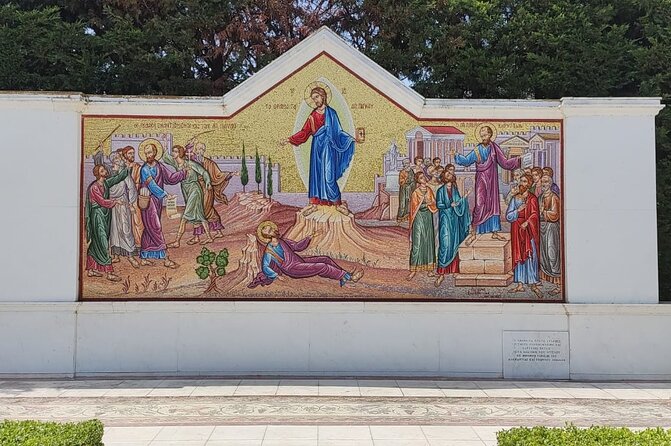
The final stop is the modern Church of Saint Paul in the center of Ancient Corinth. Inside, a large mosaic by Pastorutti and Tsotsonis depicts Paul’s journey and mission.
This church gives the tour a different mood. The archaeological site looks backward through stone, inscriptions, and foundations. The church shows how Paul remains part of Corinth’s living religious identity.
You have about 20 minutes here. It is a short visit, but it provides a fitting close for Christian visitors who want a place for quiet reflection after the archaeological stops. If you are more interested in classical Greece than religious history, the church may feel less essential, though the mosaic still adds a modern artistic layer to the day.
What the private vehicle changes
Pickup and drop-off are offered from Athens hotels, apartments, and the port. At a hotel or apartment, the driver waits at the entrance. At the port, the driver waits at the gate with a sign bearing your name. Airport pickup and drop-off are possible for an extra €50 per booking.
For groups of one to four, the company uses a sedan. Larger groups use a different vehicle arrangement, though the exact vehicle is not specified. Air conditioning, Wi-Fi, bottled water, and travel in a private group are included.
The drive from Athens is part of the five to six-hour duration. That means the time at each site is limited, but the route still covers a lot. You should think of this as a focused Corinth overview, not an all-day archaeological study.
The private format is especially useful for families, couples, and small groups with different walking speeds. Drivers have offered earlier pickups, extra time, restroom stops, luggage space, and airport transfers when arranged. These small touches can matter greatly on a travel day.
The driver is not a licensed guide who accompanies you into the sites. That is the most important service detail to understand. The strongest drivers, including Giannis, Nick, Ruslan, George, Johnny, and Fotis, have been praised for combining safe driving with historical explanation. Still, the depth of the commentary depends on the individual assigned to your group.
Is $169.03 per person a fair price?
At $169.03 per person, the tour is not the cheapest way to reach Corinth. You are paying for a private vehicle, pickup and drop-off, air conditioning, bottled water, Wi-Fi, and a flexible schedule rather than simply paying for transport.
The value improves with four people sharing the experience. For a couple, the price is harder to justify if you only want a quick look at the canal and ruins. It becomes more appealing if you are arriving from a cruise port, traveling with an older relative, carrying luggage, or needing an airport transfer.
Add €15 per person for the archaeological site and museum. Airport service adds another €50 per booking. Food is not included, though drivers may recommend a local restaurant. One guide helped a group find a meal of lamb chops, Greek salad, and dessert, but you should treat lunch as optional and extra.
The 99 percent recommendation rate and 4.9 score suggest reliable satisfaction, but they do not erase the tour’s limits. This is best value when comfort, privacy, and personal attention matter more than the lowest possible cost.
Who will enjoy this Corinth tour most?
This tour suits you if Paul’s travels give ancient Corinth a personal meaning. It also works well if you enjoy seeing biblical sites in their wider political, religious, and economic setting.
You do not need to be Christian to appreciate the route. The canal, Diolkos, ancient harbor, Temple of Apollo, museum, and Acrocorinth offer plenty of interest in classical and later Greek history. One part of the experience is explicitly Christian, while much of the day is archaeological and cultural.
Families with older relatives may find the private arrangement particularly useful. Guides have helped passengers in and out of the vehicle, supplied cold water, and adjusted the pace. Child seats are available on request.
You should think twice if you want a fully guided biblical study with a licensed archaeologist or clergy member. You should also reconsider if you dislike short stops, since the route covers seven places in roughly five to six hours, including the driving.
Free cancellation is available up to 24 hours before the start time. The experience requires good weather, and poor conditions can lead to a new date or a full refund.
Should you book the Apostle Paul tour from Athens?
Book it if you want a comfortable, private route through Corinth with Paul as the main thread, but not the only subject. The best parts are the Bema and Agora, the practical story of the Diolkos, the quiet connection at Kenchreai, and the high views from Acrocorinth.
I would choose this tour for a small family group, a couple with a strong interest in early Christianity, or anyone traveling from a hotel, port, or airport who values door-to-door transport. Ask about the assigned driver if possible, and remember that the driver is not a licensed guide inside the sites.
Skip it if your priority is a low-cost bus trip or a long, detailed visit at each ruin. For everyone else, this is a well-planned way to connect the Bible, ancient Greek city life, and the dramatic setting of Corinth in one manageable day.
FAQ
How long does the private Corinth tour last?
The experience lasts approximately five to six hours, including travel time between Athens and Corinth and the time spent at each stop.
Is hotel or port pickup included?
Yes. Hotel and apartment pickup and drop-off are included, and port pickup is also offered. The driver waits at a hotel or apartment entrance, or at the port gate with a sign bearing your name.
Is airport pickup included?
Airport pickup and drop-off are optional and cost an additional €50 per booking.
Are entrance fees included in the tour price?
No. Entrance to the archaeological sites and museum costs €15 per person. The listed tour price does include the air-conditioned vehicle, Wi-Fi, bottled water, and professional English-speaking tour drivers.
Is this a guided archaeological tour?
The driver provides historical information, but a licensed guide does not accompany you into the archaeological sites. The experience is private, and only your group participates.
What should I bring?
Wear comfortable shoes for walking and exploring the sites. Bring a hat and sunscreen because the Greek weather can be hot and sunny. Child seats are available on request.
More Private History Tours in Greece
- Ancient Olympia full day private tour from Athens
★ 5.0 · 83 reviews - Half Day Historical Athens City Private Taxi Service Tour
★ 5.0 · 79 reviews - Ancient Athens for Kids 4-Hour Private Walking Tour
★ 5.0 · 66 reviews - Ancient Sparta Ancient Corinth Private Tour from Athens/ Nafplio
★ 5.0 · 58 reviews
More Private History Tours in Athens
- Ancient Corinth, Epidaurus, Nafplio full day private tour from Athens
★ 5.0 · 206 reviews - The History of Athens: Greek Mythology Private Tour
★ 5.0 · 138 reviews - Ancient Corinth, Mycenae, Epidaurus, Nafplio full day private tour from Athens
★ 5.0 · 130 reviews - Ancient Corinth and Canal half day private tour from Athens
★ 5.0 · 96 reviews
Just added around Athens
- The original Christian tour on Paul’s footsteps in Athens and ancient Corinth★ 4.5 · 25 reviews
- Small-Group Women History in Ancient Greece Walking Tour★ 5.0 · 38 reviews
- Athens: Combo Ticket for Acropolis & 6 ancient sites★ 3.0 · 21 reviews
- Ancient Sparta & Mystras Private Day Tour from Athens★ 5.0 · 52 reviews
- Ancient Olympia & Isthmus Canal Private Tour from Athens★ 5.0 · 20 reviews
- Ancient Agora & Temple of Hephaestus Entrance Ticket★ 3.5 · 22 reviews
- Half Day Historical Athens City Private Taxi Service Tour★ 5.0 · 79 reviews
- Ancient Corinth, Sanctuary of Hera, Blue Lake & Canal from Athens★ 5.0 · 26 reviews
Ancient History Tours, compared.
Colosseum: Underground and Ancient Rome Tour
Read our review →
Colosseum & Ancient Rome with Arena Floor Option I Max 6 People
Read our review →
Colosseum, Ancient Rome Tour or AudioGuided Tour
Read our review →
Colosseum Underground & Ancient Rome Guided Tour
Read our review →
Taormina: Ancient Theater Skip-the-Line Ticket & Audio Guide
Read our review →
Discover the Ancient Ruins of Pompeii: Day Trip from Rome
Read our review →