
Review · ATHENS
Small-Group Women History in Ancient Greece Walking Tour
Ancient Athens has a women’s story, too. This two-hour walking tour follows that neglected thread through Monastiraki, the Agora, the Areopagus, the Pnyx, and Philopappos Hill. I like its unusual focus, and I like how guide Maelle connects famous figures such as Athena and Penelope with real women including Aspasia, Sappho, and Agnodice. The main drawback is that you see the Ancient Agora from outside rather than entering it, and the uphill finish is not a good fit for anyone with mobility problems.
The group is limited to 12 people, which gives the walk a personal feel and leaves room for questions. At $44.71 per person, it is a fair price for a focused history lesson with a city walk attached, though you should know that the tour moves quickly through many subjects and sites.
Key points before you book
- Women take center stage: Learn about education, marriage, work, slavery, politics, medicine, poetry, and myth.
- Maelle earns strong praise: Her warm, clear presentation is repeatedly singled out as a reason the tour works so well.
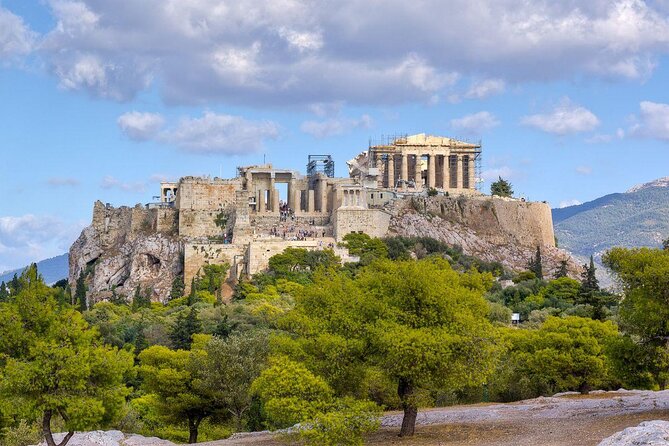
- Nine stops connect story to place: The route moves from Monastiraki to Philopappos Hill, ending with an Acropolis view.
- A small group helps: With no more than 12 people, questions and conversation are easier than on a large city tour.
- This is an outdoor history walk: There is no entry into the Ancient Agora, and the route includes uphill ground.
- Book ahead: The experience is commonly reserved about 37 days in advance, so last-minute space may be limited.
Why this women’s history walk adds something new to Athens
Most first visits to Athens focus on temples, male politicians, generals, and philosophers. This walk asks a sharper question: what did women’s lives look like inside that society, and who managed to push beyond its limits?
That change of focus matters. You still see major Athenian places, but the guide uses them to explain who could enter public life, who could vote, who could study, and who remained unseen. You hear about women in myth, but also about women whose lives were shaped by law, family, labor, and social rank.
I especially like the balance between legendary and historical figures. Athena and Pandora help explain how Greek culture imagined women. Penelope offers a model of loyalty and intelligence. Aspasia, Sappho, and Agnodice point to women who found room for influence in philosophy, poetry, medicine, or public debate.
The tone is not sentimental. One central lesson is that ancient Athenian women faced severe restrictions, while the small amount of surviving evidence makes their stories harder to recover. That can make the walk sobering, but it also gives the experience purpose. You are not simply collecting more names from mythology. You are seeing what a society lost when it shut most women out of public life.
More Ancient History Tours in Athens
- Athens: Ancient Greek Theater Performance
★ 4.7 · 2,481 reviews - Historical Delphi One Day Tour with Arachova Stop & Expert Guide
★ 4.5 · 1,247 reviews - From Athens: Ancient Corinth Day Trip with Canal & VR Guide
★ 4.6 · 1,073 reviews
Monastiraki and Hadrian’s Library: starting with education
You meet the guide at Monastiraki Square, at Pl. Monastirakiou 2. This is a practical starting point, close to public transportation and easy to find in central Athens.
The opening ten minutes set the subject and introduce the city around you. From there, the group reaches Hadrian’s Library, where the discussion turns to the education of girls and women in ancient Athens.
This is an effective early stop because education tells you a great deal about social power. The question is not only who could read or write. It is also who had access to formal learning, who could develop a public reputation, and who was expected to prepare for marriage and household life instead.
You should expect interpretation rather than a long archaeological visit. The tour uses the location as a setting for the story, and the time at each stop is brief. If you want a detailed study of Hadrian’s Library itself, you will need a separate visit.
Marriage, Eros, and the household
At the Holy Church of the All-Great Taxiarchs and the Virgin Mary Gregorousa, the guide discusses marriage in Athens and Sparta, along with Eros, the passionate form of love.
This section gives useful contrast. Athens and Sparta did not treat women in exactly the same way, so the walk avoids presenting ancient Greece as one uniform culture. Marriage was tied to family, inheritance, status, and social duty, while the idea of Eros opened a different door into Greek thought and storytelling.
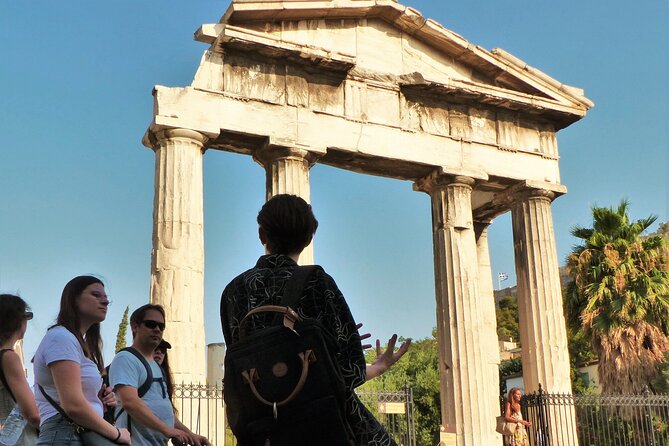
The next stop, the Gate of Athena Archegetis, adds married life and the myths of Athena. Here, a familiar goddess becomes more interesting. Athena was powerful, wise, and central to the identity of Athens, yet the city that honored her did not offer its own women equal public power.
That tension is one of the tour’s best ideas. Myth can show what qualities a society admired in a female figure, while daily law and custom show how limited real women’s choices could be. You get both parts of the picture.
Dioskouron and the women-only festival
At Dioskouron, the focus shifts to a mysterious ancient festival held exclusively for women.
This is the kind of detail you are unlikely to receive on a standard Acropolis overview. It suggests that women’s lives were not only private and domestic. They also had their own rituals, gatherings, religious roles, and shared forms of identity, even when male-controlled institutions dominated the city.
The stop lasts about ten minutes, so do not expect a full lecture on every ancient festival. Instead, it works as a compact reminder that women had social spaces and traditions that deserve attention in their own right.
More Ancient History Tours in Greece
- Acropolis, Parthenon & Athens Old City Heritage Walking Tour
★ 4.5 · 876 reviews - Private Biblical Tour Ancient Corinth & Isthmus Canal from Athens
★ 5.0 · 762 reviews - Athens: Ancient Corinth & Nafplio Full Day Trip with Swim
★ 4.8 · 531 reviews - Athens Skip the Line: Open Air Ancient Greek Theatre Performance
★ 4.5 · 520 reviews
The Ancient Agora from outside
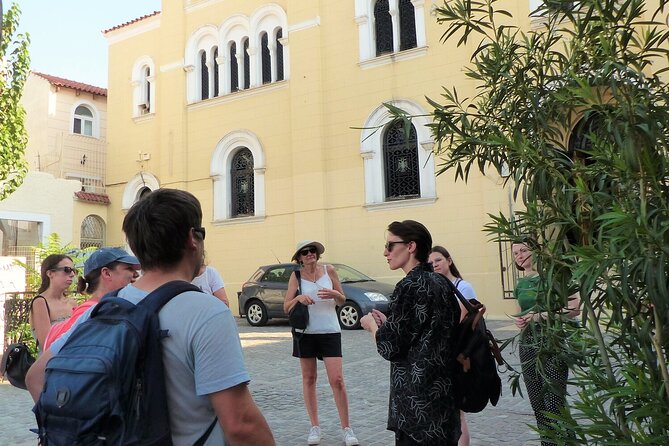
The Ancient Agora was the center of public life in Athens. It was where commerce, politics, conversation, and civic business came together. The tour pauses outside the archaeological site to discuss women in public space, including female slaves and courtesans.
This is one of the most important stops, but also one where you should set your expectations correctly. There is no entrance to the Agora included. You see it from outside and use its setting to imagine the public world from which many citizen women were excluded.
The distinction between citizen women, enslaved women, and courtesans matters. Ancient society did not give all women the same experience, and social rank shaped freedom, labor, education, and movement through the city. The conversation helps you avoid a simple picture of women as one group with one shared life.
If you plan to visit the Agora separately, this tour can make that later visit more meaningful. You will have questions ready as you walk through the site. If you are hoping for a combined ticket and guided entrance, this is not that experience.
The Areopagus and Agnodice’s daring story
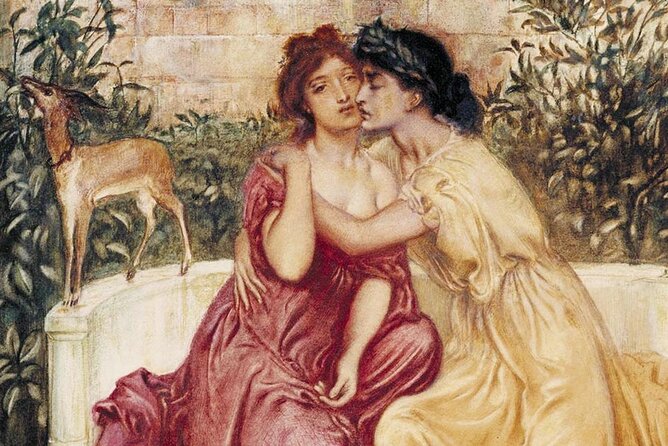
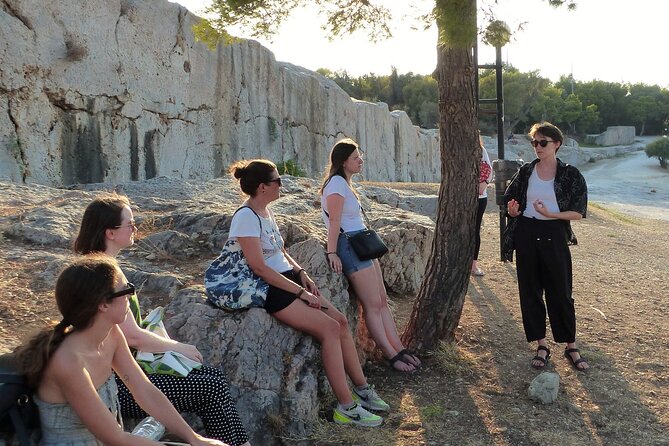
At the Areopagus, the guide introduces the place where serious crimes were tried in ancient times and tells the story of a woman who risked a death sentence to change women’s rights.
This is the point where the tour’s historical and moral questions come together. The story of Agnodice is especially memorable because it concerns women’s access to medicine and the consequences of crossing a male boundary. Her example shows how practical needs could expose the unfairness of a rule.
The Areopagus itself is also a physical feature of the route. You should expect uneven ground and an outdoor stop rather than a quiet indoor talk. Wear shoes that give you a steady footing, and keep in mind that the route does not suit people with mobility issues.
The Pnyx and women near political power
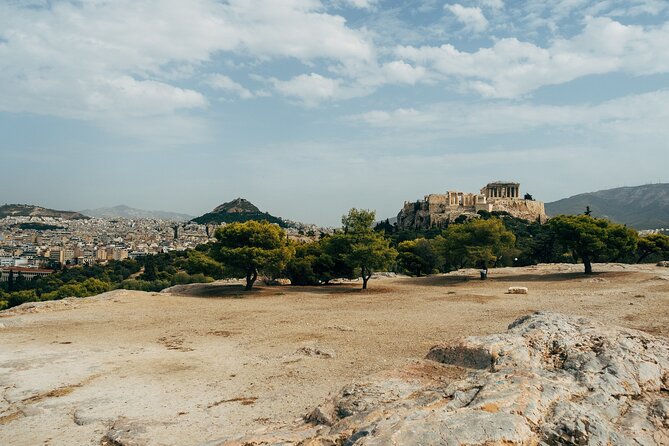
The Pnyx is where Athenian democracy took shape, but only male citizens could vote there. That fact gives the stop its force. Democracy was a major political experiment, yet its rights were narrow and carefully controlled.
Here, the guide tells the story of a woman who influenced Athenian politics during the Golden Age. Aspasia is the key figure named in the tour’s themes. She is remembered as a philosopher and as the companion of Pericles, one of the leading statesmen of classical Athens.
This section avoids the easy claim that women had no influence at all. They could lack a formal vote and still shape conversation, family alliances, education, art, religion, and the decisions of powerful men. At the same time, influence behind the scenes is not the same as equal citizenship. That distinction is worth keeping in mind as you stand at the Pnyx.
For me, this is likely to be one of the most thought-provoking parts of the walk. It puts the ideals of democracy beside the people left outside its boundaries.
Philopappos Hill and the Acropolis view
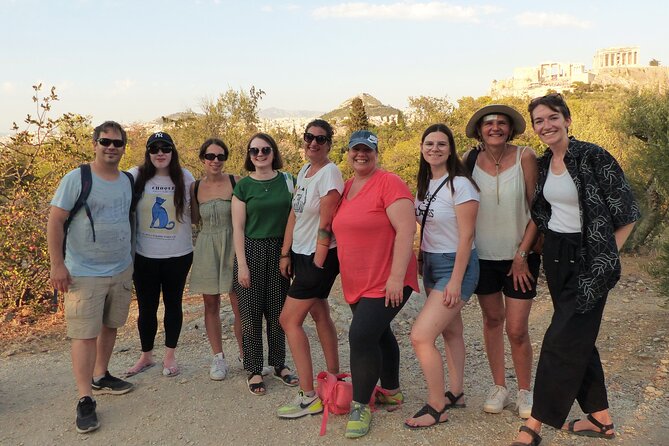
The final stop is Philopappos Hill, also called the Hill of the Muses. The walk ends with a view toward the Acropolis, and the setting gives the discussion a calm finish after a steady series of historical stops.
The view is a real part of the value here. You have spent the tour looking at Athens through questions of power, exclusion, creativity, and memory. From the hill, the Acropolis becomes more than a postcard. It is the symbol of a society that produced remarkable art and political ideas while limiting the lives of many people.
The endpoint is at Philopappos Hill, with access to the city center on foot and the metro available if needed. Because the route finishes uphill, this is not the best choice for a slow, flat stroll. The reward is a strong closing view, but you should plan around the physical effort.
What Maelle brings to the experience
The guide matters greatly on a subject like this. Maelle receives repeated praise for being kind, inclusive, funny, prepared, and clear. That combination is important because the material includes difficult subjects such as slavery, gender restrictions, and the exclusion of women from voting.
Her presentation also seems to connect ancient themes with questions that still feel familiar today. That does not turn the walk into a modern political lecture. Instead, it helps you see why these old stories still matter.
Several comments describe the tour as a missing piece after other Athens tours. That makes sense. A conventional city tour may mention a goddess, a queen, or a famous poet, but rarely spends two hours asking how ordinary women lived or why certain women were remembered.
The small group supports that personal approach. With a maximum of 12 people, you are more likely to hear the guide clearly and ask about a detail that catches your attention. Group discounts may be available, which improves the value if you are booking for several people.
Is $44.71 a fair price?
At $44.71, you are paying for a specialized two-hour experience, not admission to a major archaeological site. The price is reasonable if you want focused interpretation and a different way to understand central Athens.
The value comes from the subject and the guide’s storytelling. You visit several important locations without paying separate entry fees, and the walk gives familiar places a fresh purpose. You also finish at a good Acropolis viewpoint.
The price is less attractive if you want extended time inside ruins, a broad survey of Greek history, or a slow sightseeing walk. The tour moves through nine stops in about two hours, so each subject receives a short, concentrated treatment.
I would book it early. It is often reserved around 37 days ahead, and a group capped at 12 people can fill faster than a large bus tour.
Practical details to know before you go
The experience is confirmed when you book, and mobile tickets make arrival simple. You meet at Monastiraki Square and finish at Philopappos Hill, not back at the starting point.
The route is near public transportation, and most people can take part. Service animals are allowed. Still, the tour is specifically not recommended for people with mobility issues because it includes walking over elevated and uneven areas.
Wear comfortable shoes and check the weather before setting out. The experience requires good weather. If poor conditions cancel it, you can choose another date or receive a full refund.
Free cancellation is available up to 24 hours before the start time. Changes or cancellations made less than 24 hours ahead are not accepted for a refund.
Who will enjoy this Athens walk most?
I would recommend it to anyone who has already seen the main Athens highlights and wants a more focused subject. It also works well as a first tour because it gives you a strong framework for understanding the city, its myths, and its civic spaces.
It is especially suitable for:
- People interested in women’s history, social history, or ancient culture
- Parents traveling with older children or teenagers who enjoy history and equality issues
- Visitors who prefer discussion and storytelling to a checklist of monuments
- Small groups who want room for questions
- Anyone who wants to see Athens from a fresh angle without entering another large museum
I would choose a different activity if you need step-free access, want to enter the Ancient Agora, or prefer a broad introduction to every major Athenian monument.
Should you book this tour?
Yes, if you want Athens to be more than temples and famous men. The strongest reason to book is the focus: this tour gives you stories about education, marriage, medicine, poetry, myth, slavery, religion, and politics that are often left out.
Maelle’s style, the small group, and the final view from Philopappos Hill add real value. Just arrive ready for a brisk outdoor walk, understand that the Agora is viewed from outside, and choose it for its ideas rather than for archaeological-site access. For many people, this will fill a real gap in an Athens visit.
FAQ
How long does the Women History in Ancient Greece Walking Tour last?
The tour lasts approximately two hours.
Where does the tour begin?
It begins at Monastiraki Square, at Pl. Monastirakiou 2, Athens 105 55, Greece.
Where does the tour end?
The tour ends at Philopappos Hill, at Filis 215, Athens 117 41, Greece.
How many people can join the tour?
The group has a maximum of 12 participants.
Does the tour enter the Ancient Agora?
No. The Ancient Agora is viewed from outside, and the guide discusses its role in public life there.
Is the tour suitable for people with mobility issues?
It is not recommended for people with mobility issues.
Are service animals allowed?
Yes, service animals are allowed.
What happens if bad weather cancels the tour?
You can choose a different date or receive a full refund.
Can I cancel for a full refund?
Yes. You must cancel at least 24 hours before the experience start time for a full refund.
More History Walking Tours in Greece
- Private Athens: Historical Walking Tour Including the Changing of the Guard
★ 5.0 · 27 reviews - Corfu: History and Culture Walking Tour
★ 4.9 · 55 reviews - Olympia’s Ancient Site and Museum Private Walking Tour
★ 4.7 · 31 reviews
More History Walking Tours in Athens
- Athens: History of Rebellion Walking Tour
★ 5.0 · 110 reviews - Ancient Athens for Kids 4-Hour Private Walking Tour
★ 5.0 · 66 reviews - Private Athens Walk: Ruins, Markets & Local Stories
★ 5.0 · 41 reviews - Athens:Acropolis – Historical Center Walking Tour in Spanish
★ 5.0 · 32 reviews
Just added around Athens
- The original Christian tour on Paul’s footsteps in Athens and ancient Corinth★ 4.5 · 25 reviews
- Athens: Combo Ticket for Acropolis & 6 ancient sites★ 3.0 · 21 reviews
- Ancient Sparta & Mystras Private Day Tour from Athens★ 5.0 · 52 reviews
- Ancient Olympia & Isthmus Canal Private Tour from Athens★ 5.0 · 20 reviews
- Ancient Agora & Temple of Hephaestus Entrance Ticket★ 3.5 · 22 reviews
- Half Day Historical Athens City Private Taxi Service Tour★ 5.0 · 79 reviews
- Ancient Corinth, Sanctuary of Hera, Blue Lake & Canal from Athens★ 5.0 · 26 reviews
- Private Luxury Tour: Marathon – Battle & Run That Changed History★ 5.0 · 30 reviews
Ancient History Tours, compared.

Colosseum: Underground and Ancient Rome Tour
Read our review →
Colosseum & Ancient Rome with Arena Floor Option I Max 6 People
Read our review →
Colosseum, Ancient Rome Tour or AudioGuided Tour
Read our review →
Colosseum Underground & Ancient Rome Guided Tour
Read our review →
Taormina: Ancient Theater Skip-the-Line Ticket & Audio Guide
Read our review →
Discover the Ancient Ruins of Pompeii: Day Trip from Rome
Read our review →