
Review · BOSTON
2 Hour Boston Historical and Heritage Walking Tour
Boston rewards curious walkers. This $5 Boston history tour links Boston Common, revolutionary landmarks, immigrant memorials, and literary sites in one compact route. I like the unusually human stories, from the 54th Massachusetts Regiment to Boston’s Brahmin literary circle, and I like that guide Stephen Uys welcomes questions rather than simply marching through a script. The main caution is pace: the tour can become information-heavy, and some people may find Stephen’s fast delivery or long explanations hard to follow.
You walk about one mile from Boston Common to the area beside Faneuil Hall. I especially like the small-group limit of 24 people and the chance to see major Freedom Trail sights without paying admission fees. Still, allow more than two hours if Stephen gets carried away with a good story, and bring weather protection because this is an outdoor tour with little opportunity to sit.
Key points at a glance
- A $5 introduction to Boston: The price is remarkably low for two hours with an English-speaking guide and a route through some of the city’s most important sites.
- Stephen Uys brings the stories: His approach reaches beyond dates and famous names, connecting politics, religion, literature, immigration, and family drama.
- Boston Common begins the story: You learn how a public pasture became a place for military drills, hangings, rallies, and everyday city life.
- The route joins famous and lesser-known stops: Along with the State House and Boston Massacre Site, you hear about the Brahmins, the Kennedy family, and the Irish Famine.
- Expect a brisk, talk-heavy walk: The tour suits history fans who enjoy detail, but it may not suit anyone seeking a relaxed stroll with lots of free time for photos.
- The finish is useful: You end near Faneuil Hall, the Union Oyster House, Bell in Hand, and the entrance to Boston’s North End.
Why this $5 walk offers such good value
At five dollars per person, this is an inexpensive way to get your bearings in central Boston. You are not paying for museum admission, a meal, or transportation. You are paying for a guide’s time, local context, and a route that ties together sites you could visit on your own.
The value comes from the connections. A plaque can tell you that the Boston Massacre happened in 1770. Stephen’s presentation can connect that event to British military occupation, colonial anger, propaganda, and the road toward rebellion. At the Old Corner Bookstore, the subject shifts from revolution to publishing and literature. At the Irish Famine Memorial, the city’s story expands again to include migration and hardship.
The tour is offered in English and starts at 11:00 a.m. Confirmation arrives at booking, and the group can include up to 24 people. That is not a private tour, but it is smaller than the very large walking groups you may see around the Freedom Trail.
The route ends directly across from Faneuil Hall. That makes it easy to continue sightseeing, find lunch, explore the North End, or visit nearby historic buildings after the guide says goodbye.
More History Walking Tours in Boston
- Boston: Freedom Trail History Small Group Walking Tour
★ 5.0 · 6,450 reviews - Boston: Freedom Trail History Small Group Walking Tour
★ 4.9 · 1,590 reviews - Boston Pizza Lovers Food and History Walking Food Tour
★ 4.5 · 1,082 reviews
Boston Common: a public park with a rough past
The tour starts at the Boston Common Tablet, at 1634 Freedom Trail, Boston Common. This is a fitting opening because the Common is more than a pleasant green space. It is the oldest public park in the United States, and its past includes both civic ceremony and grim public punishment.
You hear how townspeople once pastured cattle on its 45 acres. The Common also hosted military drills, hangings, duels, political gatherings, civil rights rallies, and leisurely walks beneath the elms. That contrast gives you an early lesson in Boston’s character: refined on the surface, but often argumentative and hard-edged underneath.
The scheduled stop is about 10 minutes, though the opening explanation may take longer depending on the group. This is one place where you should listen first and take photos during a pause. Boston Common offers easy landmark photographs, but the tour is built around commentary rather than a long photo session.
Park Street Church and the fight over freedom
Park Street Church receives a short stop, yet its importance is larger than the five minutes allotted. The church played a role in the abolitionist movement and in missionary work. You also hear about the July 4, 1831 debut of My Country, ’Tis of Thee, later known as America, written by Samuel Francis Smith.
This stop helps show that Boston’s conflicts were not only fought in government buildings or on battlefields. Churches served as meeting places for arguments about slavery, freedom, religion, and national identity.
If you want interior photographs or a close look inside the church, you may need to return on your own. The walk-by format gives you context, not a full building visit.
The 54th Regiment Memorial and the human cost of war
At the Robert Gould Shaw and 54th Regiment Memorial, the focus shifts to the Civil War. The 54th Massachusetts Infantry was one of the first African American units in the Union Army. Its commander, Robert Gould Shaw, and the regiment became symbols of courage and sacrifice.
This is one of the strongest stops for visitors who want more than a parade of famous white revolutionaries. The memorial gives the tour a broader view of American history and honors Black soldiers whose service was long treated unfairly in popular accounts.
You have about 10 minutes here. The memorial rewards a close look, but the group will continue on schedule, so listen for the meeting point and keep your camera ready.
More History Walking Tours in the USA
- Boston History Tour: Scenic Walk Through Time & Landmarks
★ 5.0 · 627 reviews - Boston’s North End Food and History Walking Tour
★ 5.0 · 459 reviews - Walk the Historic Freedom Trail with Costumed Guide
★ 4.5 · 329 reviews - Boston Seafood Lovers Food and History Walking Tour
★ 5.0 · 208 reviews
The State House and Boston’s uneasy politics
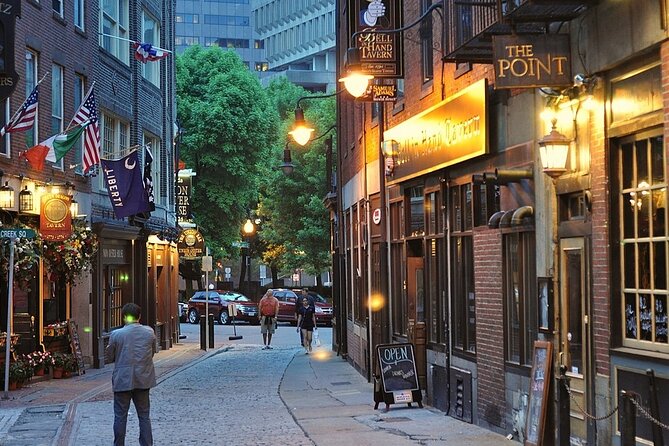
The golden dome of the Massachusetts State House is one of the route’s most recognizable sights. The building has served as the seat of the state legislature since 1798, and its architecture gives you a clear picture of Boston’s civic ambitions.
The nearby statues add less polished stories. General Joseph Hooker appears in the route, described through his unfortunate reputation. Mary Dyer recalls the religious intolerance of colonial Massachusetts. Dyer was hanged for her Quaker beliefs, a stark reminder that a place later associated with liberty once punished people for worshipping differently.
The official stop is short, only about five minutes. That is enough for an explanation from the sidewalk, not a tour of the interior. If you want to visit the State House inside, plan a separate visit.
Boston’s Brahmins and the literary life of the city
One of the more unusual portions of the walk concerns the private library of Boston’s Brahmins. The word refers to the city’s old Protestant elite, a group whose influence reached into politics, education, publishing, and culture.
This section gives the tour a welcome change of subject. Boston’s story is not only revolution and war. Books, social networks, religious disputes, and inherited wealth also shaped the city’s public life.
The library itself is presented through its history and rare books rather than as a guaranteed interior visit. You should think of this as a storytelling stop, not a museum admission.
Scollay Square and the city beneath modern streets
The West End portion recalls Scollay Square, once known for theaters, vaudeville shows, and colorful characters. Much of the old district disappeared as Boston changed, so the guide’s account helps you picture a city that is no longer fully visible.
You also hear about the Kennedy family’s romantic connections in Boston, including the so-called Love Nest. This kind of personal detail is typical of Stephen’s approach. He enjoys moving from public events to private lives, showing how history can be shaped by personalities as much as by laws.
The scheduled stop takes about 10 minutes. This is a good moment to ask questions if you want more detail about vanished neighborhoods or Boston families.
The Old State House and the Boston Massacre Site
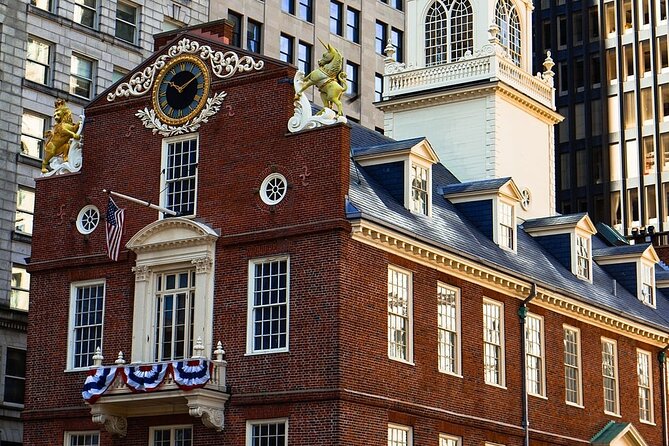
The Old State House is one of the most important buildings on the route. In 1776, a copy of the Declaration of Independence was read to Boston citizens from this area. The building later fell into disrepair, and Chicago offered to buy it. Local Bostonians rescued the site and carefully restored it over time.
That rescue story matters because preservation is part of Boston’s modern history. Old buildings do not survive simply because everyone agrees they are valuable. People have to fight for them, raise money, and decide which parts of the past deserve a place in the present city.
Nearby, the Boston Massacre Site marks the confrontation between British soldiers and colonists that helped push public opinion toward revolution. The stop is about 10 minutes. You will hear the event presented as a political turning point, but also as a moment shaped by fear, crowd pressure, military tension, and the power of printed images and speeches.
Because this area can be noisy, staying close to the guide matters. Stephen has acknowledged that city traffic, duck tours, and general street noise can make listening difficult. He has also begun using a voice amplifier, but you may still need to position yourself near him.
The Tea Party story and the Irish Famine Memorial
A short section near the revolutionary sites recalls the meeting of about 5,000 citizens on December 16, 1773. They agreed to prevent British tea from being unloaded, and men disguised as Mohawk Indians led a group toward Griffiths Wharf. That act helped turn a tax dispute into open rebellion.
The route then moves to the Boston Irish Famine Memorial. Between 1845 and 1852, the Great Famine drove thousands of Irish immigrants from Ireland to Boston. By 1850, Irish immigrants were the city’s largest ethnic group. The memorial honors those who suffered and also recognizes the many immigrant communities that later shaped Boston.
I like the way these two subjects sit close together. One concerns colonial resistance to an imperial power. The other concerns people arriving with little money, facing hardship, and building a new life. Together they make Boston’s story broader than the familiar sequence of Paul Revere, tea, and revolution.
Books, schools, and a donkey on School Street
The Old Corner Bookstore dates to 1718, when it served as a residence and apothecary. It became a bookstore in 1828 and later housed Ticknor and Fields publishers. Writers associated with the site include Henry Wadsworth Longfellow, Nathaniel Hawthorne, Oliver Wendell Holmes Sr., and Ralph Waldo Emerson.
The stop lasts about five minutes, but it gives literature fans a strong reason to take the tour. Boston helped shape American writing through publishers, clubs, schools, and personal relationships, not only through grand public buildings.
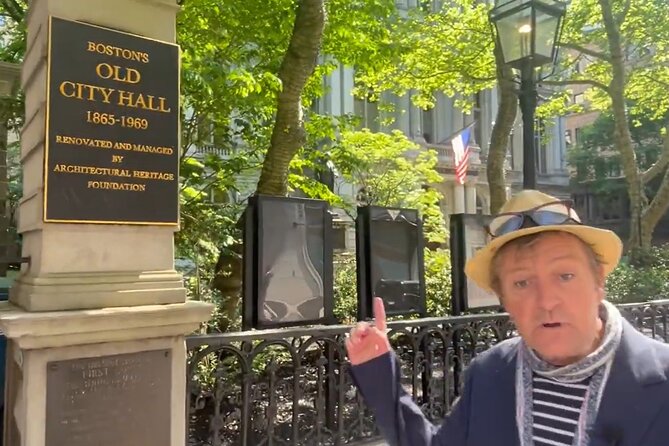
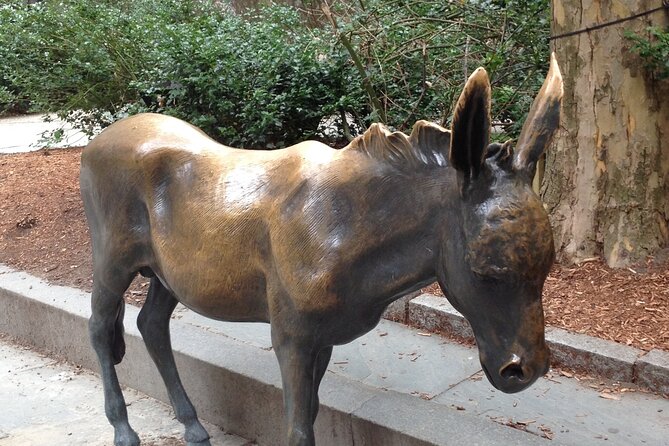
On School Street, you pass the site of Boston Latin School, identified as the first public school in the United States. The route also passes King’s Chapel, Old City Hall, and the Parker House. A lighter touch comes in the form of Boston’s beloved donkey, waiting on School Street. It is a small detail, but it keeps the tour from becoming too solemn.
Faneuil Hall and the complicated Cradle of Liberty
Faneuil Hall is often called the Cradle of Liberty, and its meeting hall played a major role in revolutionary politics. Yet the building’s origin carries a difficult fact: it was gifted to Boston by Peter Faneuil, a slave trader.
That contradiction is worth discussing. Faneuil Hall can represent public debate and democratic action while also being connected to wealth made through human bondage. The tour does not need to simplify Boston into heroes and villains. It can show you how civic ideals and moral failures existed side by side.
The grasshopper weathervane is modeled after one associated with London’s Royal Exchange. Faneuil Hall is also linked to the Ancient and Honorable Artillery Company of Massachusetts, which received its charter in 1637 and is described as the oldest military body in the Western Hemisphere.
The stop is about 10 minutes. You may want to return later for a longer look, since the tour uses the building as a historical setting rather than offering a full indoor visit.
Finishing near City Hall and the North End
The walk ends beside two statues of James Michael Curley, a four-time Boston mayor, Massachusetts governor, and congressman. Curley was a colorful political boss who dominated city politics for decades. His story provides a final look at Boston’s rough-and-tumble political culture.
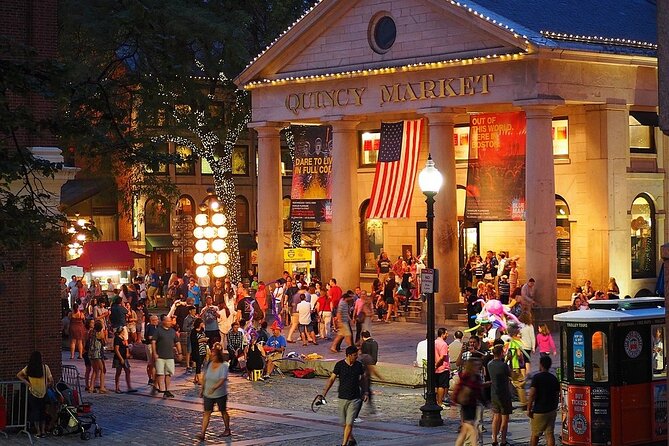
You finish near Boston City Hall, across from Faneuil Hall. The Union Oyster House and Bell in Hand tavern are nearby, and Hanover Street leads toward the North End. This is a practical ending because you can continue with food, more history, or a self-guided walk without crossing the city.
The tour is advertised at two hours, but timing can vary. Stephen has sometimes continued for close to three hours when questions, weather changes, or an especially engaging story stretch the route. That can be wonderful if you want a full history lesson. It can be frustrating if you have a dinner reservation or young children waiting for a break.
Who will enjoy this Boston walk?
I would choose this tour if you like history presented through personalities, arguments, and odd details. It is especially suitable for first-time visitors who want a quick orientation before exploring the Freedom Trail independently.
It also suits people who enjoy asking questions. Stephen is praised for being friendly, energetic, and willing to discuss subjects beyond the standard colonial script, including architecture, literature, art, religion, politics, and the Kennedy family.
I would be cautious if you prefer a quiet stroll or a short list of highlights. The content comes quickly, and non-native English speakers may find Stephen’s speed challenging. One sensible tactic is to stand near the guide, ask him to slow down when needed, and accept that you will not photograph every building at length.
Wear comfortable shoes and dress for the forecast. Cold, wind, and rain can make a two-hour outdoor walk feel much longer. The tour requires good weather, and a cancellation caused by poor conditions comes with either a different date or a full refund. You can also cancel for a full refund up to 24 hours before the start time.
Should you book this $5 Boston history tour?
Book it if you want a generous serving of Boston history for very little money, and if you enjoy a guide who is passionate enough to occasionally lose track of time. The 4.7 rating from 70 ratings and 93 percent recommendation rate reflect its strongest qualities: strong storytelling, broad subject knowledge, and a personal style.
Skip it if you need a tightly timed tour, frequent seating, or a slow pace for photographs. For everyone else, this is a smart first walk in Boston. You will finish near Faneuil Hall with a better sense of how revolution, religion, immigration, literature, politics, and preservation all shaped the city.
FAQ
How much does the Boston Historical and Heritage Walking Tour cost?
The tour costs $5 per person.
How long is the walking tour?
The scheduled duration is approximately two hours. It may run longer if the guide spends extra time answering questions or sharing additional stories.
Where does the tour begin?
It begins at the Boston Common Tablet at 1634 Freedom Trail, Boston, Massachusetts 02108.
Where does the tour end?
It ends beside the James Michael Curley statues near Congress Street and North Street, directly across from Faneuil Hall.
What time does the tour start?
The stated start time is 11:00 a.m.
What language is the tour offered in?
The tour is offered in English with an in-person guide.
What sites are included?
The route includes Boston Common, Park Street Church, the Robert Gould Shaw and 54th Regiment Memorial, the Massachusetts State House, Scollay Square, the Old State House, the Boston Massacre Site, the Boston Irish Famine Memorial, the Old Corner Bookstore, Boston Latin School, Faneuil Hall, and Boston City Hall.
Is admission to the stops included?
The listed stops have no admission charge. The experience is primarily an outdoor walking tour, and the information provided does not promise entry into every building.
How large can the group be?
The maximum group size is 24 people.
Can the tour be canceled for a refund?
You can cancel at least 24 hours before the start time for a full refund. Changes or cancellations made less than 24 hours before the start time are not accepted for a refund. If poor weather causes the tour to be canceled, you can choose another date or receive a full refund.
More Two-Hour Tours in Boston
- Boston: 2-Hour Historic Walking Tour
★ 4.7 · 88 reviews - 2 Hour Historic Pub Crawl in Boston
★ 5.0 · 45 reviews - 2-Hour Gettysburg Battlefield Guided History Bus Tour with a National Park Guide
★ 4.5 · 2,201 reviews - Kyoto Gion: 2-Hour Geisha Culture & History Walking Tour
★ 5.0 · 1,186 reviews
Just added around Boston
- Haunted Boston’s Historic Streets Walking Guided Tour★ 4.5 · 184 reviews
- Boston: Votes for Women History Tour of Back Bay★ 5.0 · 49 reviews
- Boston: Freedom Trail History Tour and Brewery Taste★ 5.0 · 38 reviews
- Boston: Food and History of The Freedom Trail Private Tour★ 5.0 · 159 reviews
- Walk the Historic Freedom Trail with Costumed Guide★ 4.5 · 329 reviews
- Self Guided “Historic Boston Downtown Freedom Trail” Audio/GPS Walking Tour★ 4.0 · 22 reviews
- Boston Seafood Lovers Food and History Walking Tour★ 5.0 · 208 reviews
- A Taste of the Freedom Trail: Boston’s Iconic Food & History Tour★ 5.0 · 32 reviews
History Walking Tours, compared.
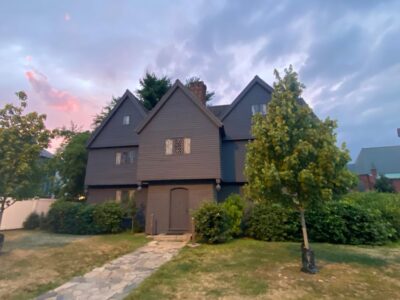
History and Hauntings of Salem Guided Walking Tour
Read our review →
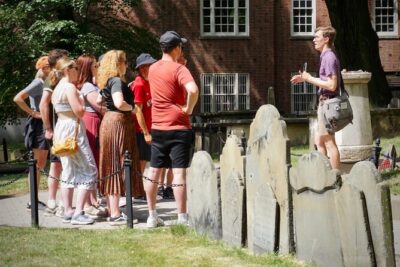
Freedom Trail History Small Group Walking Tour
Read our review →
Historic Charleston Guided Sightseeing Walking Tour
Read our review →
Tapas Walking Tour with Food, Wine, and History
Read our review →
Savannah History and Haunts Candlelit Ghost Walking Tour
Read our review →
A History of Terror – Belfast City Centre Walking Tour
Read our review →Browse the lists this tour appears in