
Review · POMPEII
Guided Tours of Pompeii Excavations Historical and Cultural Itineraries: Why It Scores 5/5
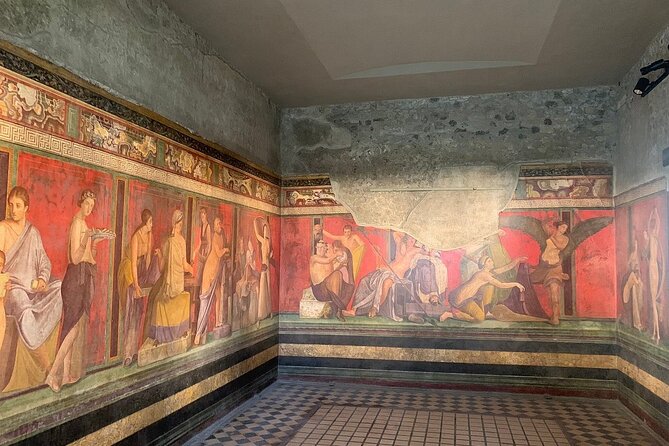
Pompeii rewards patient eyes. This four-hour guided walk connects major temples, villas, baths, and public buildings with the daily life of an ancient Hellenistic city. I especially like the small group limit of 15 people and the chance to visit the Villa dei Misteri, home to Pompeii’s famous Dionysian frescoes.
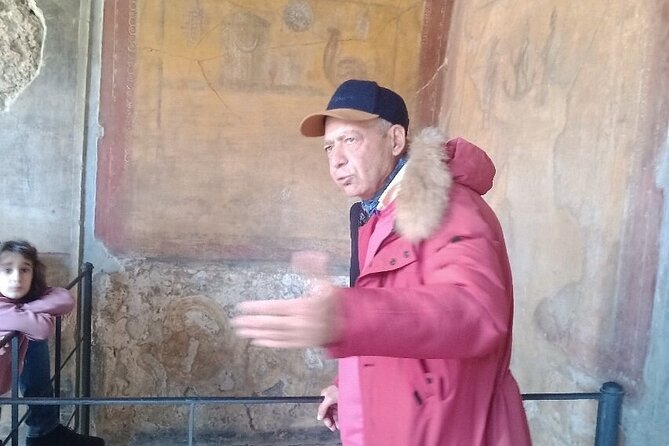
The guide, Professor Bruno Pisano, receives particularly warm praise for linking archaeology with philosophy, psychology, and modern life. I also like the clear route through ten important sites. The main drawback is simple but important: your Pompeii admission ticket is not included in the $57.62 tour price.
Key points to know before you book
- Villa dei Misteri is included: You see the celebrated first-century BC Dionysian fresco, one of Pompeii’s most important paintings.
- Professor Bruno Pisano leads the experience: His style combines history, culture, philosophy, and everyday life.
- Small groups are capped at 15 people: That makes it easier to hear explanations and ask questions.
- The tour lasts about four hours and ten minutes: Each listed stop receives about 25 minutes, with walking time between sites.
- Admission costs extra: The guiding service and assistance are included, but the ticket for the archaeological ruins is not.
- The route begins and ends at Porta Marina audioguide official: The meeting point is on Via Villa dei Misteri, 2, with a 9:30 am start.
Why this Pompeii tour has real appeal

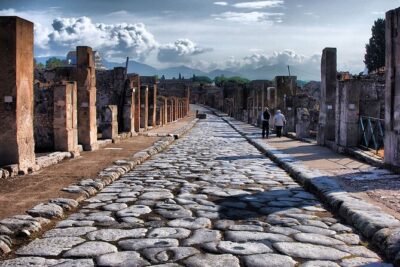
Pompeii can feel confusing without a plan. Streets, walls, shrines, shops, courtyards, and public buildings spread across a large archaeological park. You can easily spend hours admiring beautiful rooms without understanding how they fit into the city.
This tour gives those remains a framework. The route moves from public spaces and religious centers to private houses, thermal baths, and the Villa dei Misteri. That order helps you see Pompeii as a functioning city, not just a collection of ruins.
The interpretation also places Pompeii in a wider Mediterranean setting. The city is presented as a Hellenistic commercial and industrial center with connections reaching Asia Minor, India, and Persia. That approach is more useful than treating Pompeii as a sealed Roman town frozen in time.
Professor Bruno Pisano is the key personality here. He is praised for speaking with courtesy, patience, and enthusiasm, while making connections between ancient customs and modern psychology. His explanations are also described as suitable for younger visitors, which makes this a good option for families with older children and teenagers who need more than a list of dates.
The tone is academic, but the format is still a walking tour. If you want a quick photo stop at each famous building, this may feel too detailed. If you want to understand why the buildings mattered, the extra explanation is the point.
More Pompeii and Vesuvius History Tours in Italy:
- Discover the Ancient Ruins of Pompeii: Day Trip from Rome
★ 3.5 · 2,247 reviews - Small-Group Rome to Pompeii & Amalfi: Day of History & Sea
★ 5.0 · 239 reviews - Ancient Pompeii Private Tour: Skip the Line & Kid-Friendly Option
★ 5.0 · 167 reviews
Starting at the suburban baths
The first stop is the suburban baths, where you see a frigidarium with a glass-paste nymphaeum decorated with polychrome and glazed tiles. There is also a swimming pool decorated with Nilotic subjects.
This is a strong opening because baths reveal practical life. Pompeii was not only about temples and elite houses. It was also a city where people washed, socialized, exercised, and spent time in carefully designed public spaces.
The surviving decoration gives the building a more personal feel than a bare stone ruin. Look for the water-related details and the Egyptian-inspired scenes. The listed time is about 25 minutes, so you will hear the main interpretation without having unlimited time for close study.
The tour moves quickly enough that comfortable shoes matter. You will be walking across an archaeological site for several hours, and the experience includes ten stops rather than one single building.
Venus, sailors, and Pompeii’s high terrace
The Temple of Venus occupies a terrace overlooking the surrounding area. It was connected with the imperial cult and Venus as a goddess of sailors.
The location matters. A temple placed on a dominant terrace tells you something about visibility, ceremony, and civic identity. It was not an obscure neighborhood shrine. It formed part of the city’s public image.
You will also see an impressive bronze statue of Daedalus by Polish artist Igor Mitoraj. This modern work creates an unusual meeting between ancient Pompeii and contemporary sculpture. It is a useful reminder that the archaeological park is not only a preserved ancient setting. Modern artists still respond to the stories and spaces found here.
Because the stop lasts about 25 minutes, listen closely to the explanation of the site’s religious and political roles. The remains themselves can be difficult to read without guidance.
The Basilica and the city’s legal center
The Basilica of Pompeii was the city’s largest public building and served as its great tribunal. It has three naves and anticipates the basic form later associated with Christian basilicas.
This is one of the best places to think about how public life worked. The basilica was not a church in Pompeii. It was a civic and legal building, a place tied to administration and judgment.
The scale is the main feature. You may find the walls less immediately decorative than those of the villas, but the building’s size helps explain the importance of law and commerce in city life.
Pisano’s historical approach should be useful here because the basilica connects architecture with institutions. You are not just looking at columns. You are looking at the physical setting for decisions, disputes, and civic authority.
More Archaeological Site Tours in Italy:
- Ancient Syracuse: private guided tour of the Neapolis archaeological park
★ 4.5 · 88 reviews - Ancient Rome: Archeological area Largo Argentina
★ 3.9 · 49 reviews - Rome: Private Colosseum Experience and Ancient Ruins Tour
★ 4.6 · 25 reviews - Olbia: Archaeological Tour of Ancient Sardinia + Transport
★ 4.6 · 21 reviews
Apollo and the older Greek influence
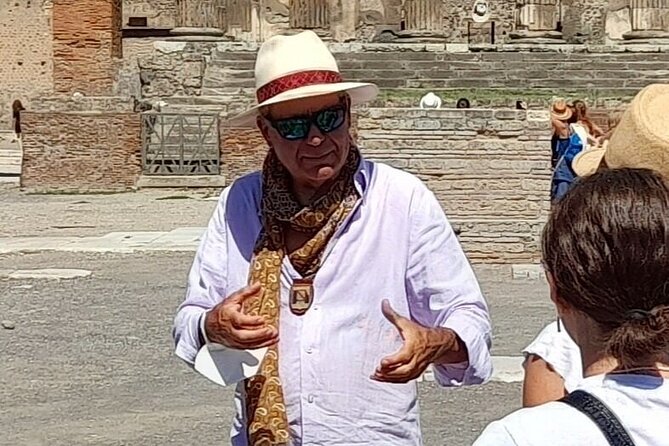
The Temple of Apollo has a Greek design and was connected with ethical and prophetic worship. Two bronze statues of Apollo and Diana dominate the site.
This stop supports one of the tour’s central ideas: Pompeii should not be understood only through a Roman lens. Its cultural identity was shaped by Greek and wider Hellenistic influence before and during Roman rule.
The temple also helps explain how religion entered everyday decision-making. Apollo was linked with prophecy, while the broader presentation connects the site to ethical ideas and public worship.
The stop is again planned for about 25 minutes. That is enough for a guided explanation, but not for a slow, private study of every architectural detail. If you are especially interested in classical architecture, you may want to remember the site and return to it after the guided portion.
The Forum, where Pompeii came together
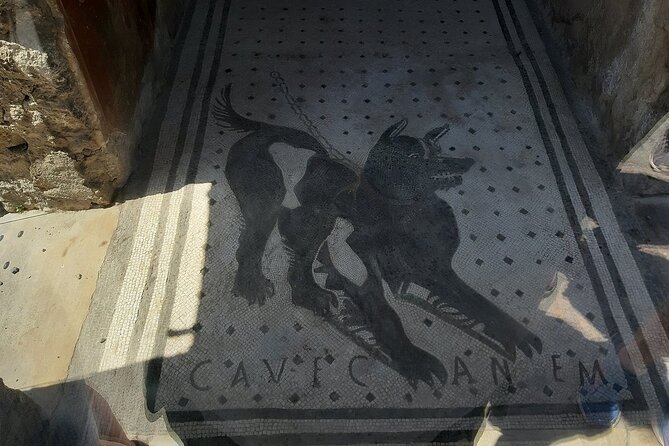
The Forum was Pompeii’s commercial, administrative, and religious center. It is dominated by the Temple of Jupiter, Juno, and Minerva.
This is the moment when the scattered parts of the city begin to make sense. The Forum was not simply an open square. It was the central stage for business, government, worship, and civic display.
The Temple of Jupiter, Juno, and Minerva gives the space its grand religious focus. At the same time, the forum’s practical role keeps the tour grounded in ordinary activity. Pompeii’s residents bought goods, handled business, attended public events, and worshipped within the same urban center.
The open setting can be hot and exposed, depending on the day. Bring water and protect yourself from the sun. Snacks are not included, and the tour itself is long enough that you should eat beforehand.
Forum Baths and the Roman spa experience
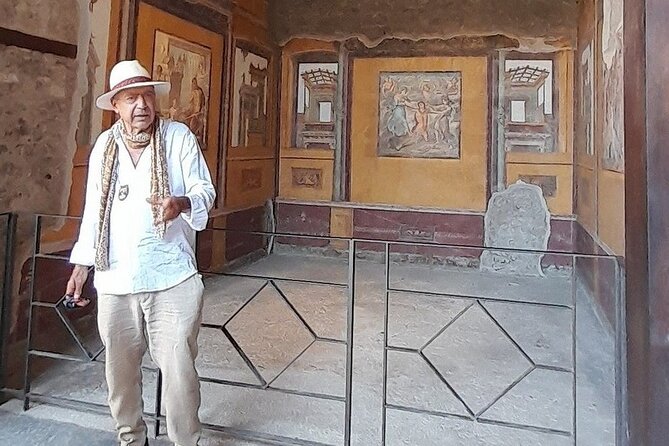
The Forum Baths were Pompeii’s wellness center. The complex is remarkably well preserved, with a tepidarium decorated with stucco from the Neronian school and a large alabaster labrum in the calidarium, reportedly of Egyptian origin.
The sequence of rooms helps you understand how Roman bathing worked. The tepidarium was the warm room, while the calidarium provided greater heat. This was a social and cultural practice, not merely a place to get clean.
The decoration is especially valuable here. Stucco work and the alabaster basin show the money and craftsmanship invested in a public facility. Egyptian materials and imagery also fit the wider picture of Pompeii as a city connected to distant parts of the Mediterranean world.
With only 25 minutes, you will get the guided explanation rather than an unhurried architectural study. Still, the baths are one of the most accessible places to picture everyday routines in ancient Pompeii.
The House of the Faun and Alexander’s mosaic
The House of the Faun is the largest house in Pompeii and dates to the Hellenistic era. Its most famous feature is an excellent copy of the Alexander Mosaic, showing the Battle of Issus in 333 BC between Alexander the Great and Darius III of Persia.
This house gives the tour a clear look at elite domestic life. Its size alone tells you that Pompeii contained powerful and wealthy households with international cultural interests.
The Battle of Issus scene is especially important because it points beyond Italy. The subject celebrates a major conflict between Macedonian and Persian power, linking Pompeii’s decorative world to the politics and art of the eastern Mediterranean.
The mosaic on display is a copy, so your guide’s explanation matters. You will benefit from hearing what the original composition represents and why a scene from Alexander’s campaigns would have mattered in a Pompeian home.
The House of the Vettii and its lively paintings
The House of the Vettii contains fine examples of the fourth Pompeian style. Inside, you see the famous Priapus, paintings connected with the Neronian school, and a grand hall filled with Cupids engaged in various kinds of work.
The mythological paintings include the story of Daedalus and the Minotaur. These are not dull wall decorations. They express social status, taste, mythology, humor, and the owner’s view of domestic life.
The Cupids at work are a particularly appealing detail because they turn labor into playful imagery. You may see ancient artistic conventions more clearly here than in the larger public buildings.
The house’s paintings deserve time, and 25 minutes can pass quickly. Stay close to the guide so you do not miss the explanation of the rooms and their themes. This is also one of the stops where a specialist guide makes a meaningful difference.
The House of the Golden Cupids
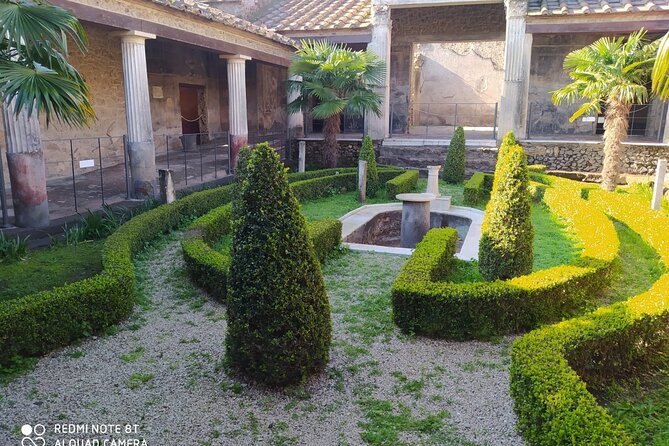
The House of the Golden Cupids is a well-preserved domus with a Rhodian peristyle. It contains obsidian mirrors, a shrine connected with Isis, a lararium for the household gods, and frescoes devoted to the Trojan War.
This house brings together several layers of Pompeian belief. The lararium reflects domestic religion, while the Isis shrine points to the broader movement of Egyptian religious traditions through the Mediterranean.
The Trojan War frescoes add a literary and mythological dimension. Ancient homes were not decorated at random. Images helped owners present education, religious loyalty, family identity, and social standing.
The Rhodian peristyle is also worth noticing. The open courtyard structure gave the house light, air, and a formal center. You will see how private architecture could combine beauty with practical organization.
Villa dei Misteri and the Dionysian fresco
The final stop is the Villa dei Misteri, one of the strongest reasons to choose this route. The villa contains a famous Dionysian fresco from the first century BC, noted for its exceptional state of preservation.
The paintings are linked to Dionysian mystery rites. The subject can be difficult to interpret, which is exactly why a guide helps. You are not simply looking at a colorful wall. You are considering initiation, ritual, symbolism, and the religious world of a wealthy ancient household.
Ending here gives the tour a dramatic finish. After seeing public buildings, baths, temples, and private homes, you arrive at a villa where painting carries much of the story.
The villa is included in the route, but the archaeological park admission is still separate. Check that point carefully before booking so the total price does not surprise you.
Price, group size, and practical value
The listed price is $57.62 per person. That is a fair price for a four-hour guided service led by a specialist, especially with a maximum of 15 people. The value is strongest if you want interpretation rather than simple directions.
The admission ticket is not included, and that changes the final cost. You should compare the combined price of the guide and park entry with other options before committing. One piece of feedback specifically raised concern about an agency adding 20 euros to a 50-euro price, so check who is selling the service and what portion goes to the guide.
The tour is usually booked about 23 days ahead. That suggests planning is sensible, especially if your visit falls during a busy period. Confirmation is sent within 48 hours, subject to availability.
The tour starts at 9:30 am at Porta Marina audioguide official, Via Villa dei Misteri, 2, 80045 Pompei. It ends at the same address. A mobile ticket is provided, and the site is near public transportation.
Service animals are allowed, and most people can participate. The four-hour length remains the main physical consideration. You should be comfortable walking through an archaeological park and standing at multiple sites.
Free cancellation is available up to 24 hours before the start time. Changes or cancellations made later are not accepted for a refund.
Who should book this Pompeii experience?
I would choose this tour if you want a serious explanation of Pompeii’s art, religion, architecture, and social life. It suits adults who enjoy context and families with children or teenagers who respond well to stories and connections.
It is also a good match if the Villa dei Misteri is high on your list, or if you want to see both famous public sites and less familiar domestic spaces in one route.
I would hesitate if you prefer to wander alone, stop for long periods at a single fresco, or set your own pace. Ten stops in roughly four hours means the schedule is structured. You will see a great deal, but you will not have unlimited time at every house.
Should you book it?
Book this experience if you want Pompeii explained by a guide with a strong academic and cultural focus. Professor Bruno Pisano’s praised ability to connect ancient life with modern ideas is the tour’s biggest asset, while the small group keeps the format personal enough for questions.
Before paying, confirm the separate archaeological park ticket and the final price through the booking channel. If that added cost fits your budget, this is a strong choice for a thoughtful first visit to Pompeii, especially for the House of the Faun, the House of the Vettii, and the Villa dei Misteri.
FAQ
How long does the Pompeii guided tour last?
The tour lasts approximately four hours and ten minutes.
What time does the tour begin?
The tour starts at 9:30 am.
Where does the tour meet?
The meeting point is Porta Marina audioguide official, Via Villa dei Misteri, 2, 80045 Pompei, Italy.
Where does the tour end?
The tour ends at the same address where it begins.
Is the Pompeii entrance ticket included?
No. The entrance ticket to the Pompeii ruins is not included in the tour price.
How many people can join the tour?
The tour has a maximum of 15 travelers per guide.
Is the Villa dei Misteri included?
Yes. The itinerary includes the Villa dei Misteri and its famous Dionysian fresco.
Can I cancel for a full refund?
Yes. You can cancel at least 24 hours before the experience start time for a full refund. Cancellations made less than 24 hours before the start time are not refunded.
More Local Culture and Traditions Tours in Italy
- Naples Spanish Quarters Walking Tour Street Art, Folklore & Sweet
★ 5.0 · 797 reviews - Matera’s Sassi Walking Tour – History & Culture
★ 5.0 · 476 reviews - Matera’s Sassi Walking Tour – History and Culture
★ 4.8 · 356 reviews - From Catania: Syracuse and Noto Culture and History Tour
★ 4.4 · 232 reviews
Just added around Italy
- Skip-the-line Exclusive Private Full-Day Complete Ancient Pompeii Guided Tour★ 5.0 · 30 reviews
- Small Group Guided Walking Tour of Ancient Pompeii Highlights★ 5.0 · 27 reviews
- Fast Access Exclusive Private Ancient Pompeii Half Day Tour with Local Guide★ 5.0 · 54 reviews
- Pompeii Small Group Tour – Tickets Included★ 5.0 · 85 reviews
- Ancient Pompei in the afternoon★ 5.0 · 140 reviews
- Discover Palermo in 3 hours. Art, history, markets and street food★ 5.0 · 352 reviews
- Guided tour of the historic center Palermo★ 5.0 · 42 reviews
- Palermo: Tour Historic Center, Catacombs & Monreale in CruiserCar★ 5.0 · 36 reviews
Pompeii & Vesuvius History Tours, compared.
Discover the Ancient Ruins of Pompeii: Day Trip from Rome
Read our review →
Small-Group Rome to Pompeii & Amalfi: Day of History & Sea
Read our review →Ancient Pompeii Private Tour: Skip the Line & Kid-Friendly Option
Read our review →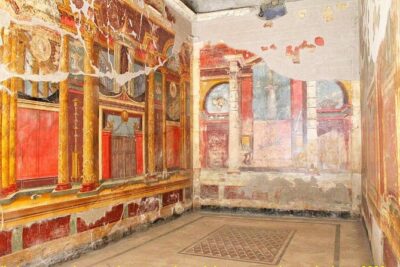
Skip-the-Line Half-Day Private Tour Ancient Pompeii Highlights with Native Guide
Read our review →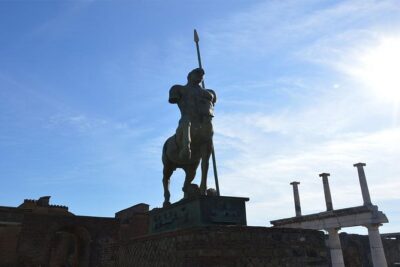
Fast Access Exclusive Private Ancient Pompeii Half Day Tour with Local Guide
Read our review →
Private Walking Tour through the Historical City of Herculaneum
Read our review →Browse the lists this tour appears in