
Review · CAIRNS & THE TROPICAL NORTH
Cairns History Walking Tour
Cairns has more stories than beaches. This 90-minute walk gives you a useful introduction to Cairns beyond the reef, with stops covering Aboriginal culture, colonial settlement, Chinese heritage, wartime Cairns, architecture, and the city’s early hotels. The group is limited to 12, which makes it easier to hear the guide and ask questions.
I like the small group size and the route’s mix of familiar landmarks and less obvious stories. I also like that the walk treats Cairns as more than a launch point for the Great Barrier Reef. The main consideration is time: with eight stops in about 1.5 hours, each topic receives a short explanation rather than a long historical lecture.
Key points to know before you book
- Eight central Cairns stops: The route begins and ends at Cairns Museum, with stops at the art gallery, Esplanade Lagoon, Tourist Information Centre, Reef Hotel Casino, The Chambers, Crystal Ball Bookstore, and Hides Hotel.
- A maximum of 12 people: This is a personal-sized group, useful when you want to hear stories clearly and speak with the guide.
- Cairns history reaches back at least 40,000 years: The tour includes traditional owners, Aboriginal art, colonial settlement, and later immigrant communities.
- The past is tied to real buildings: Old hotels, government offices, department stores, war memorials, and former commercial sites give the history a physical setting.
- Guides add practical local advice: Peter and Georgia have been praised for explaining Cairns history while also pointing out places for coffee, food, and shopping.
- A useful first-day activity: The route is short, central, and easy to fit around other Cairns plans.
Why a history walk improves a Cairns stay
Many people arrive in Cairns with the reef and rainforest at the top of the schedule. That makes sense, but it can leave the city itself feeling like a simple base for day trips. This tour corrects that impression in a compact way.
You’ll hear about a meeting place used by traditional owners and colonial settlers, the arrival of government, the gold rush, Chinese communities, wartime Cairns, and the businesses that helped the settlement grow. These subjects explain why Cairns developed where it did and how its public life changed over time.
The tour also gives you a better way to read the city afterward. A building that first looks like a shopfront may have been a department store, government office, hotel, or transport company headquarters. That added context is one of the best reasons to take the walk early in your visit.
At $37.98 per person, this is not the cheapest way to spend 90 minutes in Cairns. Still, the price is reasonable if you value a focused local guide, a maximum group of 12, and a route that brings together Aboriginal, colonial, Chinese, commercial, and military history. You are paying for interpretation, not entry tickets, since all listed stops are free to visit.
The tour has a 4.9 out of 5 rating from 52 ratings, with 98 percent recommending it. That strong response fits the tour’s purpose: it is short, clearly themed, and packed with stories. Just do not expect a long museum visit or an exhaustive account of every period in Cairns history.
More History Walking Tours in Australia
- Ultimate Melbourne Walking Tour: History, Laneways & Culture
★ 5.0 · 1,451 reviews - Sydney: The Rocks 90-Minute History Walking Tour
★ 4.7 · 1,092 reviews - Discover Perth Walking Tour: History, Art, Local Insights + More!
★ 5.0 · 458 reviews
Starting at Cairns Museum and the city’s first meeting place
The walk begins outside Cairns Museum at 93/105 Lake Street. This is a sensible starting point because the museum puts the city’s past in view before you begin moving through the streets.
The first stop looks at the area as a meeting place for traditional owners and colonial settlers. That framing matters. It places the arrival of the settlement within a much older human story, rather than treating Cairns as if it began with European construction.
The tour introduces a history reaching back at least 40,000 years. You can expect discussion of traditional owners and the change that came with colonial settlement. Because the stop lasts about 10 minutes, the guide needs to keep the explanation focused, but it gives you an important base for the rest of the walk.
I recommend arriving ready to listen rather than rushing into photographs. This opening sets the tone for a tour that connects modern Cairns with the people and events that came before its present-day tourism economy.
Cairns Art Gallery, Aboriginal art, and the colonial story
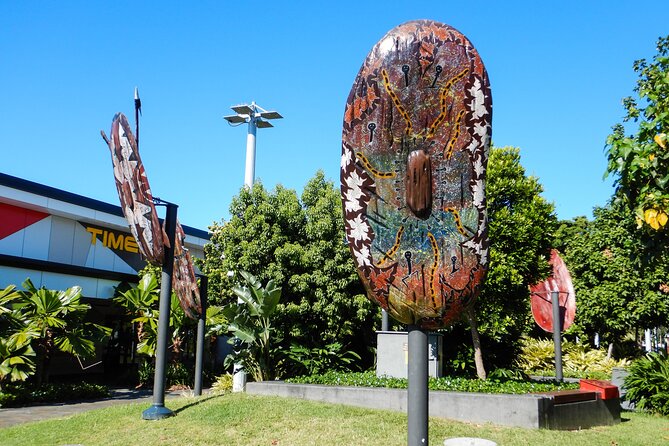
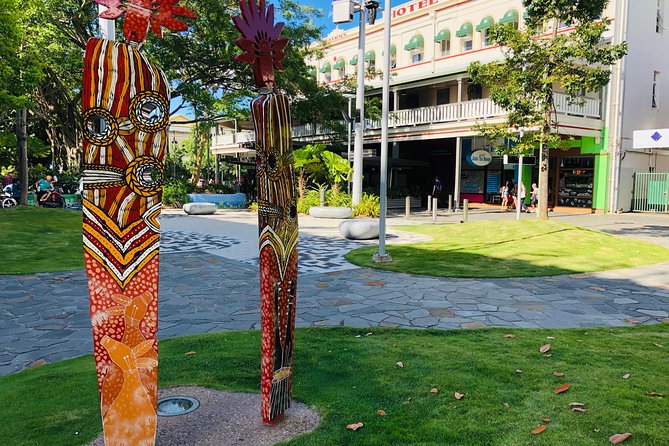
The second stop is Cairns Art Gallery, where the guide discusses the Shields Street Aboriginal shields street art by Paul Bong. This brings outdoor Aboriginal artwork into the route, so you are not limited to history told through old buildings and colonial records.
The stop also covers the gold rush and the establishment of the colony. That pairing helps explain two sides of Cairns development: the people and cultures connected to the region long before colonial rule, and the economic forces that shaped the settlement afterward.
You’ll also hear about the Public Curators building, now associated with the Cairns Regional Gallery. Architecture becomes part of the lesson here. Instead of treating buildings as decoration, the guide uses them to explain how public institutions and civic life developed.
This is a good point for anyone interested in art or architecture, but it may feel quick if you want detailed discussion of Paul Bong’s work or a full gallery visit. The walking tour takes place around the city, so it does not replace time inside Cairns Art Gallery.
The Esplanade Lagoon and the reef and rainforest connection
At Cairns Esplanade Lagoon, the focus shifts to the natural features that define the region. The guide discusses the reef and rainforest as World Heritage Sites, then connects them with the story of early settlers and even pirates.
This stop helps you understand the relationship between Cairns and its surroundings. The city’s identity is tied to the coast, the Great Barrier Reef, and the rainforest, but those places are also part of a longer human and economic story.
The lagoon is a familiar modern Cairns landmark, so the stop gives a useful contrast between present-day public space and the earlier settlement. You may already have plans for swimming, walking, or sitting around the lagoon. Hearing its historical context makes the area more than a convenient waterfront stop.
The pirate stories add a lighter edge to the tour, while the discussion of settlers gives the stop substance. With roughly 10 minutes here, you will get a concise explanation rather than a full account of maritime history.
Same place, a different slice of the past:
- Puffing Billy Railway: Heritage Steam Train Journey
★ 4.6 · 1,195 reviews - Morning World Heritage Cruise on the Gordon River from Strahan
★ 5.0 · 1,193 reviews - Strahan: World Heritage Cruise on Gordon River with Lunch
★ 4.8 · 1,143 reviews - Experience History onboard The Mary Valley Rattler
★ 5.0 · 963 reviews
Early government outside the Mulgrave Shire building
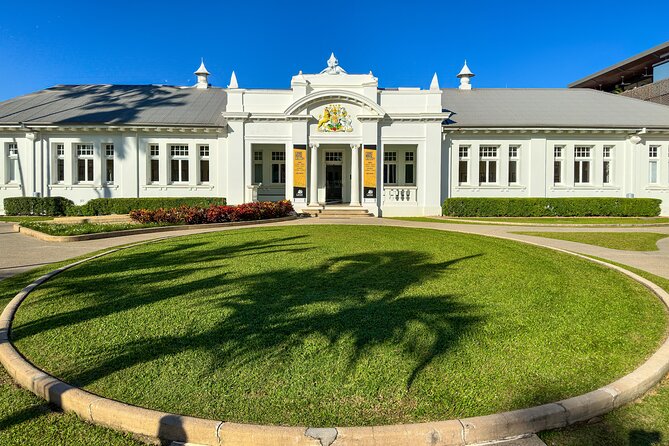
The next stop is near the Cairns Tourist Information Centre, in front of the Mulgrave Shire building. This was the original local government headquarters for the colony, making it a useful place to discuss how early government operated.
For me, this is the sort of detail that turns a city walk into a practical lesson. Government is often invisible in a modern city, but an older headquarters gives you a physical point of reference. You can connect the building with the decisions, services, and administration needed to run a growing settlement.
The stop lasts about 10 minutes and stays close to the central route. That makes the walk easy to follow, though you should expect city streets and public spaces rather than a quiet nature walk. The tour is designed around buildings and landmarks, so comfortable shoes will help even though the distance is not described as strenuous.
War memorial stories beside the Reef Hotel Casino
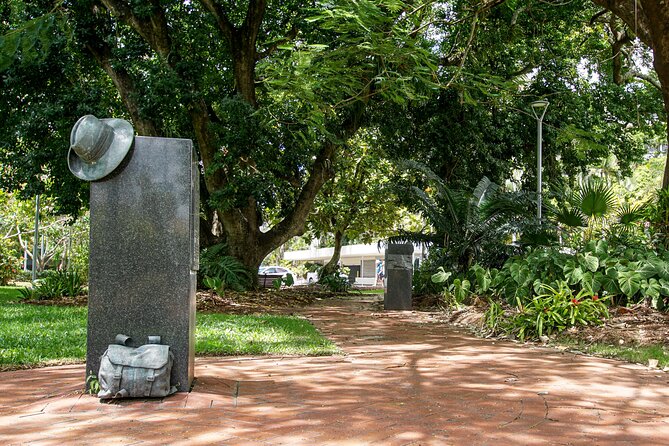
At the war memorial next to the Reef Hotel Casino, the guide explores the role of war in Cairns life, with special attention to World War II. This is an important change of subject from settlement and commerce.
World War II affected Cairns in ways that went beyond distant newspaper headlines. The memorial gives the guide a place to discuss how war became part of local life and how a regional city was connected to wider events.
The casino provides an unmistakably modern backdrop, which makes the contrast useful. Cairns has changed dramatically, but the memorial keeps older experiences visible within the current city center.
This stop is likely to appeal most if you want social and military history rather than only architecture. It also prevents the tour from presenting Cairns as a place shaped solely by tourism, trade, and the natural environment.
The Chambers, Bolands Centre, and early Cairns business
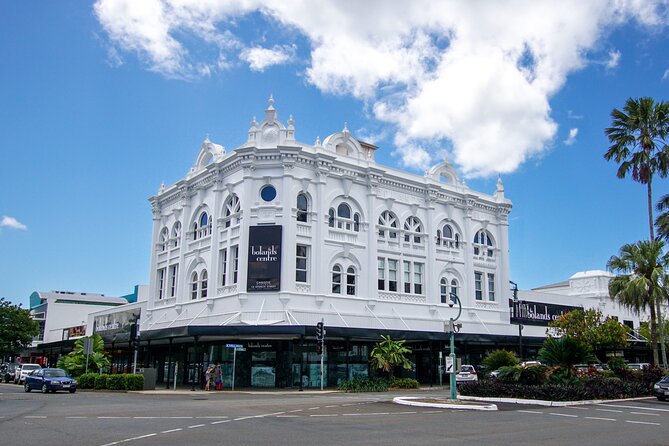
From The Chambers, the guide explains the history of the Bolands Centre, described as Cairns’ first department store. The view also provides a starting point for discussing the Adelaide Steamship Company and the Central Hotel.
This is one of the strongest sections for understanding how Cairns worked as a commercial center. Department stores, shipping companies, and hotels were not random businesses. Together, they show how goods, people, and services moved through the settlement.
The Adelaide Steamship Company points toward the importance of transport and trade. The Central Hotel brings in the social side of early town life, while Bolands shows the growth of retail. You get several connected pieces of the city’s development from one location.
The advantage of this stop is its efficiency. The drawback is that the three subjects may move quickly, especially if you are especially interested in shipping or old hotels. You can note the names and return later if one catches your attention.
Chinatown at Crystal Ball Bookstore
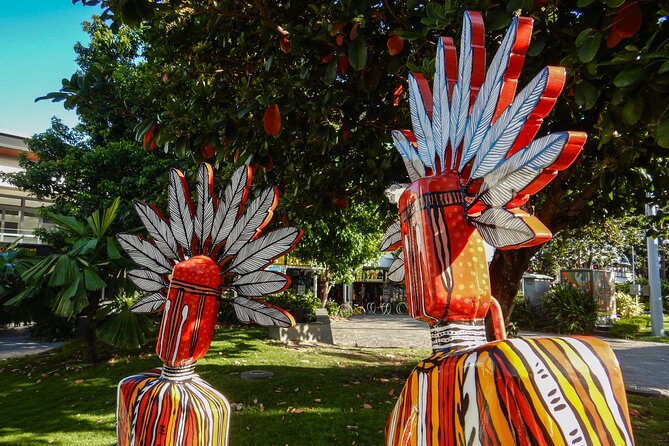
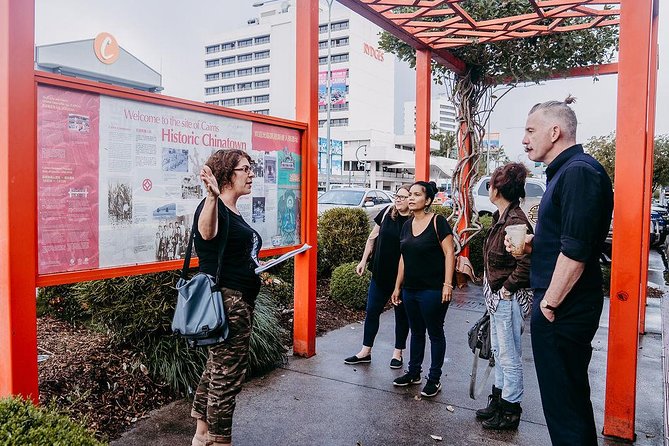
The Chinatown exhibit in front of Crystal Ball Bookstore provides the clearest look at the Chinese role in Cairns history. The guide also discusses Grafton Street as the heart of Chinatown.
This stop is especially valuable because Chinese communities were important to the development of many Australian towns, yet that part of local history can be easy to miss when you walk through a modern shopping district. Here, the exhibit gives the story a visible place.
The bookstore location also makes the stop easy to remember. Instead of receiving a list of names and dates, you connect the account with a specific street, storefront, and former center of community life.
At about five minutes, this is a brief stop. It works as an introduction, not a full study of Chinese Cairns. Still, it adds an essential part of the city’s story and helps explain why Grafton Street mattered.
Hides Hotel and the final look at early town life
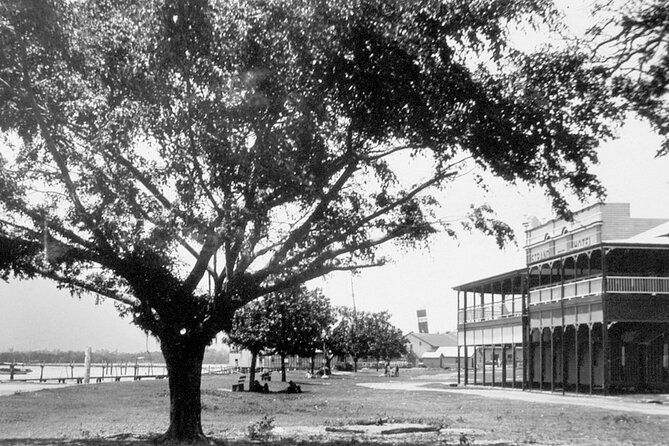
The route returns to the start in front of Cairns Museum, with a final discussion of the School of Arts and Hides Hotel. The School of Arts is linked with the founding colony, while Hides Hotel helps explain the role of historic hotels in early town life.
Hotels were important gathering places in early settlements. They could serve as places for accommodation, meetings, business, and social contact. That gives Hides Hotel a wider importance than its function as a place to sleep.
Ending here is practical because you are returned to the same central location. It also gives the tour a tidy structure, moving from the earliest meeting place through art, government, war, commerce, Chinatown, and early civic life before returning to where you began.
This final five-minute stop may feel short, but it ties together several themes from the walk: public institutions, social life, and the everyday businesses that helped establish Cairns.
Guides, group size, and the pace of the walk
The maximum group size is 12. That is one of the tour’s best features. A small group makes it easier to stand near the guide, ask a question, and keep the walk moving without the delays common in large sightseeing groups.
Peter has received praise for making the time pass quickly while explaining Cairns, the Great Barrier Reef, and local sites. Georgia has also been appreciated for combining Cairns history with suggestions for coffee and dining. Those practical tips can be useful if you take the tour near the start of your stay.
The walk lasts approximately 1.5 hours, with most stops taking about 10 minutes and two final stops taking about five minutes each. This is a brisk format. You will hear many names, places, and subjects, so I suggest making a mental note of anything you want to explore later.
The route begins at Cairns Museum and ends there. You do not need to arrange transport between stops, and the central route makes this easy to fit into a day of sightseeing. The tour is listed as suitable for most people, near public transportation, and service animals are allowed.
Cairns weather can change, and the experience requires good weather. If poor weather causes cancellation, you will be offered another date or a full refund. Free cancellation is available up to 24 hours before the start time. A minimum number of participants is also required, so cancellation for that reason comes with a new date, another experience, or a full refund.
Who will get the most from this Cairns walk?
I would recommend this tour to anyone arriving in Cairns who wants the city to make more sense before heading out to the reef or rainforest. It is particularly useful for first-time visitors, people interested in architecture, and anyone who likes local stories tied to actual streets and buildings.
It also suits people who prefer a short activity rather than a half-day excursion. You get an overview of Aboriginal culture, colonial settlement, Chinese heritage, commerce, government, and war without committing a full morning or afternoon.
Families and older visitors may appreciate the compact route, though the walk still involves moving between several city locations. Anyone seeking a detailed academic history, a long museum session, or a specialized Aboriginal cultural tour should choose a more focused experience instead.
The walk is also a good choice for solo visitors and couples who want practical local orientation. The advice about coffee, food, and shopping can help you make better use of the rest of your time in Cairns.
Should you book the Cairns History Walking Tour?
Book it if you want a short, well-priced introduction to Cairns and prefer stories over a simple list of sights. The mix of traditional owners, Aboriginal art, colonialism, pirates, the opium trade, Chinese communities, government, war, and early business gives the city more depth than you might expect from a resort base.
At $37.98, the value depends on your interest in guided interpretation. The tour does not include paid admissions, and every stop is viewed from public areas. You are paying for the guide’s explanation, structure, and local perspective.
I would take it early in a Cairns visit, then use the rest of the trip to see the reef, rainforest, galleries, and waterfront with a better sense of place. Skip it only if your schedule is extremely tight or you want a long, specialist history experience. For most visitors with 90 minutes available, the small group and strong range of subjects make this a sensible city introduction.
FAQ
How long does the Cairns History Walking Tour last?
The tour lasts approximately 1 hour and 30 minutes.
Where does the tour begin?
It begins at Cairns Museum, located at 93/105 Lake Street, Cairns City, Queensland 4870.
Where does the tour finish?
The tour ends back at the Cairns Museum meeting point.
How large is the tour group?
The experience has a maximum of 12 participants.
Is the tour suitable for most people?
Yes. Most people can participate, and service animals are allowed. The tour is also near public transportation.
Can I cancel for a full refund?
Yes. You can cancel at least 24 hours before the experience start time for a full refund. Cancellations or changes made less than 24 hours before the start time are not accepted for a refund.
Just added around Australia
- Entry Ticket at Historic Village Herberton★ 5.0 · 114 reviews
- Self-Guided Ngilgi Cave Ancient Lands Experience★ 4.5 · 154 reviews
- Hinterland Heritage Wine Tour★ 4.0 · 28 reviews
- Albany’s Historic Whaling Station Admission Ticket★ 4.5 · 86 reviews
- 7 Day Adelaide to Uluru Adventure and Cultural Tour★ 5.0 · 52 reviews
- Sydney Historical Walking Tour including The Rocks★ 4.6 · 20 reviews
- Sydney Convicts, History & The Rocks 2.5-Hour Walking Tour★ 4.9 · 181 reviews
- Port Arthur Historic Site Ghost Tour★ 4.2 · 173 reviews
History Walking Tours, compared.

History and Hauntings of Salem Guided Walking Tour
Read our review →
Freedom Trail History Small Group Walking Tour
Read our review →
Historic Charleston Guided Sightseeing Walking Tour
Read our review →
Tapas Walking Tour with Food, Wine, and History
Read our review →
Savannah History and Haunts Candlelit Ghost Walking Tour
Read our review →
A History of Terror – Belfast City Centre Walking Tour
Read our review →Browse the lists this tour appears in