

Review · ATHENS
Biblical Corinth: St. Paul and His Letters to the Corinthians
Paul’s Corinth is still easy to trace. This private day trip links Mars Hill, the Corinth Canal, Ancient Corinth, and Kenchreai into one long look at the places tied to Paul’s preaching, work, and letters. I like the flexible pacing and the range of stops, from a busy Roman forum to a quiet seaside port.
I also like the personal service. Drivers such as Alex, George, Stefanos, Spiros, and Panos have been praised for clear English, safe driving, local knowledge, and a relaxed manner. The main drawback is important: your driver does not enter the archaeological sites as a licensed guide unless you arrange that service separately.
The tour costs $218.43 per person and takes about eight to nine hours. That is a fair price for private transport, hotel or port pickup, Wi-Fi, water, and a full itinerary, but the value depends on your group size and expectations. If you want detailed explanations inside every ruin, add the optional licensed guide.
Key points before you book
- Paul’s Athens connection: Begin at Areopagus Hill, where Paul addressed the council about the Unknown God.
- A full Corinth circuit: See the canal, Diolkos, Isthmia, Ancient Corinth, Kenchreai, Apostolou Pavlou church, and Akrokorinthos.
- Private pacing: Your group can spend more time at the fortress, skip a stop, or adjust the schedule with the driver.
- Self-guided archaeological sites: The driver provides commentary on the road and before you enter, but does not normally walk through the ruins with you.
- Optional Greek lunch: Choose the traditional-food option if you want lunch included, or make your own arrangement.
- Good for cruise passengers: Port pickup, flexible timing, and direct return make this useful when you have a ship to catch.
Why Paul’s Corinth makes a strong day trip from Athens
Corinth was not a sleepy religious outpost. It occupied the narrow Isthmus of Corinth, the land bridge between mainland Greece and the Peloponnese. Ships, merchants, soldiers, athletes, officials, and religious pilgrims all passed through this corridor.
That setting helps explain why Paul spent about 18 months in Corinth around AD 51 to 52. He was preaching in a commercial center where people from many places crossed paths. His letters to the Corinthians later addressed practical problems inside the early Christian community, including divisions, morality, worship, and the meaning of spiritual life.
I like this tour because it does not treat Corinth as a single pile of stones. The canal explains the geography. Isthmia explains the athletic and religious world. Ancient Corinth shows the Roman city where Paul worked. Kenchreai connects the story to sea travel and the wider Mediterranean.
The drive from Athens also gives the day a useful rhythm. You ride between sites in an air-conditioned vehicle, with Wi-Fi and bottled water included. The driver can explain what you are seeing, then give you time to look around on your own.
More Ancient History Tours in Athens
- Athens: Ancient Greek Theater Performance
★ 4.7 · 2,481 reviews - Historical Delphi One Day Tour with Arachova Stop & Expert Guide
★ 4.5 · 1,247 reviews - From Athens: Ancient Corinth Day Trip with Canal & VR Guide
★ 4.6 · 1,073 reviews
Areopagus Hill and the beginning in Athens
The first stop is Areopagus Hill, also called Mars Hill, near the Acropolis. According to Acts, Paul spoke there to the council of Athens, referring to an altar dedicated to an Unknown God.
The stop lasts about 20 minutes and has no admission charge. It is not a long visit, but it gives the day a clear starting point. You are not beginning with a generic ancient ruin. You are beginning with Paul’s attempt to speak to the intellectual and religious center of Athens.
Be prepared for uneven stone and a short climb. The hill is exposed, so sturdy shoes and water help. The tour description places this visit within the Acropolis area, but the main purpose is the rock of Mars Hill rather than a full Acropolis tour.
This is also where a driver’s road commentary matters. A licensed guide is not included by default, but drivers can explain the biblical setting before you walk up. Alex, for example, was praised for adapting the day so a visitor could include Mars Hill as a personal priority.
The Corinth Canal and the old Diolkos
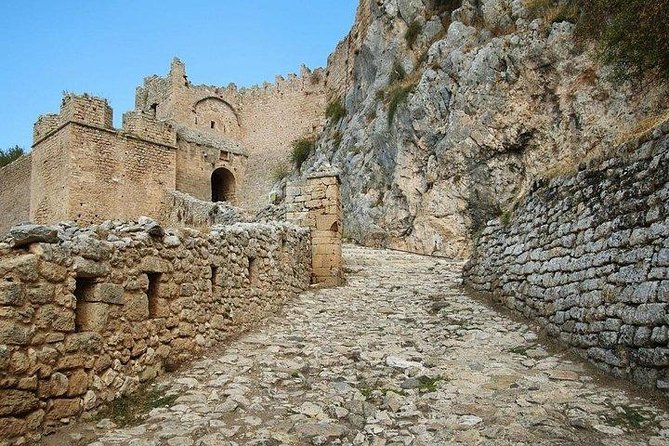
The Corinth Canal is a quick but memorable stop. From above, you can look down at the narrow waterway and its steep limestone walls. The canal is about 6.4 kilometers long and only about 21.4 meters wide at its base, so some modern ships cannot use it.
The canal has no locks. It was cut at sea level through the isthmus, separating the Peloponnese from mainland Greece. That simple fact makes the geography easier to understand: Corinth controlled a short route between the Gulf of Corinth and the Saronic Gulf.
You get about 30 minutes here. That is enough for photographs and a look at passing vessels, though not enough for a long stop if traffic or weather slows the morning.
Nearby, the Diolkos offers an older solution to the same problem. Before the canal, ships and cargo could be moved overland across parts of the isthmus. The remains are modest, so you will get more from this stop if your driver explains how it worked.
I find the Diolkos especially useful for understanding Paul’s world. Corinth was tied to movement, trade, and shipping long before the Christian era. Paul’s message traveled through the same commercial network.
Isthmia, the games, and the museum

Isthmia was home to the Isthmian Games, a major athletic festival held in honor of Poseidon. The games ranked below the Olympics in importance and drew athletes and spectators from across the Greek world.
The tour allows about an hour at Isthmia, followed by roughly 30 minutes in the Archaeological Museum of Isthmia. The museum admission is not included. The stated entrance cost for Ancient Corinth and the Archaeological Museum of Isthmia is €15 per person, payable on site.
The museum gives you objects that the open-air ruins cannot. Its collection includes finds from the Sanctuary of Poseidon, statues, votive offerings, burial objects, and glass panels from nearby Kenchreai. Those glass panels are particularly useful because they connect the museum to the port Paul used when he sailed toward Syria.
The biblical connection here should be handled with care. Paul worked as a tentmaker, and the tour presents the possibility that his work brought him into contact with athletes and visitors during the games. His letters use athletic images such as running and competition, but the exact setting for each image is not always certain.
The driver will not normally accompany you through the museum. If you want object-by-object explanation, request a licensed guide in advance. Otherwise, take your time with the displays and use the driver’s introduction as a framework.
More Ancient History Tours in Greece
- Acropolis, Parthenon & Athens Old City Heritage Walking Tour
★ 4.5 · 876 reviews - Private Biblical Tour Ancient Corinth & Isthmus Canal from Athens
★ 5.0 · 762 reviews - Athens: Ancient Corinth & Nafplio Full Day Trip with Swim
★ 4.8 · 531 reviews - Athens Skip the Line: Open Air Ancient Greek Theatre Performance
★ 4.5 · 520 reviews
Ancient Corinth, the Bema, and the Temple of Apollo
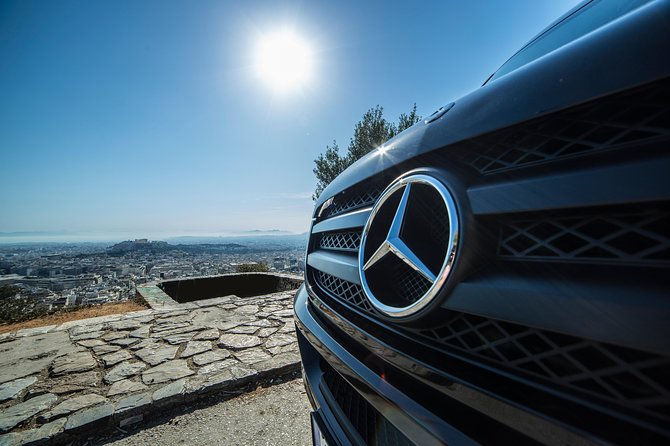
Ancient Corinth is the heart of the day. Allow at least an hour, and expect the site to feel larger than you may first expect. The ruins include the Roman Forum, the Bema, and the Temple of Apollo.
The Bema is the stone platform associated with Paul’s appearance before Proconsul Gallio. Acts describes Gallio refusing to treat the accusation against Paul as a Roman criminal matter. He regarded it as an internal religious dispute, allowing Paul’s work in Corinth to continue.
That episode gives the Bema unusual force. You are looking at more than a courtroom marker. It represents a moment when a Roman official chose not to intervene in a dispute about Paul’s teaching.
The Temple of Apollo dates to about 560 BC and is known for its large monolithic Doric columns. When Paul arrived, the temple would have been one of the most prominent sights in the city. Its presence helps you picture the religious setting he faced: a city shaped by Greek traditions, Roman power, commerce, and many forms of worship.
The driver drops you near the archaeological area and gives you background before you enter. This is the part of the tour most likely to disappoint if you expect a guided walk. One guest specifically found the lack of an included site guide frustrating, even though the driver’s explanations were useful. Read the inclusions carefully and arrange the licensed guide if this detail matters to you.
Kenchreai and the Apostolou Pavlou church
Kenchreai, also written Cenchreae, was Corinth’s eastern port. It is associated with Acts 18:18, which describes Paul leaving for Syria after cutting his hair to fulfill a vow.
The stop lasts about 30 minutes. Today, the setting is quieter than Ancient Corinth, and the remains are less visually dramatic. That is part of its appeal. You get a pause from the main ruins and a direct connection to the sea route Paul used.
Paul’s letter to the Romans also mentions Phoebe, a servant of the church at Cenchreae. The visit therefore brings in an important early Christian figure beyond Paul himself and points to the role of women in the first Christian communities.
The Apostolou Pavlou church adds a modern religious layer. It honors Paul’s time in Corinth and the Christian community connected with his preaching. The stop takes about 20 minutes and works well as a reflective pause after the archaeological sites.
Do not expect a major museum or long service here. The value is the link between place and memory. You are seeing how modern Corinth keeps Paul’s story present.
Akrokorinthos and the best view of the day
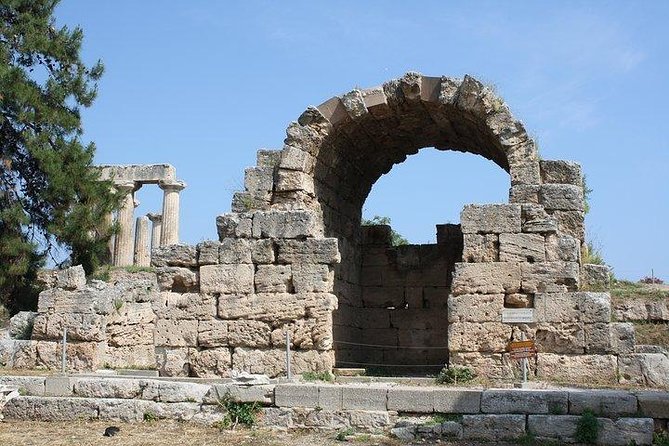
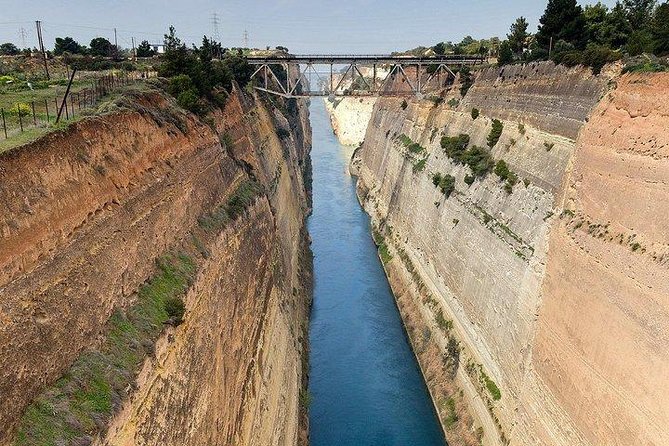
Akrokorinthos is the biggest physical challenge on the itinerary. The fortress rises above Ancient Corinth, and reaching the higher areas involves a climb over ancient paths and uneven surfaces.
The tour allows about an hour, but your actual time will depend on how far you go and how comfortable your group is with the ascent. Several visitors found the climb harder than expected, yet considered the view from the upper area worth the effort.
From Akrokorinthos, you can see the territory around Ancient Corinth, the isthmus, and the mountains beyond. The fortress also makes clear why this site mattered. Its height offered control, visibility, and protection.
The tour connects the place to Paul by suggesting that he may have looked out over the city from here. That is a thoughtful way to reflect, but it is not the same as a documented event in Acts. I would enjoy the view for what it is and treat the Paul connection as a possibility rather than a proven stop on his route.
Wear shoes with a firm sole. If someone in your group has difficulty with steep or uneven paths, tell the driver early so the day can be adjusted. The private format helps here. You are not being pushed along by a fixed group schedule.
Lunch, vehicles, and the private format

Lunch is taken at a traditional seaside Greek taverna. If you select the option with Greek traditional food, the meal is included. Otherwise, confirm exactly what you have chosen when booking.
The meal has been a strong part of the day for many people. Drivers have helped with menus, found scenic places, and allowed time for a proper lunch rather than a rushed snack. One group chose to bring its own lunch to save time, while another praised a meat platter served near Ancient Corinth.
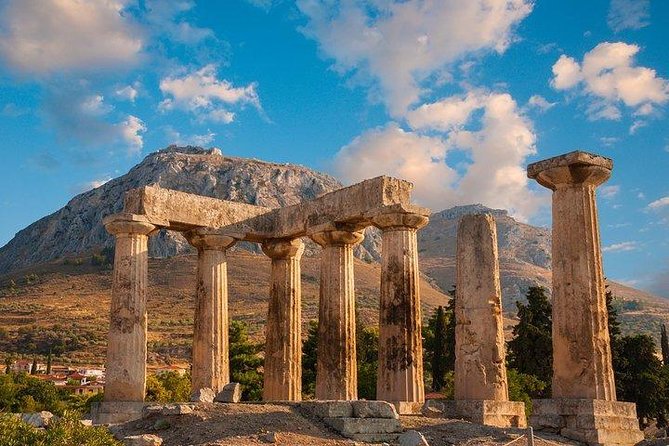
The vehicle is air-conditioned and includes Wi-Fi and bottled water. Pickup and return are available from hotels, apartments, and the port. At a hotel, the driver waits in the lobby. At an apartment, the meeting point is the building entrance. At the port, the driver waits at the gate with your name.
Because the tour is private, only your group participates. The pickup time can be adjusted, and the route can be adapted to your priorities. This flexibility helped one cruise passenger after a mistake about the return time. The driver communicated with the ship and helped the group return before sailing.
Still, leave a generous margin before departure. An eight to nine hour day from Athens includes a lot of road time and many stops. Tell the company your ship’s actual all-aboard time, not simply the port’s departure time.
What the $218.43 price really buys
At $218.43 per person, the tour is not a bargain for one person. The price makes more sense for a private group, especially when shared among several people.
You are paying for private transportation, a full day of driving, hotel or port pickup, air conditioning, Wi-Fi, water, and a driver who can discuss Greek history and Paul’s route in English. You also get freedom from a large group schedule.
The price does not include entrance to Ancient Corinth or the Archaeological Museum of Isthmia. Budget €15 per person for those admissions based on the stated fee. A licensed guide is also extra and depends on availability.
For me, the value is strongest if you want to combine many scattered places in one day. It is weaker if your main goal is a formal archaeological lesson inside Ancient Corinth. In that case, the extra guide cost is worth considering before you commit.
The tour is offered in English, is confirmed at booking, and can be canceled for a full refund up to 24 hours before the start time. It is generally suitable for most people, but Akrokorinthos requires more effort than the other stops.
Who should book this Corinth experience?
I would choose this tour if Paul’s ministry is central to your trip, if you are traveling from a cruise ship, or if you want a private day rather than a fixed group excursion. It also suits families and small groups that want to control the pace.
It is a good match for people who appreciate context on the road, then prefer to explore ruins independently. The drivers have been praised for being patient, careful, personable, and willing to answer questions. Alex, George, Stefanos, Spiros, Panos, and other named drivers have each received strong personal praise, though your assigned driver will vary.
I would hesitate if you want a guide beside you at every monument. The wording is clear once you read the details: drivers are not licensed site guides and do not normally enter the archaeological areas with you.
My practical advice is simple. Ask for the licensed guide if the Bema, Temple of Apollo, and museum displays deserve detailed explanation. Ask for the traditional lunch option if food matters to you. And tell the company your must-see stops, such as Mars Hill or the full climb at Akrokorinthos, before the day begins.
FAQ
How long does the tour last?
The experience takes approximately eight to nine hours.
Where does pickup take place?
Pickup is available from hotels, apartments, ports, and other agreed locations in Athens. The driver returns you to the same place or another preferred point.
Is this a private tour?
Yes. Only your group participates, and the pickup time can be adjusted upon request.
Is a licensed tour guide included?
No. The standard service provides a professional driver with historical knowledge. A licensed guide who enters the archaeological sites can be requested for an additional cost, subject to availability.
Can I visit Ancient Corinth on this tour?
Yes. Ancient Corinth is included, including the Roman Forum, the Bema, and the Temple of Apollo. The entrance fee is not included.
How much are the site entrance fees?
The stated fee for Ancient Corinth and the Archaeological Museum of Isthmia is €15 per person, payable on site.
Is lunch included?
Lunch is included only if you select the With Greek Traditional Food option. The tour visits a traditional seaside Greek taverna.
Is the Corinth Canal included?
Yes. The itinerary allows about 30 minutes to view the canal and its limestone walls from above.
Does the tour visit Mars Hill?
Yes. Areopagus Hill, also called Mars Hill, is included as an approximately 20-minute stop in Athens.
Can I cancel for a refund?
You can cancel at least 24 hours before the experience begins for a full refund. Cancellations or changes made less than 24 hours before the start time are not accepted.
Is Akrokorinthos difficult to visit?
The fortress includes ancient paths and an uphill walk. The climb can be more demanding than expected, although the views from higher areas are rewarding.
Just added around Athens
- The original Christian tour on Paul’s footsteps in Athens and ancient Corinth★ 4.5 · 25 reviews
- Small-Group Women History in Ancient Greece Walking Tour★ 5.0 · 38 reviews
- Athens: Combo Ticket for Acropolis & 6 ancient sites★ 3.0 · 21 reviews
- Ancient Sparta & Mystras Private Day Tour from Athens★ 5.0 · 52 reviews
- Ancient Olympia & Isthmus Canal Private Tour from Athens★ 5.0 · 20 reviews
- Ancient Agora & Temple of Hephaestus Entrance Ticket★ 3.5 · 22 reviews
- Half Day Historical Athens City Private Taxi Service Tour★ 5.0 · 79 reviews
- Ancient Corinth, Sanctuary of Hera, Blue Lake & Canal from Athens★ 5.0 · 26 reviews
Ancient History Tours, compared.
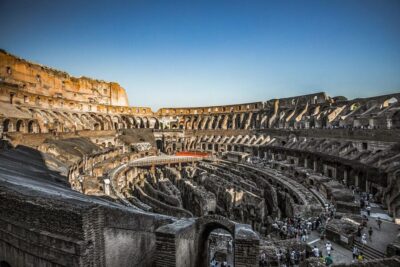
Colosseum: Underground and Ancient Rome Tour
Read our review →
Colosseum & Ancient Rome with Arena Floor Option I Max 6 People
Read our review →
Colosseum, Ancient Rome Tour or AudioGuided Tour
Read our review →
Colosseum Underground & Ancient Rome Guided Tour
Read our review →
Taormina: Ancient Theater Skip-the-Line Ticket & Audio Guide
Read our review →
Discover the Ancient Ruins of Pompeii: Day Trip from Rome
Read our review →
Discover Matera, the ancient city – English tour
Read our review →Browse the lists this tour appears in