Review · ATHENS
Ancient Athens tour: Acropolis, Parthenon and Acropolis Museum
Athens makes you work for its best views. This four-hour walking tour pairs the Acropolis and Parthenon with the Acropolis Museum, so you see both the ancient buildings and many surviving sculptures. I like the licensed guides, who bring mythology, politics, and daily life into the ruins. I also like the small maximum group of 20, bottled water, and the chance to pause for photos. The main catch is cost: the $72.59 starting price may not include the Acropolis or museum tickets.
The 9:00 a.m. start is a smart choice. You can reach the Acropolis before the worst heat and, in theory, before the thickest crowds. Still, this is Athens, and the site can be busy even in September. The uneven marble and slippery stone require steady footing, and four hours leaves little free time at the Acropolis itself.
Key points before you book
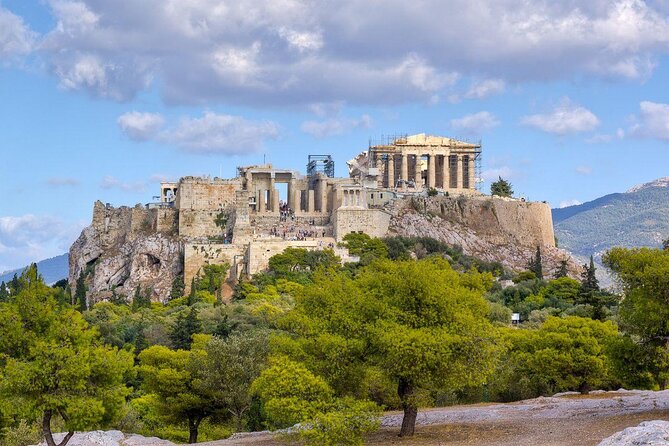
- Two major Athens sights in four hours: You visit the Acropolis monuments and then spend about an hour at the Acropolis Museum.
- Licensed guides make the ruins readable: Guides such as Alexia, Lydia, Giannas, John, and Bernardos have been praised for clear explanations, humor, and good crowd management.
- The early start helps with heat: The 9:00 a.m. meeting time gives you a better chance of cooler conditions and a more comfortable climb.
- Ticket choices need careful checking: The base price is $72.59, while admission fees may be extra unless you choose the ticket-inclusive option.
- Expect a real walk: The route includes uphill paths, uneven stone, hot sun, and slippery areas around the Acropolis.
- The museum completes the visit: Seeing preserved sculptures and architectural details indoors helps explain what the weathered ruins once looked like.
Why the Acropolis and museum work so well together
You can visit the Acropolis alone and still have a memorable morning. But the rocktop monuments are easier to understand when you follow them with the Acropolis Museum.
At the site, you see columns, foundations, battered marble, and views across Athens. Inside the museum, you can look closely at sculpture and decoration that would be easy to miss outdoors. The pairing turns a famous photo stop into a clearer lesson in how the buildings were designed and decorated.
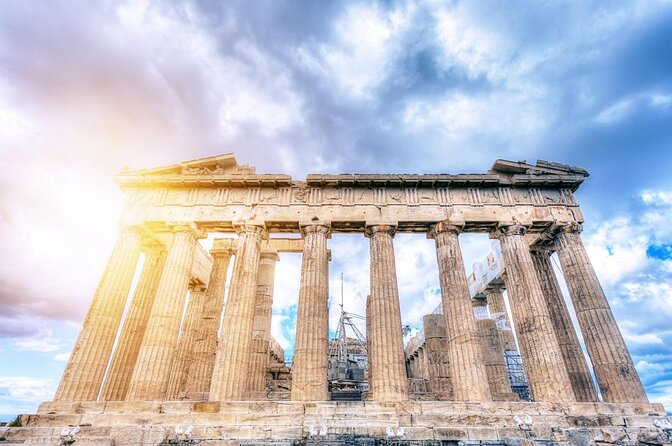
That matters most at the Parthenon. From ground level, the temple can seem like a grand but incomplete shell. A guide can explain its purpose, the role of Athena, the surviving decoration, and the changes caused by time, conflict, and reuse. The museum then gives you a better sense of the craftsmanship behind the fragments.
I also like the practical shape of this tour. The guide leads you through the monuments first, then explains the museum for about an hour. Several guides encourage you to remain inside afterward if you want more time. That is useful because an hour is enough for a guided overview, but not enough for every gallery and detail.
More Ancient History Tours in Athens
- Athens: Ancient Greek Theater Performance
★ 4.7 · 2,481 reviews - Historical Delphi One Day Tour with Arachova Stop & Expert Guide
★ 4.5 · 1,247 reviews - From Athens: Ancient Corinth Day Trip with Canal & VR Guide
★ 4.6 · 1,073 reviews
Starting at Porinou 5 at 9:00 a.m.
The meeting point is Porinou 5 in Athens, near public transportation. The tour begins at 9:00 a.m. and ends back at the meeting point.
The company limits the group to 20 people. That is not a private tour, but it is manageable for a major archaeological site. Guides have used audio equipment or ear pieces on some departures, which helps when other groups are nearby. One useful caution: a guide’s voice can still be hard to hear in crowded areas, so ask early about the listening equipment and bring wired headphones if the operator advises it.
Arrive ready to walk. The group may pause for water, shade, photos, and restroom breaks, but this is not a slow neighborhood stroll. The climb and stone surfaces call for comfortable shoes with a good grip.
The early hour is one of the strongest practical reasons to book this departure. The Greek sun can be fierce, even outside midsummer. Guides such as Alexia and Lydia have been praised for watching the group’s comfort, finding shade, and allowing water breaks. Bottled drinking water is provided, but bring sunscreen and continue drinking throughout the morning.
Climbing through the Acropolis for two hours
The main Acropolis visit lasts about two hours. This is where the tour earns its keep, since a good guide helps you use limited time without wandering past the key monuments.
The approach includes uneven and sometimes slippery rock. One guide described the walk as moderately challenging, and that is a fair expectation. You do not need an athlete’s fitness level, but you should be comfortable walking uphill and standing on hard surfaces.
The guide can adjust the order and length of stops within the site. That flexibility matters when the entrance area is crowded or when a group needs a short rest. It also lets you spend more time on the monuments that interest you most, although you should not expect a long period to explore alone.
The Acropolis is not just one temple. It is a collection of buildings and performance spaces, each with a different role. The tour moves between them while adding the stories that connect the stones.
The Parthenon and the power of Athena
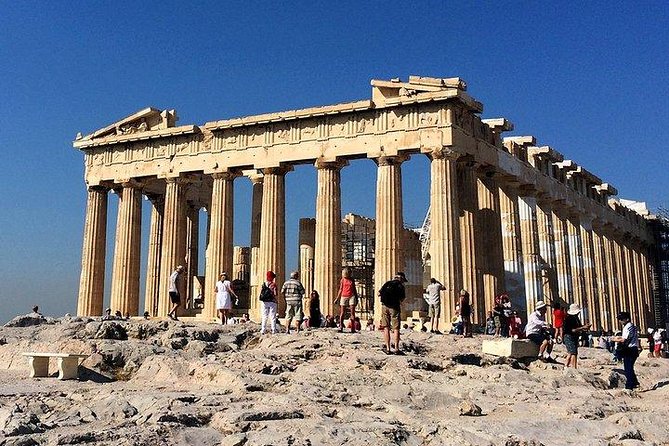
The Parthenon is the centerpiece. Built as a temple to Athena, it occupies the high point of the Acropolis and dominates the view from below.
You receive about 10 minutes listed for this stop, but that does not mean you simply walk up, snap a picture, and leave. The guide uses the surrounding space to explain the temple’s design, religious purpose, and place in Athenian identity. You can also look outward across Athens and toward the surrounding monuments.
The drawback is obvious: everyone else wants the same view. A skilled guide can find a place for the group to gather and speak without blocking the entire route. Guides including Giannas, Zeta, and Alexia have been praised for moving groups through crowds while still finding photo spots.
Bring patience. The Parthenon will not feel like a quiet private discovery. It is one of the world’s most visited ancient sites. The reward is seeing it with enough context to understand why the bare marble still carries such force.
More Ancient History Tours in Greece
- Acropolis, Parthenon & Athens Old City Heritage Walking Tour
★ 4.5 · 876 reviews - Private Biblical Tour Ancient Corinth & Isthmus Canal from Athens
★ 5.0 · 762 reviews - Athens: Ancient Corinth & Nafplio Full Day Trip with Swim
★ 4.8 · 531 reviews - Athens Skip the Line: Open Air Ancient Greek Theatre Performance
★ 4.5 · 520 reviews
Theater of Dionysus and the birth of public performance
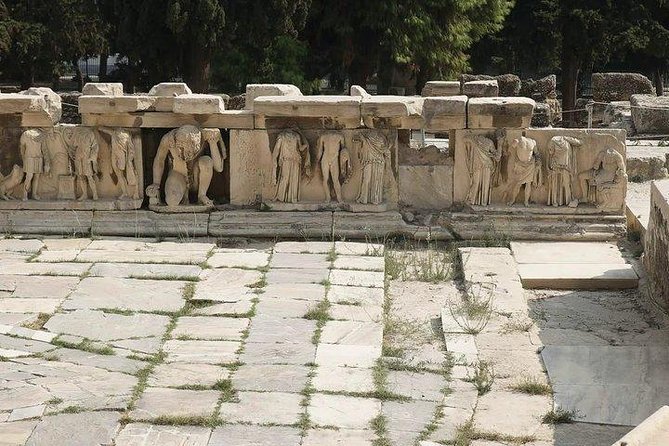
The Theater of Dionysus appears as a separate stop, with about 10 minutes assigned to it. It is one of the world’s most important ancient theaters and sits on the southern slope of the Acropolis.
This is a useful reminder that the Acropolis was not only a religious center. Public performance, civic life, and political ideas were tied closely to Athens. Your guide can help you picture how drama functioned in ancient society rather than treating the theater as another set of stone seats.
The duplicate theater entry in the schedule suggests that the stop may be approached from more than one point or included twice in the route description. Do not expect two separate theater visits. The important point is that the theater forms part of the Acropolis experience, not an optional side trip.
Herod Atticus Odeon and the Propylaea
The Herod Atticus Odeon is another short stop. This Greek and Roman-era theater is still used for performances, giving the ruins a rare link to modern Athens. Unlike a monument that exists only as an archaeological shell, this space retains a working role.
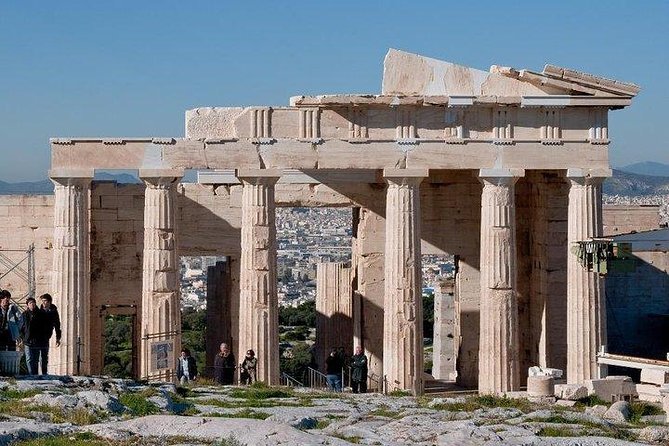
The Propylaea, or entrance gates, bring you to the formal threshold of the Acropolis. The approach makes clear that arriving at the summit was meant to feel important. The structure frames the climb and prepares you for the Parthenon and nearby temples.
These 10-minute stops may seem brief, but they add shape to the visit. Without a guide, you could easily hurry past the gates or treat the Odeon as a scenic wall. With context, each site becomes part of a larger plan.
The Erechtheion and the famous Caryatids
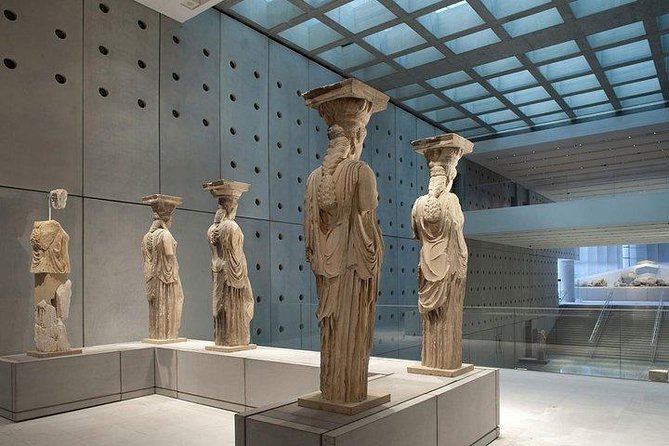
The Erechtheion is best known for its Caryatids, the carved female figures used as architectural supports. It is also one of the Acropolis buildings that rewards close looking because its design is less straightforward than the Parthenon.
The guide can explain why the building matters and point out details you might miss while watching for a clear photo. The museum visit later helps you understand the difference between original sculpture, copies, fragments, and pieces protected indoors.
The listed stop is about 10 minutes, so the visit will be an introduction rather than a long examination. If the Caryatids are your main interest, use the museum portion and any remaining time afterward for a closer look.
One hour inside the Acropolis Museum
The museum is not an afterthought. It is one of the best reasons to choose this combined tour instead of an Acropolis-only visit.
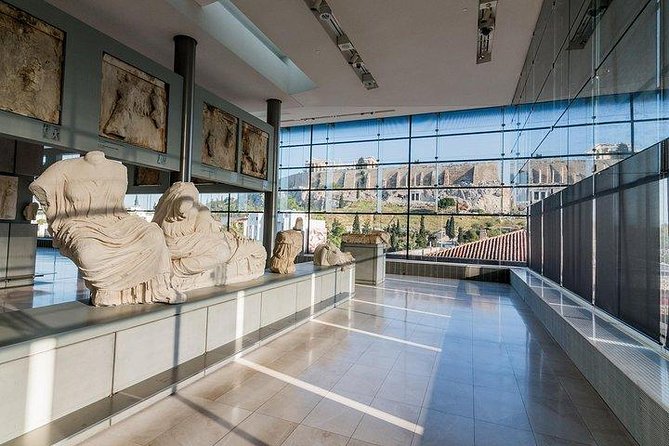
The building focuses on objects found on the Acropolis and its slopes, covering material from the Greek Bronze Age through Roman and Byzantine periods. It also sits over the remains of Roman and early Byzantine Athens, adding another archaeological layer beneath your feet.
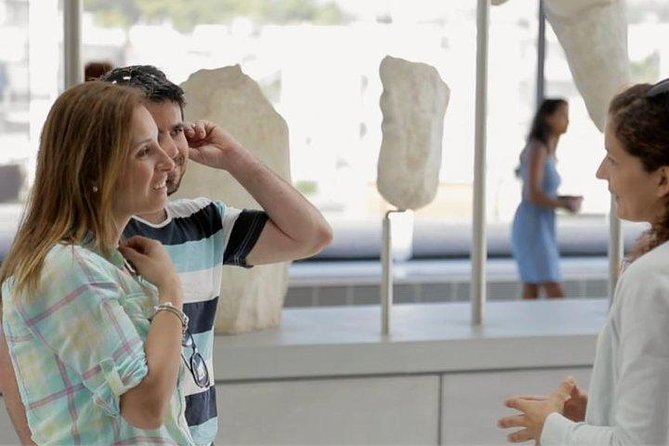
Your guide leads you through the main displays for about an hour. That guided hour helps you connect objects to the buildings you have just seen. You can learn what architectural decoration looked like when it was painted, how sculpture was positioned, and why fragments matter even when the original structure is gone.
I would not treat the museum as a quick indoor cool-down. Its design and displays deserve attention. After the guided portion, you may be able to stay on your own, which gives you a chance to revisit the pieces that caught your eye.
The museum also solves a common problem at the Acropolis: the ruins are weathered, scattered, and difficult to read at a glance. Indoors, the surviving pieces are easier to study. A guide such as Bernardos has been praised for pointing out details that are easy to pass by, while John was praised for turning the museum into a useful lesson rather than a rushed final stop.
Guides are the main reason to pay for this tour
The strongest part of this experience is the guide. The names vary by departure, but several guides have received especially warm praise, including Alexia Kolia, Lydia, Giannas, Selena, Efie, Aphrodite, Zeta, Michael G, Simon, Demos, George, Fey, and Bernardos.
The most valued qualities are clear English, strong command of Greek history and mythology, a calm pace, and the ability to handle a group in a crowded place. Some guides are archaeologists, while others bring teaching experience or a gift for storytelling. The best moments come when a guide explains not only what a building is, but why its details mattered to the people who made and used it.
A guide also helps with the human side of the visit. The Acropolis is hot, exposed, and crowded. A good leader finds gathering spots, keeps the group together, watches for fatigue, and leaves room for photos. That practical care can make the difference between an inspiring morning and an exhausting one.
No guide can remove every crowd or create extra time. One person wished for more time to look around independently, and that is the main tradeoff. You gain structure and explanation, but you give up some freedom to set your own pace.
Price, tickets, and the real value
The starting price is $72.59 per person. That is fair if you want a licensed guide, organized access to two major sights, and useful interpretation at both locations.
Check the exact booking option before paying. The stated admission fees are €30 for the Acropolis and €20 for the Acropolis Museum unless the ticket-inclusive option is selected. The tour details also describe the museum visit as included, so the admission arrangement needs special attention. If you arrive without tickets, you may be able to buy them in cash from the guide at the meeting point, but I would not leave this question until the morning of the tour.
If both entrance fees are extra, the total cost is much higher than the headline price. If tickets are included in the option you choose, the price becomes easier to judge against the time saved and the guide’s service.
The best value comes from the combination. You are not paying only for entry to the Parthenon. You are paying for explanations, group management, a planned route, and a museum connection that is hard to recreate with a quick audio download.
Who will enjoy this four-hour tour most?
I would recommend it to a first-time visitor who wants the main ancient sights explained without spending an entire day on a private tour. It also suits anyone who prefers a clear route and a guide who can put mythology, architecture, and historical events into plain language.
It is a good match for cruise passengers because the four-hour format gives you a strong introduction to Athens without committing the whole day. The meeting point is near public transportation, and the tour returns there.
You should think twice if you want long stretches alone at the Acropolis, dislike group schedules, or find uphill walking and uneven stone difficult. The group is limited to 20, but it is still a group. Crowds remain part of the setting, especially later in the day.
Book the earliest available time you can manage. You will have a better chance of cooler conditions, and the site may feel easier to navigate before the day builds. Wear secure shoes, use sunscreen, take the provided water, and bring a hat if you have one.
Should you book the Acropolis and Museum tour?
Yes, if you want the Acropolis to make sense rather than simply appear in your holiday photos. The guides are the major strength, and the museum adds the missing pieces to the outdoor monuments.
I would book it with the entrance-ticket option clearly confirmed, especially if you want a simple morning with no cash arrangements at the meeting point. I would also choose the 9:00 a.m. start and accept that the tradeoff for expert guidance is less independent time.
Skip it only if you already have strong background knowledge, prefer to explore entirely alone, or need a slower pace. For most first visits, the combination of Parthenon, Acropolis monuments, and museum offers a useful and well-paced introduction to ancient Athens.
FAQ
How long does the tour last?
The tour lasts approximately four hours. About two hours are assigned to the Acropolis area and about one hour to the Acropolis Museum, with the remaining time used for movement and stops.
What time does the tour begin?
The tour starts at 9:00 a.m.
Where does the tour meet?
The meeting point is Porinou 5, Athina 117 42, Greece.
Where does the tour end?
The activity ends back at the meeting point.
Are entrance tickets included?
Entrance tickets depend on the option selected. The listed fees are €30 per person for the Acropolis and €20 per person for the Acropolis Museum unless you book the option that includes tickets.
Is the tour offered in English?
Yes. The experience is offered in English.
How large is the group?
The tour has a maximum of 20 participants.
Is the tour physically demanding?
You should have a moderate level of physical fitness. The visit includes uphill walking, uneven surfaces, and areas of slippery stone, so comfortable shoes, water, and sun protection are important.
More Museum and Gallery History Tours in Athens
- Paris: Louvre Museum Entry with History of Mona Lisa
★ 3.9 · 2,823 reviews - Venice’s Best: Basilica, Doge’s Palace, Gondola & History Gallery
★ 4.5 · 2,478 reviews - Guided African American History Tour with Reserved Museum Entry
★ 4.5 · 1,180 reviews - Warsaw: POLIN Museum of the History of Polish Jews Ticket
★ 4.7 · 1,142 reviews
More Museum and Gallery History Tours in Greece
- Acropolis of Athens, Ancient Agora and the Agora Museum Tour
★ 5.0 · 86 reviews - Athens: Kotsanas Ancient Greek Technology Museum Guided Tour
★ 5.0 · 29 reviews - Herakleidon Museum of Ancient Greek Technology: Entry Ticket
★ 3.5 · 19 reviews - Ancient Olympia: Archaeological Site and Museum Entry Ticket
★ 4.3 · 555 reviews
Just added around Athens
- The original Christian tour on Paul’s footsteps in Athens and ancient Corinth★ 4.5 · 25 reviews
- Small-Group Women History in Ancient Greece Walking Tour★ 5.0 · 38 reviews
- Athens: Combo Ticket for Acropolis & 6 ancient sites★ 3.0 · 21 reviews
- Ancient Sparta & Mystras Private Day Tour from Athens★ 5.0 · 52 reviews
- Ancient Olympia & Isthmus Canal Private Tour from Athens★ 5.0 · 20 reviews
- Ancient Agora & Temple of Hephaestus Entrance Ticket★ 3.5 · 22 reviews
- Half Day Historical Athens City Private Taxi Service Tour★ 5.0 · 79 reviews
- Ancient Corinth, Sanctuary of Hera, Blue Lake & Canal from Athens★ 5.0 · 26 reviews
Museum & Gallery History Tours, compared.

Louvre Museum Entry with History of Mona Lisa
Read our review →
Venice’s Best: Basilica, Doge’s Palace, Gondola & History Gallery
Read our review →
Guided African American History Tour with Reserved Museum Entry
Read our review →
POLIN Museum of the History of Polish Jews Ticket
Read our review →
Bell Tower & St Mark’s Square History Gallery Ticket
Read our review →
Field Museum of Natural History Ticket or VIP Tour
Read our review →
Madrid in a Day Tour:Royal Palace, Historic Center & Prado Museum
Read our review →