Review · ATHENS
Acropolis of Athens, Ancient Agora and the Agora Museum Tour
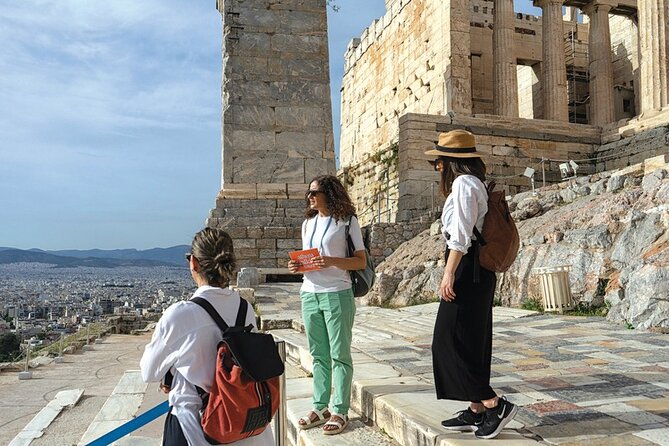
Ancient Athens makes more sense with a guide. This four-hour walking tour links the Acropolis with the Ancient Agora, giving you both the city’s grand religious monuments and the everyday civic center where Athenian public life took shape. I especially like the strong historical storytelling from guides such as Pam, Tina, Helen, Eli, and Hermes, plus the chance to see the Parthenon, Dionysus Theater, Temple of Hephaestus, and Agora Museum in one outing.
I also like the well-planned route from the Acropolis to the Agora, which saves you from arranging two separate visits. The main caution is practical: the $67.58 tour price does not automatically include admission tickets, and you must have the correct tickets before the tour begins. Add steep, slippery stone, summer heat, security queues, and a strict start time, and this is not a casual stroll.
Key points at a glance
- Two major archaeological sites in four hours: Start at the Acropolis around 10:30 a.m., then reach the Ancient Agora at about 1 p.m.
- Guides turn ruins into context: Strong guides explain how temples, drama, democracy, education, and daily city life fit together.
- Tickets require careful planning: Admission fees depend on the option you select, and a valid ticket is essential before joining.
- Expect real physical effort: You will walk on uneven ancient stone, climb ramps and steps, and spend much of the day in the sun.
- The group can reach 24 people: That is manageable, though larger groups may make it harder to hear every explanation.
- Excellent overall satisfaction: The tour is rated 4.8 out of 5, with 99 percent of customers recommending it.
Why this pairing works so well in Athens
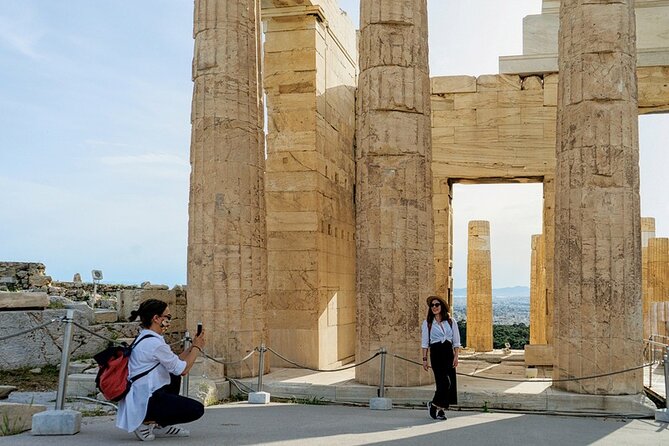
The Acropolis is the obvious star of Athens, but it tells only part of the story. High above the city, you see temples, theaters, and monuments tied to religion, power, art, and civic pride. Down at the Ancient Agora, you get closer to the daily machinery of Athenian life.
That contrast gives this tour its value. At the Acropolis, you look up at the Parthenon and across the city. At the Agora, you walk through the setting where public decisions, trade, social life, and political debate took place. A good guide helps connect those stones to the wider idea of the Greek city-state and its influence on modern Western life.
The ratings support that strength. The experience holds a 4.8 out of 5 score from 86 ratings, and 99 percent of people recommend it. The most repeated praise goes to the guides’ command of history, friendly manner, clear English, and ability to make ruins meaningful instead of simply pointing at them.
More Ancient History Tours in Athens
- Athens: Ancient Greek Theater Performance
★ 4.7 · 2,481 reviews - Historical Delphi One Day Tour with Arachova Stop & Expert Guide
★ 4.5 · 1,247 reviews - From Athens: Ancient Corinth Day Trip with Canal & VR Guide
★ 4.6 · 1,073 reviews
Starting at Dionysiou Areopagitou Street
The meeting point is at Dionysiou Areopagitou 3, near the Acropolis, with a 10:30 a.m. start. The nearby Fresko Yogurt Bar has also been used as a recognizable meeting landmark, so read your voucher carefully for the exact instructions and arrive early.
Do not treat the start time as flexible. Acropolis entry times are controlled, and the group cannot wait for late arrivals. No refund is provided if you miss the beginning, so allow extra time for public transport, finding the meeting point, and walking through the surrounding pedestrian area.
The tour begins with the Acropolis rather than the Agora. That is a sensible order because the Acropolis is the harder climb and the place where a missed entry time causes the biggest problem. The Agora follows at roughly 1 p.m., though the precise pace can vary.
The Acropolis: temples, theaters, and city views
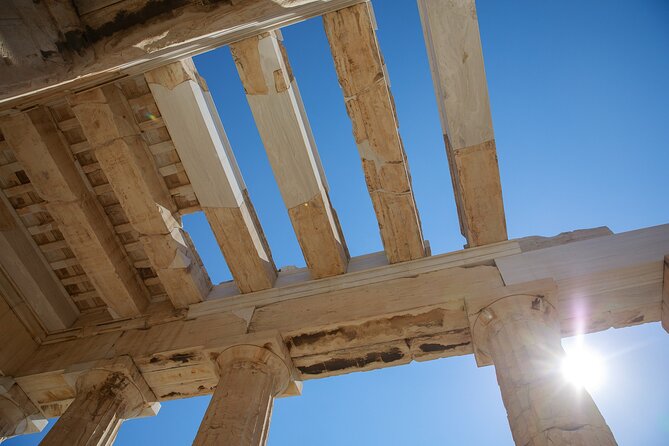
The first Acropolis portion lasts about an hour, followed by roughly 30 minutes focused on the Parthenon and the upper monuments. The route covers the major sights, including the Parthenon, the Temple of Athena Nike, the Theater of Dionysus, and the Odeon of Herodes Atticus.
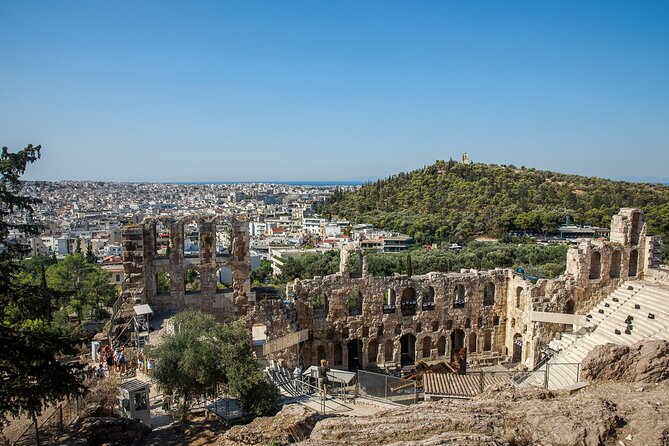
The Theater of Dionysus is an important early stop. It helps you picture Athens not just as a place of temples, but as a city that valued drama, public performance, and shared civic experiences. The Odeon of Herodes Atticus offers a different reminder of how later Romans shaped the site.
At the Parthenon, your guide provides the context that photographs cannot. You will hear about the building’s purpose, its place in Athenian identity, and the way its design influenced later ideas about architecture and public monuments. Guides such as Sissy and Eli received especially strong praise for making the ancient world easier to picture and for connecting Athenian achievements to modern life.
The views are a major reward. From the Acropolis, you can look over Athens and see why this hill carried such power for the city. You will have time for photographs, but this is still a guided walk, not an extended photo stop. Keep your camera ready, then listen when the group gathers.
The ground deserves respect. Ancient stone can be uneven and slippery, especially on worn paths and sloping surfaces. Comfortable walking shoes are the minimum, and hiking shoes may feel better if you are unsteady on rough ground.
How the guide changes the Acropolis visit
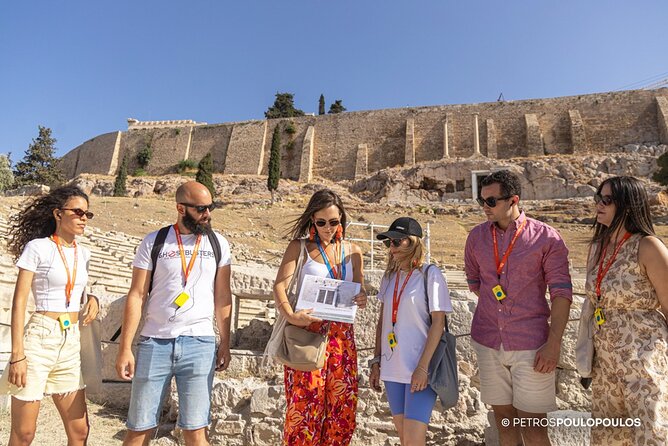
A guide is most useful here when the group stops in shade and looks at the same feature together. Several guides were praised for finding shaded places to speak during hot weather and for adjusting the pace when people struggled with the climb.
The strongest guiding style seems to combine facts with imagination. Tina was praised for connecting individual interests to the larger story of the Acropolis and Western civilization. Stavros focused on the continuing effect of Greek ideas on education, democracy, and modern society. Amaryllis was praised for adding social context, not just dates and building names.
That approach matters because the Acropolis can otherwise become a parade of famous stones. You may recognize the Parthenon but miss why the site mattered, how the monuments related to one another, or what ancient Athenians were trying to express. A guide gives you a framework, then lets you enjoy the views and details with more purpose.
There is one small risk. Guide styles differ. One guide was described as repeating points and talking at too much length, while another was considered overly detailed in the heat. If you prefer complete quiet and a quick visit, a group tour may feel slow. If you want interpretation, questions, and historical connections, that tradeoff is worthwhile.
More Ancient History Tours in Greece
- Acropolis, Parthenon & Athens Old City Heritage Walking Tour
★ 4.5 · 876 reviews - Private Biblical Tour Ancient Corinth & Isthmus Canal from Athens
★ 5.0 · 762 reviews - Athens: Ancient Corinth & Nafplio Full Day Trip with Swim
★ 4.8 · 531 reviews - Athens Skip the Line: Open Air Ancient Greek Theatre Performance
★ 4.5 · 520 reviews
Walking from the Acropolis to the Ancient Agora
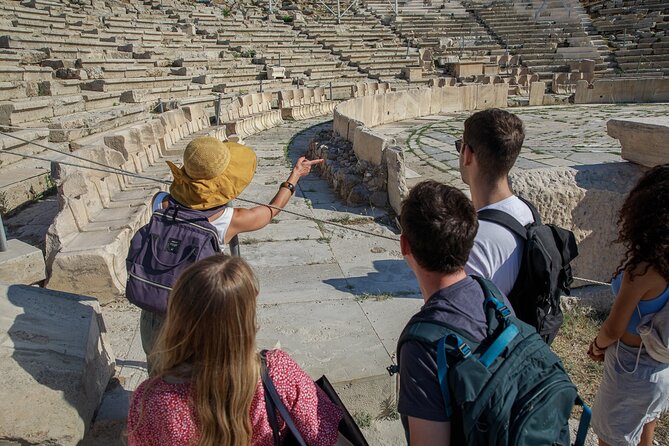
After the Acropolis, the tour continues on foot toward the Ancient Agora. The total experience lasts about four hours, so you should think of it as a serious half-day outing rather than two short sightseeing stops.
The change in setting is one of the best parts. The Acropolis represents ceremony, religion, and civic pride from above. The Agora brings you down into the working center of the city. Here, the guide can explain how public life functioned, where people gathered, and how the city-state operated beyond its famous hilltop temples.
The Agora is also less physically demanding than the Acropolis in some sections, but you are not finished walking. Heat, uneven paths, and tired legs can catch up with you by this point. One person found the Acropolis and Agora combination excellent but felt worn out by the end, which is a fair warning for anyone planning a busy afternoon afterward.
Ancient Agora and the Temple of Hephaestus
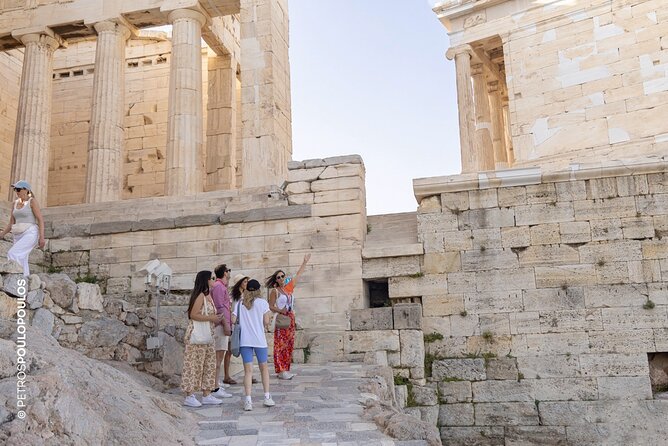
The Ancient Agora stop lasts about an hour. You will see the remains of the civic center and visit the Temple of Hephaestus, which one guide specifically included in the route. The temple gives you a chance to compare a better-preserved ancient structure with the more damaged remains elsewhere on the site.
This is where the tour’s wider story becomes especially useful. Instead of seeing scattered foundations, you can understand the Agora as a place connected to public discussion, social life, commerce, and government. Eli’s guiding style was praised for showing how ancient Greek ideas still affect everyday life, while Helen was praised for explaining the meaning of individual ruins rather than leaving you to guess.
The Agora is a good counterweight to the Acropolis. It feels more grounded and human. You are not only looking at monumental architecture. You are considering how a city operated and how people took part in its public life.
Inside the Museum of the Ancient Agora
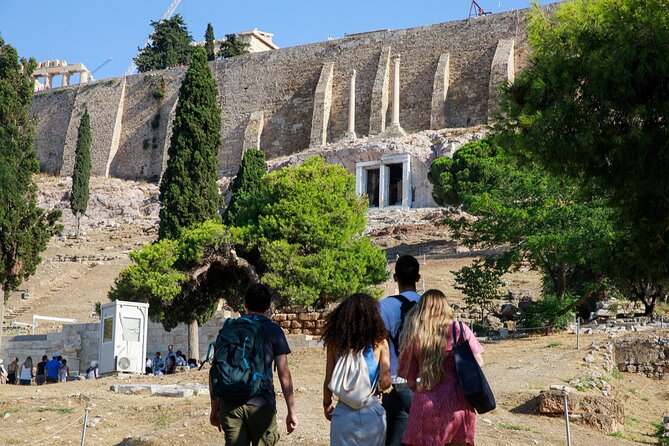
The final stop is the Museum of the Ancient Agora, with about 30 minutes set aside for the visit. It is located at 24 Adrianou, within the Agora area, and gives you a closer look at objects connected with the site.
The museum is not a huge separate commitment, which makes it a sensible finish to the tour. After seeing the ruins outdoors, you can use the indoor collection to reinforce what the guide explained. That said, this is the portion most likely to feel optional if you are tired, overheated, or more interested in outdoor monuments.
One person found the museum less essential than the Acropolis and Agora, while another had the museum closed for renovation during the visit. Conditions can change, so do not build your entire Athens schedule around seeing every gallery. The tour still has value if the museum is unavailable, but you should understand that the final stop may not be the highlight for everyone.
Tickets, skip-the-line service, and the biggest booking trap

The tour price is listed at $67.58 per person, but entrance fees are separate depending on the option you choose. That distinction matters. You are paying for the licensed guide, the walking tour, and the organization of the visit, not necessarily for admission to both sites.
If you choose an option without tickets, follow the voucher instructions and buy the required site tickets before booking or before the tour, as directed. You must have a valid ticket at the beginning of the experience. Without it, you can be refused entry and the tour fee is not refunded.
Some people prefer arranging their own admission because they may want a multi-site pass covering the Acropolis, Ancient Agora, Roman Agora, Hadrian’s Library, and Kerameikos. That can be useful if you plan to explore Athens independently over several days. Others will find it easier to purchase the site tickets through the tour company, avoiding confusion over the correct entry time.
The skip-the-ticket-line service can speed up entry, but it does not mean instant access. All visitors pass through airport-style security, and in peak season the wait can exceed 30 minutes. Your best advantage is having the correct ticket and arriving early, not assuming the phrase skip the line removes every queue.
Bring your passport or another valid form of identification if required to prove age and nationality at the archaeological sites. This is particularly important if you are using a discounted admission category.
Heat, water, shoes, and family considerations
Athens can be punishing around midday. The tour runs in all weather, so carry more water than you think you need, wear a hat, and use strong sun protection. Past participants specifically advised bringing about two liters of water each during hot conditions.
The guide may look for shade when explaining the monuments, but shade is limited on the Acropolis. You cannot count on escaping the sun. A small umbrella, breathable clothing, and sturdy footwear can make the difference between enjoying the history and simply trying to endure the next stop.
Baby strollers are not allowed on the Acropolis archaeological site, and the side entrance used by this tour has no cloakroom. A baby carrier or pouch is recommended instead. Most people can take part, but the climbs and rough ground make this a poor choice for anyone who cannot manage sustained walking and steps.
The maximum group size is 24. That is not an intimate private tour, but it is still small enough for a guide to address the group and answer questions. Stay near the guide, especially around crowded areas, and keep an eye on your belongings. One guide specifically warned the group about pickpockets.
Is $67.58 good value?
The price makes sense if you want interpretation and a planned route through two major sites. A self-guided visit may cost less for the guiding portion, but you would need to research the monuments, coordinate two timed entries, understand ticket rules, and connect the Acropolis to the Agora yourself.
The value is strongest for a first visit to Athens. Guides such as Pam, Gina, Hermes, Helen, and Daphne were praised for clear explanations, patience, storytelling, and friendly help with questions. That consistency is the main reason to pay for this experience.
The value is weaker if you already know ancient Greek history well or prefer to spend unlimited time at one monument. The group moves according to a schedule, and the museum receives only about 30 minutes. You also need to budget separately for admission if your chosen option excludes tickets.
Who should book this tour?
I would choose this tour if you have limited time in Athens and want an efficient introduction to the Acropolis and Agora. It suits first-time visitors, history fans, families with older children, and anyone who wants the ruins explained rather than simply photographed.
I would be more cautious if you dislike midday heat, have difficulty with steep or uneven surfaces, or want a relaxed museum visit. In that case, visit the Acropolis separately at a time that suits your energy, then explore the Agora on your own.
Book it if you can commit to arriving early, buying the correct tickets, carrying plenty of water, and walking for four hours. Skip it if you want complete freedom or are not prepared for the physical demands. For most first-time visitors, the guide’s context is the deciding factor, and this pairing gives you a much fuller picture of ancient Athens than the Acropolis alone.
FAQ
How long does the Acropolis and Ancient Agora tour last?
The experience lasts approximately four hours. It begins at the Acropolis at 10:30 a.m. and reaches the Ancient Agora at about 1 p.m.
Are entrance tickets included in the $67.58 price?
Entrance fees depend on the option you select and may not be included. If you choose the option without tickets, you must follow the voucher instructions and obtain the required admission tickets before joining.
Where does the tour start and finish?
The meeting point is Dionysiou Areopagitou 3 in Athens. The tour ends at the Ancient Agora of Athens, at 24 Adrianou.
What should I bring to the tour?
Bring plenty of water, sun protection, a hat, and sturdy, comfortable shoes. A valid passport or identification document may be required to confirm age and nationality at the sites.
Are baby strollers allowed at the Acropolis?
No. Baby strollers are not permitted on the Acropolis archaeological site, and there is no cloakroom at the side entrance used by the tour. A baby pouch is recommended.
Can I join if I arrive late?
No. Acropolis entry times are strict, and the group cannot wait for late arrivals. No refund is provided if you miss the required start or entry time.
More Museum and Gallery History Tours in Athens
- Paris: Louvre Museum Entry with History of Mona Lisa
★ 3.9 · 2,823 reviews - Venice’s Best: Basilica, Doge’s Palace, Gondola & History Gallery
★ 4.5 · 2,478 reviews - Guided African American History Tour with Reserved Museum Entry
★ 4.5 · 1,180 reviews - Warsaw: POLIN Museum of the History of Polish Jews Ticket
★ 4.7 · 1,142 reviews
More Museum and Gallery History Tours in Greece
- Ancient Athens tour: Acropolis, Parthenon and Acropolis Museum
★ 5.0 · 256 reviews - Athens: Kotsanas Ancient Greek Technology Museum Guided Tour
★ 5.0 · 29 reviews - Herakleidon Museum of Ancient Greek Technology: Entry Ticket
★ 3.5 · 19 reviews - Ancient Olympia: Archaeological Site and Museum Entry Ticket
★ 4.3 · 555 reviews
Just added around Athens
- The original Christian tour on Paul’s footsteps in Athens and ancient Corinth★ 4.5 · 25 reviews
- Small-Group Women History in Ancient Greece Walking Tour★ 5.0 · 38 reviews
- Athens: Combo Ticket for Acropolis & 6 ancient sites★ 3.0 · 21 reviews
- Ancient Sparta & Mystras Private Day Tour from Athens★ 5.0 · 52 reviews
- Ancient Olympia & Isthmus Canal Private Tour from Athens★ 5.0 · 20 reviews
- Ancient Agora & Temple of Hephaestus Entrance Ticket★ 3.5 · 22 reviews
- Half Day Historical Athens City Private Taxi Service Tour★ 5.0 · 79 reviews
- Ancient Corinth, Sanctuary of Hera, Blue Lake & Canal from Athens★ 5.0 · 26 reviews
Museum & Gallery History Tours, compared.

Louvre Museum Entry with History of Mona Lisa
Read our review →
Venice’s Best: Basilica, Doge’s Palace, Gondola & History Gallery
Read our review →
Guided African American History Tour with Reserved Museum Entry
Read our review →
POLIN Museum of the History of Polish Jews Ticket
Read our review →
Bell Tower & St Mark’s Square History Gallery Ticket
Read our review →
Field Museum of Natural History Ticket or VIP Tour
Read our review →
Madrid in a Day Tour:Royal Palace, Historic Center & Prado Museum
Read our review →