
Review · PARIS
History of Paris City Center w/ Notre Dame Semi-Private 12ppl Max
Paris reveals itself on foot. This small-group walk links Notre Dame, the Seine, the Louvre, and the Tuileries in about two and a half hours, giving first-time visitors a useful introduction to the city’s oldest center. I like the group limit of 12, which makes it easier to hear your guide and ask questions, and I like the route’s variety, from medieval churches to royal squares and Revolutionary-era sites. The main drawback is that several famous buildings are viewed from outside, and the Notre Dame visit is unguided.
The $59.69 price is reasonable if you want context rather than just a string of photo stops. Guides such as Tamari, Hugo, François, Alasdair, Lili, Ren, Alex, Jill, and Claudia have been praised for being friendly, engaging, and willing to shape the conversation around personal interests. Just remember that this is a moderately active walking tour, not a museum tour with long interior visits.
Key points to know before booking
- Notre Dame is included, but the interior visit is unguided, due to access regulations.
- The group never exceeds 12 people, with a private upgrade available.
- The route covers several major sights, including Pont Neuf, the Louvre exterior, Tuileries Gardens, and Place de la Concorde.
- The tour begins at Cité Métro station and ends at Place de la Concorde, so you finish near the Champs-Élysées.
- A professional guide supplies the historical thread, connecting Roman Lutetia, French kings, Napoleon, and the Revolution.
- The tour runs in rain or shine, so comfortable shoes and weather protection matter.
Why this Paris walk works for first-time visitors
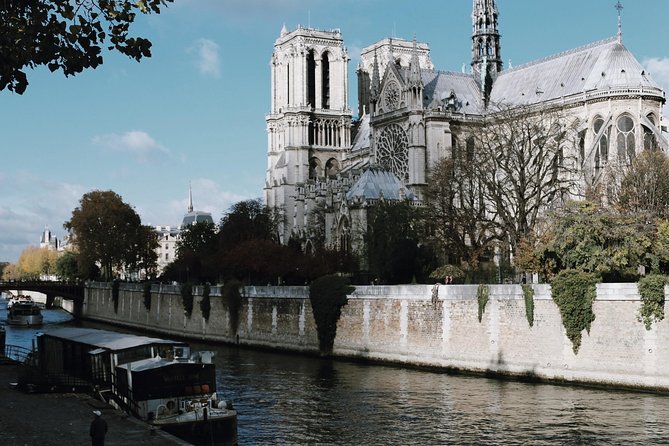
Paris can feel like a grand collection of separate sights. This tour helps connect them. You begin on the Île de la Cité, the island where Paris first grew, then cross the Seine toward the Louvre and walk through the Tuileries to Place de la Concorde.
That route gives you a useful sense of direction. You see how the medieval core, royal Paris, Napoleon’s city, and the grand avenues of modern Paris fit together. It also saves you from spending your first morning working out how the major sights relate to one another.
The small group matters. With no more than 12 people, you should have a better chance of hearing the guide beside a busy street or crowded square. The format also leaves room for questions. Alex, for example, has been praised for adapting the walk to personal interests, while Ren was noted for taking time to make the experience feel personal.
The tour is offered in English and takes roughly 2 hours 30 minutes to 2 hours 40 minutes. That is long enough to cover a good portion of central Paris without taking up a full day. You will not see every major sight in the city, and you will not receive a detailed tour of the Louvre or Sainte-Chapelle. Think of this as a strong orientation walk with historical commentary.
More Private History Tours in France
- Paris City of Fashion History Private Guided Walking Tour
★ 5.0 · 221 reviews - Private Half Day Historic Tour
★ 5.0 · 58 reviews - The History of Paris: Historical Le Marais Private Tour
★ 4.5 · 47 reviews
Starting on the Île de la Cité
You meet in front of the entrance to the Cité Métro station. This is a practical starting point because the station is near Notre Dame and the oldest part of Paris. Arrive ready to walk, since hotel pickup and drop-off are not included.
The first stop is the Île de la Cité itself. Once known as Lutetia during the Roman period, this island is the original center from which Paris expanded. Your guide uses the streets and buildings here to explain how a Roman settlement became the capital of France.
This opening is especially helpful if you are new to Paris. Instead of beginning with a famous facade and a list of dates, you get the basic answer to a useful question: why did Paris develop here?
Notre Dame after the 2019 fire
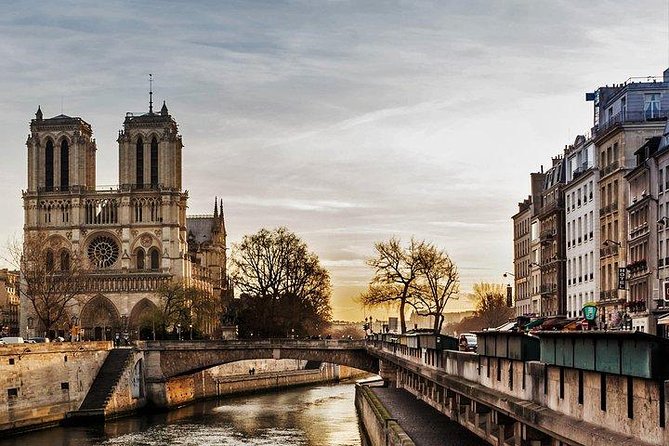
Notre Dame is the emotional center of the walk. The cathedral is about 800 years old and remains one of the clearest symbols of Paris. You can admire its Gothic structure and learn about its place in French history before entering the building.
The interior visit is included, but it is unguided. Regulations prevent the guide from leading the commentary inside, so you should expect the historical explanation to happen outside or before the entry. Access arrangements can also change, and increased security measures may limit interior visits at some sights.
That distinction is important. If you want a detailed explanation of the stained glass, chapels, sculpture, and restoration work while inside, this tour will not provide that. If you mainly want to see Notre Dame and hear the larger story of the cathedral and Île de la Cité, it does the job.
Allow yourself a quiet moment here. Even a short visit can feel meaningful, particularly because the cathedral has recently undergone major restoration after the 2019 fire.
The law, prison, and royal power around the Palais de Justice
From Notre Dame, the walk continues past the Palais de Justice, once known as the Palais de la Cité. This complex contains some of the oldest surviving buildings on the island and helps explain how royal authority and legal power once centered here.
Nearby, Sainte-Chapelle offers one of Paris’s finest examples of Gothic design. It was built in only seven years to house precious Christian relics, including the crown of thorns acquired by Saint Louis. The building is famous for its stained glass, but this experience does not include a full interior visit with admission.
The Conciergerie adds a darker note. It is the oldest remaining section of the former palace and later became one of France’s most notorious prisons. More than a thousand people held there were labeled enemies of the Revolution, and Marie Antoinette spent her final days there.
You pass these sites and hear their stories, but admission is not included. That is both a limitation and a useful choice. The walk gives you enough context to decide if you want to return later for a paid visit. If Sainte-Chapelle or the Conciergerie is high on your list, plan separate time and check entry arrangements before your visit.
More Private History Tours in Paris
- Paris Jewish History 2-Hour Private Guided Walking Tour
★ 4.6 · 32 reviews
Saint-Michel and Place Dauphine
The route then moves toward the Saint-Michel Fountain. Commissioned under Napoleon III during Haussmann’s rebuilding of Paris, the monument shows the archangel Michael defeating the Devil. It is a compact example of how public monuments in Paris often combine political history, religious imagery, and urban design.
Place Dauphine offers a calmer contrast. Created under Henri IV, this historic square sits near the western tip of the island. Its shape and setting give you a pleasant pause before the route heads toward the bridges.
You may appreciate this part of the walk because it is not only a parade of famous attractions. The guide also points out smaller urban spaces that help you understand the character of central Paris. The schedule lists about 10 minutes at each stop, so do not expect a long break in every location. The value comes from seeing the connection between places while the guide supplies the story.
Crossing Pont Neuf and the Seine
The equestrian statue of Henri IV appears near the bridge crossing. The original statue dated from the 1600s but was destroyed during the French Revolution. The version you see today is a replica, a small detail that neatly illustrates how political change reshaped Paris monuments.
Pont Neuf is considered the oldest stone bridge in Paris. Despite its name, which means New Bridge, it is centuries old. From here, you get an important view of the Seine and a clear sense of how the river shaped the city’s growth.
The riverbanks are part of a UNESCO World Heritage site. Your guide can use the bridge to tie together the island, the river, and the expansion of Paris on both banks.
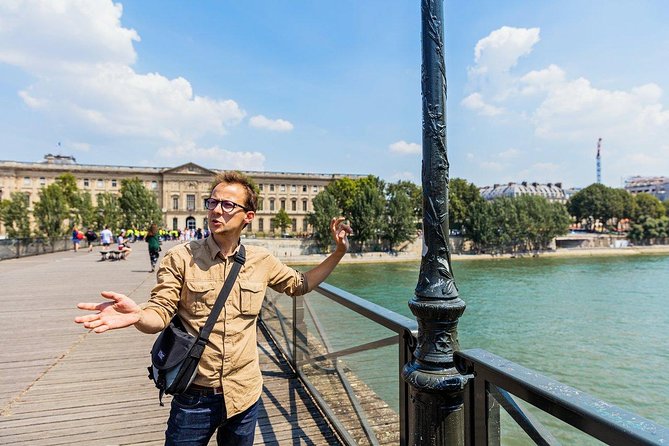
After Pont Neuf, the route includes the Pont des Arts, built between 1801 and 1804 as the first iron bridge in Paris. It connects the Institut de France and the Louvre. This stretch is one of the more scenic parts of the walk, but it may also feel exposed in rain or strong sun. Bring an umbrella or hat as appropriate.
The Louvre from courtyard to pyramid
The walk continues toward the Louvre and the Domaine National du Palais-Royal. Cardinal Richelieu created the Palais-Royal in 1633, and royal families used the palace before Versailles became the main royal residence.
The gardens offer a quieter setting and a view of the contemporary sculptures and architecture around the historic palace. Admission is not included, so the stop focuses on the grounds and the guide’s explanation rather than a full palace visit.
At the Louvre, you pass through the Cour Carrée and see the glass pyramid, designed by Chinese-American architect I. M. Pei. This is a smart way to approach the museum for the first time. You see the old palace, the formal courtyard, and the modern entrance in one sequence.
Do not confuse this stop with a Louvre museum tour. You will not explore the galleries or see the Mona Lisa as part of this walk. The Louvre is enormous, and a proper visit can take several hours. Instead, this section helps you understand the building’s scale and gives you a good starting point for a later museum visit.
From Napoleon’s arch to the Tuileries

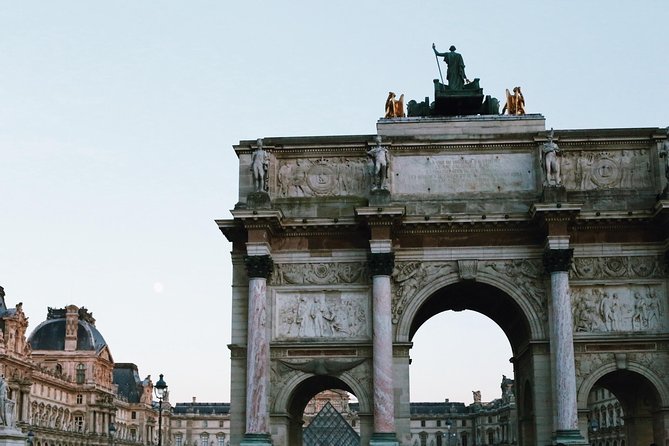
Leaving the Louvre, you pass under or near the Arc de Triomphe du Carrousel. Napoleon built the arch to honor military victories, so it adds another layer to the changing story of Paris. Kings, revolutionaries, emperors, and republicans all left their mark on the same central spaces.
The Tuileries Gardens are the next major section. They date to the 17th century and are often described as the oldest park in Paris. Their carefully arranged paths and greenery create a sharp change from the stone courtyards and crowded streets around the Louvre.
The walk may include the Tuileries Gardens Bookstore, a small shop with books on gardening and garden design, along with garden-themed gifts and cards. It is a minor stop, but it gives the stroll a more local and human rhythm. You are not rushing from one monument to the next every minute.
The gardens are also a useful place to judge your energy. By this point, you have crossed the island, walked over several bridges, and passed many major sites. If you have limited mobility or dislike extended walking, this route may feel demanding even though the pace is described as moderate.
Finishing at Place de la Concorde
The tour ends at Place de la Concorde, one of Paris’s largest squares. It was once an execution site during the French Revolution, including the period when the guillotine became a symbol of the upheaval. Today, it marks the beginning of the Champs-Élysées and provides a convenient location for continuing your day.
Ending here is useful. You can walk onward toward the Champs-Élysées, find transport, or use the location as a reference point for later sightseeing. The tour does not return you to the starting point, so plan your next stop accordingly.
The ending also completes the historical arc. You begin at the island’s earliest settlement and finish in a monumental square shaped by royal planning, revolution, and later urban design.
How much value do you get for $59.69?
At $59.69 per person, this is not the cheapest way to walk around Paris. You could follow much of the route on your own for free. The question is what you want from the experience.
I think the price is fair if you value a guide who can connect scattered sights into one story. You are paying for the route planning, the English commentary, the small group, and the chance to ask questions. A guide can also help you avoid spending your first hours in Paris simply moving between landmarks without understanding what you are seeing.
The value is weaker if you mainly want interior access. Sainte-Chapelle, the Conciergerie, Palais de Justice, Palais-Royal, and the Louvre involve either outside viewing or separate admission. Notre Dame’s interior is included, but the visit is unguided.
Group discounts may be available, and a private option can be chosen if you want a more personal outing. The private version makes the most sense for families or small parties with specific interests, such as medieval architecture, the French Revolution, or Napoleon.
Guide quality and the feel of the walk
The strongest praise centers on the guides. Tamari was described as adaptable and very well informed about Parisian history, culture, and architecture. Hugo received praise for keeping the discussion interesting, while François was especially effective at explaining the city’s story from its earliest tribes through Roman attacks, the Goths, the Franks, and the French monarchy.
Alasdair handled a rainy morning with energy and kept the history engaging. Lili was praised for a friendly approach during a longer walk. Claudia was noted for providing a pleasant and well-informed experience, and Jill worked hard to accommodate requests.
These details matter because a walking tour depends heavily on the person leading it. The route is fixed, but the feel can change with the guide. The available feedback suggests a strong pattern of enthusiasm, clear explanations, and willingness to answer questions, though no tour can guarantee a particular guide on a particular date.
Practical advice for a smooth morning
Wear comfortable shoes. The route involves a moderate amount of walking, bridges, paved streets, gardens, and time on your feet. Carry water, especially in summer.
Bring rain protection. The tour operates in all weather conditions, and a wet walk along the Seine is less pleasant without an umbrella or suitable clothing. A hat can help in summer.
Do not bring large bags or suitcases. Increased security at major attractions can also affect access, and national celebrations may change the route. In that situation, the operator says an alternative route will still cover the main highlights, but refunds or discounts are not provided for the change.
Provide a mobile phone number with your country code when booking. The tour requires at least two people to operate. If that minimum is not reached, you are offered another date or a full refund.
Free cancellation is available up to 24 hours before the start time. Changes or cancellations inside that window are not refunded. Since the tour is often booked well ahead, with an average booking lead time of about 50 days, reserve early if your schedule is fixed.
Who should book this Paris experience?
I would choose this walk for a first visit, a short stay, or a morning when you want a clear introduction before tackling the Louvre or other museums. It is also a good fit if you prefer history explained in plain language rather than a large group with a microphone.
Families and small parties may appreciate the 12-person cap. The private upgrade is worth considering if your group wants to set the pace or focus on a particular period of French history.
I would skip it if you want lengthy interior visits, extensive time at the Louvre, or a route with little walking. Independent visitors who already know Paris well may find the pace and coverage too basic.
Should you book it?
Book it if you want to see the heart of Paris in one connected walk and understand why each place matters. The small group, strong guide feedback, and efficient route make the $59.69 reasonable for many first-time visitors.
Go in with clear expectations: Notre Dame is unguided inside, the Louvre is an exterior stop, several attractions require separate admission, and the tour ends away from the starting point. With those limits in mind, this is a useful, well-paced introduction to the Île de la Cité, the Seine, the Louvre district, and the grand route to Place de la Concorde.
FAQ
Where does the tour begin?
The tour begins in front of the entrance to the Cité Métro station in Paris.
Where does the tour end?
It ends at Place de la Concorde, at Place de la Concorde, 75008 Paris.
How long does the walking tour last?
The experience lasts approximately 2 hours 40 minutes. The included description also gives the duration as about 2.5 hours.
How large is the group?
The group is limited to a maximum of 12 people. A private tour upgrade is also available.
Is Notre Dame Cathedral included?
Yes. Entry to Notre Dame is included, but the interior visit is unguided because of regulations. Access to the building is free and open to all, subject to current arrangements and security measures.
Is the Louvre included?
The route passes the Louvre, including the Cour Carrée and the Louvre Pyramid. Admission to the museum is not included.
Are Sainte-Chapelle and the Conciergerie included?
They are included as sightseeing stops on the route, but admission tickets are not included.
Does the tour operate in bad weather?
Yes. The tour runs in all weather conditions, so you should dress appropriately and bring an umbrella if rain is possible.
Can I cancel for a full refund?
You can cancel up to 24 hours before the experience start time for a full refund. Cancellations or changes made less than 24 hours before the start time are not refunded.
Just added around Paris
- The historic district of Montmartre★ 4.9 · 66 reviews
- Paris: Fashion History Walking Tour in the Heart of Paris★ 4.9 · 22 reviews
- Paris: Khéops VR Experience – Explore Ancient Egypt★ 4.9 · 39 reviews
- Paris: French Fashion History Walking Tour★ 4.9 · 37 reviews
- Paris Jewish History 2-Hour Private Guided Walking Tour★ 4.6 · 32 reviews
- Montmartre Walking Tour: A Journey Through Art and History★ 5.0 · 21 reviews
- Historic Paris Walking Tour in English★ 4.9 · 78 reviews
- Explore the Marais: History, Art & Local Culture★ 4.6 · 105 reviews
Private History Tours, compared.

Private Guided Historic Electric Cart Tour of St. Augustine
Read our review →
Acemoglu Historical Turkish Bath w/Private Options
Read our review →
Private Full-Day Tour of Historical Alexandria
Read our review →
Private Tour of the Historic City in a Ford T Car
Read our review →
Madrid Historical Tour with Local Guide in Eco Tuk Tuk Private
Read our review →
Private Biblical Tour Ancient Corinth & Isthmus Canal from Athens
Read our review →
Private Kathmandu Sightseeing Tour | UNESCO World Heritage sites
Read our review →Browse the lists this tour appears in