
Review · ATHENS
Ancient Athens Corinth Biblical Tour Following Paul 51.A.D
Paul’s Corinth still feels surprisingly close. I like the private air-conditioned vehicle, which makes a long day between Athens and Corinth much easier, and I especially like the climb to Acrocorinth, where the views and fortress remains provide the tour’s biggest visual reward. The main drawback is clear: your driver-guide does not accompany you inside the Ancient Corinth archaeological site, so you need to read ahead or arrange your own guide.
This is a full, private day of biblical sites, Greek monuments, coastal roads, and old harbors. Guides such as Michael, Nick, George, Jorge, and Konstantinos have been praised for being warm, flexible, and willing to adjust the pace. Still, this is not a formal guided excavation tour. It is best understood as a comfortable road journey with a strong Christian focus and plenty of time to explore on foot.
Key points to know before booking
- Paul’s Athens begins at Areopagus, the rocky hill where Paul addressed the Athenians in 51 AD.
- Ancient Corinth is the main stop, with Paul’s Bema, the Temple of Apollo, and the nearby church mosaic.
- Acrocorinth delivers the best views, but the steep fortress site can require extra walking.
- The driver stays outside Ancient Corinth, so bring background reading if you want more than an overview.
- A private group price of $313.01 for up to two people can be good value for a long day with pickup and private transport.
- A Corinthian lunch may be added, but food and entrance fees are not included.
What this Athens to Corinth day is really like
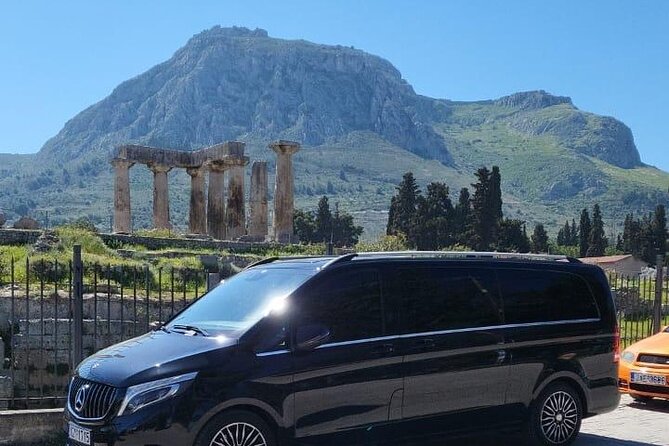
The tour lasts about seven to eight hours, depending on the pace you set with your driver. Pickup is offered from an Athens hotel, Airbnb, or cruise port, and the vehicle includes air-conditioning, Wi-Fi, bottled water, and private transportation.
That setup matters. Corinth is outside central Athens, and the day includes several stops spread across the ancient city, the canal, the old harbor, and the mountain fortress. You are not tied to a large coach schedule, and your driver can allow more time for photographs, questions, or a slower visit at a favorite site.
The experience is offered in English. Guides are not all the same, but the strongest part of the service is the human touch. Michael has been praised for his patience and kindness, Nick for handling a smaller group with care, and Konstantinos for his energy and ability to shape the day around what you want to see. George and Jorge have also been singled out for clear explanations and a friendly manner.
The price is $313.01 per group of up to two people, not per person. For a couple, that is a reasonable figure for private pickup, a luxury vehicle, bottled water, Wi-Fi, and a full day on the road. For a larger private group, the per-person value improves. You still need to budget for the Ancient Corinth entrance fee, listed as €15 per person, lunch, and gratuities.
More Ancient History Tours in Athens
- Athens: Ancient Greek Theater Performance
★ 4.7 · 2,481 reviews - Historical Delphi One Day Tour with Arachova Stop & Expert Guide
★ 4.5 · 1,247 reviews - From Athens: Ancient Corinth Day Trip with Canal & VR Guide
★ 4.6 · 1,073 reviews
Areopagus and the first Christian stop in Athens
The day begins at Areopagus, also called Mars Hill, near the Acropolis. This is the rocky outcrop associated with Paul’s speech to the Athenians in Acts 17. The stop is brief, around 30 minutes, but it gives you a direct physical link to the story before the tour heads toward Corinth.
The setting is more meaningful than elaborate. You look across Athens, consider the city Paul encountered, and hear how this place fits into the early Christian account. Admission is free.
One practical warning matters here. A recent visit found Mars Hill closed for repairs, although it could still be viewed. Conditions can change, so you should not assume you will be able to climb onto every part of the rock. Wear shoes with a firm sole, since this is an uneven outdoor site rather than a polished museum stop.
Roman Agora and Paul’s first Athens setting
The Roman Agora takes you into the later civic world of Athens. It is associated with the city’s public life and is presented as the place Paul first encountered Athens after arriving from the port of Piraeus.
You have about 30 minutes here. The site gives useful context for the city’s streets, public buildings, and judicial culture, although the entrance fee is not included. If your main goal is biblical history, this stop works best when your guide explains how public debate and civic authority shaped Paul’s appearance before the Areopagus.
Do not expect a long archaeological visit at this point. The tour gives you a short orientation, then moves on. That rhythm is part of the appeal for people who want a broad day covering both Athens and Corinth, but it may feel rushed if you prefer to examine every monument closely.
Diolkos, the ancient boat road
The Diolkos is one of the day’s most unusual stops. This ancient stone route was used to move boats across the Isthmus of Corinth between the Corinthian Gulf and the Saronic Gulf, linking waters connected to the Aegean and Ionian seas.
The engineering idea is simple but startling. Instead of sailing around the Peloponnese, boats could be hauled overland along a prepared route. The stop lasts about 30 minutes and is free.
I like this part because it moves beyond the usual Paul-focused itinerary. You see why Corinth became so important as a commercial center. The city controlled a narrow crossing between two seas, and that position helped bring ships, merchants, and political power through the area long before the Roman period.
More Ancient History Tours in Greece
- Acropolis, Parthenon & Athens Old City Heritage Walking Tour
★ 4.5 · 876 reviews - Private Biblical Tour Ancient Corinth & Isthmus Canal from Athens
★ 5.0 · 762 reviews - Athens: Ancient Corinth & Nafplio Full Day Trip with Swim
★ 4.8 · 531 reviews - Athens Skip the Line: Open Air Ancient Greek Theatre Performance
★ 4.5 · 520 reviews
Corinth Canal: a modern cut through an ancient route
The Corinth Canal is one of the easiest places to appreciate from a short stop. The canal is about six kilometers long, around 80 meters high at the surrounding rock walls, 24 meters wide, and 10 meters deep, according to the tour information.
The modern excavation began under King George in 1882, using about 5,000 workers. The canal finally created the water route that ancient engineers had only partly solved with the Diolkos.
You have around 30 minutes for views and photographs. This is not a museum visit, and there is no entrance fee listed. The canal is a quick visual lesson in geography: a narrow strip of land separates two gulfs, and ships pass through a dramatic trench cut into the rock.
The stop also breaks up the ruins and religious sites. After several ancient monuments, the clean lines of the canal give the day a different scale.
Ancient Corinth and Paul’s Bema
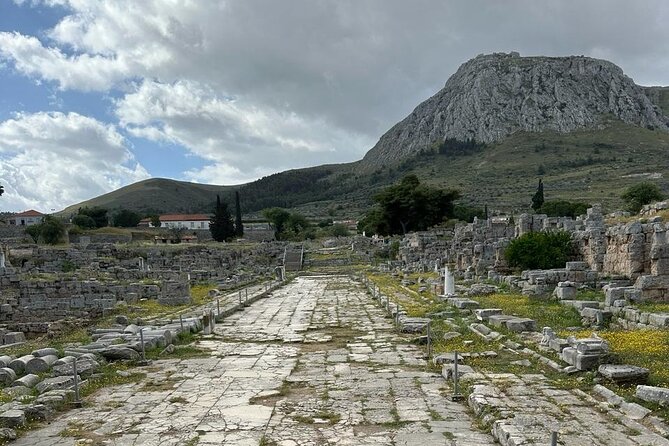
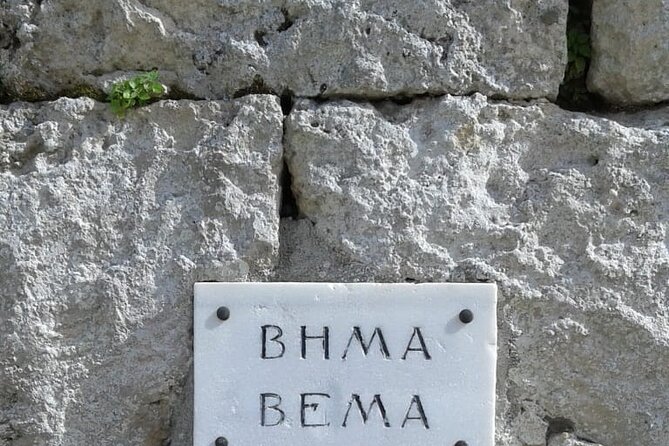
Ancient Corinth is the heart of the excursion. This is where the biblical connection becomes most direct, with the Bema, or public speaking platform, associated with Paul’s appearance before the Roman authorities and the Corinthians.
You have about 30 minutes listed for the stop, though the exact time can depend on the day and your arrangement with the driver. Entrance costs €15 per person and is not included.
The most important practical detail is that the driver-guide does not go inside the archaeological site with you. Your driver can explain the setting before you enter, but you should not expect a guided walk among the ruins. I strongly suggest reading a short account of Corinth and Paul before departure. That preparation will help you understand the Bema, the forum, and the city plan instead of simply seeing stones without a story.
This limitation is balanced by flexibility. Several guides have allowed extra time when a group wanted to linger, take photographs, or ask questions. The private format also means you are not being moved along with a large busload of people.
The Temple of Apollo and Corinth’s older roots
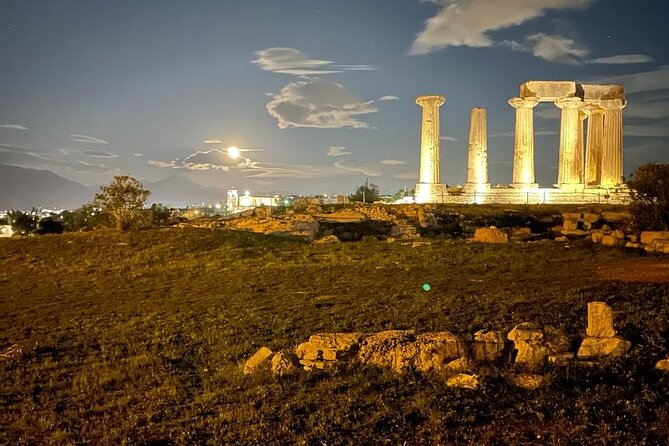
The Temple of Apollo sits within Ancient Corinth and gives the site its most recognizable ancient columns. The temple is presented as dating to 716 BC and as a major sanctuary of Apollo, the local god associated with light and music.
Only about 30 minutes is assigned here, and the admission fee is part of the Ancient Corinth ticket rather than a separate charge. The columns are powerful even in a short visit, especially when your guide connects the temple to Corinth’s earlier religious life.
The biblical focus can sometimes dominate this tour, so this stop helps widen the picture. Paul entered a city with its own religious traditions, political tensions, and public institutions. Seeing Apollo’s temple beside the later Christian story makes that contrast easier to grasp.
Acrocorinth: the day’s biggest view

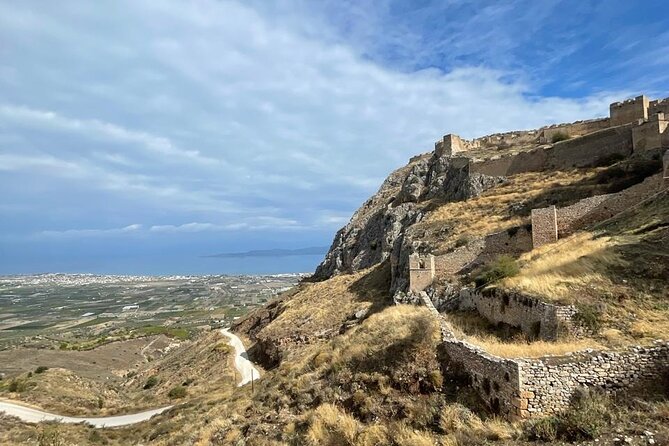
Acrocorinth rises above the ancient city and is one of the most rewarding stops. The fortress sits about 530 meters above sea level and includes remains from several periods. The site is linked in the tour narrative with a palace of Caesar, the Temple of Aphrodite, and later medieval rule under William of Villehardouin in 1246.
The fortress walls spread across a large area, so do not treat this as a quick photo stop if you want to explore. The terrain can be uneven, and you may need to walk uphill. Comfortable shoes are essential.
The reward is the panorama. From Acrocorinth, you can understand why this height mattered for defense and control. You see the plains, the gulf, and the old routes that made Corinth valuable. One meal suggestion connected with the tour has been a restaurant around 500 meters above sea level, where the view becomes part of the lunch experience. Lunch is extra, but the setting may be worth considering if your schedule allows.
The tour describes Acrocorinth as the biggest castle in Europe. That is a broad claim, so I would treat it as promotional language rather than a precise comparison. The important point is that it is a vast and imposing fortified site, and for many people it becomes the most memorable stop of the day.
Kechries and the port connected with Paul
Kechries was the eastern harbor of ancient Corinth. The stop is tied to the account of Paul meeting Priscilla and Aquila, who worked as tentmakers, and to Paul’s departure for Ephesus around 53 AD.
The harbor area is quieter and less monumental than Ancient Corinth. That is part of its value. You are looking at the practical edge of the ancient city, the place where people and goods arrived and departed. It adds movement to the story rather than leaving Paul frozen at a speaking platform.
A small church connected with Paul, Priscilla, Aquila, and Phoebe is also part of the visit. The stop lasts about 30 minutes and is free. Expect an open-air setting and a short explanation rather than a large museum complex.
Apostolos Pavlos Church and the closing mosaic
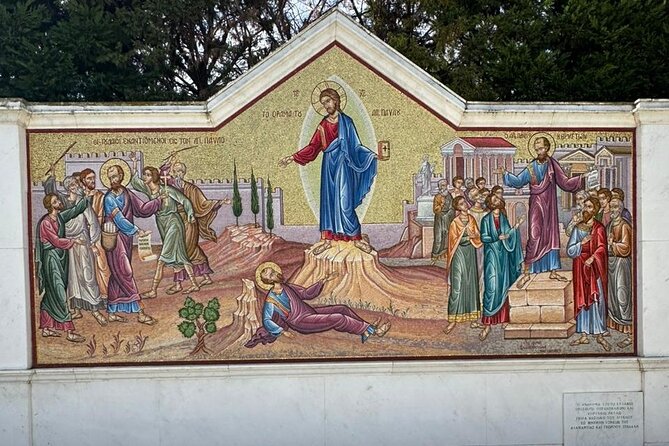
The Apostolos Pavlos Church in Ancient Corinth is a brief final stop, about 20 minutes. Its key feature is a mosaic depicting Paul’s vision.
This is a quiet way to finish the Christian portion of the route. After the Roman forum, pagan temple, high fortress, and harbor, the church brings the focus back to the religious community that developed in Corinth.
Because the stop is short, your visit will depend on whether the church is accessible at that time. The tour information presents it as a free stop, but it does not promise a full interior visit or a scheduled service.
Transport, pace, and the private-tour advantage
The vehicle is one of the strongest reasons to choose this experience. Air-conditioning matters during a long summer day, and Wi-Fi plus bottled water are small comforts that make repeated road transfers easier.
Pickup and drop-off are included from hotels, Airbnb properties, and cruise ports. At a hotel or Airbnb, the driver waits at the entrance. At the port, the driver waits at the gate with a sign bearing your name. Airport pickup costs extra.
A child seat can be requested. Most people can participate, but the day includes ancient ruins, uneven ground, and the uphill setting of Acrocorinth. If anyone in your group has trouble with slopes or rough surfaces, ask the operator about the walking demands before booking.
The private format also helps with cruise schedules. A guide can wait at the port and return you there, though you should allow a generous buffer because the route includes several stops and the drive between Athens and Corinth.
Who should book this tour?
I would choose this tour if you want Paul’s Corinth presented through both scripture and archaeology, but you also want the comfort of private transport. It suits couples, families, and small groups who dislike large buses and prefer to ask questions along the way.
It is especially useful for a first visit when you want to combine Athens, Corinth, the canal, a harbor, and Acrocorinth in one day. The strong service record, flexible guides, and comfortable vehicles add real value.
I would hesitate if your priority is detailed archaeological instruction inside Ancient Corinth. Since the driver does not enter the site with you, a specialist guide or a separate guided visit may serve you better. I would also reconsider if you want a slow museum-style day, since nine stops in seven to eight hours creates a brisk rhythm.
Final booking advice
Book it if your main goal is to follow Paul’s route while seeing the major Corinth sights without managing Greek transport yourself. The private price is fair for two people, and the best parts are the personal pickup, the flexible pace, Acrocorinth’s views, and the strong sense of place at Ancient Corinth and Kechries.
Before you go, read about Paul’s time in Athens and Corinth, wear sturdy shoes, confirm the day’s access to Mars Hill, and set aside €15 per person for Ancient Corinth. If you do that homework, this becomes more than a sightseeing drive. It becomes a clear, practical way to connect biblical events with the roads, harbors, temples, and public spaces where they unfolded.
FAQ
How long does the Athens and Corinth tour last?
The experience lasts approximately seven to eight hours.
Is hotel pickup included?
Yes. Pickup and drop-off are included from Athens hotels and Airbnb properties. The driver waits at the entrance.
Is cruise port pickup available?
Yes. For port pickup, the driver waits at the gate with a sign showing your name, and drop-off is included.
Does airport pickup cost extra?
Yes. Airport pickup is available at an additional cost.
Is the Ancient Corinth entrance fee included?
No. Admission to Ancient Corinth is listed as €15 per person and is not included in the tour price.
Does the driver-guide enter the archaeological site with the group?
No. A tour guide to accompany you inside the archaeological site is not included. The driver-guide provides information during the day, but you should prepare with background reading if you want a detailed visit inside Ancient Corinth.
Just added around Athens
- The original Christian tour on Paul’s footsteps in Athens and ancient Corinth★ 4.5 · 25 reviews
- Small-Group Women History in Ancient Greece Walking Tour★ 5.0 · 38 reviews
- Athens: Combo Ticket for Acropolis & 6 ancient sites★ 3.0 · 21 reviews
- Ancient Sparta & Mystras Private Day Tour from Athens★ 5.0 · 52 reviews
- Ancient Olympia & Isthmus Canal Private Tour from Athens★ 5.0 · 20 reviews
- Ancient Agora & Temple of Hephaestus Entrance Ticket★ 3.5 · 22 reviews
- Half Day Historical Athens City Private Taxi Service Tour★ 5.0 · 79 reviews
- Ancient Olympia & Ancient Corinth Private LuxuryTour from Athens★ 5.0 · 25 reviews
Ancient History Tours, compared.
Colosseum: Underground and Ancient Rome Tour
Read our review →
Colosseum & Ancient Rome with Arena Floor Option I Max 6 People
Read our review →
Colosseum, Ancient Rome Tour or AudioGuided Tour
Read our review →
Colosseum Underground & Ancient Rome Guided Tour
Read our review →
Taormina: Ancient Theater Skip-the-Line Ticket & Audio Guide
Read our review →
Discover the Ancient Ruins of Pompeii: Day Trip from Rome
Read our review →
Discover Matera, the ancient city – English tour
Read our review →Browse the lists this tour appears in