
Review · HOUSTON
Walking Tour of Houston: History, Architecture, Street Art
Houston rewards people who look up. This $25 walking tour links old civic buildings, Art Deco skyscrapers, theater venues, NASA stories, and colorful murals into a useful introduction to downtown. I like the way it mixes major landmarks with street art, and I like that local guide John Gu explains Houston through its people, buildings, and artists rather than simply reciting dates. The main consideration is the pace: seven stops in about two hours means most visits are brief exterior looks, not long building tours.
You get a clear start at Lyric Market and finish near Lynn Wyatt Square in the Theater District. That makes the outing easy to fit into a city break, especially if you have a meeting, a free morning, or only one day in Houston. Bring water and a little patience for the weather, since this is an outdoor walk and food and drinks are not included.
Key points before you book

- Houston’s early story begins at Market Square: See the area tied to the city’s founding and stop at the popular Houston is inspired mural.
- Seven downtown sights fit into about two hours: Expect short explanations at each stop, with time for photos and questions.
- John Gu gives the tour a personal edge: He explains architecture, city figures, and mural artists in clear, lively language.
- The route connects several architectural eras: Art Deco, Italian Renaissance design, Brutalist theater architecture, and early civic buildings all appear.
- The NASA connection is easy to miss without a guide: Tranquility Park gives the space program a place in downtown Houston’s story.
- The tour works well for mixed groups: It is stroller accessible, service animals are welcome, and the maximum group size is 25.
Start at Lyric Market and meet downtown Houston
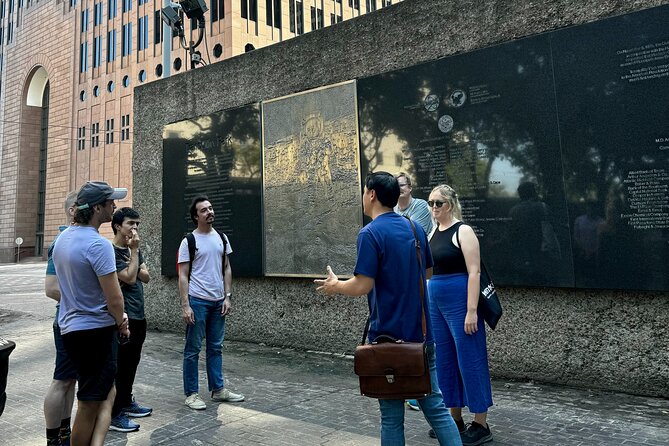
The tour begins at Lyric Market, at 411 Smith Street. The location is near public transportation, and one useful detail from the tour setup is that the start and finish are only about a block apart. That makes the route simple to manage if you arrive by rail or want to leave your bags, plans, or car arrangements unchanged.
Houston is a spread-out city, so a walking tour of the central district gives you something important right away: a sense of proportion. You can see how the old commercial core, civic center, Theater District, and newer public spaces relate to one another. You are not trying to understand the entire city in one walk, but you can get a working map in your head.
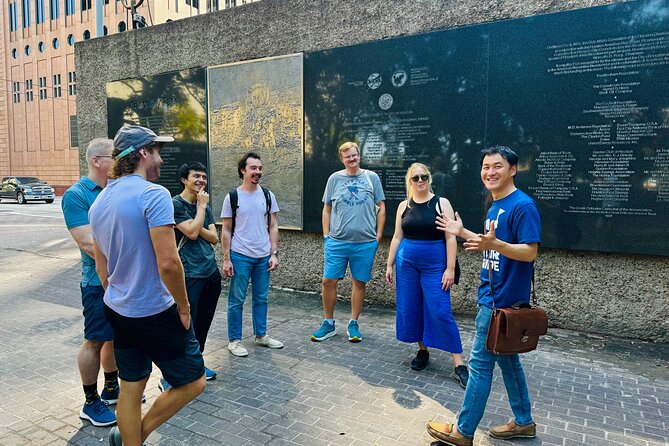
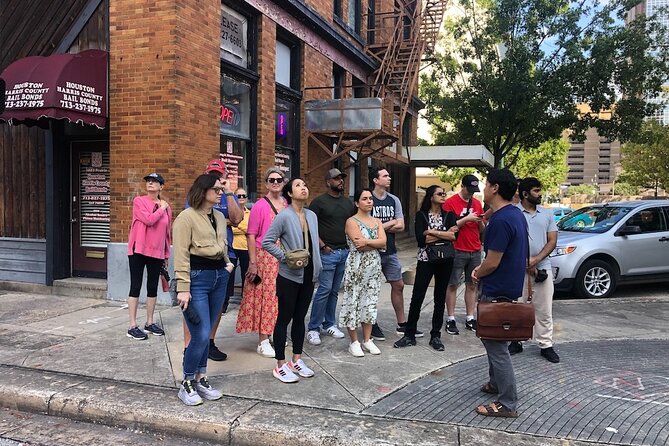
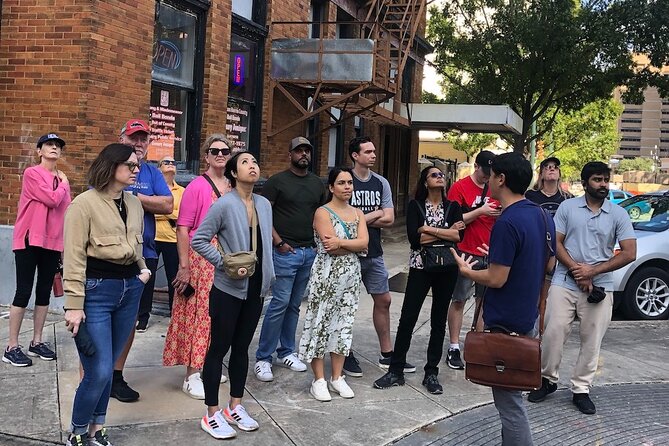
John Gu leads the experience. He is described as funny, clear, and attentive to the group. For a group of about 20, he spoke loudly enough to hear, which matters on city streets. He also made a point of including a solo participant during a roughly 20-minute break for a restroom stop, snack, and drink. That small touch suggests a guide who pays attention to people, not just buildings.
The advertised duration is about two hours, though one account describes spending closer to two and a half hours. I would leave room in your schedule for the longer version, especially if the group asks questions or the guide pauses for photos.
More History Walking Tours in the USA
- History and Hauntings of Salem Guided Walking Tour
★ 5.0 · 14,564 reviews - Boston: Freedom Trail History Small Group Walking Tour
★ 5.0 · 6,450 reviews - Historic Charleston Guided Sightseeing Walking Tour
★ 5.0 · 6,216 reviews
Market Square reveals Houston’s first chapter
The Downtown Historic District and Market Square provide the best opening because this is where Houston’s story begins. The guide points out some of the city’s oldest buildings and explains the area’s role in the early town.
The stop is brief, listed at about five minutes, so expect an orientation rather than a full historical lecture. That is enough to give later buildings context. Houston’s downtown can otherwise feel like a wall of modern towers, and Market Square reminds you that the city grew from a much smaller commercial center.
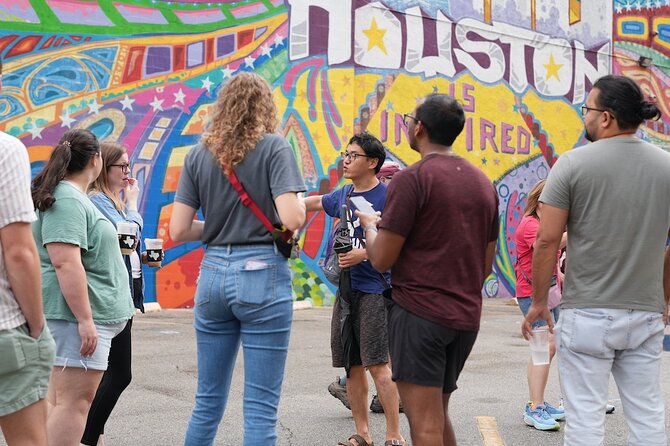
You also get a photo stop at the Houston is inspired mural. It is described as the city’s most popular Instagram photo, so this is one of the tour’s more obvious social-media moments. If murals are a major reason you booked, keep your expectations measured. The tour includes street art, but it is not a dedicated mural crawl with a long list of works.
Still, the mural fits the tour’s main idea. Houston’s identity here is not only about old stone buildings or tall offices. It also includes public art and the way the city presents itself today.
The Gulf Building shows off 1920s Houston

The Gulf Building is one of the strongest architectural stops. Completed in 1929, it rises 37 stories and reflects the confident style of Houston’s early skyscraper period.
Look for the Art Deco details: stepped setbacks, marble, geometric decoration, and the illuminated crown that gives the tower a strong nighttime profile. It was once Houston’s tallest building, a fact that helps you picture the effect it must have had on the skyline when it opened.
The mural-covered lobby sounds especially appealing, but the tour information does not promise an interior visit. Plan to admire the exterior and learn about the building from the street unless John says otherwise on the day. That distinction matters. This is an architecture walk, not a ticketed interiors tour.
I like this stop because the building gives you a quick lesson in how skyscrapers communicated ambition. The height mattered, but so did the decorative crown and polished materials. Houston wanted a tower that could compete visually with major American cities, and the Gulf Building still makes that argument from the sidewalk.
The Theater District shifts from offices to performance
The route then moves into Houston’s Theater District, where the focus turns from commercial power to performance and culture. The district includes the Alley Theatre and Jones Hall.
The Alley Theatre is noted for its bold Brutalist design. That style can divide opinion, but it is useful to see it explained in place. The building’s heavy, modern form is very different from the ornate Gulf Building, and the contrast helps you read downtown as a collection of changing architectural ideas rather than one uniform style.
Jones Hall brings a different mood. Its marble interior and careful acoustics are part of the building’s identity, although the walk may focus mainly on the exterior. You should not expect a performance or a backstage visit. The value is in seeing how Houston created a formal arts district and in learning which venues shape the city’s cultural life.
The final stop is also in this area. Lynn Wyatt Square gives you a convenient place to pause, eat, or continue exploring after the guide says goodbye. That ending is practical, since you are not dropped in an isolated part of downtown.
More Architecture and Landmark Tours in the USA:
- Chicago in a Day: Food, History & Architecture Walking Tour
★ 5.0 · 1,153 reviews - Historic Charleston Walking Tour: Rainbow Row, Churches, and More
★ 5.0 · 691 reviews - Charleston’s Best Highlights: History, Culture & Architecture
★ 5.0 · 422 reviews - Charleston: History and Architecture Guided Walking Tour
★ 4.8 · 349 reviews
City Hall and Hermann Square explain civic Houston
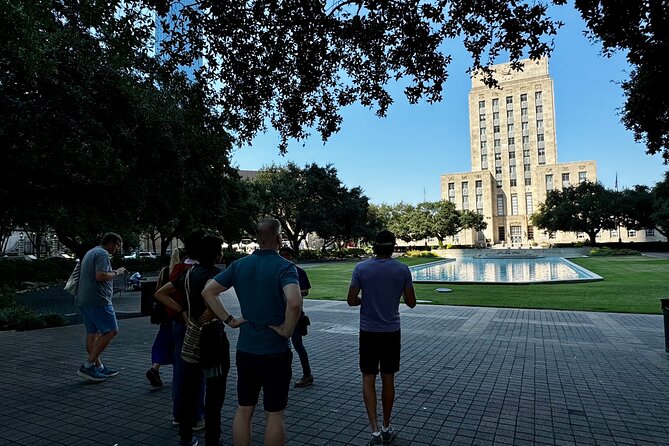
Houston’s City Hall was completed in 1939 and uses a restrained Art Deco design. Its limestone exterior, geometric patterns, and decorative friezes give it the formal look you would expect from a major civic building of the period.
Hermann Square helps frame the structure. The tour gives you a chance to consider how public buildings were designed to project authority. The building is not just an office for local government. Its scale, materials, and placement communicate what Houston wanted its civic center to say about the city.
This stop will appeal to you if you enjoy architecture that rewards close inspection. Look for the geometric details rather than only taking a wide photograph. The five-minute format means the guide has to keep moving, so ask a question if you want more on the design or the city’s government.
Tranquility Park brings NASA into downtown
Tranquility Park gives the walk a needed change of subject. Instead of another tower or courthouse, you learn about Houston’s connection with NASA and the space program.
The park is dedicated to that history, making it a useful reminder that Houston’s public identity reaches well beyond oil, offices, and skyscrapers. If you know the city mainly through its role in space exploration, this stop connects that story to the downtown center.
The information provided does not promise a museum visit or exhibits, so think of Tranquility Park as an outdoor history stop. It is short, but it adds range to the tour. You see that Houston’s story is not told through architecture alone.
The Niels Esperson Building adds old-world drama
The Niels Esperson Building is perhaps the route’s most theatrical tower. Completed in 1927, it was built by Mellie Esperson as a tribute to her husband, real estate figure Niels Esperson.
Its Italian Renaissance style makes it easy to spot. Terracotta decoration, grand columns, and a temple-like crown give it a far more ornamental appearance than many modern office towers. After the clean geometry of the Gulf Building, the Esperson Building feels almost like a piece of European-inspired architecture placed in the middle of downtown Houston.
This is a good stop for anyone who likes the personal stories behind buildings. The tower is not simply named after a company or institution. Its design and purpose were tied to a specific relationship and a period of Houston’s growth.
Again, the visit is short. You will have enough time to understand why the building matters and take photographs, but not enough for a detailed architectural study. If you want close-up images of the terracotta work, stay alert as the group moves between stops.
The 1910 Harris County Courthouse closes the civic story

The final listed landmark is the 1910 Harris County Courthouse, described as a major example of Houston’s golden age of civic architecture.
This building gives the tour a strong ending because it brings together several ideas from the route: public power, historical growth, decorative design, and Houston’s desire to present itself as an important city. After modern theater buildings and skyscrapers, the courthouse offers another view of the city’s public face.
The courthouse is best appreciated from the outside on this tour. Five minutes is enough for an introduction and some pictures, but not an extended examination of the building’s rooms or legal history. You are building a visual timeline, moving from Houston’s early days at Market Square through the city’s early skyscraper era and civic expansion.
The route then concludes at Lynn Wyatt Square, near the heart of the Theater District. The listed end address is 601 Capitol Street. From there, you can find a nearby cafe, walk back toward the start, or continue seeing downtown on your own.
What the $25 price really buys you
At $25 per person, the tour is fairly priced if you want a guide to connect the sights. You are not paying admission to museums or interiors, and the walk does not include snacks or bottled water. The value comes from the explanations, route planning, and local point of view.
You could pass several of these buildings alone, but you might not know why the Gulf Building has a stepped crown, why the Esperson Building looks so different, or how Tranquility Park relates to Houston’s public image. The guide turns a collection of downtown façades into a story.
The price is especially reasonable if you are new to Houston and want orientation before exploring alone. It also works well for someone with a spare morning while a companion attends a meeting. Just remember that the experience is short-stop sightseeing, not a full museum program or a private architectural consultation.
The tour is offered in English and uses a mobile ticket. Confirmation arrives when you book. Free cancellation is available up to 24 hours before the start time, but changes or cancellations inside that window are not accepted for a refund.
Comfort, group size, and weather tips
The maximum group size is 25. That is large enough to create a social walk but still small enough for a guide to manage, especially if everyone stays close. John’s ability to speak clearly to a group of about 20 is a positive sign, though street noise and weather can still affect how comfortable the walk feels.
Most people can take part, and the route is stroller accessible. Service animals are welcome. The information does not give a precise distance or accessibility details for every sidewalk, so contact the provider if you need specifics beyond stroller access.
Bring water, since bottled water is not included. Food and drinks bought during the walk are also your responsibility. Since the tour is outdoors, rain is a real consideration. One participant completed the walk in rainy weather and still enjoyed John’s explanations, but a light rain jacket and shoes suited to wet pavement would be sensible.
I would also plan for the possible 2.5-hour version rather than racing to your next appointment. The official estimate is about two hours, but questions, photos, and the break can stretch the outing.
Who will enjoy this Houston walk?
I would choose this tour if you want a friendly overview of downtown, care about buildings, or like learning the human stories behind public places. It is a strong first activity in Houston because it gives you landmarks and a route for later independent exploring.
It also suits solo visitors. John has shown attention to people who might otherwise fade into the group, and the planned stop for a restroom break, snack, and drink makes the experience less rigid.
Families with a stroller can consider it, as can anyone who wants a tour that does not require paid entry to attractions. English speakers will get the full experience, and the clear explanations should help you follow the story even if architecture is not your usual interest.
I would choose something else if you want long interior visits, a food-focused outing, or a specialized mural tour. The street art is part of a broader city story, not the main subject. You will also need to be comfortable walking outdoors and stopping briefly at several locations.
Should you book this downtown Houston tour?
Book it if you want a low-cost, well-organized introduction to central Houston with a guide who brings humor and human detail. John Gu is the biggest reason to expect a good experience: he explains clearly, answers questions patiently, and covers architecture, city figures, and mural artists without making the walk feel like a dry lecture.
The tour earns its strong reputation through its range. In one short outing, you see the city’s birthplace, two early skyscrapers, major theaters, City Hall, a NASA-related park, and a historic courthouse. It will not show you every side of Houston, but it gives you a useful starting point and leaves you near cafes and more downtown sights.
At $25, that is a sensible deal. Pack water, allow a little extra time, and book this walk if you want Houston to make more sense before you explore on your own.
FAQ
How long does the Walking Tour of Houston last?
The stated duration is approximately two hours. Plan for up to about two and a half hours if the group spends extra time on questions, photos, or the break.
Where does the tour begin?
The tour begins at Lyric Market, 411 Smith Street, Houston, Texas 77002.
Where does the tour end?
The tour concludes at Lynn Wyatt Square in the Theater District. The listed end address is 601 Capitol Street, Houston, Texas 77002.
What language is the tour offered in?
The tour is offered in English.
Is food or bottled water included?
No. Snacks and bottled water are not included, and you pay separately for food or drinks during the walk.
Can I cancel for a full refund?
Yes, if you cancel at least 24 hours before the experience begins. Cancellations or changes made less than 24 hours before the start time are not refunded.
More Street Art Tours in the USA
- 3-Hour Atlanta Beltline Food, Street Art and History Tour
★ 5.0 · 345 reviews - 2-Hour Food, History and Street Art Tour of Ponce City Market
★ 5.0 · 159 reviews - Atlanta: Beltline Food, Street Art, and History Walking Tour
★ 5.0 · 47 reviews - Naples Spanish Quarters Walking Tour Street Art, Folklore & Sweet
★ 5.0 · 797 reviews
Just added around the USA
- Beginner Whitewater Rafting on Historic Clear Creek★ 5.0 · 284 reviews
- Pearl Harbor [Early Access], USS Arizona & Historic Honolulu Tour★ 4.5 · 87 reviews
- Pearl Harbor with USS Arizona and Hawaiian Kingdom History Tour★ 4.5 · 184 reviews
- Beaufort Gullah Heritage Tour★ 5.0 · 47 reviews
- Complete History and Movie Walking Tour of Beaufort★ 5.0 · 30 reviews
- History Walking Tour of Healdsburg★ 5.0 · 32 reviews
- Strawberry Islands Scenic Boat Tour and Historic Cottage Row★ 5.0 · 40 reviews
- Packers Heritage Trail Segway Tour w/ Private Tour Option★ 5.0 · 20 reviews
Architecture & Landmark Tours, compared.
St. Mark’s Basilica Guided Tour & VR History Intro
Read our review →
Venice’s Best: Basilica, Doge’s Palace, Gondola & History Gallery
Read our review →
Córdoba: Skip-the-Line Great Mosque-Cathedral History Tour
Read our review →
Pantheon Elite Guided Tour – Rome’s Iconic Ancient Temple
Read our review →
Abu Dhabi Grand Mosque, Palace, and Heritage Village
Read our review →
Chicago in a Day: Food, History & Architecture Walking Tour
Read our review →

Colosseum Special Access Tour, with Ancient Temples & Tombs
Read our review →Browse the lists this tour appears in