
Review · GRAND EST
Strasbourg on Foot: Historic Center and Petite France with a Local Guide
Strasbourg reveals itself best on foot. This two-hour walk links the city’s major sights in a sensible route, from Place Kléber and Notre-Dame Cathedral to the canals and half-timbered houses of Petite France. I like the clear historical thread, and I like that local guides such as Stef, Leila, Stefania, Maya, and Javier add personal tips about food and places to visit. The main limitation is time: two hours gives you a strong introduction, but not much chance to enter museums or explore the cathedral in depth.
The $34 price feels fair if you are new to Strasbourg and want quick orientation without spending half a day on a formal tour. The walk includes a typical Alsatian sweet, a map, and recommendations for the rest of your stay. You should be ready for steady walking over cobbled streets, and remember that the cathedral portion is described as an outside visit rather than a full interior tour.
Key points at a glance
- A smart first-day route: The walk connects Place Kléber, the cathedral, Rohan Palace, Gutenberg Square, Saint-Thomas Church, the covered bridges, and Petite France.
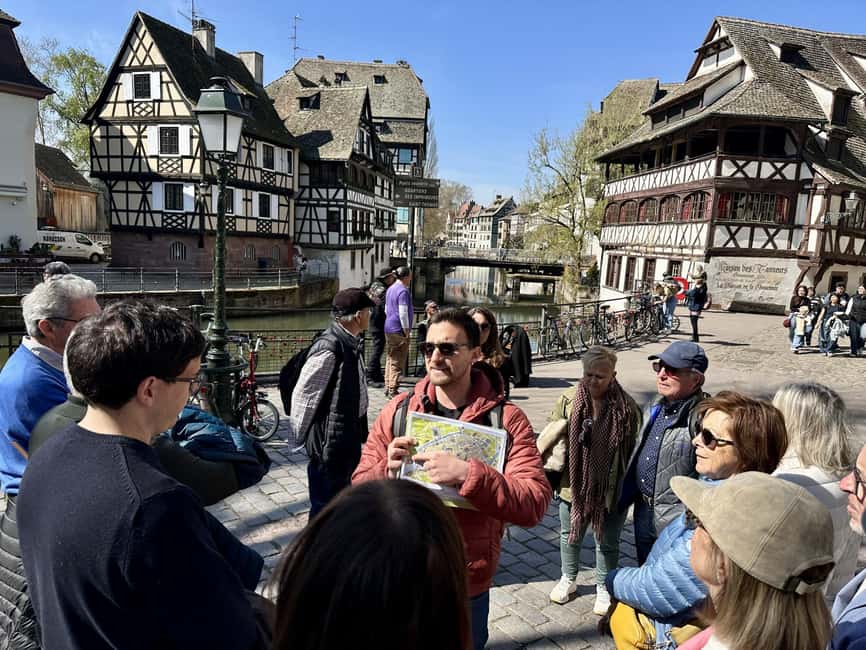
- The best finale is Petite France: The tour finishes beside canals, traditional houses, and the former Tanners’ Quarter.
- Strong guide presence: Stef, Leila, Stefania, Maya, and Javier are praised for clear explanations, humor, energy, and useful restaurant suggestions.
- Good value at $34: You receive two hours of guiding, a city map, local recommendations, and an Alsatian sweet tasting.
- English and Spanish are offered: Some material may appear in its original language, so confirm your preferred language when booking.
- Christmas adds atmosphere: Place Kléber is especially festive when its large seasonal tree and lights are in place.
Why this two-hour walk works well in Strasbourg
Strasbourg’s old center is compact enough to explore by foot, but its story is not simple. Roman roots, medieval trade, religious power, French and German influence, defensive walls, canals, and modern European identity all overlap here.
That is why a guide can add real value. Without context, the cathedral is simply a very tall Gothic church, Petite France is a pretty canal district, and the covered bridges are good photo stops. With a guide, these places connect into a story about trade, defense, religion, craft, and daily life.
The route is also sensibly arranged. You begin in the city center, move toward the cathedral and palace district, cross the older commercial quarter, then continue west toward the defensive works and Petite France. You are not zigzagging across town. The walk keeps moving while giving you a useful mental map.
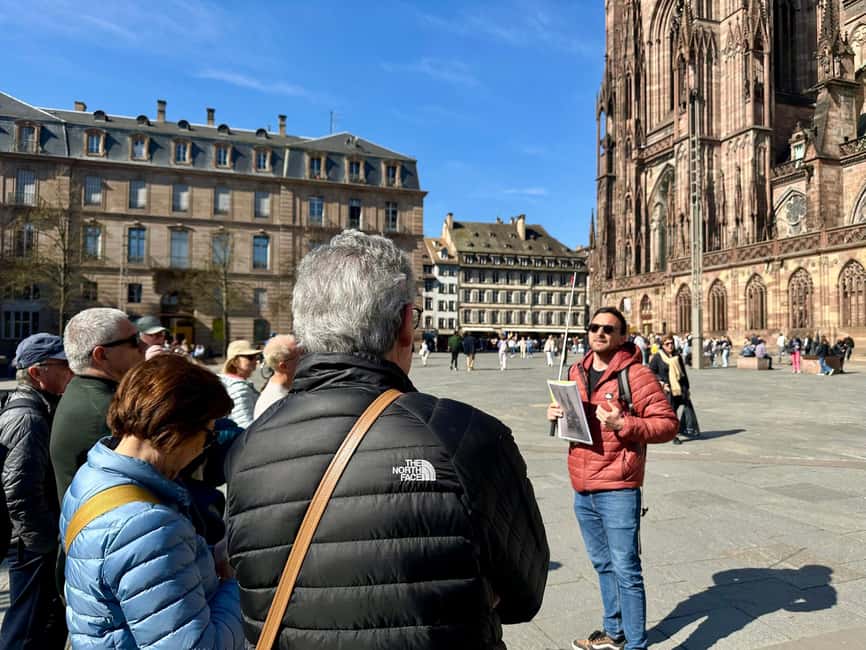
Several people who joined with Stef or Leila especially praised the pace. The walk appears designed to keep you moving without making you feel hurried. That matters in Strasbourg, where cobblestones, narrow lanes, and crowded squares can slow a group down.
More History Walking Tours in France
- Paris: Dark History and Ghostly Guided Walking Tour
★ 4.7 · 1,000 reviews - Vieux Lyon Cultural & Historical Walking Guided Tour (English)
★ 5.0 · 942 reviews - Strasbourg: Guided Historical Neighborhoods Walking Tour
★ 4.9 · 275 reviews
Starting at Place Kléber, Strasbourg’s central stage
Place Kléber is the natural opening point for a first look at the city. It is Strasbourg’s central square and a useful place to understand how the old center fits together.
During the Christmas season, the square takes on a different mood. Its large Christmas tree becomes the visual focus, with lights and seasonal decorations adding a festive layer to the start of the walk. If you visit outside that period, the square still works well as an orientation point, but you will not see the Christmas display described for the holiday season.
The tour may use a meeting point connected with 14 Rue Mercière, though the exact meeting location can depend on the option you book. Check the booking details before setting out. In a pedestrian center, a few minutes spent finding the guide can make a noticeable difference on a short tour.
Notre-Dame Cathedral and the limits of a short visit
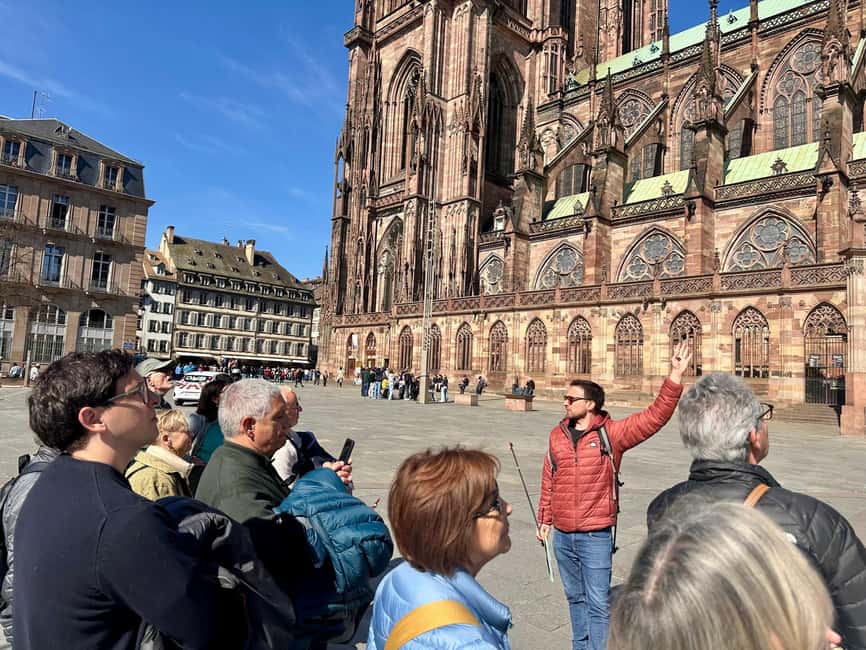
Strasbourg’s Notre-Dame Cathedral is the visual high point of the old center. Its tower reaches 142 meters, making it one of the defining sights on the city skyline.
The guide explains the Gothic design and the role the cathedral played in Strasbourg’s religious and civic life. If the route or timing allows, you may also hear about the multicolored medieval stained glass and the astronomical clock, a Renaissance mechanism famous for its moving display at certain times of day.
The important practical point is that this experience includes a tour outside the cathedral. Do not book it expecting a long interior visit or a dedicated clock presentation. You may receive useful background on what to see inside, but the schedule gives the guide only about 15 minutes here.
That short stop is still worthwhile. It helps you recognize the major details when you return on your own. If the cathedral is high on your list, use this tour as an introduction, then come back later for a slower look.
Rohan Palace and the city’s grander side
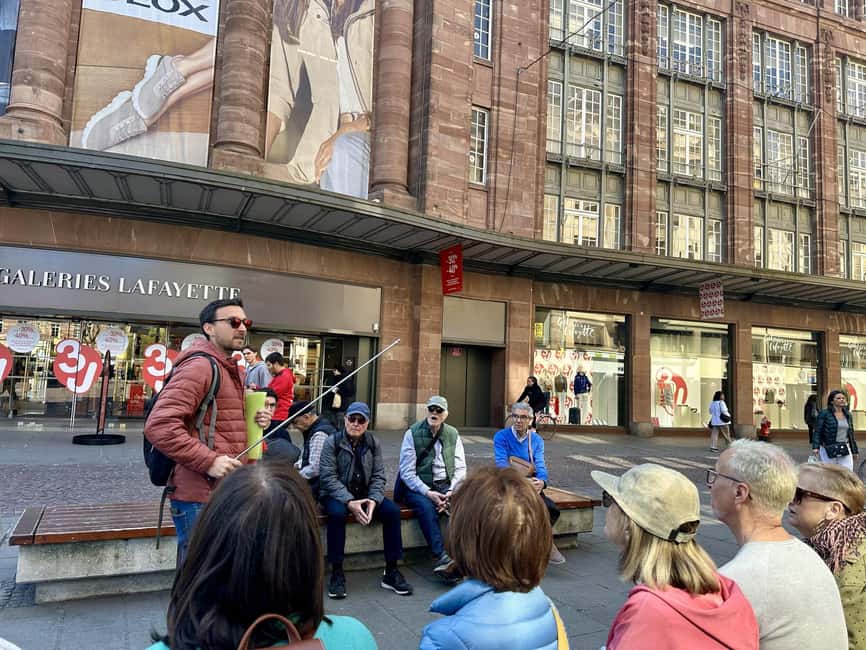
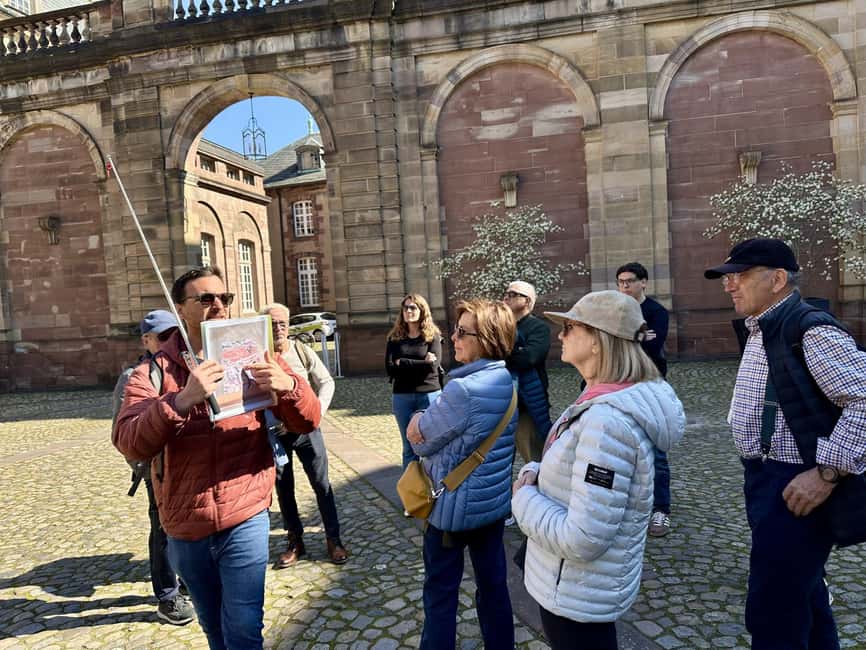
The route continues to Rohan Palace, an elegant 18th-century residence built for princes and cardinals. It offers a sharp contrast to the narrow medieval lanes and modest half-timbered houses elsewhere in the center.
The palace now houses museums connected with fine arts and decorative arts. The guide may point out its connection with figures such as Marie Antoinette and Napoleon, giving you a sense of the political and social circles that passed through this building.
The tour includes a stop at the palace, but two hours does not allow for a detailed museum visit. Think of this part as an architectural and historical introduction. If the palace interests you, note the museums for a separate visit after the walk.
I like this contrast in the itinerary. Strasbourg is not only canals and old houses. Rohan Palace shows the wealth and authority that shaped the city at a larger scale.
More Old Town and Historic Centre Walks in France
- Bordeaux: Historic Center & Chartrons District Bike Tour
★ 4.8 · 709 reviews - Rouen: Guided Tour of the Historic Center
★ 4.8 · 145 reviews - Strasbourg: Private Walking Tour of the Historical Center
★ 4.2 · 107 reviews - Strasbourg: Historic Center Walking Tour
★ 4.7 · 88 reviews
L’Ancienne Douane and the working city
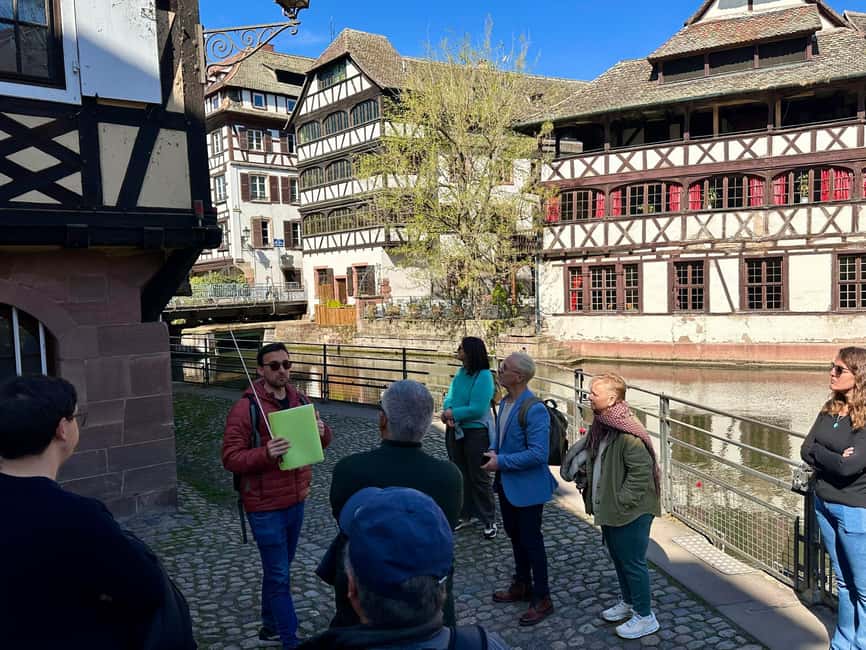
At L’Ancienne Douane, the focus shifts toward commerce. The old customs house points to Strasbourg’s role as a trading center, where goods moved through the city and fees were collected.
This stop helps explain why the waterways mattered. The canals were not placed here merely for scenery. They supported mills, workshops, transport, and the movement of products through the old city.
You will probably get more from this stop if you pay attention to the relationship between buildings and water. The tour is strongest when it explains how Strasbourg functioned as a working city, not only how it looked in postcards.
Place des Tripiers and the Tanners’ Quarter
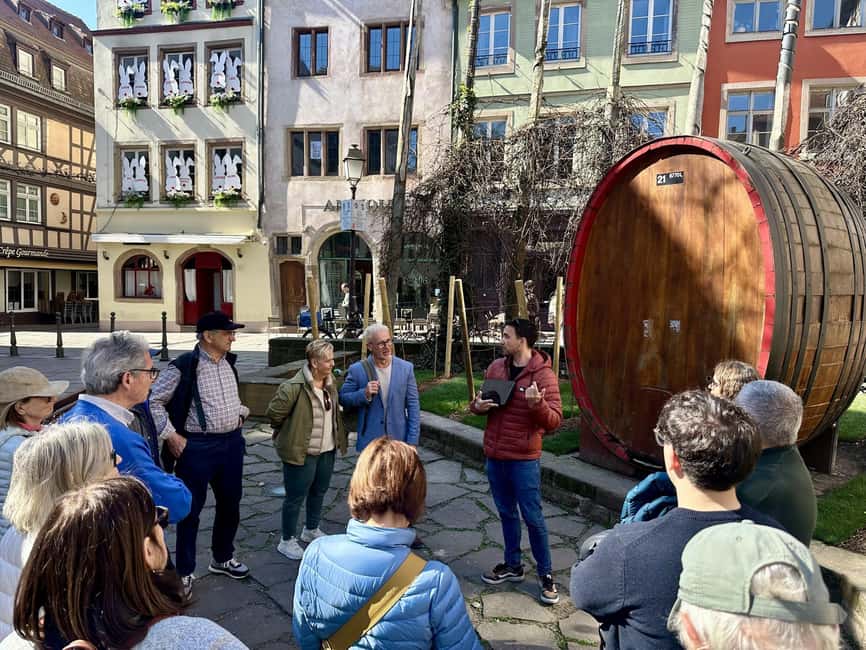
Place des Tripiers brings you closer to the old neighborhoods shaped by trades and guilds. The nearby Tanners’ Quarter recalls the artisans who processed hides and worked along the water.
This is one of the more useful parts of the walk for understanding Petite France. The area’s narrow streets and canals were tied to practical work. Tanners, millers, fishermen, and other craftspeople needed water, access, and small workshops. The picturesque setting came later in the tourist imagination.
The guide can help you read the buildings in a more grounded way. Those steep roofs, timber frames, and canals were once part of an industry district. You are not just looking at an attractive old quarter. You are looking at a place built around labor.
Gutenberg Square and Saint-Thomas Church
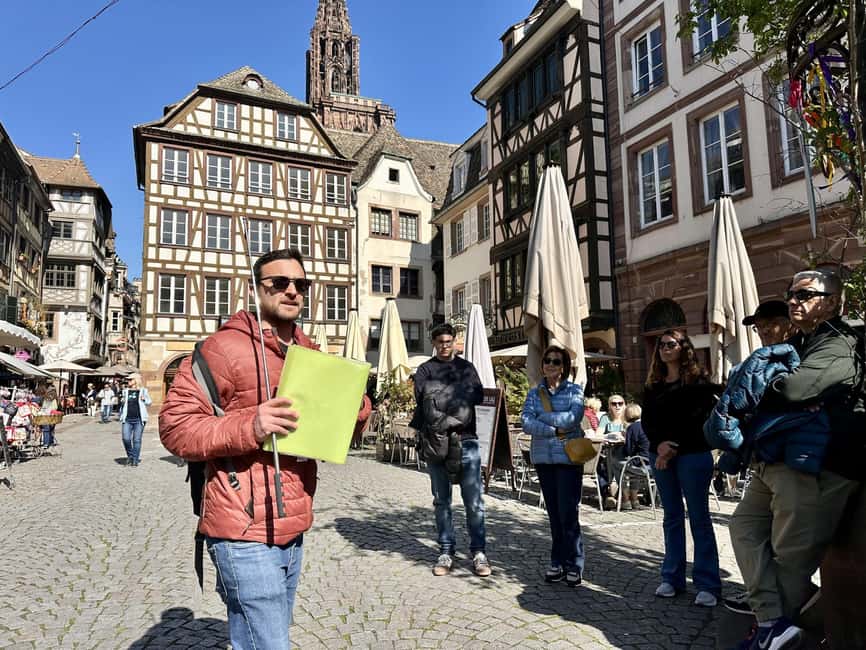
Place Gutenberg is presented as a cultural and historical center of Strasbourg. It is a useful stop for connecting the city’s civic identity with its commercial and intellectual life.
The square also gives the walk a change of scale. After smaller streets and close-set buildings, you get a broader public space where the city’s different eras meet.
The route then continues toward Saint-Thomas Church. This church adds another religious landmark to the cathedral, but it is not simply a repeat of the same experience. The guide can place it within Strasbourg’s changing religious story and explain why several important churches exist within such a compact area.
Expect an overview rather than a long church visit. The strength here is the sequence. By this point, you have seen the city’s major religious, political, commercial, and craft centers.
Covered Bridges and the old defenses
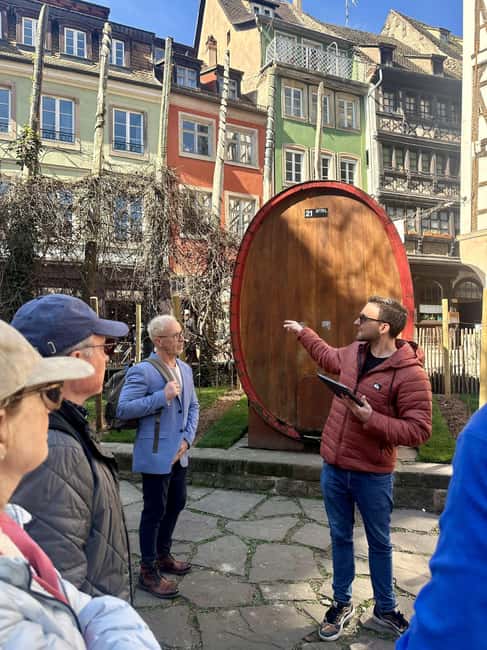
The Covered Bridges are among Strasbourg’s most recognizable historic structures. Their original wooden roofs have disappeared, but the name remains, along with the defensive towers and waterways that made this area important.
The bridges once formed part of the city’s defensive system. From here, the canals and towers show how Strasbourg protected its western approaches and managed movement around the old center.
This is a particularly good stop for photographs, but the guide gives it more substance than a quick picture break. You learn how defense shaped the city’s layout and how those old structures later became part of Strasbourg’s public image.
The setting can be busy, and the ground may be uneven. Keep your attention on the guide as the group moves across bridges and along the canals. If you have mobility concerns, ask the provider for current route details before booking, since no specific accessibility information is supplied.
Finishing in Petite France
Petite France is the payoff of the route. This former neighborhood of fishermen, millers, and tanners is known for canals, half-timbered houses, narrow streets, and reflections on the water.
The walk finishes in the heart of the district, giving you time to take in the architecture after the more structured stops earlier in the tour. The ending feels calm and visual, especially when the water mirrors the traditional houses.
I appreciate that the tour does not rush through Petite France at the beginning. By saving it for last, the guide can explain why the neighborhood looks the way it does. You arrive with a better sense of the trades, canals, and defenses that shaped it.
This is also the most useful place to continue on your own. Once the tour ends, you can linger, take photographs, find a café, or return to any street that caught your eye. The map and restaurant suggestions included with the tour can help with that next step.
What the guides add to the experience
The strongest praise is directed at the guides’ personal style. Stef is described as animated, passionate, and easy to follow. Leila is praised for strong storytelling, humor, patience, and an ability to answer questions. Stefania is noted for remembering names and making the group feel included.
Maya is especially useful if you want food advice, with tips on where to eat and what to try. Javier is also praised for a friendly and informed presentation. The guide can vary, so you should not book expecting one specific person unless your booking confirms the name.
Several useful details come through clearly:
- Guides explain the city’s past in a way that connects one stop to the next.
- Questions are welcomed rather than treated as interruptions.
- The pace is generally comfortable, including for people who walk more slowly.
- Some tours use headphones, which can make explanations easier to hear in busy streets.
- Guides may share restaurant suggestions and ideas for the rest of your stay.
That last point is important. A good first-day tour should not try to show you every corner. It should help you choose where to return. This walk appears to do that well.
Food tasting, maps, and practical value
The included tasting is a small feature, but it gives the tour a local touch. The formal description promises a typical Alsatian sweet, while some tour sessions have included gingerbread and cheese tastings. Treat the food as a pleasant extra rather than a full tasting tour, since the exact item may vary.
You also receive a city map and recommendations for places to visit. At $34 per person, those extras support the value, but the real benefit is the guide’s interpretation and the route planning.
For two hours, the cost is reasonable if you want an introduction without committing to a longer excursion. It is less compelling if you already know Strasbourg well or prefer to explore at your own pace. In that case, you may get more from visiting the cathedral and Petite France independently.
The short duration is both a strength and a limit. It fits neatly into a first morning or afternoon, but you will not have time for full museum visits, a lengthy cathedral interior tour, or long stops at every square.
Who should book this Strasbourg walk?
I would choose this tour for a first visit, especially if you have only a day or two in Strasbourg. It gives you the city’s main old-center sights in a logical order and leaves you with a clear list of places to revisit.
It is also a good fit if you enjoy history but do not want a lecture. The guides use stories, local advice, and questions to keep the walk moving. Families and mixed-age groups may appreciate the manageable length and relaxed pace.
You should think twice if you want a specialist architecture tour, extended museum time, or a detailed interior visit to Notre-Dame. The experience is an overview, not a deep examination of any single building.
Wear comfortable shoes and allow time for cobbled streets, bridges, and canalside paths. Bring your questions, since the guides are repeatedly praised for making room for them.
Should you book Strasbourg on Foot?
Book it if you want a friendly, well-organized introduction to Strasbourg for $34. The route covers the cathedral, Rohan Palace, old trade quarters, Gutenberg Square, Saint-Thomas Church, the covered bridges, and Petite France without wasting time on backtracking.
I especially like it as a first activity in town. You can use the guide’s restaurant tips, map, and sightseeing suggestions to shape the rest of your visit.
Skip it if you prefer complete independence or already know the historic center. Otherwise, the balance of price, route, local stories, and practical advice makes this a sensible way to get oriented.
Free cancellation is available up to 24 hours before the tour, and you can reserve now and pay later. English and Spanish tours are offered, though some content may appear in its original language.
FAQ
How long is Strasbourg on Foot?
The tour lasts two hours.
How much does the tour cost?
The listed price is $34 per person.
Where does the tour begin?
There are two starting location options, with 14 Rue Mercière listed as a starting point. The exact meeting point may depend on the option booked.
Where does the tour finish?
The tour finishes in Petite France.
Is Notre-Dame Cathedral visited inside?
The included information specifies an outside visit to Notre-Dame Cathedral in Strasbourg.
What languages are available?
Live guiding is available in English and Spanish.
Does the tour include a food tasting?
Yes. The tour includes a tasting of a typical Alsatian sweet. Some sessions have also included gingerbread and cheese tastings.
What sights are included?
The route includes Place Kléber, Notre-Dame Cathedral, Rohan Palace, L’Ancienne Douane, Place des Tripiers, Place Gutenberg, Saint-Thomas Church, the covered bridges, and Petite France.
Is a map included?
Yes. The tour includes a city map and recommendations for places to visit.
Can I cancel for a full refund?
You can cancel up to 24 hours in advance for a full refund.
Just added around France
- Private Bordeaux History Tour with a glass of Bordeaux wine.★ 5.0 · 28 reviews
- Bordeaux Historic and Gourmet Food Walking Tour★ 4.5 · 82 reviews
- 2-Hour Walking Tour of the City’s Iconic Sights and History★ 4.0 · 207 reviews
- Bordeaux’ Best Boulangeries & History Tour★ 5.0 · 126 reviews
- Historical Center, Bordeaux Food Tour★ 5.0 · 33 reviews
- Historic Bayeux Daily Group City Tour In English 2 hrs (Apr-Sept)★ 5.0 · 220 reviews
- Private Walking Guided Tour of Historic Bayeux English or French★ 5.0 · 36 reviews
- Roman Sites and Historical Places Day Trip from Avignon★ 4.0 · 101 reviews
Old Town & Historic Centre Walks, compared.
Live Fado Show with Port Wine in Historic Center
Read our review →
Valencia Old Town Tour with Wine & Tapas in 11th Century Historic Monument
Read our review →
Prague Old Town, Medieval Underground and Dungeon Historical Tour
Read our review →
Historic Center and Getsemaní Shared Walking Tour
Read our review →
Old Town Walking Tour History and Tales in Edinburgh
Read our review →
Philadelphia Old City Historic Walking Tour with 10+ Top Sites
Read our review →
Saadian Tombs & Bahia Palace, Medina Guided Tour
Read our review →Browse the lists this tour appears in