
Review · BORDEAUX
Private Bordeaux History Tour with a glass of Bordeaux wine.
Bordeaux rewards curious walkers. This private tour links the city’s grandest squares, medieval gateways, and elegant streets with a local guide, then finishes with a glass of Bordeaux wine at a popular local bar. I like the one-to-one format, which lets you ask questions and adjust the conversation, and I like how much ground the route covers in two hours. The main drawback is its pace: with 13 stops, some landmarks receive only a brief look from outside.
The tour costs $90.36 per person, a fair price if your group values personal guiding and a quick historical orientation. Guides Victor and Emma have earned especially strong praise for clear storytelling and friendly conversation. You will not enter the monuments, and the wine tasting is a single glass rather than a full winery visit, so this suits first-time visitors more than serious wine collectors.
Key points to know before booking
- A private English tour begins at Bordeaux Cathedral and ends at Place des Quinconces.
- You see major landmarks including Porte Cailhau, Place de la Bourse, the Grand Théâtre, and the Monument aux Girondins.
- The route explains Bordeaux’s medieval past, English connections, royal history, and urban redesign.
- A glass of Bordeaux wine at a partner bar is included after the walk.
- The tour lasts about two hours, with no entrance fees included for the monuments.
- The current rating is 5 out of 5 from 28 ratings, with 100 percent recommending it.
Why this private Bordeaux walk works well
Bordeaux can feel easy to wander, but its story is not always easy to read. A grand square may reflect royal ambition, a gateway may recall medieval power, and a wide avenue may reveal how the city was reshaped in the 18th century. This tour gives those details a clear order.
You meet at Cathédrale Saint-André, in Place Pey Berland, then walk through the historic center toward Place des Quinconces. The route is mostly about orientation and interpretation. You see famous buildings, hear why they matter, and finish with a drink that connects the city’s past to its best-known modern product.
The private format matters here. If you want to ask about Bordeaux’s wine regions, its time under English rule, architecture, or local life, you do not have to wait for a group pause. The guide can spend more time on your interests. Victor is praised for adding detail when visitors show particular curiosity, while Emma is noted for giving a thorough and friendly explanation.
There is a practical tradeoff. Thirteen stops in approximately two hours means the walk moves quickly. Several stops last only five or ten minutes. Think of this as a well-paced introduction, not a slow architectural study.
More Private History Tours in France
- Paris City of Fashion History Private Guided Walking Tour
★ 5.0 · 221 reviews - History of Paris City Center w/ Notre Dame Semi-Private 12ppl Max
★ 5.0 · 194 reviews - Strasbourg: Private Walking Tour of the Historical Center
★ 4.2 · 107 reviews
Starting with Saint-André Cathedral and Pey-Berland
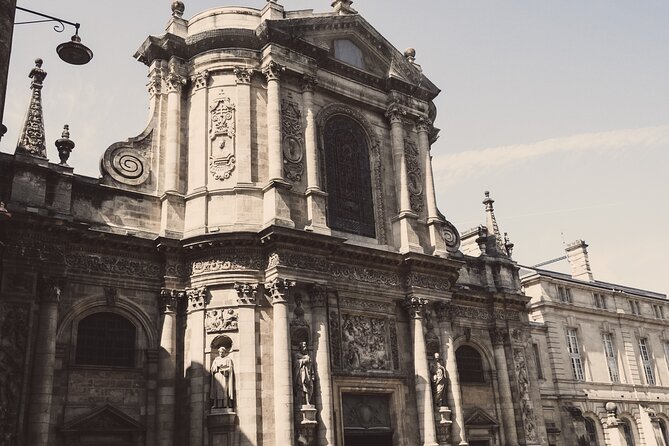
Saint-André Cathedral is a fitting starting point. Its Gothic façade, carved details, and tall interior introduce you to Bordeaux’s religious and civic importance. The cathedral has hosted royal events, including the marriage of Eleanor of Aquitaine and King Louis VII, a connection that gives the building a place in wider French and European history.
You receive around 15 minutes here, with no admission charge included because the tour does not include interior monument visits. That distinction matters. You can admire the cathedral and learn about its medieval origins and later restoration, but you should not expect a guided visit inside.
The nearby Tour Pey-Berland is part of the opening section. The supplied route description connects this part of the walk with Rue Sainte-Catherine, so you should expect the guide to use the area as a bridge between the cathedral quarter and the pedestrian center. The tour focuses on how Bordeaux’s religious and civic buildings fit together rather than treating each monument as an isolated photo stop.
This is also a useful moment to ask your guide for a basic map of the city. Bordeaux’s center becomes easier to understand once you see how the cathedral, riverfront, shopping streets, and large squares relate to one another.
Rue du Loup and Bordeaux under English rule
Rue du Loup provides a change of scale. Instead of looking only at monumental façades, you examine medieval architecture and hear how Bordeaux became English. That political shift is one of the key facts needed to understand the city’s later wealth and connections.
The stop lasts about ten minutes. It is short, but the subject is important. The guide can connect local streets to the period when Bordeaux had close ties to England, helping explain why wine trade and international links became so important to the city.
I like this portion because it gives the tour a stronger historical spine. Without it, Bordeaux can appear to be only a collection of elegant 18th-century buildings. With it, you get a sense of the older city beneath the polished façades.
Rue Sainte-Catherine and Promenade Sainte-Catherine
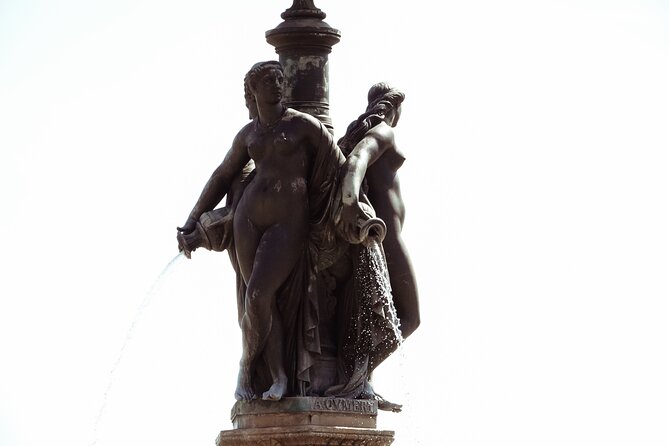
The walk then reaches Rue Sainte-Catherine, described as the longest pedestrian street in Europe. Its modern shops and steady foot traffic make it one of the clearest places to see present-day Bordeaux. The guide also explains its earlier role as a Roman road and its later change into a major shopping street.
The route includes Promenade Sainte-Catherine as another short stop. These two entries cover related ground, so the experience may feel repetitive if you already know the street. For a first visit, though, the connection between Roman routes, commerce, and modern city life is useful.
This is not a stop for grand monuments. It is a chance to observe how Bordeaux functions at street level. You pass from medieval stories into daily city life, with shops, cafés, and local movement replacing formal squares and church façades.
Same place, a different slice of the past:
- Paris: Louvre Museum Entry with History of Mona Lisa
★ 3.9 · 2,823 reviews - Paris: Dark History and Ghostly Guided Walking Tour
★ 4.7 · 1,000 reviews - Vieux Lyon Cultural & Historical Walking Guided Tour (English)
★ 5.0 · 942 reviews - Bordeaux: Historic Center & Chartrons District Bike Tour
★ 4.8 · 709 reviews
Place du Palais and Porte Cailhau
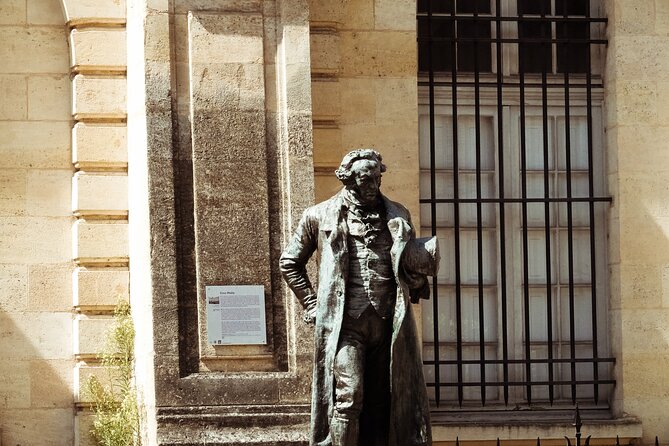
Place du Palais offers a lesson in urban design. Rather than simply taking a picture and moving on, you hear about the idea behind the square and how its buildings were arranged. The 10-minute stop gives the guide enough time to explain the space without turning it into a long lecture.
Porte Cailhau is one of the route’s best visual moments. This 15th-century gateway once served as a main entrance to Bordeaux. Its design combines Gothic and Renaissance elements, and its construction honored King Charles VIII’s victory at Fornovo.
The gate also helps you picture medieval Bordeaux as a defended city. It was not merely an attractive archway. It controlled movement into the city and carried political symbolism. The guide explains its defensive purpose and its link to Bordeaux’s prosperity.
I would pay close attention here because a gateway can be easy to overlook when you are eager to reach the riverfront. Porte Cailhau rewards a slower look at its upper details, narrow openings, and unusual profile.
Place de la Bourse and the riverfront story
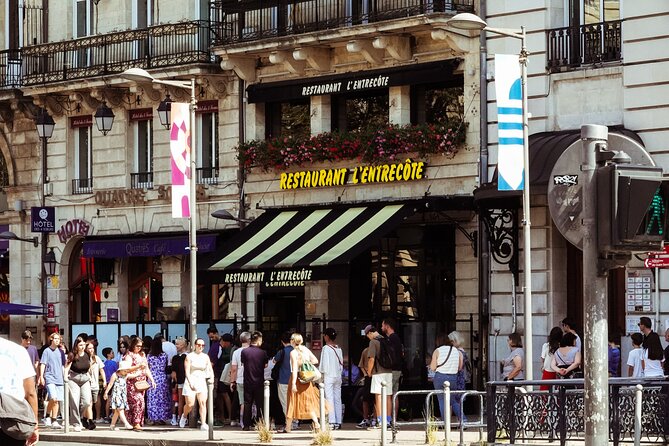
Place de la Bourse is one of Bordeaux’s best-known views. The tour gives this stop only about five minutes, so you should expect a concise explanation rather than a long pause. Even so, the square is central to understanding Bordeaux’s grand public image.
The route also identifies the Miroir d’Eau as one of the major sights connected with the walk. Since no separate time is listed for it, your exact pause may depend on the guide and conditions on the day. The reflective water surface is a natural place for photographs, but the value here is also how the square opens toward the river.
This part of the route shows Bordeaux at its most formal. Earlier, you encountered medieval lanes and a fortified gate. Here, broad design and monumental architecture present a more confident city shaped by trade, wealth, and civic ambition.
The Grand Théâtre and Place Gambetta
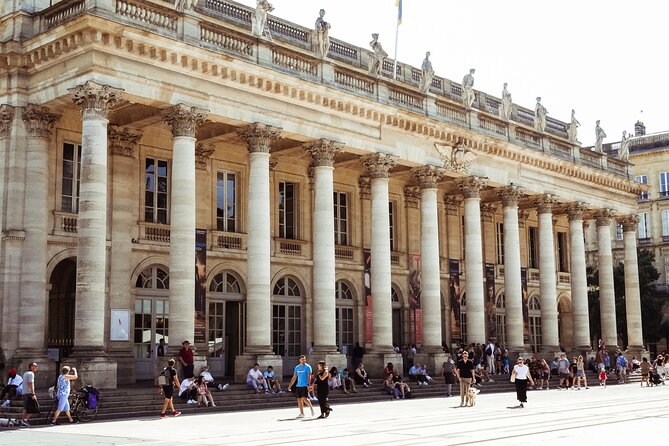
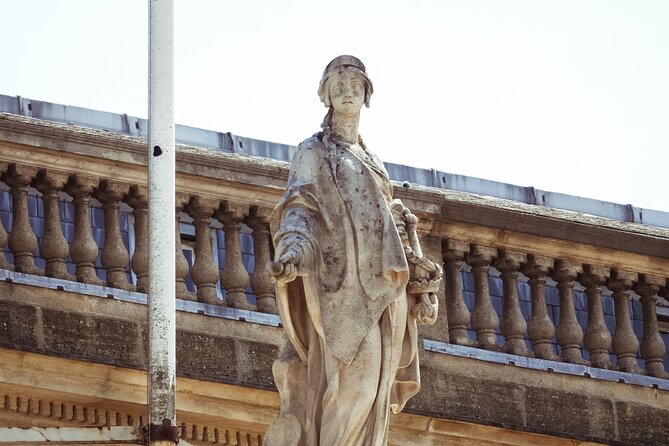
The Grand Théâtre receives another five-minute stop. Designed by Victor Louis and completed in 1780, it is a major example of neoclassical architecture. Its façade, columns, and statues of the nine muses and goddesses make it one of the city’s most recognizable buildings.
The brief timing means you mainly examine the exterior. The tour explains the theatre’s role in Bordeaux’s cultural life, but entrance is not included. If you want to see the grand staircase, chandelier, or interior, you will need to arrange that separately.
Place Gambetta adds a quieter urban note. Once linked to the western gate of the city, it later became part of Bordeaux’s 18th-century transformation. Its gardens and surrounding architecture offer a pause from the commercial center, while the guide explains connections to political events including the French Revolution.
Together, these stops show two sides of Bordeaux: public performance and public power. One is built for opera and ceremony. The other reflects changing ideas about civic space.
Passage Sarget and Place du Chapelet
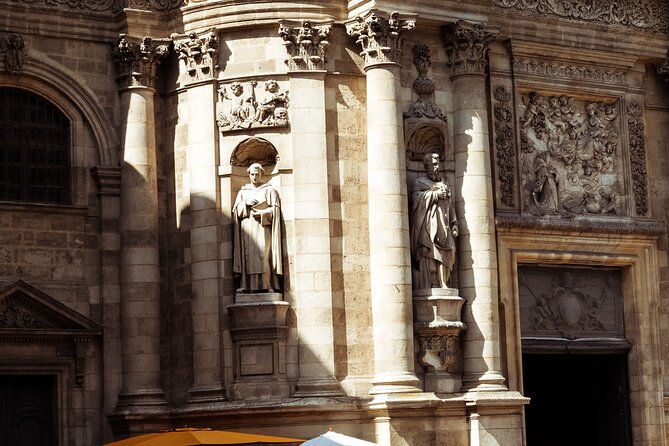
Passage Sarget is a small but appealing change of pace. Built in the late 19th century, this covered passage links Rue de la Porte-Dijeaux with Place des Grands-Hommes. Its glass roof, ironwork, and stone details reflect the fashion for Paris-style arcades.
The passage was named for Jean-Alexandre Sarget, a banker and philanthropist. It once attracted luxury shops and intellectual gatherings. Today, shops and cafés keep the walkway in use, giving you a glimpse of Bordeaux’s Belle Époque commercial style.
You then reach Place du Chapelet, home to the 17th-century Church of Notre-Dame. The church is known for its organ, which still sounds during special performances. It also has a connection to a notable 19th-century painter’s funeral.
This stop is best for people who enjoy smaller cultural details. It does not have the instant impact of Place de la Bourse or Porte Cailhau, but it adds texture to the walk. You see how churches, covered passages, and quiet squares fit into the everyday city.
Allées de Tourny and the Girondins monument
Allées de Tourny is a broad, tree-lined avenue tied to the person who helped redesign Bordeaux and later influenced urban planning in Paris. The stop lasts only five minutes, but it gives you a useful way to read the city’s larger avenues and orderly classical design.
The final major sight is the Monument aux Girondins at Place des Quinconces. This large monument honors Girondin deputies who died during the French Revolution. Sculptures represent liberty, the Republic, and Bordeaux’s maritime identity.
Place des Quinconces is also the end point, so the monument provides a fitting finish. By this stage, you have moved from medieval city gates to royal and revolutionary symbols. The route closes with a public monument that connects local identity to national politics.
Because the stop is short, do not expect a detailed account of every figure and sculpture. You will get the main story and the symbolism. If revolutionary history is a major interest, you may want to return later for a closer look.
What the wine glass adds
The included glass of Bordeaux wine comes at a partner bar after the walking portion. It is a simple but welcome finish. You can sit down, ask follow-up questions, and connect the city’s history with its wine culture.
Keep your expectations sensible. This is one glass, not a vineyard visit, cellar tour, or formal tasting flight. The tour does not promise an explanation of specific appellations or winemaking methods. Its value is social and local: you finish the walk with a drink and a chance to continue the conversation.
For many people, that final glass makes the experience feel more personal than a standard sightseeing circuit. I especially like it for visitors who want an introduction to Bordeaux without giving half a day to a distant wine estate.
Price, pace, and practical details
At $90.36 per person, the tour is not the cheapest way to walk around Bordeaux. You can see many of these public spaces without paying for admission. The price is easier to justify if you are traveling as a small private group and want an English-speaking guide to organize the route and explain the connections between places.
The private setup also means you are paying for attention, not just access. A guide can answer questions about your interests, adjust the emphasis, and keep the walk focused. The strongest praise goes to Victor and Emma for their clear explanations, warm manner, and ability to make the history easy to follow.
The tour is offered in English and includes mobile ticketing. It begins at Saint-André Cathedral and ends at Place des Quinconces. Public transportation is nearby, and service animals are allowed. Most people can participate, but you should be ready for continuous city walking and a quick pace between stops.
The tour confirms at booking, and cancellation is free if you cancel at least 24 hours before the start time. Changes or cancellations inside that window are not accepted for a refund.
Who should book this Bordeaux tour?
I would choose this experience for a first visit, especially if you have only a morning or afternoon to get oriented. It gives you the city’s main visual landmarks, a useful account of its medieval and English connections, and a short introduction to its wine culture.
It also suits couples, families, or friends who prefer private conversation to a large group. History fans will appreciate the range from Eleanor of Aquitaine to the French Revolution. Architecture fans will enjoy the Gothic cathedral, Renaissance gateway, neoclassical theatre, covered passage, and formal squares.
I would hesitate if you want to enter several monuments, taste multiple wines, or spend a long time at each site. The route is broad rather than slow. Some stops last five minutes, and the wine portion is limited to one glass.
The current score is 5 out of 5 from 28 ratings, with every rating recommending the experience. That strong record fits the tour’s main strengths: personal guiding, clear historical context, and a friendly finish.
Should you book it?
Book this private Bordeaux history tour if you want a fast, personal introduction to the city with an English-speaking guide and a glass of wine afterward. The strongest reason to choose it is not admission to exclusive sights. It is the guide’s ability to connect streets, monuments, politics, and wine into one readable story.
Skip it if you prefer independent wandering or want a full wine-focused excursion. For most first-time visitors who value context and convenience, the $90.36 price can be good value, particularly when shared by a private group.
FAQ
How long does the Bordeaux private history tour last?
The tour lasts approximately two hours.
Where does the tour begin?
It begins at Cathédrale Saint-André de Bordeaux, at Place Pey Berland, 33000 Bordeaux, France.
Where does the tour end?
The tour ends at Place des Quinconces, 33000 Bordeaux, France.
Is the tour offered in English?
Yes. An English-speaking guide leads the private walking tour.
Is a wine tasting included?
A glass of Bordeaux wine at a partner bar is included. The experience does not include a full winery visit or multiple tasting flights.
Are entrance fees to the monuments included?
No. The tour includes the outside walking tour, but entrance inside the monuments is not included.
More Wine Tours in France
- Nice : Wine Tasting at a Historic Château in a Land Rover !
★ 4.9 · 156 reviews - Nice: Sunset & Wine Tasting in a historic Land Rover
★ 5.0 · 91 reviews - Avignon: Historic District Guided Food & Wine Walking Tour
★ 4.8 · 84 reviews - Champagne Cellar Experience: Explore our historic cellars
★ 4.7 · 46 reviews
Just added around France
- Bordeaux Historic and Gourmet Food Walking Tour★ 4.5 · 82 reviews
- 2-Hour Walking Tour of the City’s Iconic Sights and History★ 4.0 · 207 reviews
- Bordeaux’ Best Boulangeries & History Tour★ 5.0 · 126 reviews
- Historical Center, Bordeaux Food Tour★ 5.0 · 33 reviews
- Historic Bayeux Daily Group City Tour In English 2 hrs (Apr-Sept)★ 5.0 · 220 reviews
- Private Walking Guided Tour of Historic Bayeux English or French★ 5.0 · 36 reviews
- Roman Sites and Historical Places Day Trip from Avignon★ 4.0 · 101 reviews
- Enchanting Historical Walking Tour in Avignon★ 5.0 · 53 reviews
Private History Tours, compared.
Private Guided Historic Electric Cart Tour of St. Augustine
Read our review →
Acemoglu Historical Turkish Bath w/Private Options
Read our review →
Private Full-Day Tour of Historical Alexandria
Read our review →
Private Tour of the Historic City in a Ford T Car
Read our review →
Madrid Historical Tour with Local Guide in Eco Tuk Tuk Private
Read our review →
Private Biblical Tour Ancient Corinth & Isthmus Canal from Athens
Read our review →
Private Kathmandu Sightseeing Tour | UNESCO World Heritage sites
Read our review →Browse the lists this tour appears in