
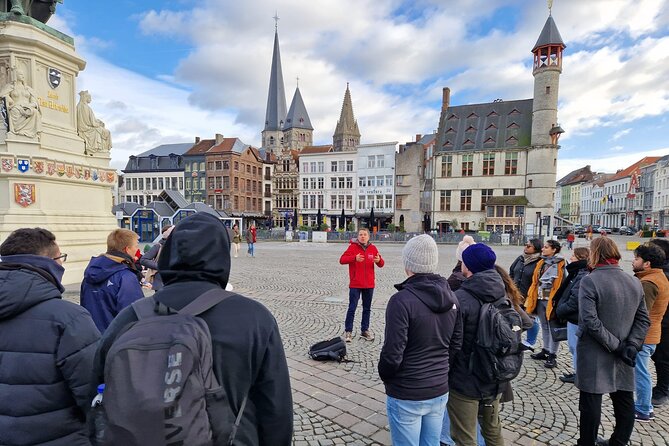
Review · GHENT
Private Historical Tour: The Best of Ghent
Ghent rewards anyone who looks up. This private walking tour makes the city’s medieval core easy to read, linking canals, towers, castles, churches, and local legends in about two hours. I like the private format, since you can ask questions without waiting for a large group, and I like the way the route covers both famous sights and offbeat corners such as Werregarenstraat’s graffiti alley. The main drawback is price: at $105.82 per person, you pay for personal attention, but entrances are not included.
The tour also benefits from strong local guides. Kenny, Camila, Hans, Arn, Sonia, Kasia, and others have been praised for clear storytelling, humor, flexibility, and restaurant advice. Still, guide quality can vary, and one poor experience involved missed timing and another guide distracted by personal matters. I would book this for a first visit, especially if you have only one day, but I would compare the cost with a small-group option.
Key points for your Ghent visit
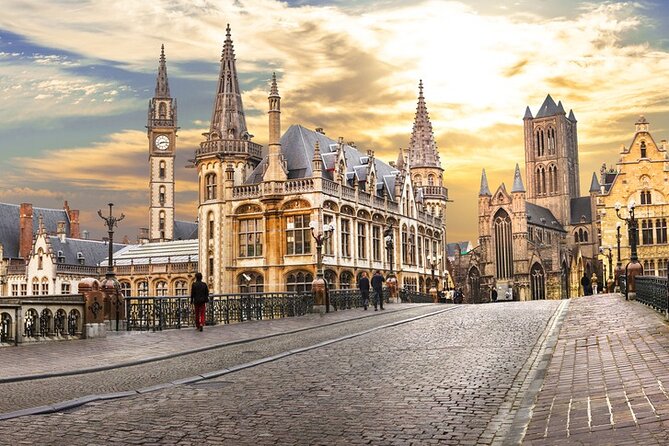
- A private route through 12 central sights: You move from St. Michael’s Bridge to St. Nicholas’ Church, with the main historic center covered on foot.
- The best first view of medieval Ghent: St. Michael’s Bridge frames the city’s three famous towers and introduces Ghent as a major medieval trading center.
- History told through local character: The route explains Ghent’s stubborn civic spirit, its conflicts, its odd legends, and its practical trading past.
- No admission tickets are included: The tour looks at major buildings from outside, so budget separately if you want to enter places such as the Castle of the Counts or see the Ghent Altarpiece.
- Private guiding is the real product: You can ask questions, slow down, discuss food, or adjust the pace without being held up by strangers.
- A useful fit for a short stay: The tour ends at the Belfry, placing you near several central sights and making it easy to continue exploring.
Why this two-hour walk works well
Ghent can feel confusing at first. Canals split the old center, grand buildings crowd the waterfront, and three towers rise above the roofs. This tour gives you a simple thread to follow: Ghent grew through trade, defended its independence fiercely, and left its arguments written in stone.
The route is private, so only your group takes part. That changes the feel of the walk. You can stop to ask why a building looks the way it does, request more detail about a legend, or tell the guide that your group needs a slower pace. Hans has adjusted his walk for people who moved more slowly, while Arn and Julien have been praised for changing the route or timing to suit the group.
The tour lasts about two hours, though one booking ended after roughly one hour and twenty minutes. That shorter experience was a clear disappointment, especially at this price. Confirm the starting time and expected length before you set out.
The advertised language is English, while the tour information also says it can be offered in multiple languages. If language matters to your group, confirm the available guide before booking.
More Private History Tours in Belgium
- Private Historical Tour: The Highlights of Bruges
★ 5.0 · 315 reviews - Private tour: Highlights & History of Antwerp
★ 5.0 · 299 reviews - Bruges: Private Historical Highlights Walking Tour
★ 4.7 · 191 reviews
St. Michael’s Bridge and the three towers
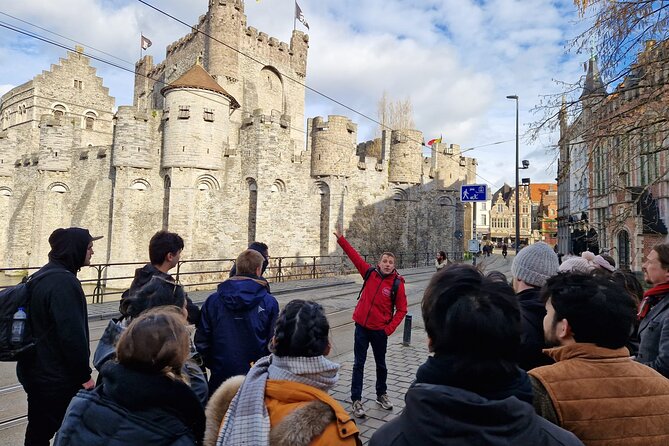
The walk begins at Hostel Uppelink on St. Michielsplein, beside St. Michael’s Bridge. This is an excellent place to get your bearings because the view gathers several layers of Ghent in one frame.
Your guide introduces Ghent as a medieval trading center and explains how its position and waterways helped it grow. From the bridge, you can see the three towers that define the skyline: St. Nicholas’ Church, the Belfry, and St. Bavo’s Cathedral.
I like starting here because the towers are not treated as separate photo stops. You get the larger idea first, then spend the rest of the tour understanding what each building meant to the city. The bridge itself is free to visit, and no entrance ticket is needed for this part.
Graslei, Korenlei, and the old port
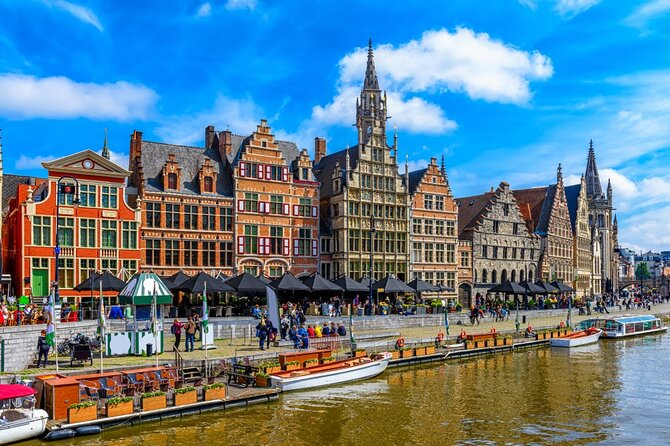
The walk continues to Graslei and Korenlei, the canal-side heart of historic Ghent. These waterfront buildings once supported trading activity, and the guide points out which structures had commercial roles.
This is one of the prettiest stretches of the route, but the value lies in learning to read the façades. Instead of seeing a row of attractive old buildings, you begin to see a working port, merchants, goods, and civic power.
A canal cruise is not part of this tour, although one person particularly enjoyed Ghent’s canal views. If that appeals to you, treat it as a separate activity rather than something included here.
The brief stop is only about ten minutes. That is enough for an explanation and photographs, but not enough for an extended architectural study. You will need to return later if you want quiet time along the water.
The Design Museum and Ghent’s stubborn spirit
One short portion of the route uses the Design Museum to explain a local trait: the stubborn, rebellious attitude associated with the people of Ghent.
The exact feature used to make this point is not specified, so expect a guide-led explanation rather than a museum visit. This is a good example of the tour’s style. It is less about entering every building and more about using the city’s streets to explain how local identity developed.
That approach works best when your guide tells stories well. Camila, Arn, Onur, and Sonia have all been praised for combining historical facts with questions, humor, and personal enthusiasm. The experience will feel more like a conversation with a proud local than a formal lecture.
Same place, a different slice of the past:
- Historical Walking Tour: Legends of Bruges
★ 5.0 · 2,541 reviews - Historical Walking Tour: Legends of Antwerp
★ 5.0 · 1,837 reviews - Historical Walking Tour: Legends of Gent
★ 5.0 · 1,761 reviews - Brussels: Historical Tour with Chocolate & Waffle Tasting
★ 4.8 · 1,206 reviews
Great Butchers’ Hall and the darker side of trade
At Het Groot Vleeshuis, you look across the water toward the medieval covered Great Butchers’ Hall. The guide shares less cheerful facts about the building and its past.
This is a useful change of tone. Ghent’s old center can look almost too polished, with handsome waterfront buildings and carefully preserved towers. The darker details remind you that medieval trade also involved strict controls, hard work, and less pleasant parts of daily life.
The stop lasts about ten minutes and is viewed from outside. If you want to tour the building itself, the cost and admission arrangements are separate.
Gravensteen, a castle in the middle of town
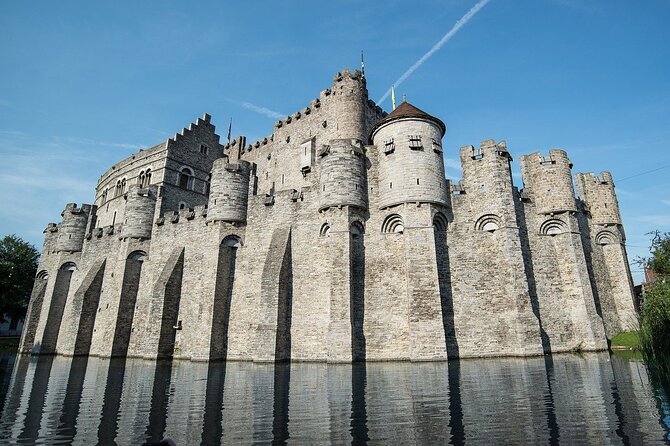
The Castle of the Counts is one of Ghent’s strongest sights. Unlike a castle set beyond the city, Gravensteen sits right in the center, surrounded by streets, canals, and daily city life.
The guide explains its impressive past during a roughly ten-minute stop. That short introduction helps you understand why the castle matters before you decide if you want to return and go inside.
The main limitation is clear: admission is not included. You see the castle from the outside on this walk. One person felt the tour would have offered better value if it had included a city historical pass, which cost 42 euros at the time of that booking and allowed entry to several places. If interiors matter to you, add those costs to the $105.82 tour price.
St. Veerleplein, the square of death and life
In front of Gravensteen, St. Veerleplein carries two grimly contrasting nicknames: the square of death and the square of life.
Your guide explains both names, turning an ordinary-looking open space into a place tied to public punishment, civic life, or other events in Ghent’s past. The supplied details do not spell out the full story, which is part of the appeal of hearing it in person.
This ten-minute stop also gives you a natural pause after the castle. It is a compact example of the tour’s method: place a story in the exact location where it happened, then let the surroundings do some of the work.
Huis van Alijn and the old god house
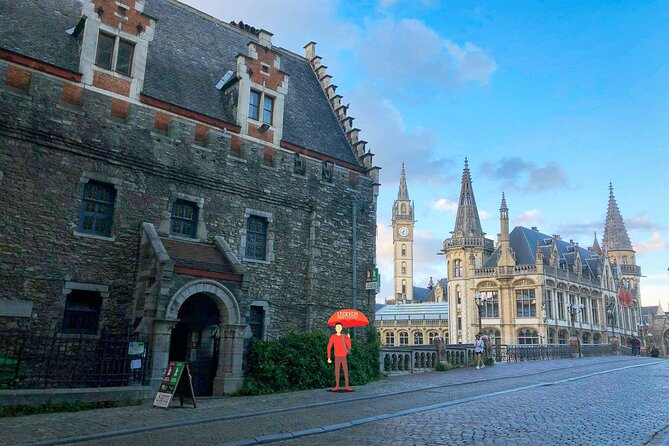
Huis van Alijn is described as Ghent’s only remaining god house. It once served as a hospital, and the guide explains the unfortunate events that led to that role.
The stop adds social history to the tour. You are not only looking at rulers, merchants, churches, and military buildings. You also hear about care, illness, and the institutions that served ordinary people.
The visit lasts about ten minutes and does not include entry. If this subject catches your interest, you can decide later if the building deserves a longer visit.
Vrijdagmarkt and Ghent’s civic battles
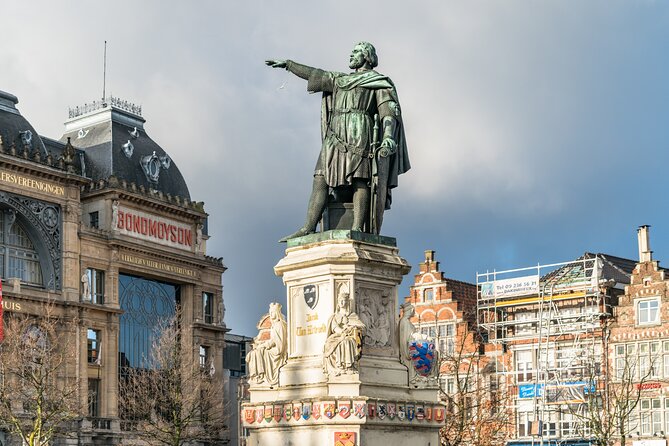
Vrijdagmarkt has played an important role in Ghent’s past, and the statue at its center gives the guide another way to explain the city’s politics and conflicts.
This stop connects especially well with the earlier discussion of Ghent’s independent character. The city’s relationship with outside rulers was not simple, and its people repeatedly defended their privileges and identity.
Sonia’s tour was described as a strong history lesson that connected Ghent’s role to wider European changes from the thirteenth through seventeenth centuries. That is the kind of context you should hope for here. The point is not to memorize dates, but to understand why Ghent looks and behaves as it does.
Werregarenstraat, where graffiti gets its own lane
Werregarenstraat offers a sharp modern contrast to the medieval center. The city designated this passage for street artists so that historic buildings would be less likely to receive unwanted graffiti.
Your guide walks you through the area and explains its purpose. It is a quick, lively break from churches, castles, and formal squares, and it shows that Ghent’s relationship with artistic expression is not limited to old paintings and carved stone.
The alley can also help younger visitors stay engaged. On a private tour, you can spend more or less time here depending on what interests your group.
Town Hall and the city’s major conflict
At Ghent Town Hall, the guide explains why the building looks visually confused. Different architectural sections reflect a major conflict in the city’s past.
This is one of the most useful stops for understanding Ghent’s character. The Town Hall becomes a physical record of disagreement, rather than just another grand civic building. The stop is short, about five minutes, but the idea helps explain the city’s unusual appearance.
If your guide enjoys explaining architecture through politics, this may become one of your favorite moments. It is a good place to ask follow-up questions about who built each part and why.
St. Bavo’s Cathedral and the Ghent Altarpiece
St. Bavo’s Cathedral is one of the tour’s key landmarks. Its long history includes major art treasures, most notably the Ghent Altarpiece by Hubert and Jan van Eyck.
The guide gives you the background during a ten-minute stop. Again, entrance is not included, so you should plan a separate visit if you want to see the altarpiece properly rather than hear about it from outside.
This is an important distinction when judging the price. The walk gives you a framework for the cathedral and its art, but it is not an art museum tour. I would use the guide’s explanation to decide how much time to reserve for a later interior visit.
The Belfry and the people’s tower
The Belfry of Ghent is the people’s tower, linked with the city’s power, independence, and stubborn civic spirit. The former prison façade also carries a strange local legend, which the guide shares during a short stop.
The tour ends in front of the Belfry on Sint-Baafsplein. That finish is practical. You are close to St. Bavo’s Cathedral, the Town Hall, and central streets, so you can continue sightseeing without retracing the route.
The Belfry is also a sensible place to end because it brings the opening skyline lesson full circle. At St. Michael’s Bridge, you saw the towers as a group. Here, one of those towers gets its own story.
St. Nicholas’ Church and the final legend
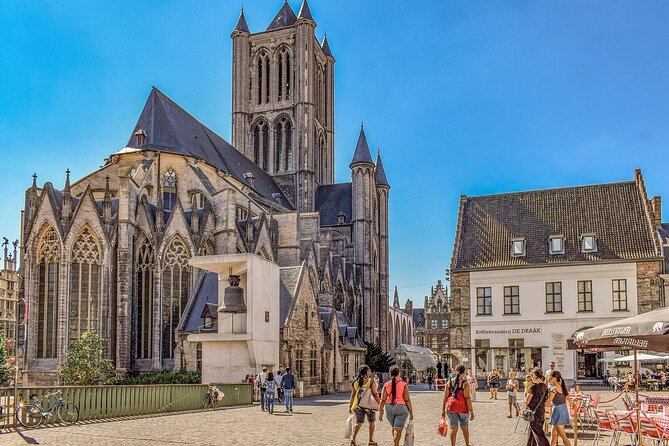
The last stop is St. Nicholas’ Church, a building dating to the early twelfth century. It overlooks Korenmarkt and honors St. Nicholas, the protector of merchants and sailors.
The façade helps tell the story of its patron saint, giving the tour a final legend before you return to the center of modern Ghent. Its position also brings you back toward the waterfront and the view you saw near the beginning.
The route covers a lot in two hours. You should expect introductions and stories, not long interior visits or unhurried photography at every stop.
Price, private value, and what is not included
At $105.82 per person, this is a premium walking tour. The price includes a local professional guide, private participation, taxes, and hotel pickup and drop-off as listed. Food and drinks are not included.
The private format is worth more if you have a family, a small group with different interests, or limited time. Sophia’s relaxed style allowed open questions, while guides such as Maria, Julian, and Arn also gave useful food and shopping suggestions. One group even had the route adjusted to finish at a lunch place.
The value is weaker if you mainly want entry to Ghent’s major buildings. No admission tickets are included, and the tour largely explains sights from outside. In that case, compare it with a small-group walk and reserve money for the city’s paid attractions.
Group discounts may be available, and the tour is often booked well ahead, around 51 days in advance. That suggests planning early for a preferred date, especially if your schedule is tight.
Who should book this Ghent walk?
I would choose it if you have one day in Ghent, want a quick historical framework, or prefer asking questions without a large group around you. It also suits families and mixed-age groups because the guide can adjust the pace and explain stories in a more natural way.
It is a good match for first-time visitors who want the major landmarks in a logical order. The route is central, the walking is described as modest, and the finish near the Belfry makes onward sightseeing easy.
I would think twice if you are on a strict budget, already plan to visit every major interior, or prefer exploring independently. The tour does not include those admission costs, and one person found the private price too high compared with a small-group option.
Service animals are allowed, public transportation is nearby, and most people can participate. Free cancellation is available up to 24 hours before the start time. Changes or cancellations inside that window are not accepted for a refund.
Should you book the Best of Ghent private tour?
Book it if personal attention and local storytelling matter more to you than included admissions. The strongest guides bring Ghent to life through humor, useful recommendations, historical connections, and genuine pride in the city.
Skip it if $105.82 per person feels steep for an outdoor overview. You can still see the main sights independently, then spend your budget on the Castle of the Counts, St. Bavo’s Cathedral, the Ghent Altarpiece, or the Belfry.
My practical advice is simple: use this tour as your orientation walk, confirm the guide’s language and start time, and ask whether hotel pickup applies to your booking or whether you should meet at Hostel Uppelink. With those details settled, it can be a smart way to make sense of Ghent quickly.
FAQ
How long does the Private Historical Tour: The Best of Ghent last?
The tour lasts approximately two hours. The route includes 12 main stops, with individual explanations ranging from about five to fifteen minutes.
Where does the tour start and end?
It starts at Hostel Uppelink, Sint-Michielsplein 21, Ghent. It ends in front of the Belfry of Ghent on Sint-Baafsplein.
Is this a private tour?
Yes. Only your group participates, with no other group members added to the booking.
Are entrance tickets included?
No. The tour includes fees and taxes, but the listed stops are presented as outside visits and admission tickets are not included.
Is hotel pickup and drop-off included?
Hotel pickup and drop-off are listed as included. The specified meeting point is Hostel Uppelink, so confirm the exact pickup arrangement when booking.
Can I cancel for a full refund?
Yes, if you cancel at least 24 hours before the experience start time. Cancellations or changes made less than 24 hours before the start time are not accepted for a refund.
Just added around Belgium
- Small Group Ypres Remembrance Day Filled With War History★ 5.0 · 31 reviews
- Discover authentic Ghent with historian & taste the best chocolate★ 5.0 · 30 reviews
- Chocolate history workshop Ghent★ 5.0 · 34 reviews
- Bicycle tour in historic Ghent★ 5.0 · 87 reviews
- Historical Walking Tour: The Story of Brussels – by Legends★ 5.0 · 164 reviews
- Bruges Bites & Sights – Belgian Food, Beer & A Little Bit Of History★ 5.0 · 94 reviews
- 2-Hour Historical Walking Tour in Bruges with Praline Included★ 5.0 · 291 reviews
- Historic Battle of the Bulge Sites Tour from Brussels★ 5.0 · 31 reviews
Private History Tours, compared.

Private Guided Historic Electric Cart Tour of St. Augustine
Read our review →
Acemoglu Historical Turkish Bath w/Private Options
Read our review →
Private Full-Day Tour of Historical Alexandria
Read our review →
Private Tour of the Historic City in a Ford T Car
Read our review →
Madrid Historical Tour with Local Guide in Eco Tuk Tuk Private
Read our review →
Private Biblical Tour Ancient Corinth & Isthmus Canal from Athens
Read our review →
Private Kathmandu Sightseeing Tour | UNESCO World Heritage sites
Read our review →Browse the lists this tour appears in