
Review · GYEONGJU
Gyeongju UNESCO World Heritage Sites and History Full-Day Tour with Lunch
Gyeongju packs centuries into one day. This tour makes the ancient Silla capital manageable by linking Bulguksa Temple and Seokguram Grotto with royal tombs, palace grounds, old villages, and central historic sites. I like the hotel pickup, air-conditioned minivan, included lunch, and the way the route handles sights that are spread well beyond the city center. I also like that guides such as Steve, Sue, Chris, and Jina have been praised for clear English and strong storytelling.
The main drawback is time. If you start in Busan, traffic can eat into the eight-hour day, leaving roughly five hours for actual sightseeing in some conditions. The smaller stops may also feel thin if you expect grand ruins at every turn, and the Gyeongju National Museum is not included.
The essential points at a glance
- Bulguksa and Seokguram anchor the day: These are the tour’s most important historic and artistic stops.
- Pickup saves real effort: An air-conditioned minivan removes the need to piece together trains, buses, and taxis.
- Lunch and admission fees are included: Vegetarian and gluten-free arrangements have been handled when requested in advance.
- The route covers six major stops: You visit Cheomseongdae, Donggung Palace and Wolji Pond, Gyochon Village, Daereungwon, Seokguram, and Bulguksa.
- Group size can vary greatly: The stated maximum is 40 people, but some departures have had only three to five participants or even become private tours.
- Expect walking and stairs: Comfortable shoes matter, especially at the temples and tomb complex.
Why Gyeongju works well as a day trip
Gyeongju was the capital of the Silla Kingdom for centuries, from 57 BC to AD 935. Its historic sites are not gathered in one compact old quarter. Tombs sit near the center, palace remains lie elsewhere, and Bulguksa and Seokguram are outside town on the slopes of Tohamsan Mountain.
That spread is the reason this tour has practical value. You can certainly visit parts of Gyeongju on your own, but fitting the city sites and mountain temples into one day takes planning. With a vehicle and driver, you spend less time working out connections and more time looking at the places themselves.
The catch is the road from Busan. Pickup and drop-off are offered, and the tour is designed for a Busan-based day trip, but morning and evening traffic can make the full outing feel long. One critical assessment found the sightseeing portion closer to five hours after the transport time was counted. I would treat the eight-hour duration as the total day, not eight uninterrupted hours among monuments.
More UNESCO World Heritage Tours in Korea:
- From Busan: Gyeongju UNESCO World Heritage Guided Day Tour
★ 4.8 · 1,250 reviews - Gyeongju UNESCO World Heritage Guided Day Tour from Busan
★ 5.0 · 660 reviews - Gyeongju: UNESCO Heritage Tour Including Bulguksa Temple
★ 4.8 · 104 reviews
Cheomseongdae: a small structure with a large purpose
The first stop is Cheomseongdae Observatory, where you have about 30 minutes. Built during Queen Seon-deok’s reign from 632 to 647, it is described as the oldest surviving astronomical observatory in Asia. Silla court officials used observations of the stars to help forecast weather.
Visually, Cheomseongdae is more modest than the word observatory may suggest. It is a stone structure, and there is no large interior exhibition to explore. You come here for its age, purpose, and place in Silla science rather than for a long visit.
This is where a good guide matters. Without context, you may look at the stone tower, take a photograph, and wonder why it earned a place on the route. With explanation, it becomes a reminder that Silla was not only a kingdom of temples and royal tombs, but also a society that watched the sky closely.
Crowds can affect this stop. One departure skipped Cheomseongdae during a very busy holiday weekend. That flexibility is useful, but it also means the exact experience can change with the day.
Donggung Palace and Wolji Pond after dark in history
You spend about an hour at Donggung Palace and Wolji Pond, with admission included. The pond was created during the reign of King Munmu in the fourteenth year of his rule, around AD 674. Small artificial mountains and palace buildings once formed part of a royal entertainment and reception complex.
Today, you see restored or reconstructed structures around the water rather than a complete palace. The setting is attractive, but it asks you to use your imagination. A sharply worded assessment described the site as only a few pavilions, which is a fair warning if you expect walls, halls, and a fully rebuilt royal residence.
Still, I think the stop earns its place. The water, garden design, and carefully framed buildings show how Silla elites shaped ceremonial spaces. Your guide can help connect the quiet pond to the royal court that once used it.
The site is often especially appealing for photographs, but the value is not only visual. It gives you a feel for court life and planned gardens, even though little of the original palace remains above ground.
Gyochon Traditional Village and the Choi family story
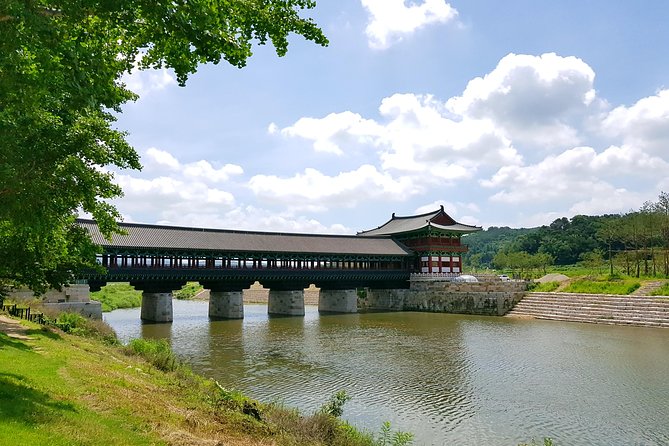
Gyochon Traditional Village takes about 45 minutes. This hanok area offers a look at the former home of the Gyeongju Choi Clan, a family known in local history. The traditional houses and village setting provide a change from stone monuments and temple grounds.
Keep your expectations measured. This is not a large open-air museum packed with dozens of fully furnished historic homes. Parts of the village can feel quiet, and the amount open to explore may vary. One disappointed visitor found the stop too slight, describing only one shuttered structure.
I would see Gyochon as a short cultural pause rather than a major headline attraction. It helps break up the day and gives you a sense of domestic architecture, family life, and the old city pattern. If your main goal is Silla archaeology, this will matter less than the tombs and temples.
A few more history tours around Korea worth a look
- Douro Valley: Historical Sites, Wine Experience, Lunch & Cruise
★ 5.0 · 5,133 reviews - Tromsø: Reindeer Camp and Sami Cultural Tour with Lunch
★ 4.7 · 3,326 reviews - Ninh Binh Heritage Full Day Tour with Buffet Lunch and Limousine
★ 5.0 · 2,692 reviews - From Kuala Lumpur: Historical Melaka Day Tour with Lunch
★ 4.4 · 2,297 reviews
Daereungwon Tomb Complex and the royal dead
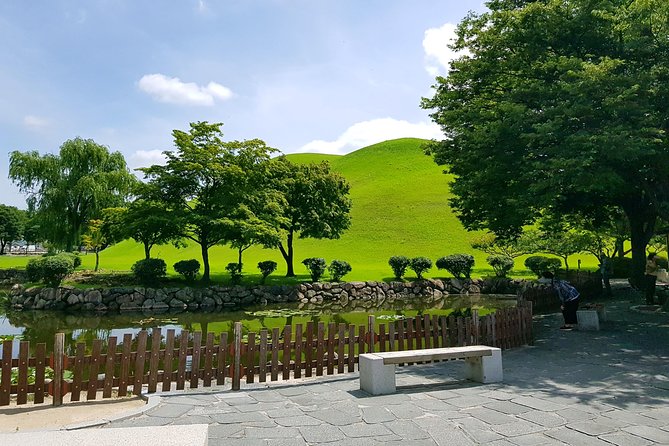
At Daereungwon, you spend about an hour among the large grassy burial mounds of Silla kings and nobles. Twenty-three major tombs are found in the complex, including Cheonmachong Tomb, which you can enter.
This is one of the strongest central Gyeongju stops because the tombs are both easy to understand and visually striking. The smooth green mounds rise from the city without the stone façades you may associate with royal burial places. Their size hints at the power of the people buried inside.
Cheonmachong gives you the rare chance to see the interior of a Silla tomb. You can learn how the burial mound was constructed and why the site produced important objects. The original treasures are not all displayed here, so anyone keen on artifacts should add the National Museum separately if time allows.
The complex is also a good place to notice how modern Gyeongju and ancient Silla overlap. You are not visiting a remote ruin. You are walking through a living city with royal burial grounds at its center.
Seokguram Grotto on Tohamsan Mountain
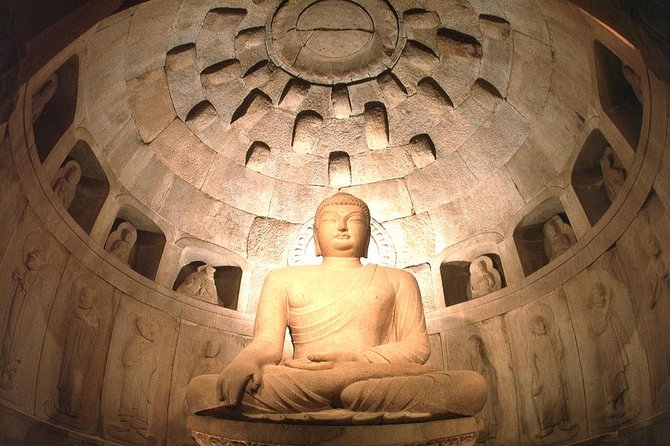
Seokguram is one of the day’s main reasons to book. The stone temple sits on Tohamsan Mountain and is recognized as a major Korean cultural treasure and UNESCO World Heritage site. You receive about an hour here, with admission included.
The centerpiece is the carved stone Buddha inside the grotto. The setting and craftsmanship are the point, not a large complex of buildings. The interior is protected, and photography is not allowed inside, so prepare to put your phone away and look carefully.
The route to the grotto involves walking, and the mountain location can bring heat, rain, or changing conditions. Comfortable shoes and sun protection are sensible. The site is not the kind of place you rush through while checking off a list. A guide who can explain the spiritual purpose and artistic details adds real value here.
Seokguram and Bulguksa are close enough to combine efficiently, but they feel different. Seokguram is quiet, focused, and sculptural. Bulguksa is broader, more architectural, and more open to wandering.
Bulguksa Temple, the day’s grand finale
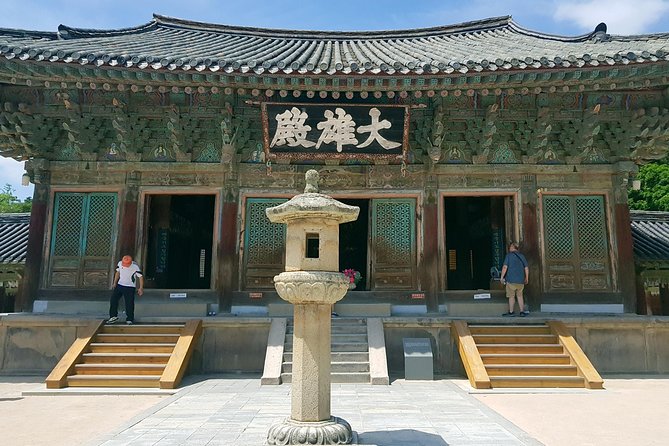
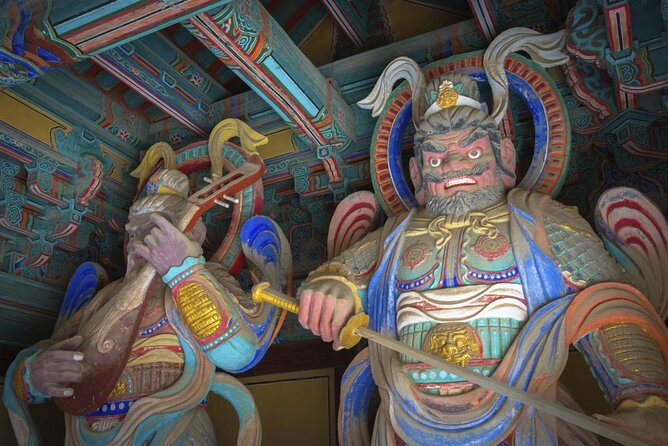
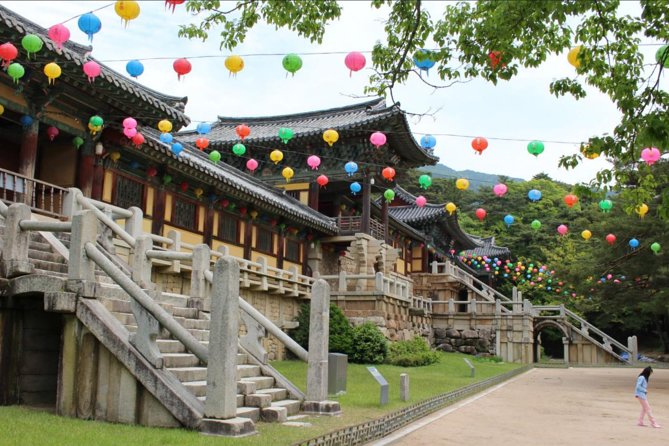
Bulguksa is the tour’s other major highlight. The temple is regarded as one of Gyeongju’s defining monuments and became a UNESCO World Heritage site in 1995. You have about an hour to see its courtyards, stone features, stairs, gates, and timber buildings.
This is where the day’s history becomes most tangible. The stonework is refined, the temple layout is carefully composed, and the setting gives you plenty to study. The temple is not simply a scenic backdrop. It expresses Buddhist ideas and the resources available to the Silla court.
One hour is enough for an organized introduction, but not enough for every detail. If you are passionate about Korean Buddhist art or architecture, you may want a slower return visit. On this tour, listen closely to the guide, then use free time for the details that catch your eye.
The temple grounds require walking, and some surfaces are uneven. Nothing described about the tour suggests strenuous hiking, but this is not a sit-in-the-van sightseeing day. One participant recorded about 11,000 steps and found the total easier than expected, while other accounts mention the heat and heavy rain. Plan for active sightseeing.
Guides, drivers, and the comfort factor
The strongest praise goes to the guides. Steve is repeatedly described as engaging, attentive, and fluent in English. Sue has been praised for strong historical explanations and careful handling of dietary needs. Chris is noted for friendliness, safe driving, and clear explanations, while Jina is described as well informed about each stop.
That consistency matters because the smaller sites need interpretation. Cheomseongdae, Gyochon, and the palace pond can feel underwhelming if you only receive a name and a photograph. A guide who explains what disappeared, what was reconstructed, and why the site mattered can turn a short stop into a useful lesson.
The driver also affects the day. Reports describe drivers dropping people close to entrances and collecting them afterward, which reduces unnecessary walking. The minivan provides air conditioning during a long day, a major benefit in hot weather or rain.
The standard maximum is 40 people, so you should not assume a private experience. In practice, some departures have been very small, including groups of three to five, and some bookings have become private tours. That depends on the date and demand, not something you can count on.
Lunch and dietary requests
Lunch is included, and it has been a popular part of the day. The meal is served at a local restaurant, with Korean food described as filling and enjoyable. That gives you a proper break instead of asking you to spend the whole day searching for food between monuments.
Vegetarian meals are available when requested at booking. Gluten-free needs have also been accommodated, but you should state any requirement in advance. Do not leave dietary planning until pickup time.
The lunch stop is useful beyond convenience. It gives you a taste of everyday Korean food and a chance to sit down after the temple and tomb walks. Still, the precise dishes and restaurant are not specified, so you should not book expecting a particular menu.
Is $189.99 a fair price?
At $189.99 per person, this is not a budget sightseeing day. The price includes transport, pickup and drop-off, entrance fees, lunch, and a guide, which makes the comparison with independent travel less simple.
If you are staying in Busan and want to see both Bulguksa and Seokguram in one day, the vehicle is the main value. You avoid arranging intercity transport, local taxis, temple connections, parking, and timing. For a first visit with limited time, that convenience can justify the cost.
If you are already staying in Gyeongju, the calculation changes. Several central stops are close enough to visit independently, and the mountain temples can be reached by arranging local transport. The tour is less compelling for you unless you place a high value on one-day organization and guide commentary.
The missing National Museum is the clearest weakness in the route. It contains important Silla objects and would provide stronger background for the tombs and kingdom. If archaeology and original artifacts are your priority, plan a separate museum visit or choose another program that includes it.
Who should book this Gyeongju day?
I would choose this tour if you are based in Busan, have only one day for Gyeongju, do not have a car, and want the major UNESCO sites handled in one organized outing. It also suits solo visitors who want transport and lunch arranged without paying for a fully private vehicle.
It is a good fit for first-time visitors who want explanation as they go. The route gives you the broad outline of Silla: science at Cheomseongdae, court life at Wolji, family tradition at Gyochon, royal burial at Daereungwon, Buddhist art at Seokguram, and temple culture at Bulguksa.
I would be more cautious if you dislike group schedules, prefer long quiet visits, or want extensive museum time. The smaller stops may feel brief, traffic can reduce sightseeing hours, and a maximum group of 40 is possible.
Wear walking shoes, bring sun protection, and prepare for warm or wet weather. The tour is rated 4.8 from 104 ratings, with 94 percent recommending it, but the lower assessments make the limits clear: the route is efficient, not leisurely, and the ancient sites require some imagination.
Should you book it?
Book it if your base is Busan and your goal is to see Gyeongju’s main sights in one day without managing the transport yourself. The best reasons are Bulguksa, Seokguram, included lunch, and strong guides, especially when the group is small.
Skip it if you are staying in Gyeongju for several days, want the National Museum, or prefer to set your own pace. At $189.99, the tour earns its price through transport and organization rather than through eight full hours at the monuments. Canceling is free up to 24 hours before the start time, which gives you some flexibility while finalizing your plans.
FAQ
How long does the Gyeongju tour last?
The advertised duration is approximately eight hours, starting at 8:00 am. If you begin in Busan, driving time can reduce the hours available for sightseeing.
What sites are included?
The route includes Cheomseongdae Observatory, Donggung Palace and Wolji Pond, Gyeongju Gyochon Traditional Village, Daereungwon Tomb Complex, Seokguram, and Bulguksa Temple.
Are lunch and entrance fees included?
Yes. Lunch and entrance fees for the included sites are part of the tour price.
Is hotel pickup available?
Pickup and drop-off are offered. The tour is designed for transport between the pickup point and Gyeongju, with many bookings using hotel pickup.
Can I request a vegetarian meal?
Yes. A vegetarian option is available, but you need to advise the operator when booking.
How large is the group?
The tour can have a maximum of 40 participants. Actual groups may be much smaller, and some departures have operated with three to five people or as private tours.
What is the cancellation policy?
You can cancel at least 24 hours before the start time for a full refund. Changes or cancellations made less than 24 hours before the start time are not accepted for a refund.
More Full-Day Tours in Korea
- Full day Private Gyeongju UNESCO Heritage Tour : a glimpse into Silla
★ 5.0 · 60 reviews - Bali: Tanah Lot UNESCO World Heritage Sites Full-Day Tour
★ 4.7 · 1,947 reviews - UNESCO’s Ayutthaya Historical Park: Full-Day Tour from Bangkok
★ 4.5 · 1,559 reviews - Full-Day Aruba History and Must-See Landmarks Tour
★ 4.5 · 1,497 reviews
Just added around Korea
- Full day Private Gyeongju UNESCO Heritage Tour : a glimpse into Silla★ 5.0 · 60 reviews
- Busan history and market food tour with local chef★ 5.0 · 58 reviews
- Gyeongju Historic Areas Day Tour with Sky Capsule from Busan★ 5.0 · 18 reviews
- Seoul: Street Photoshoot and Hidden Gem History Walking Tour★ 5.0 · 25 reviews
- Seoul: Suwon Hwaseong & Waujeongsa & Starfield Heritage Tour★ 4.8 · 27 reviews
- Seoul: UNESCO Heritage Palace, Shrine, and More Tour★ 4.8 · 18 reviews
- Gyeongju: UNESCO Heritage Tour Including Bulguksa Temple★ 4.8 · 104 reviews
- From Busan: Echoes of Silla Gyeongju Historical Day Tour★ 4.8 · 55 reviews
UNESCO World Heritage Tours, compared.
World Heritage Shirakawa-go and Experience Tours from Kanazawa
Read our review →
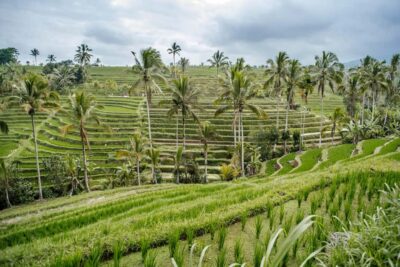
Bali: Tanah Lot UNESCO World Heritage Sites Full-Day Tour
Read our review →World Heritage Kyoto & Nara Uji Authentic Matcha Experience
Read our review →
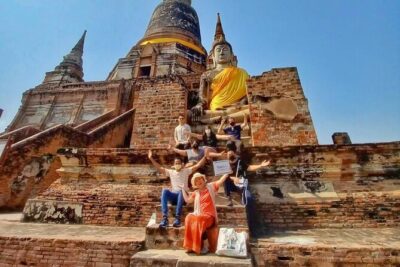
UNESCO’s Ayutthaya Historical Park: Full-Day Tour from Bangkok
Read our review →
Rotterdam: Kinderdijk UNESCO World Heritage Entry Ticket
Read our review →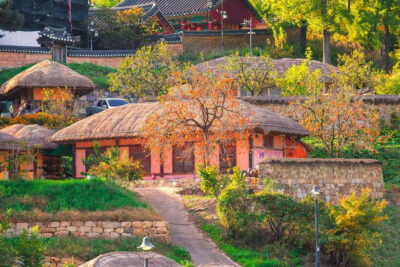
From Busan: Gyeongju UNESCO World Heritage Guided Day Tour
Read our review →Browse the lists this tour appears in