
Review · BUDAPEST
Budapest Jewish Heritage: Synagogues, Shoes, Secrets & Flódni
Budapest tells its Jewish story in layers. I like the way this private walking tour connects grand synagogues with the smaller, sadder places of wartime memory. I also like the finish: flódni, a traditional Jewish pastry, gives the nearly three-hour walk a human and distinctly local ending.
The main consideration is cost. At $102.95 per person, you also pay synagogue entrance fees separately, so the final bill can rise. Still, the personal guide, hotel pickup option, and chance to ask questions make this a stronger choice than a large scripted group tour. Guides such as Gabriella, Edith, Kata, Peter, and Miklos have been praised for warmth, personal stories, and thoughtful explanations.
Key points to know before booking
- Three synagogues, three Jewish traditions: The Great Synagogue, Rumbach Street Synagogue, and Kazinczy Street Synagogue each reveal a different religious and architectural community.
- A private tour with a real conversation: Only your group participates, so you can ask questions and request more or less detail.
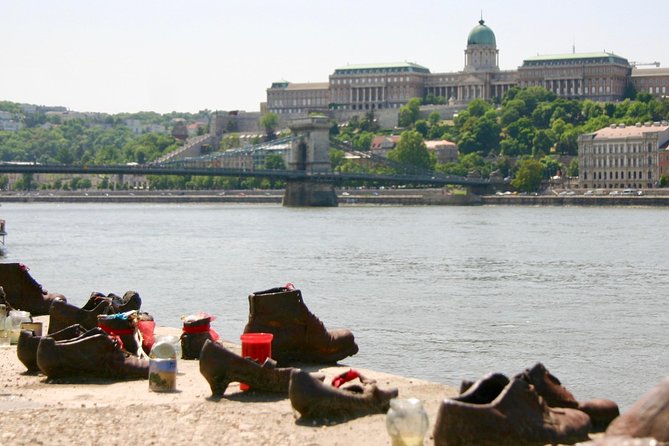
- World War II memory is central: The route includes the Carl Lutz Memorial, the former ghetto area, and Shoes on the Danube Bank.
- The guide makes the difference: Gabriella, Edith, Kata, Peter, and Miklos have all been praised for strong historical knowledge and a personal approach.
- Flódni is included: The tour ends with a traditional Jewish pastry, giving you a taste of Hungarian Jewish culture as well as its history.
- Budget for extra admissions: Synagogue entrance tickets are not included in the $102.95 price, and public transportation is also extra.
Starting at the Great Synagogue on Dohány Street
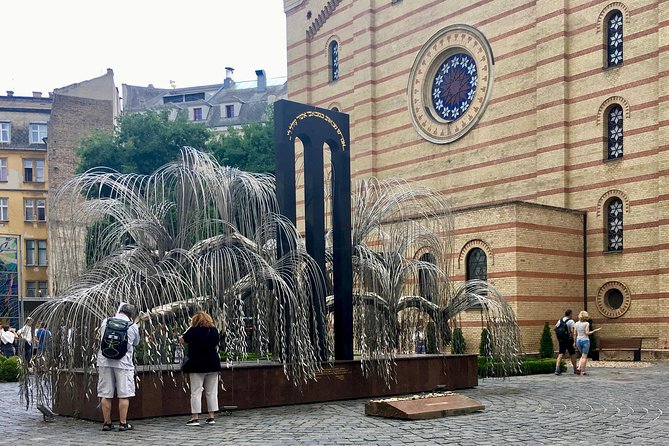
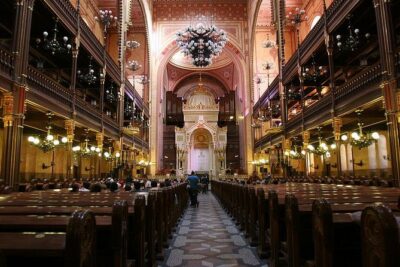
The walk begins around Herzl Square and the Great Synagogue at Dohány Street. This is a useful starting point because the building immediately shows you that Budapest’s Jewish story is not confined to a single narrow idea of Jewish life.
The Dohány Street Synagogue is the largest synagogue in Europe, with seating for about 3,000 people. It serves the Neolog branch of Judaism, a Hungarian movement with its own customs and identity. Your guide explains the building’s unusual architecture, then places it in the larger story of Hungarian Jewry before, during, and after World War II.
The planned stop here lasts about 20 minutes. That is enough for a clear introduction, but it is not a full independent visit to every part of the complex. Admission is not included, so check the current entrance price when planning your budget.
I find this opening especially useful for first-time visitors to the Jewish Quarter. You get the major landmark first, then the later stops can show you how different communities worshipped, lived, and remembered their past.
The guide may also introduce famous Hungarian Jews connected with science, music, cinema, fashion, and business. The point is not simply to list famous names. It is to show how much Jewish citizens contributed to Budapest’s growth and public life before the destruction of the Holocaust.
More Jewish Heritage Tours in Budapest:
- Budapest Jewish Heritage Memorial Walking Tour & Synagogue Entry
★ 5.0 · 568 reviews - Budapest: Jewish Heritage Guided Tour with Synagogue Ticket
★ 4.8 · 533 reviews - Budapest: Jewish History Guided Walking Tour with Historian
★ 4.8 · 205 reviews
Rumbach Street and the differences between communities
A short walk brings you to the Rumbach Sebestyén Street Synagogue. Built in 1872 by Austrian architect Otto Wagner, it was created for the more moderate Conservative community. Its Moorish design makes it very different from the Great Synagogue.
The interior has undergone a long restoration, and the building’s decorative details are a major reason to visit. The tour allows about 15 minutes here, enough for your guide to explain how this synagogue differed from the Neolog and Orthodox institutions nearby.
This comparison is one of the tour’s best teaching tools. Instead of treating Jewish Budapest as one single community, the guide shows you the differences between religious branches. Those differences affected architecture, worship, social life, and the way each group saw its place in Hungarian society.
Again, entrance is not included. If you want to spend extra time inside, ask your guide how the schedule can accommodate you. With only two hours and 45 minutes in total, the tour has to keep moving.
Carl Lutz and the moral choices of wartime Budapest
The Carl Lutz Memorial is a brief but serious stop. Lutz was a Swiss diplomat who helped save tens of thousands of Jews in Budapest from persecution and deportation. The memorial is in the area of the former ghetto, so it links one person’s actions with the wider crisis facing the city’s Jewish population.
This is where a good guide matters. The subject can easily become a list of dates and heroic names. The stronger approach is to explain what protection looked like, how official papers could sometimes help, and how uncertain life became as the war continued.
The stop lasts about 10 minutes and is free. It is short, but it gives the walk moral weight before you continue through the old Jewish Quarter.
Some guides also bring in the work of other rescuers and the later memorials to those recognized as Righteous Among the Nations. The exact conversation will depend on your guide, which is one benefit of a private booking.
Kazinczy Street and Budapest’s Orthodox synagogue
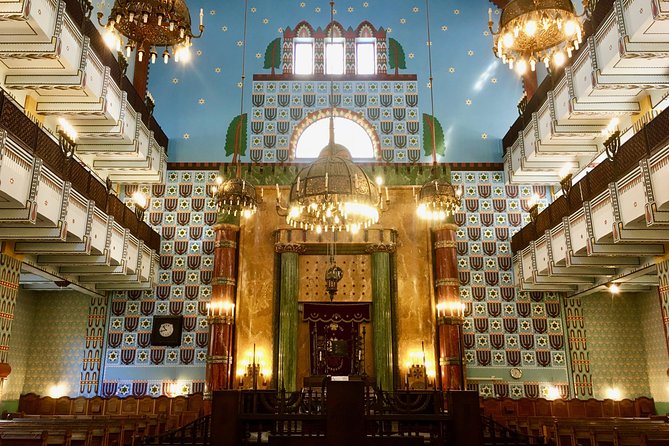
The Kazinczy Street Synagogue represents Budapest’s Orthodox community. Built in 1913, it has a modern-for-its-time design with late Art Nouveau touches and bright colors. The ceiling stained glass was designed by Miksa Róth, one of Hungary’s best-known decorative artists.
The stop is scheduled for about 10 minutes. It is short, but it completes the three-synagogue comparison neatly:
- Dohány Street represents the Neolog community.
- Rumbach Street was built for a more moderate Conservative group.
- Kazinczy Street is the Orthodox synagogue.
The value here comes from seeing the buildings as part of a living community structure, not just as attractive old interiors. You learn that Budapest’s Jewish institutions served different groups with different customs and social ties.
Entrance fees are separate here too. If your main goal is interior photography or extended architectural study, this tour may feel quick. If your aim is to understand how the quarter fits together, the pace works better.
A few more history tours around Budapest worth a look
- Budapest: Historic Cruise with Welcome Drink
★ 4.7 · 6,512 reviews - Budapest Historical Sightseeing – Free Walking Tour
★ 5.0 · 1,302 reviews - Buda Castle District Dark History, Legends and Vampire Night Tour
★ 4.5 · 1,240 reviews - BloodThirsty Hungary: Walking tour & Dark Historical Stories
★ 4.9 · 633 reviews
The Shoes on the Danube Bank memorial
The route then reaches the Shoes on the Danube Bank, one of Budapest’s most affecting memorials. The sculpture recalls Jewish victims murdered at the riverbank during World War II. They were forced to remove their shoes before being shot, and their bodies were carried away by the Danube.
The memorial uses cast-iron shoes left along the river. It is a simple design, and that simplicity is the point. Instead of a large monument, you face an absence: ordinary shoes belonging to people who were denied even the dignity of a proper burial.
The stop lasts about 10 minutes and admission is free. You should expect a quiet moment rather than a long lecture. A thoughtful guide will give the facts, then allow you time to look.
This is also a useful place to remember that the Jewish Quarter is not only a collection of synagogues and restaurants. The history reaches beyond the district to the river, where the city’s wartime crimes became part of the public landscape.
The former ghetto and the last remaining wall
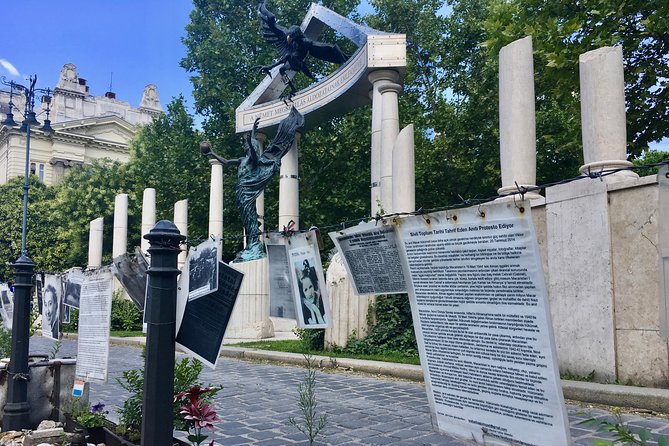
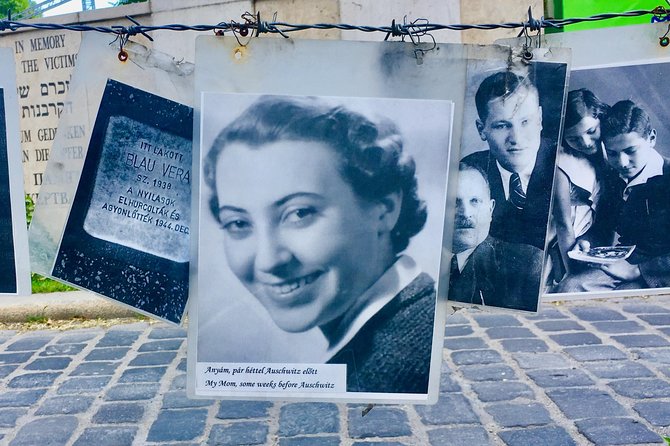
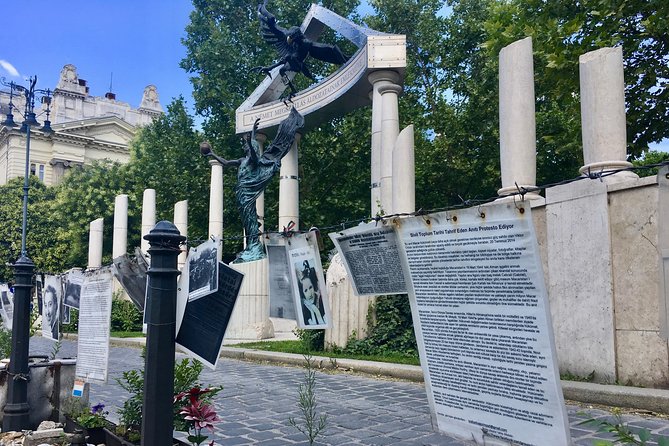
Back in the Jewish Quarter, the tour explores the former Budapest ghetto. Near the end of World War II, Jewish residents were forced into this confined area. A small section of the ghetto wall remains in the middle of the city.
The scheduled stop is about 15 minutes and free. The physical remains are limited, so the guide’s storytelling does much of the work. You may not see a complete historic district laid out in front of you. Instead, you use the surviving wall, streets, memorials, and old buildings as clues.
Several experiences described by the guide team’s customers point to the emotional strength of visits to a small house or tenement synagogue. That stop is not listed as a standard part of every route, so you should not assume it is guaranteed. Ask in advance if seeing a modest neighborhood prayer space is important to you.
That request matters because the grand synagogues tell only part of the story. A small synagogue or tenement setting can suggest how ordinary families worshipped and lived between the two world wars. One guide, Kata, has also shared personal stories about her Hungarian Jewish family, the Holocaust, Soviet occupation, and raising a daughter within Hungary’s Jewish culture. A personal account like that can make the past feel closer, but the exact guide cannot be guaranteed.
Finishing with flódni on Dohány Street
The final stop is a taste of flódni, a traditional Jewish Hungarian pastry. It is usually made with layered fillings, and on this tour it serves as more than a snack. Food gives you a small, everyday connection to a community whose story is often told only through tragedy.
The pastry stop lasts about 20 minutes and is included. Some past experiences have ended with time for coffee, discussion, or a nearby café, but you should treat that as dependent on the guide and schedule rather than a fixed promise.
I like this ending because it avoids leaving the tour on a purely solemn note. Jewish Budapest is a story of persecution and loss, but it is also a story of family life, food, work, religious practice, art, and survival.
What the private format adds
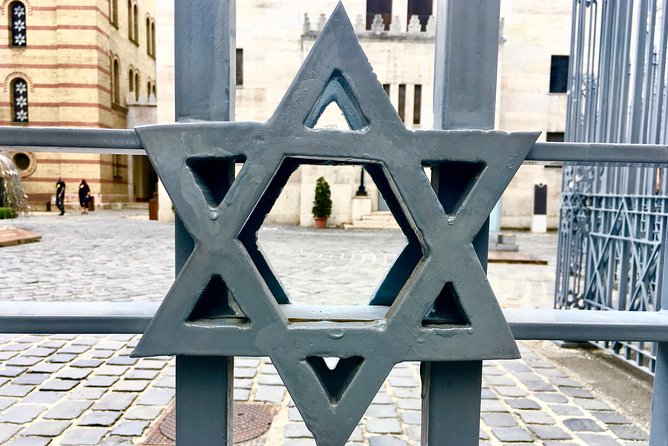
The tour is private, so only your group takes part. That matters most when the subject becomes personal or when your group has a particular interest, such as family roots, Holocaust history, synagogue architecture, or Hungarian Jewish culture.
A private guide can ask why you booked the tour and adjust the conversation. Miklos, a retired educator, has been praised for asking that question at the start and for explaining Hungarian Jewish history as something distinct from Jewish experience elsewhere in Europe. Edith has been praised for combining information with questions that encourage you to think about what you are seeing.
You also have more room to explain your needs. One couple with a tight schedule for returning to a ship found the private format useful. Another participant valued a guide’s ability to add places and stories that would not appear on a standard route.
There is a tradeoff. A private tour can become too dependent on the guide’s style. Most guide feedback is very positive, particularly for Gabriella, but one experience felt too general and not personal enough. If you want detailed accounts of individual wartime events, ask for that focus before the walk begins.
Is $102.95 good value?
At $102.95 per person, this is not the cheapest way to see the Jewish Quarter. The price makes more sense if you value a private historian guide, hotel pickup, a carefully connected route, and the freedom to ask questions.
The price does not include synagogue admission. Public transportation tickets are also excluded, although the route itself is a walking experience and the meeting point is near public transportation. Pickup is offered, but confirm the exact arrangement when booking rather than assuming it is included in every situation.
For two people, the cost can be worthwhile if you want a serious introduction without spending a full day. The tour covers major landmarks, wartime memorials, the old ghetto, and food culture in under three hours. It also avoids the problem of wandering past important sites without understanding what happened there.
For budget-minded visitors, you could visit some memorials independently and pay only for the attractions you choose. You would lose the links between the sites, the synagogue comparison, and the personal stories. The private format is the main thing you are paying for.
The experience is booked an average of 61 days ahead, so popular dates may disappear early. Free cancellation is available up to 24 hours before the start time. Changes or cancellations inside that window are not accepted for a refund.
Who should take this walk?
I would recommend it to you if you want Jewish Budapest explained through architecture, family life, wartime memory, and modern remembrance. It suits people with Jewish heritage, visitors tracing Hungarian family connections, and anyone who wants more context than a quick synagogue visit provides.
It also works well for non-Jewish visitors. One especially strong experience began with the guide asking why the group wanted to take the tour. That kind of opening can make the history feel relevant rather than assumed.
You should think twice if you want a long museum visit, extensive time inside each synagogue, or a tour focused almost entirely on Holocaust rescue stories. The itinerary moves through many sites quickly, and entrance fees are extra.
Ask for the level of detail you want. If you prefer stories of daily life, say so. If you want wartime events, family histories, or religious differences explained in depth, say that too. The private format gives you a better chance of shaping the experience.
FAQ
How long does the Jewish heritage tour last?
The tour lasts approximately 2 hours and 45 minutes.
Where does the tour begin?
It begins at Budapest, Dohány u. 1, 1074 Hungary, near the Great Synagogue and Herzl Square.
Where does the tour end?
The activity ends back at the meeting point.
Are synagogue entrance tickets included?
No. Entrance tickets are not included in the tour price.
Is hotel pickup available?
Yes, hotel pickup is offered. The tour information also lists public transportation tickets as not included.
Is this a private tour?
Yes. Only your group participates in the activity.
What food is included?
The tour ends with an authentic Jewish dessert called flódni. Snacks are included, but other drinks or café visits should not be assumed.
Should you book it?
Book this tour if you want a personal guide to connect Budapest’s synagogues, ghetto history, memorials, and Jewish food traditions. The strongest part is not any single building. It is the way the stops fit together, especially when your guide adds family stories or explains the differences between Neolog, Conservative, and Orthodox communities.
At $102.95 plus admission fees, it is a considered purchase. But for a private group that wants a focused introduction, the cost can be fair. Choose this walk for conversation, context, and a human approach to difficult history. Choose another option if you prefer a low-cost self-guided visit or a longer, museum-style examination of the Holocaust.
Just added around Budapest
- Private Jewish Heritage Tour including Hotel Pickup★ 4.5 · 35 reviews
- Time Machine Budapest Historical Exhibition Ticket★ 5.0 · 32 reviews
- Jewish Heritage in Hungary with a Historian★ 5.0 · 37 reviews
- Jewish Heritage / Full tour★ 5.0 · 59 reviews
- Michael Jackson History Exhibition Ticket★ 5.0 · 42 reviews
- Budapest Historic Downtown Bicycle Tour in small groups★ 5.0 · 288 reviews
- Communist History Evening Walking Tour of Budapest★ 4.5 · 23 reviews
- HOLLÓKŐ UNESCO World Heritage site + Eger Castle Private guided tour★ 4.5 · 18 reviews
Jewish Heritage Tours, compared.
Budapest Jewish Heritage Memorial Walking Tour & Synagogue Entry
Read our review →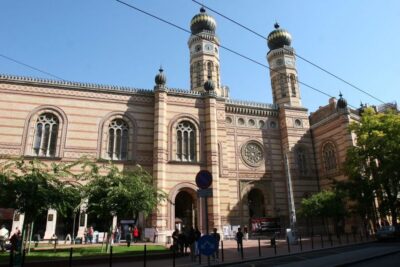
Jewish Heritage Guided Tour with Synagogue Ticket
Read our review →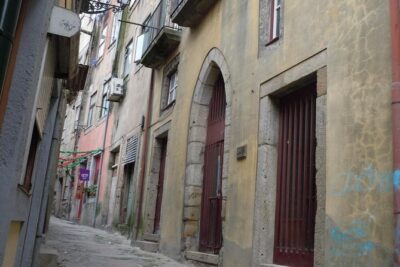
3-Hour Porto Jewish Heritage Walking Tour with Local Guide
Read our review →
Private Jewish Heritage Journey by Barcelona Dreaming
Read our review →
Anne Frank and the Jewish History of Amsterdam Private Tour
Read our review →
Lisbon Jewish Heritage and History – Private Tour Van
Read our review →
Browse the lists this tour appears in