
Review · POMPEII
Ancient Pompeii Private Tour: Skip the Line & Kid-Friendly Option
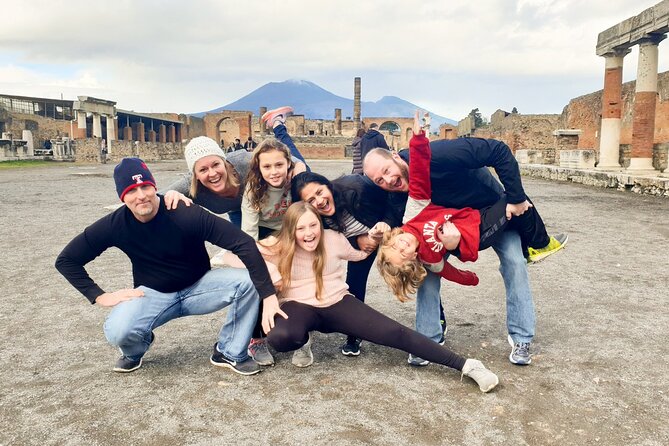
Pompeii rewards a good guide. This private walking tour gives you skip-the-line access and a personal route through the Forum, baths, homes, theaters, and plaster casts. I especially like the flexible pace and the family option, which turns the ruins into a puzzle for children instead of a long march through hot stones. The main caution is price: at about $165.05 per person, you need to value private attention, and the ticket-inclusion details should be confirmed before booking.
The tour lasts about two hours and is offered in English. Your guide meets you at Via Villa dei Misteri 2 in Pompeii, then returns you to the same place. I also like that guides such as Francesca, Natalia, Viviana, Fabrizio, Anna, and Sabrina have earned praise for clear storytelling and patient work with children. One practical concern is the heat and walking: one guest found the pace too fast for people with mobility issues, so speak up early if your group needs more time.
What makes this Pompeii tour worth considering
- A private route through Pompeii’s major sights: You see the Forum, Via dell’Abbondanza, Forum Baths, Temple of Apollo, Basilica, House of the Vettii, theater, and Antiquarium.
- A family kit for children ages 6 to 11: The Pompeii4kids option includes a map, stickers, games, puzzles, and activities tied to the buildings you visit.
- Guides who adjust the experience: Your guide can shape the route around your interests, answer questions, and look for shade or quieter paths when possible.
- A useful mix of public and private life: The tour moves from politics and religion to shops, baths, houses, theater, food, and the darker story of the eruption.
- A good way to handle a huge archaeological site: Pompeii is large and easy to approach without context. A private guide helps you spend limited time on the places that matter most.
- A strong record for family groups: Children as young as five have enjoyed the games, while teenagers and adults have also found the explanations worthwhile.
Why a private guide helps at Pompeii
Pompeii is not a tidy museum arranged room by room. It is a full ancient city, with streets, buildings, courtyards, temples, shops, and homes spread across a large archaeological park. Without help, you can easily walk past a major building and miss why it mattered.
A private guide gives you a human map. You can ask why the streets have raised stepping-stones, how a Roman bath worked, or what daily business took place in a particular shop. You can also ask for more time at a favorite house or less time at a crowded stop.
The guides praised most often include Francesca, Natalia, Viviana, Fabrizio, Sabrina, Anna, Giuseppe, Alfredo, Nandor, Francesco, and Laura. Their strengths vary, but the pattern is clear: strong explanations, warm interaction with children, and an ability to adjust the route. Natalia was especially praised for avoiding crowds, while Viviana found shade on a hot day and answered questions patiently.
The private format matters most if your group has mixed interests. One person may want architecture, another Roman politics, and a child may care only about gladiators or food. A guide can connect all of those interests without making the entire group follow a fixed lecture.
More Ancient History Tours in Italy
- Colosseum: Underground and Ancient Rome Tour
★ 4.7 · 12,691 reviews - Colosseum & Ancient Rome with Arena Floor Option I Max 6 People
★ 5.0 · 3,306 reviews - Rome: Colosseum, Ancient Rome Tour or AudioGuided Tour
★ 4.4 · 2,879 reviews
Starting at Porta Marina and finding your bearings
You meet your guide at Via Villa dei Misteri 2, near the archaeological park. The guide begins with the eruption of Mount Vesuvius in AD 79 and the ash that covered Pompeii. This opening gives the ruins a human frame before you begin walking.
The route includes the city walls and Porta Marina, the old entrance connected with Pompeii’s harbor. It is a useful place to picture Pompeii as a working Roman town, not simply a disaster site. The city had movement, trade, politics, religion, entertainment, and ordinary family life long before the eruption.
The access arrangement deserves attention. The tour information says skip-the-line entry is included, but another part says admission fees are not included and that the guide can buy tickets quickly at the fast-track window. That is an important difference. Check the final booking terms so you know if the $165.05 price covers your admission or only the guide service and fast-track assistance.
The Forum, Basilica, and Temple of Apollo
The Forum was Pompeii’s main public square and the first major stop on the route. It handled political, religious, and commercial life, and chariots were not allowed inside the rectangular plaza. Your guide can help you read the space as a civic center rather than a field of broken columns.
Nearby, the Basilica was Pompeii’s most imposing public building. Dating from the second century BC, it served legal and business purposes. Even in a damaged state, its scale helps you see how seriously Romans treated public architecture and civic life.
The Temple of Apollo adds an older religious layer. Its origins reach back to the sixth century BC, and its design blends Greek and Italic influences. The temple sits on a raised platform, reached by stairs and surrounded by a portico with 48 columns.
You may see bronze replicas of Apollo and Diana here. The original Hellenistic sculptures are kept at the National Archaeological Museum in Naples. That small detail is useful if Naples is part of your trip, since the museum provides context for art removed from Pompeii.
The Forum area can feel exposed under the sun. Ask your guide about the walking pace and take advantage of any shaded pause. The route is not difficult in a technical sense, but uneven ancient paving and heat make good walking shoes essential.
Via dell’Abbondanza and the Roman street scene
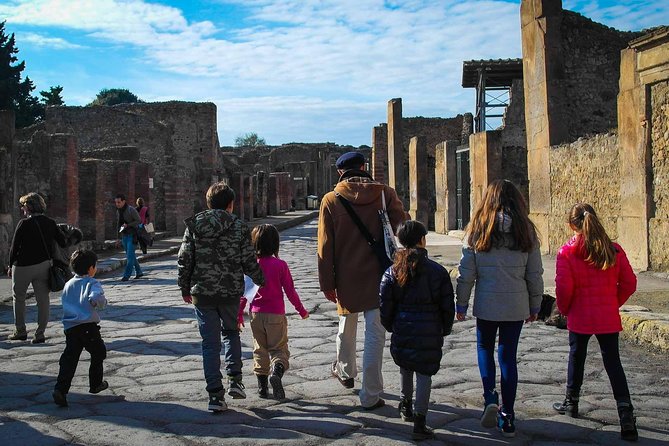
Via dell’Abbondanza was Pompeii’s longest and most important street. It ran from the Forum toward the Sarno Gate and served as a main commercial and social artery.
This is one of the best places to see how ordinary movement worked. The road surface is made of basalt blocks. Raised stepping-stones allowed people to cross when rainwater, waste, or street flooding made the road unpleasant. The gaps between the stones were sized for carts, giving you a simple example of Roman urban planning.
Along the street, your guide points out shops, homes, public buildings, and food businesses. One especially memorable stop is the ancient fast-food counter, where large storage jars remain set into the counter. It offers a direct connection to daily eating habits, and it tends to work well with children because the idea is easy to grasp.
The route also includes public weighing scales. Small features like this are valuable because they move the focus away from emperors and temples. You begin to see Pompeii as a place where people bought food, handled goods, ran businesses, and crossed the city on foot.
More Private History Tours in Italy
- Ancient Ostia Antica Semi-Private Day Trip from Rome by Train with Guide
★ 4.5 · 579 reviews - Colosseum & Ancient Rome Semi-Private Tour
★ 5.0 · 208 reviews - Skip-the-Line Half-Day Private Tour Ancient Pompeii Highlights with Native Guide
★ 5.0 · 146 reviews - Private Rome Food Tour in the Historic Centre with 8+Tastings
★ 5.0 · 135 reviews
The Forum Baths and Roman comfort
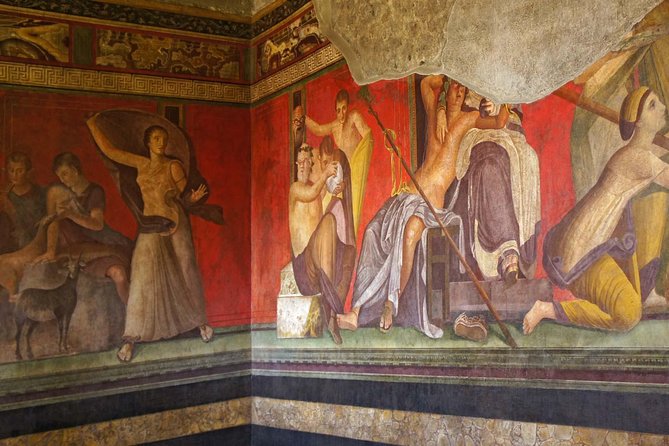
The Forum Baths were built around 80 BC and were still operating when Vesuvius erupted. They preserve the basic order of Roman bathing: changing room, cold room, warm room, and hot room.
The apodyterium was the changing room. From there, bathers could move to the frigidarium, tepidarium, and calidarium. The rooms also show high barrel-vaulted ceilings, stucco decoration, and terracotta figures called telamones.
This stop helps correct the idea that ancient Romans simply washed in a stream or at home. Public baths were social spaces and part of city life. Your guide can explain how the sequence worked and why heat, cold water, and steam were arranged in that order.
The baths are a good pause in a tour packed with open streets. You will still be walking across uneven surfaces, but the rooms provide a change of scale and a closer look at interior decoration.
The House of the Vettii, Pompeii’s great private home
The House of the Vettii is one of the tour’s highlights. It reopened in 2023 after a 20-year restoration and is often compared to Pompeii’s Sistine Chapel because of its paintings and decorative interiors.
The house belonged to Aulus Vettius Conviva and Aulus Vettius Restitutus, two freedmen who became wealthy wine merchants. Their home was not modest. It was designed to display money, taste, and social success.
This is an especially useful stop because it shows private life at a high level. Temples and public squares tell you how the city presented itself, but a home reveals how wealthy residents received visitors, decorated rooms, and displayed status.
Allow time here. The House of the Vettii is one of the places where a guide’s explanation adds real value, since many details can look like decoration without context. If the house is busy, your guide may need to keep the group moving.
Theater, brothel, and the human side of the city
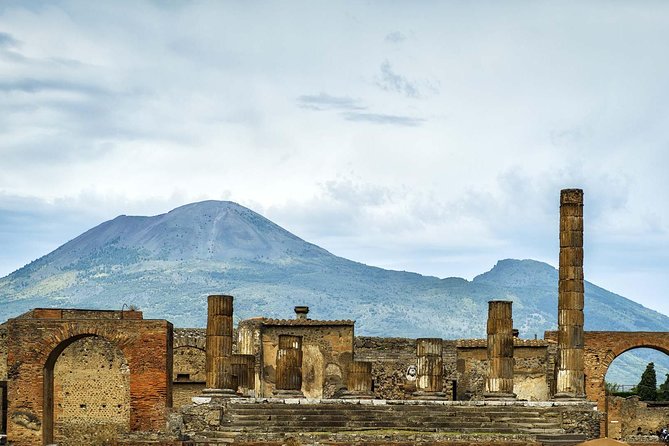
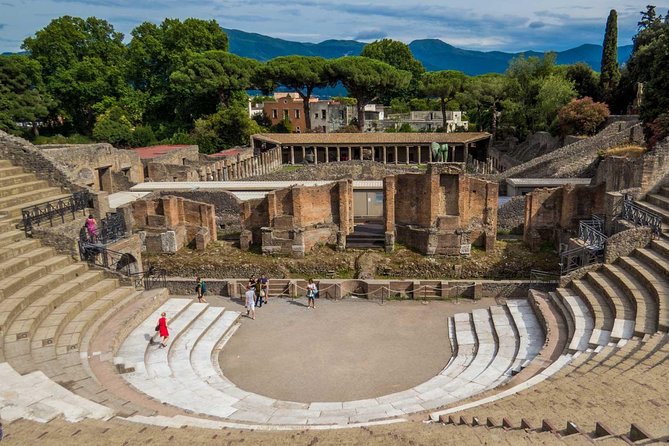
The Teatro Grande is an ancient masonry theater built in the second century BC. It was carved into a natural lava hillside and shows the change from Greek-style theater design to Roman use.
The theater helps you imagine Pompeii as a place of performance and public entertainment. It also offers a different view of the city from the Forum and baths. The setting uses the slope of the land rather than fighting it.
The tour can also include an old brothel. The stop is brief but useful for understanding Roman attitudes toward sex and commercial life. Your guide can put the building into social context rather than treating it as a cheap curiosity.
For families, the guide adjusts the explanation to the ages in your group. Adults can hear the historical background, while children can focus on the roles people played in the city. Parents should still decide how much detail suits their children, since Pompeii’s adult subjects are part of the site.
The Antiquarium and the plaster casts
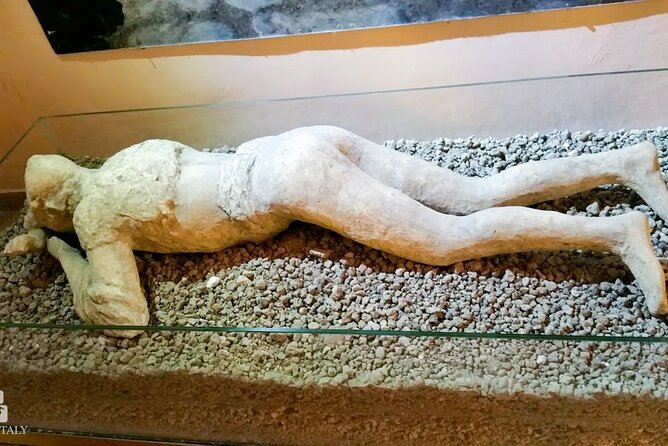
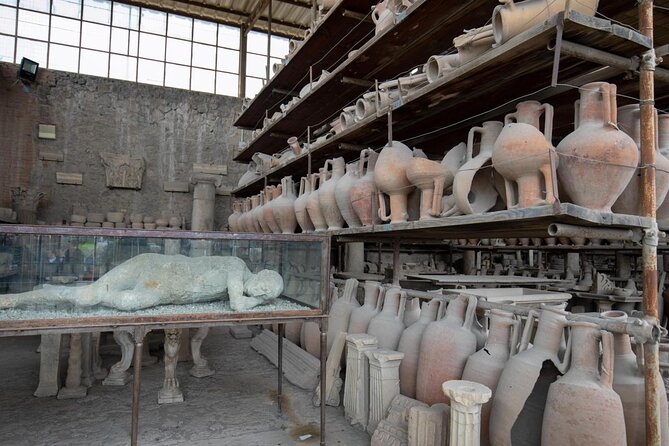
The Antiquarium is Pompeii’s climate-controlled museum. It houses fragile objects and important finds from across the archaeological park, including plaster casts of eruption victims.
The casts are among the most emotional parts of the visit. They preserve final body positions, including those of small children. Seeing them can be difficult, especially for younger visitors, so parents may want to prepare children in simple terms before arriving.
The casts also explain what makes Pompeii different from a normal ancient ruin. The site preserves not only walls and mosaics, but evidence of a sudden catastrophe that interrupted daily life. Your guide can explain how the casts were made and why some remain at the ruins while others are displayed in the Antiquarium.
This is usually a quieter, more reflective end to the route. It balances the earlier focus on buildings and gives the eruption a personal face.
The family option and keeping children interested
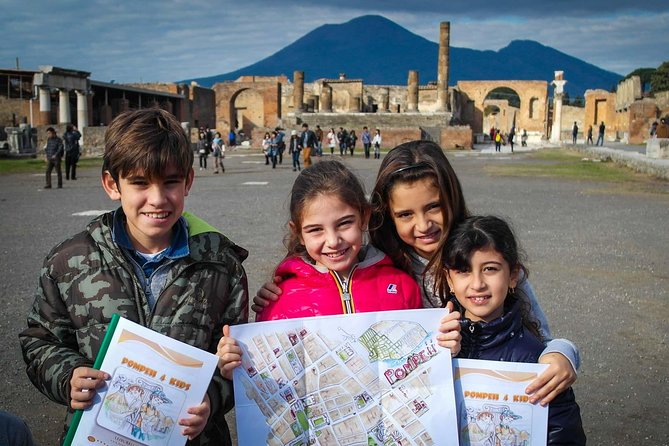
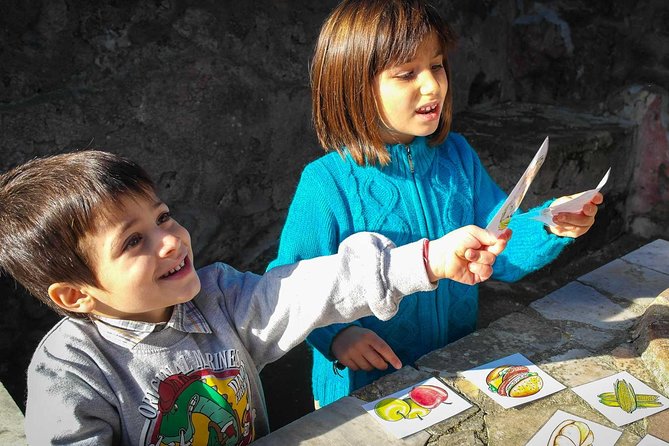
If you are traveling with children from 6 to 11, the family option is worth serious consideration. It includes a special map with stickers, activity sheets, games, puzzles, and a Pompeii4kids activity book.
The activities connect people and buildings. A child may place a sticker for a gladiator, actor, slave, or politician near the part of town linked with that role. Short quizzes reinforce facts without turning the visit into school.
The guide also changes the route and tone for younger visitors. Sabrina, Natalia, Viviana, Fabrizio, and Anna were praised for patience and for keeping children involved. One family with children ages 7 and 9 found the activities effective even in sweltering heat, while another family with children ages 9, 7, and 3 had a strong experience with Francesca.
The family option is not only for children. Adults still see the main sights and receive the historical explanation. It simply gives younger minds something active to do while the guide talks.
For children under 6, the supplied information does not promise a kit designed for them. A guide may adapt, but you should not assume the full activity package applies to every age.
Timing, heat, walking, and pace
The advertised duration is about two hours. The listed stops add up to roughly 80 minutes of time at specific sites, leaving room for walking, explanations, questions, and transitions. Some past visits have run longer, including one group that spent more than three hours with its guide, but you should plan around the stated two-hour duration.
Book as early in the day as your schedule allows. A group visiting at 11 a.m. found the later heat tiring and wished it had chosen a 9:30 start. Pompeii has limited shade across many streets, and the stone can make a warm day feel hotter.
Wear good walking shoes and bring what you need for sun and heat. The tour requires a moderate level of physical fitness. If someone in your group has mobility concerns, tell the guide at the start. One visit felt rushed because the guide moved ahead of people who needed more time.
Skip-the-line access is useful, but it does not remove the physical demands of the site. You still cross uneven paving, walk between spread-out buildings, and spend much of the tour outdoors.
Is $165.05 per person good value?
At $165.05 per person, this is not a budget Pompeii visit. The value comes from privacy, a Blue Badge guide, route flexibility, and a family program rather than from the length of the tour alone.
For a couple or small group with a strong interest in Roman life, private guiding can be worthwhile. You avoid a one-size-fits-all lecture and can ask questions whenever something catches your attention. For families, the games and map may prevent the usual complaints about heat, stones, and old walls.
The price is harder to justify if you only want a quick look at the Forum or if you are happy reading signs at your own pace. It is also worth checking the admission wording carefully, since the information provided gives two different accounts of whether the entrance fee is included.
Free cancellation is available up to 24 hours before the start time. Changes or cancellations within 24 hours are not accepted for a refund.
Who should book this Pompeii tour?
Book it if you want the major sights explained in a compact route, prefer a private guide, or are visiting with children. It is also a good choice if you care about daily life, not only famous monuments.
Families should select the Pompeii4kids option for children ages 6 to 11. Ask for a guide who is comfortable with children, such as Francesca, Natalia, Viviana, Fabrizio, Sabrina, or Anna, if names can be requested.
Skip it if your group cannot manage a moderate amount of walking, needs a fully accessible route, or wants to explore for most of a day. In that case, a shorter private visit may feel rushed, and the price may not fit your plans.
For most people who want context and personal attention, I would book this tour, with two checks first: confirm the ticket cost and request an early start to beat the heat.
FAQ
Where does the Pompeii tour start and finish?
The tour starts at Via Villa dei Misteri 2, 80045 Pompei, Italy. It ends back at the same meeting point.
How long does the tour last?
The advertised duration is approximately two hours. The exact length can vary depending on questions, pace, and the route arranged with your guide.
Is the tour private?
Yes. Only your group participates in the private activity.
Is the tour offered in English?
Yes. The experience is offered in English.
Are Pompeii admission tickets included?
The supplied information gives conflicting details. The inclusions list says an admission fee is included, while another note says admission fees are not included and that the guide can obtain tickets through a fast-track line. Confirm this point when booking.
What sights are included?
The route includes the Forum, Via dell’Abbondanza, Forum Baths, Temple of Apollo, Basilica, House of the Vettii, Teatro Grande, and Antiquarium. It can also include the city walls, Porta Marina, shops, an ancient food counter, public scales, and an old brothel.
Is there a family version of the tour?
Yes. The family option includes a Pompeii4kids kit with a map, stickers, activities, and an activity book. It is recommended for children ages 6 to 11.
What should I bring?
Wear good walking shoes. You should also be prepared for substantial outdoor walking and heat. The tour requires a moderate level of physical fitness.
Can I cancel for a full refund?
Yes, if you cancel at least 24 hours before the experience begins. Cancellations or changes made less than 24 hours before the start time are not accepted for a refund.
More Skip-the-Line Tickets in Italy
- Taormina: Ancient Theater Skip-the-Line Ticket & Audio Guide
★ 4.5 · 2,412 reviews - Historic Milan Tour with Skip-the-Line Last Supper Ticket
★ 4.5 · 1,976 reviews - Córdoba: Skip-the-Line Great Mosque-Cathedral History Tour
★ 4.7 · 1,690 reviews - Skip-the-Line Schonbrunn Palace Guided Tour and Vienna Historical City Tour
★ 3.5 · 940 reviews
More Pompeii and Vesuvius History Tours in Italy
- Discover the Ancient Ruins of Pompeii: Day Trip from Rome
★ 3.5 · 2,247 reviews - Small-Group Rome to Pompeii & Amalfi: Day of History & Sea
★ 5.0 · 239 reviews - Discover Herculaneum: A guided tour of the ancient Roman city
★ 4.9 · 34 reviews
Just added around Italy
- Guided Cultural Tour of the Godfather Film in Messina★ 5.0 · 31 reviews
- SU NURAXI BARUMINI Unesco World Heritage Site★ 5.0 · 129 reviews
- Picnic aperitif in the vineyard of an ancient trullo in Martina Franca★ 5.0 · 21 reviews
- Brescia the Unexpected: History, Local Stories & a drink★ 5.0 · 31 reviews
- Bologna historical art walking tour with hidden gems and tastings★ 5.0 · 108 reviews
- Private or semi-private tour of the historic center of Bologna★ 5.0 · 34 reviews
- Best of Bologna in one day : Food, architecture, art and history★ 5.0 · 27 reviews
- Bolognese Cooking Class with Margherita in the Historic Center★ 5.0 · 26 reviews
Pompeii & Vesuvius History Tours, compared.
Discover the Ancient Ruins of Pompeii: Day Trip from Rome
Read our review →
Small-Group Rome to Pompeii & Amalfi: Day of History & Sea
Read our review →
Skip-the-Line Half-Day Private Tour Ancient Pompeii Highlights with Native Guide
Read our review →
Discover Herculaneum: A guided tour of the ancient Roman city
Read our review →Browse the lists this tour appears in