

Review · HAMPI
1 day private tour of Hampi world heritage site in car with professional guide
Hampi rewards early starts. This private car tour turns a vast 16th-century capital into a manageable day, linking its grand temples, royal ruins, giant statues, and famous stone chariot with a professional guide. I especially like the door-to-door car transport and the chance to shape the pace around your own group. The main catch is simple: Hampi is enormous, and nine hours gives you the highlights rather than the whole story.
I also like the mix of major monuments and smaller archaeological corners, from Virupaksha Temple to the Underground Shiva Temple. Guides such as Akhil and Kumar have been praised for clear explanations and good planning. At $125 per person, the price makes the most sense for couples or small groups who value a private vehicle, guide, and efficient sightseeing. A one-day visit can feel rushed, especially if you are also making the long journey from Bangalore.
Key points to know before booking
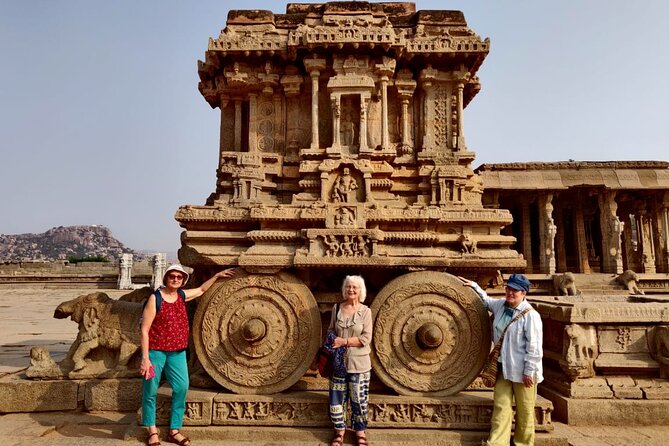
- The stone chariot is the visual star: Vijaya Vittala Temple gives you Hampi’s most famous monument early in the day.
- A private group keeps the day flexible: Only your party joins the tour, which is useful at a large site with many separate ruins.
- The itinerary covers Hampi’s main themes: Temples, royal buildings, statues, water structures, and ceremonial spaces all appear.
- The tour runs about nine hours: The listed sightseeing stops add up to less than four hours, leaving the rest for driving between areas and time on site.
- A guide adds much-needed context: Hampi’s broken walls and scattered stones make far more sense when someone explains their former purpose.
- One day is a sampler, not the full meal: If Hampi is central to your trip, consider allowing a second day.
Why this private Hampi tour works

Hampi is not one compact monument. It is a broad archaeological area filled with temples, platforms, tanks, statues, and royal buildings. You can walk into one group of ruins, turn a corner, and find another important site several minutes away. That makes a private car useful.
The tour begins at 8:00 am and lasts about nine hours. You travel between the main areas with your own guide and driver, rather than trying to organize every connection yourself. That saves time and keeps the day from becoming a puzzle of local transport, directions, and uncertain distances.
The private format is especially helpful if your group has different interests. You can spend longer at the stone chariot or royal buildings, ask for more explanation at a temple, or keep moving when a statue needs only a quick look. The schedule is still full, but it is less rigid than a large group outing.
The guide is an important part of the value. Hampi’s ruins can look like a collection of impressive stones if you do not know what you are seeing. A good guide links the architecture to the Vijayanagara kingdom and explains how temples, royal courts, ceremonial platforms, tanks, and defensive spaces worked together.
Two named guides, Akhil and Kumar, received especially warm praise for their explanations and attention. The driver matters too, since you spend part of the day moving between scattered sites. A comfortable air-conditioned car was a highlight for one group, a welcome feature in Hampi’s heat.
More Private History Tours in India
- Blue City Heritage Private Walking Tour With Pickup and Drop-Off
★ 5.0 · 441 reviews - Private Heritage Walking Tour in Jaisalmer Fort and Old Bazaar
★ 5.0 · 306 reviews - Private Jaipur Full-Day Tour with Block Printing
★ 5.0 · 206 reviews
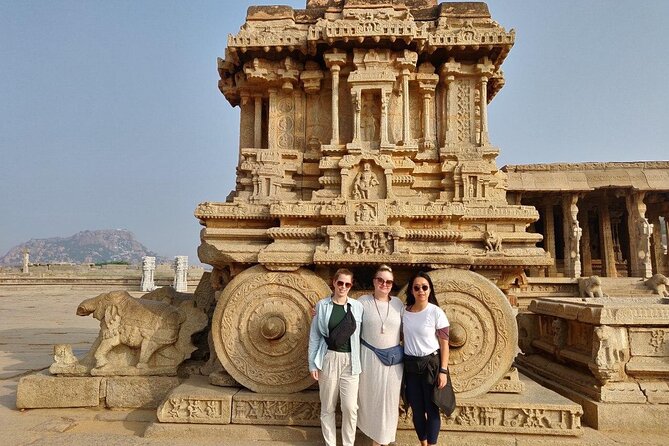
Vijaya Vittala Temple and the famous stone chariot
The first stop is Vijaya Vittala Temple, one of Hampi’s grandest monuments. You have about 30 minutes here, with admission included.
The temple is famous for its stone chariot, a carved monument that looks ready to roll despite being made from rock. It is one of the images most closely linked with Hampi, and it gives you an immediate sense of the skill and ambition behind the city’s public buildings.
The temple itself is built on a polyhedron-shaped foundation, an unusual detail that your guide can help you notice. The complex has a ceremonial scale that is hard to grasp from photographs. Thirty minutes is enough for the main view and a focused explanation, but not enough for a slow inspection of every carved element.
I would pay close attention here. This is the kind of stop where a quick photograph can easily replace actually looking at the structure. Ask your guide to point out the relationship between the chariot, the temple court, and the surrounding stonework.
King’s Balance and the idea of royal generosity
King’s Balance is a shorter 15-minute stop near Purandara Mantapa. A large stone beam rests on two stone pillars, creating a simple frame with an unusual royal story attached to it.
According to local tradition, Vijayanagara kings were weighed here against valuable goods, which were then distributed as gifts. The structure is less ornate than the temples, but it gives the tour a useful change of pace. Hampi was not only a place of worship. It was also a center of ceremony, power, wealth, and public display.
This is a quick photo stop rather than a place where you will spend a long time. Its value comes from the explanation, since the physical structure alone does not reveal why it mattered.
Virupaksha Temple, Hampi’s living center
Virupaksha Temple receives about 30 minutes and is one of the day’s major highlights. It is described as Hampi’s oldest temple and dates to the Hoysala period. Its tower rises eleven storeys and reaches about 165 feet, giving the monument a strong presence even among Hampi’s many large ruins.
Unlike many sites in the area, Virupaksha is a functioning temple. That gives you a different experience from the empty royal platforms and damaged halls elsewhere. You are not only looking at abandoned architecture. You are also seeing a place that continues to have religious meaning.
The short visit lets you see the main temple and hear its story, but it is not a leisurely temple study. Dress and conduct should suit a religious site. Your guide can help you understand where to focus and how this temple fits into the wider city.
This stop also shows why a guide is useful. The tower, courtyards, and surrounding structures can blur together when you are moving quickly. A clear explanation gives the visit a shape.
More UNESCO World Heritage Tours in India
- World heritage Somnathpur sculptures and Talakadu temple mystery
★ 5.0 · 79 reviews - 2 days Private tour of Hampi world heritage site from Bangalore by car
★ 5.0 · 75 reviews - World heritage Ahmedabad city tour in private car with guide and lunch
★ 5.0 · 44 reviews - Private Elephanta Caves UNESCO World Heritage Site Tour
★ 5.0 · 34 reviews
Sasivekalu Ganesha and Ugra Narasimha
The tour next moves to two large monolithic statues. Sasivekalu Ganesha is carved from one block of rock and measures about eight feet high. The scale is striking, but the single-stone construction is the detail worth remembering.
You have 15 minutes here. That is enough to view the statue, take photographs, and hear the basic story. It is not a long stop, which helps preserve time for the larger temple and royal areas.
A few minutes away is Ugra Narasimha, described as Hampi’s largest idol at 22 feet high. The statue was carved during the time of Krishnadevaraya, and a serpent with an open hood rises behind it. The pairing of these two statues gives you a good look at Hampi’s taste for monumental religious sculpture.
Again, the schedule is brisk. You will see the form and scale, but a specialist interested in iconography or stone carving may want more time than the itinerary allows. If a particular statue matters to you, tell the guide early.
Queen’s Bath and the Royal Enclosure
The Royal Enclosure receives the longest scheduled visit, one hour. That is sensible. This was the seat of Vijayanagara power, with royal halls, platforms, tanks, underground chambers, and temples spread across a broad area.
The visit begins at Queen’s Bath, a large bathing structure that helps reveal the courtly side of Hampi. It is not simply another temple ruin. It points to the daily life, ceremony, and private world of the ruling family.
From there, the enclosure brings together several types of remains. You may see the foundations of audience spaces, water structures, administrative areas, and religious buildings. Much of the original decoration is gone, so the guide’s explanation becomes essential. Without context, a raised platform can be hard to distinguish from another raised platform. With context, you begin to see how the royal center was organized.
One hour is useful but still limited. The enclosure is one of the places where I would resist rushing for photographs. Look at the scale of the platforms and the gaps between structures. Those empty spaces once carried ceremony and authority.
Zanana Enclosure and Lotus Mahal
The Zanana Enclosure was associated with the royal women, and the tour allows about 20 minutes here. Its best-known building is Lotus Mahal, a two-storey palace set inside a rectangular walled area.
Lotus Mahal is more delicate in appearance than the heavy temple structures elsewhere. Its arches and layered form give you a welcome change after the massive statues and tall gopurams. The building is easy to appreciate at a glance, but the guide can explain why it belongs to a royal residential compound rather than a temple complex.
Twenty minutes is enough for the main building and its setting. It is not enough to wander slowly through every part of the enclosure. The private format helps here because you can ask for a quick explanation tailored to your interests instead of listening to a long general talk.
Hazara Rama Temple and carved royal storytelling
Hazara Rama Temple receives another 20-minute visit. It is the only temple inside the Royal Enclosure and is dedicated to Lord Ram, an incarnation of Vishnu.
The temple is especially useful for understanding the connection between religion and royal identity. Its position inside the royal zone makes it feel different from Virupaksha Temple, which serves a wider religious community. Here, the setting ties worship more closely to the court.
The stop is short, so ask your guide to point out the most important carvings and architectural features. You will get a focused introduction rather than a complete study of the temple.
Underground Shiva Temple and the final archaeological details
Near the end of the day, the route includes an Underground Shiva Temple, an excavated water tank, and an administrative enclosure. The temple’s below-ground setting makes it one of the more unusual stops.
This part of Hampi rewards curiosity. Not every important place has a towering entrance or a famous photograph. Water management and administration were basic to the operation of a major capital, and these less glamorous remains help explain how the city functioned.
The scheduled time is about 20 minutes. That is enough to see the main features, but you may feel the day’s limits here. By this point, you will have already seen several major monuments, so the guide’s ability to connect the final sites to the larger city matters more than simply adding another stop.
What the day feels like in practice
The listed visits total roughly three hours and 45 minutes. The rest of the nine-hour day is taken up by driving between separated areas, entering sites, walking around monuments, listening to explanations, and taking short pauses.
That pacing is reasonable for a first visit, but do not expect a slow archaeological study. Hampi is too large for that in one day. You will cover the headline monuments and gain a useful framework, then return later if one area catches your interest.
The air-conditioned car is more than a comfort perk. Hampi sightseeing involves repeated movement between outdoor ruins, and the heat can wear you down. A private vehicle gives you a place to cool off between stops and keeps the day moving.
One group enjoyed lunch at the Mango Tree before continuing. Lunch is not listed as a formal tour stop, so treat that as an example of how the day may unfold rather than a guaranteed inclusion. One account also included a boat ride to ancient temples. Since that is not part of the nine named stops, confirm it before counting on it.
Is $125 per person good value?
At $125 per person, this is not the cheapest way to see Hampi. The price needs to cover a private car, driver, professional guide, admissions, and the convenience of arranging a large route in one day. For a small group, that can be fair value because the cost buys time and simplicity, not just transport.
The value improves when you consider the size of the archaeological area. Organizing the same day independently would mean arranging transport between sites, working out the order, and finding explanations on your own. You would also lose the private group format.
The price is less attractive if you want only a few central monuments or prefer to move slowly without a fixed route. In that case, a longer stay with local transport or a shorter guided visit may suit you better.
Group discounts are available, but the exact reduction is not specified. Ask for the current rate before booking. Admission is included at the listed stops, and mobile tickets make the entry process easier.
Getting there, timing, and practical limits
The start time is 8:00 am. That early departure helps you use the cooler part of the day and fit in the wide route. Pickup is offered, but the precise pickup area should be confirmed when you reserve.
If you are coming from Bangalore, plan carefully. One party described an 8.5-hour drive on good roads, stayed overnight, and then toured Hampi the next day. That is a sensible approach. Trying to combine that drive with the full nine-hour sightseeing program would make for a punishing schedule.
The experience is near public transportation, and most people can take part. The information provided does not give detailed mobility guidance for every monument, so ask the provider about walking distances or specific access needs before booking.
Free cancellation is available if you cancel at least 24 hours before the local start time. Changes or cancellations made less than 24 hours ahead are not refunded.
Who should book this Hampi experience?
I would recommend it to a couple, family, or small private group with one full day in Hampi and a clear wish to see the main monuments efficiently. It suits first-time visitors who want the story of the city explained as they go.
It is also a good choice if you are arriving by train near Hospet, using a short Hampi stay, or want an air-conditioned vehicle between outdoor stops. The guide and driver combination received particularly strong praise, with the overall rating at 4.8 from 34 ratings and 100 percent recommendation shown.
I would hesitate if you have two or three days available and prefer slow exploration. Hampi deserves more time than this route can provide. Use this tour as a strong first pass, then return to the areas that deserve a quieter look.
Should you book the one-day private Hampi tour?
Book it if your priority is efficient coverage with a private guide and car. You will see the stone chariot, Virupaksha Temple, royal buildings, Lotus Mahal, Hazara Rama Temple, major statues, and several less obvious archaeological sites in one organized day.
Think twice if your schedule allows a longer stay. One day gives you the outline of Hampi, not every detail. For a first visit, though, the thoughtful route, included admissions, comfortable vehicle, and praised guiding from people such as Akhil and Kumar make the $125 price reasonable for many small groups.
FAQ
How long does the Hampi private tour last?
The tour lasts approximately nine hours.
What time does the tour start?
The scheduled start time is 8:00 am.
Is this a private tour?
Yes. Only your group participates in the activity.
What is the price?
The listed price is $125 per person. Group discounts are available, though the exact discount is not specified.
Is pickup offered?
Yes, pickup is offered. Confirm the exact pickup location when booking.
Are admission tickets included?
Admission tickets are listed as included for the named stops on the route.
Which major Hampi sites are included?
The route includes Vijaya Vittala Temple, King’s Balance, Virupaksha Temple, Sasivekalu Ganesha Temple, Ugra Narasimha, the Royal Enclosure, Zanana Enclosure, Hazara Rama Temple, and the Underground Shiva Temple.
Can most people participate?
The tour information says most people can participate and notes that it is near public transportation. Detailed access information for each monument is not provided.
What is the cancellation policy?
You can cancel at least 24 hours before the local start time for a full refund. Cancellations or changes made less than 24 hours before the start are not accepted or refunded.
More Day Trips in India
- Kyoto: Fushimi Inari, Kinkakuji, Bamboo Grove 1 Day Bus Tour
★ 4.8 · 4,316 reviews - From Bangkok: Ayutthaya Historical Park Guided Day Trip
★ 4.6 · 3,020 reviews - Discover the Ancient Ruins of Pompeii: Day Trip from Rome
★ 3.5 · 2,247 reviews - Historical Delphi One Day Tour with Arachova Stop & Expert Guide
★ 4.5 · 1,247 reviews
Just added around India
- Kamakhya Heritage Walking Tour★ 5.0 · 57 reviews
- Fontainhas Heritage Walk With Guide Mario★ 5.0 · 29 reviews
- Private Portuguese Heritage Tour: Se Cathedral, Basilica of Bom Jesus and Dona Paula Beach in Goa★ 4.5 · 21 reviews
- Heritage Houses of Goa-Chandor by Soul Travelling★ 5.0 · 199 reviews
- Campal Heritage Walk by Make It Happen★ 5.0 · 48 reviews
- Chandor Heritage Trail by Make It Happen★ 5.0 · 79 reviews
- CULTURAL & HISTORIC DAY TOUR ATTRACTIONS – Churches, Temples & Spice Plantation★ 4.5 · 53 reviews
- Old Goa Heritage & Culture E-Bike Tour★ 4.5 · 46 reviews
UNESCO World Heritage Tours, compared.

World Heritage Shirakawa-go and Experience Tours from Kanazawa
Read our review →

Bali: Tanah Lot UNESCO World Heritage Sites Full-Day Tour
Read our review →World Heritage Kyoto & Nara Uji Authentic Matcha Experience
Read our review →

UNESCO’s Ayutthaya Historical Park: Full-Day Tour from Bangkok
Read our review →
Rotterdam: Kinderdijk UNESCO World Heritage Entry Ticket
Read our review →
From Busan: Gyeongju UNESCO World Heritage Guided Day Tour
Read our review →Browse the lists this tour appears in