
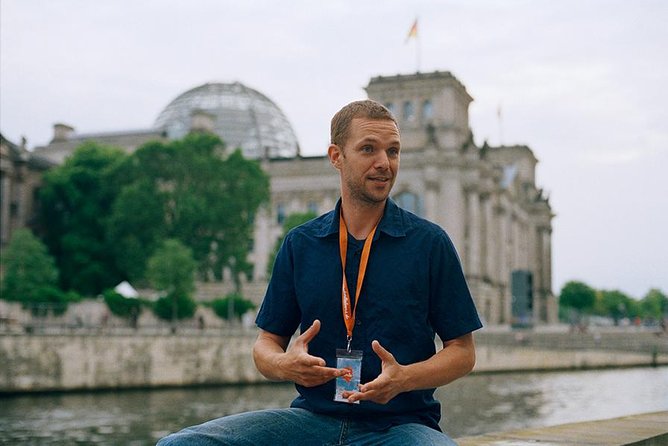
Review · BERLIN
Historic center of Berlin – Tour in Italian
Berlin reveals itself in layers. This 3.5-hour walk connects those layers through the city’s hardest and most important places, from Potsdamer Platz and Checkpoint Charlie to the Holocaust Memorial, Brandenburg Gate, and Museum Island. With an Italian-speaking guide, you follow Berlin’s story from Prussian power through Nazi rule, Cold War division, and reunification.
I like the Italian-language commentary, especially for a tour dealing with complicated political history and memorials that deserve careful explanation. I also like the route itself: it covers a large part of central Berlin on foot and ends near the Pergamon Museum, giving you a useful base for the rest of your day.
The main consideration is the walking. The tour lasts about three and a half hours, operates in all weather, and includes many outdoor stops with little time at each one. If you want to explore museums or memorial interiors at length, you will need to return on your own.
Key points to know before booking
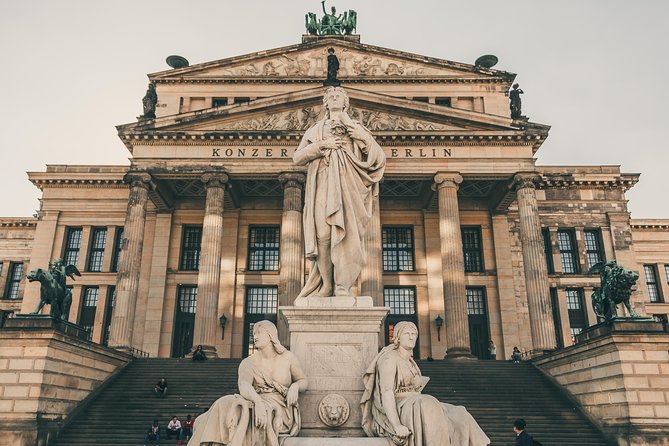
- Potsdamer Platz to Museum Island: The route crosses Berlin’s central historical core rather than staying in one small neighborhood.
- Italian-speaking guide: Guides such as Paolo, Giulia, Fabio, Chiara, Elena, and Daniele have received especially warm praise for clear explanations and friendly service.
- Major 20th-century history: The tour covers Nazi persecution, the Holocaust, the Berlin Wall, Communist rule, and German reunification.
- Outdoor sightseeing: Most stops are viewed from outside, including the Reichstag, Brandenburg Gate, and Berliner Dom.
- Small-group format: The maximum group size is 28 people, large enough to provide company but still manageable on city streets.
- Good first-day option: The route gives you useful orientation and ends by Museum Island, where you can continue sightseeing independently.
Why this route works for first-time Berlin visitors
Berlin can be confusing at first. Its major sights are spread across broad avenues and large public spaces, while much of the city’s story is marked by empty lots, fragments of wall, memorials, and rebuilt facades rather than one preserved old center.
This tour gives those places a clear order. You begin at Potsdamer Platz, once divided by the Berlin Wall and now filled with modern architecture. From there, you move through sites tied to the Nazi dictatorship, the Cold War, Jewish persecution, Prussian monarchy, and reunification.
That order matters. You are not simply ticking off famous landmarks. You are seeing how one political system replaced another, how war reshaped the city, and how Berlin remembers what happened.
The route is also practical for a short stay. In one morning, you see Checkpoint Charlie, the Wall, the former Nazi government district, the Reichstag, Brandenburg Gate, Unter den Linden, Bebelplatz, the Berliner Dom, and Museum Island. You will not have time to visit every museum, but you will know which areas deserve a return visit.
More Old Town and Historic Centre Walks in Germany
- Berlin: Historic Center Walking Tour with a Real Berliner
★ 5.0 · 134 reviews - Berlin: 1-Hour Guided Tour of the Historic Center
★ 4.2 · 33 reviews - The Local Tour of Hamburg Historic Centre
★ 5.0 · 1,058 reviews
Meeting the guide at Potsdamer Platz
The starting point is Potsdamer Platz 10 at 10:00 a.m. The meeting point is near the Potsdamer Platz S-Bahn and U-Bahn station. Look for the blue bicycle and the VIVE BERLIN TOURS flag.
That marker is a useful detail because Potsdamer Platz is a large, modern area with several entrances and public spaces. Arrive with enough time to find the blue bicycle without rushing. The tour includes local taxes and a local guide, but not transport to the meeting point.
Potsdamer Platz is an effective place to begin. Before World War II, it was an important city center. War damage and the later division of Berlin left it cut apart, while the Wall ran through the area. Today, its glass towers and broad plazas present a sharp contrast with the city’s earlier appearance.
The guide uses this contrast to explain Berlin’s repeated changes. You get a short introduction here, then walk toward the Sony Center, where modern construction incorporates surviving fragments connected with the older square.
Sony Center and the first look at rebuilt Berlin
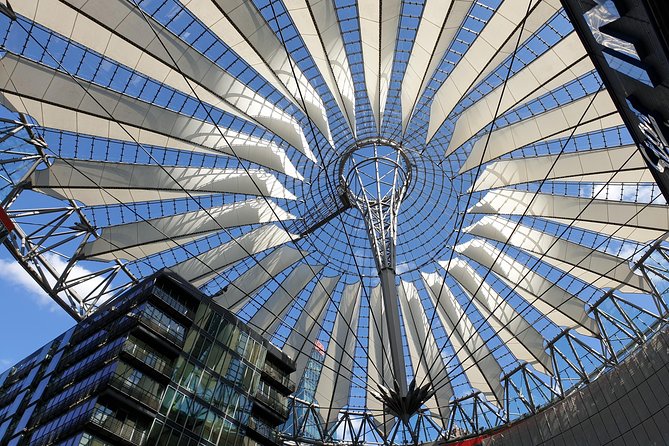
The Sony Center offers a quick lesson in how Berlin handles its past. The complex is modern, but remains of the former Potsdamer Platz area have been preserved within the contemporary setting.
You should not expect a long architectural visit. The scheduled stop is brief, about ten minutes. Its value comes from the explanation of what stood here before wartime destruction and postwar division changed the district.
I like this early stop because it prevents a common mistake: assuming modern Berlin was always modern. The city’s new buildings often sit on ground marked by war, political division, and reconstruction.
Topography of Terror and the former Nazi power center
At the Topography of Terror, the group reaches one of Berlin’s most serious historical sites. This is where the Gestapo and SS once had their headquarters. The tour explains how the Nazi dictatorship is remembered at the place where its machinery operated.
You also see the former Nazi Aviation Ministry, Martin Gropius Bau, and an original section of the Berlin Wall. That combination is typical of central Berlin. A museum, a government building, a Wall fragment, and a site of Nazi terror can all appear within a short walk.
The stop is listed at about ten minutes, so you should think of it as an introduction rather than a complete museum visit. If the subject interests you, allow extra time another day for a longer visit. The walking tour gives you the location and context, then keeps moving.
More Old Town and Historic Centre Walks in Berlin:
- Madrid Essential: Historic Center, Plaza Mayor & Royal Palace
★ 5.0 · 6,416 reviews - Lisbon: Live Fado Show with Port Wine in Historic Center
★ 4.7 · 4,166 reviews - Valencia Old Town Tour with Wine & Tapas in 11th Century Historic Monument
★ 5.0 · 3,234 reviews - Prague Old Town, Medieval Underground and Dungeon Historical Tour
★ 4.5 · 3,227 reviews
Checkpoint Charlie and the Cold War divide
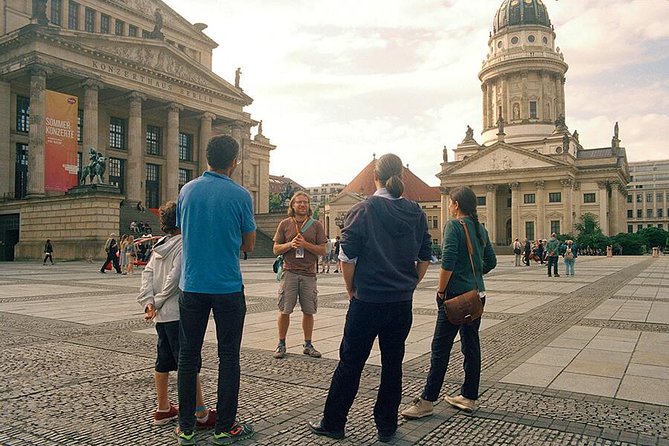
Checkpoint Charlie was once one of the most tense crossing points between East and West Berlin. Here, the guide explains the construction of the Wall and the division of the city under Communist rule.
The physical setting today is less powerful than the history associated with it. That is precisely why a guide helps. Without context, you might see a busy central street and a famous name. With explanation, you understand why this point mattered during the Cold War.
The stop is brief, around ten minutes. You will hear the story and see the location, but you will not get a long examination of every Cold War detail. Treat it as one chapter in a larger route.
The Aviation Ministry and the former Führerbunker site
The former Aviation Ministry is a massive building with several political lives. It was built during the Nazi period for the Ministry of Aviation under Hermann Göring. During the Cold War, it served the Communist government, and it is now used as a ministry by the Federal Republic of Germany.
That change of use makes the building a useful symbol of Berlin’s political shifts. The tour presents it from outside, so its importance comes from the guide’s explanation rather than an interior visit.
Nearby, you visit the location of the former Führerbunker, where Hitler spent his final days. There is no grand monument announcing the site. The point of the stop is to explain why the place is treated so plainly today and how its meaning is handled in modern Berlin.
This is one of the tour’s more delicate moments. A guide can keep the focus on historical facts rather than sensational stories. The scheduled time is about ten minutes, enough for orientation and explanation.
The Holocaust Memorial and the cost of remembrance
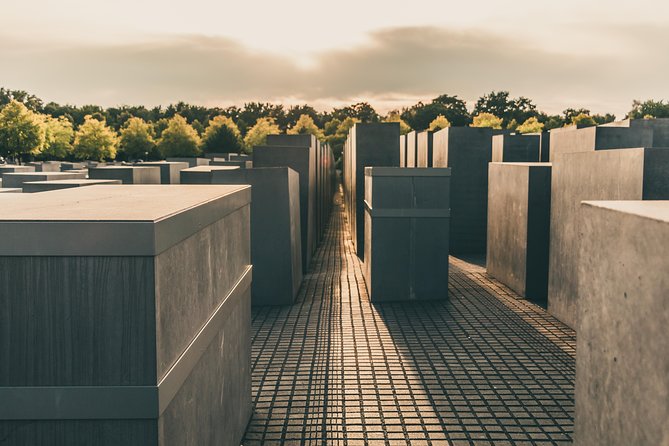
The Memorial to the Murdered Jews of Europe is one of Berlin’s most emotionally demanding places. The guide explains the murder of Europe’s Jews under the Nazi state and the role of this memorial in public remembrance.
You walk among the memorial’s large concrete blocks. The experience is not a conventional statue visit. Its design invites you to think about scale, uncertainty, and the absence of easy answers.
The tour allows about ten minutes here. That may feel short, especially if you want to walk farther into the memorial or sit with the subject. Still, the guide’s explanation gives the site a responsible introduction. I would return later if this is a major reason you came to Berlin.
Because the tour covers several difficult subjects in one morning, the pace can feel intense. That is not a flaw, but it is worth knowing before you book. This is a history-focused walk, not a light sightseeing stroll.
Reichstag and Brandenburg Gate
The Reichstag is the seat of Germany’s federal Parliament. The tour views it from outside and explains how you can book a visit to the dome.
That advice adds practical value. The building is one of Berlin’s major sights, but seeing it on this walk does not include entry. If you want to go inside, you must arrange that separately.
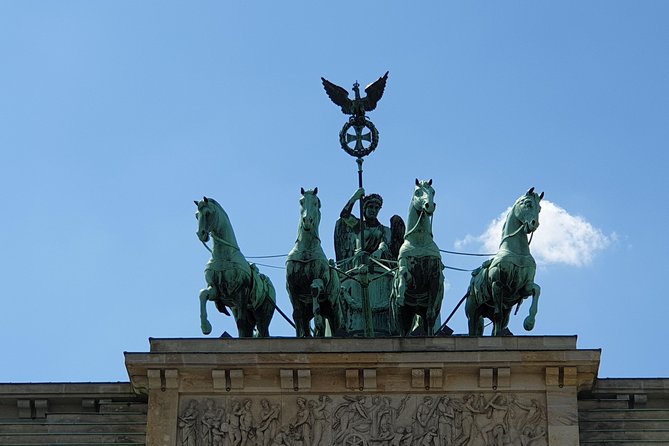
From the Reichstag, the route continues to the Brandenburg Gate. This is Berlin’s best-known gateway and one of its most photographed landmarks. The guide traces its changing meaning, from a symbol of royal strength to a Cold War image and later a sign of German reunification.
The gate is more than a photo stop. Its story shows how one monument can be claimed by different governments and political ideas. The ten-minute visit is enough for the explanation and photographs, although the area can feel busy at popular times.
Unter den Linden, Bebelplatz, and Humboldt University
After Brandenburg Gate, you walk along Unter den Linden, the grand avenue that once led toward the emperor’s palace. The guide points out different construction periods and signs of wartime damage.
This part of the walk shifts from 20th-century dictatorship and division toward Berlin’s older royal and academic identity. Look up as you walk. The avenue is not just a connection between sights. It shows how Berlin rebuilt and retained parts of its earlier civic character.
Bebelplatz brings the group to the site of the Nazi book burning. The square is also home to Humboldt University and a Catholic cathedral. The tour separates the square from its memorial, allowing the guide to explain both the event and the design that recalls it.
The Book Burning Memorial is underground and visible through a glass panel in the square. The empty library represents the destruction of ideas and censorship under the Nazi dictatorship. The stop is short, but the guide’s narration helps you notice a memorial that is easy to miss if you walk through Bebelplatz alone.
At Humboldt University, you hear about the institution’s history and famous students. This is a quick five-minute stop, so it works best as a piece of the wider story rather than a university visit.
Neue Wache, Berliner Dom, and Museum Island
Neue Wache is a memorial against war and its suffering. At its center, a mother mourns her son, a soldier killed in battle. The design is spare, and the guide explains how the memorial expresses grief rather than military glory.
Next comes the Berliner Dom. The grand church was built with the ambition of serving as a Lutheran counterpart to St. Peter’s Basilica. You view it from outside, so consider this a useful introduction if you later want to explore the building and its interior.
The final stop is Museum Island, a UNESCO World Heritage Site. The tour ends near the Pergamon Museum on Bodestraße. The guide gives directions for continuing through Berlin and explains how to approach the museum area.
The end point is well chosen. You can stop for lunch, continue to another museum, or use the central location to reach other parts of the city. The tour does not include museum admission, food, drinks, or transport.
Price, pace, and group size
At $27.91 per person, the tour is fairly priced for a 3.5-hour guided walk in central Berlin. You are paying mainly for the route and the Italian commentary, not for admissions. Since nearly every stop is viewed from public streets or squares, the value depends on how much you want historical explanation.
I think the price works best if you are visiting Berlin for the first time, have limited time, or prefer to learn in Italian. It is less useful if you already know the city well or want lengthy visits inside museums.
The maximum group size is 28 people. That is not an intimate private walk, but it remains reasonable for a major city route. The group must keep moving, especially because the itinerary covers so much ground.
Wear comfortable shoes and dress for the weather. The tour runs in all weather conditions. A cold or rainy morning could make the outdoor format tiring, so plan clothing carefully.
The tour is near public transportation, and most people can take part. Service animals are allowed. Hotel pickup is not provided, and you must arrange your own way to Potsdamer Platz.
The Italian guides and the tone of the experience
The strongest praise centers on the guides’ preparation, courtesy, and ability to make the history understandable. Paolo is praised for connecting historical facts with anecdotes and for showing Berlin through several angles. Giulia and Fabio are described as highly prepared, while Chiara helped make the Mitte area clear even in cold weather.
Elena is praised for pointing out places you might miss without a guide. Daniele is remembered for explaining both the city’s beauty and its small details. The guide you receive will vary, but these names give you a sense of the service style to expect.
The Italian language is not just a translation feature. It can make the political and memorial subjects easier to follow, especially when the guide moves quickly between Nazi Germany, the Cold War, monarchy, and reunification.
Who should book this Berlin walk?
I would recommend it to Italian-speaking visitors who want a strong introduction to central Berlin. It suits first-time visitors, couples, families with older children, and anyone who prefers a clear walking route to planning each sight alone.
It is also a good choice if you want orientation before visiting museums. You will learn where the major sites are and receive suggestions for continuing at the Reichstag, Museum Island, and the Pergamon Museum.
I would be more cautious if you have limited mobility, dislike walking in poor weather, or want to spend serious time inside museums. The tour is packed with stops, and the short time at each place favors explanation over extended viewing.
FAQ
How long does the Berlin Italian walking tour last?
The tour lasts approximately 3 hours and 30 minutes.
What time does the tour start?
The tour starts at 10:00 a.m.
Where does the tour meet?
The meeting point is Potsdamer Platz 10, 10785 Berlin, near the S-Bahn and U-Bahn station. Look for the blue bicycle and the VIVE BERLIN TOURS flag.
Where does the tour end?
The tour ends near the Pergamon Museum at Bodestraße 1-3 on Museum Island.
Is the tour conducted in Italian?
Yes. The tour includes an Italian-speaking local guide.
Are museum admissions included?
No. The tour views most sites from outside, and museum admission is not included.
Is food or drink included?
No. Food and drinks are not included.
What is the maximum group size?
The tour can have a maximum of 28 participants.
Can I cancel for a full refund?
Yes. You can cancel at least 24 hours before the start time for a full refund. Cancellations or changes made less than 24 hours before the start time are not accepted for a refund.
Should you book this tour?
Book it if you want Berlin’s central sights tied together by a clear Italian explanation. The route is especially useful at the start of a visit because it covers the Wall, Nazi sites, memorials, Parliament, Brandenburg Gate, Unter den Linden, and Museum Island in one morning.
Do not book it expecting museum entry or long pauses at each memorial. This is a fast-moving outdoor introduction. For the price, the combination of coverage, Italian commentary, and practical orientation makes it a sensible choice for a first look at Berlin, especially with a guide such as Paolo, Chiara, Elena, or Daniele bringing the city’s difficult story into focus.
Just added around Berlin
- Berlin Food & Cultural Tour: Must-Try German & Berliner Classics★ 5.0 · 51 reviews
- Private Berlin WWII and Cold War History Tour with Local Expert Guide★ 5.0 · 28 reviews
- Private Tour: Jewish Heritage Walking Tour of Berlin★ 5.0 · 29 reviews
- Small-Group Historical Bike Tour in Berlin★ 4.5 · 103 reviews
- East Berlin Food & History Tour with Eating Europe★ 5.0 · 204 reviews
- Explore Berlin History and Highlights Sightseeing Walking Tour★ 5.0 · 81 reviews
- Berlin: Private Bike Tour of the Berlin Wall and Third Reich★ 5.0 · 23 reviews
- Berlin Beers & Battlefields Tour: War History and German Beer★ 5.0 · 29 reviews
Old Town & Historic Centre Walks, compared.
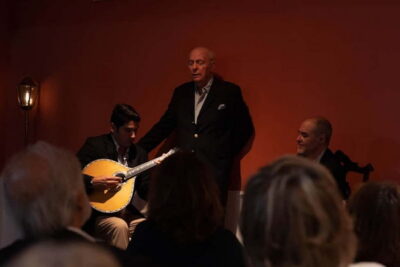
Live Fado Show with Port Wine in Historic Center
Read our review →
Valencia Old Town Tour with Wine & Tapas in 11th Century Historic Monument
Read our review →
Prague Old Town, Medieval Underground and Dungeon Historical Tour
Read our review →
Historic Center and Getsemaní Shared Walking Tour
Read our review →
Old Town Walking Tour History and Tales in Edinburgh
Read our review →
Philadelphia Old City Historic Walking Tour with 10+ Top Sites
Read our review →
Saadian Tombs & Bahia Palace, Medina Guided Tour
Read our review →Browse the lists this tour appears in