
Review · YEREVAN
Yerevan: Garni, Geghard, Symphony of Stones & Lavash Baking
Armenia packs big sights into a short ride. This six-hour outing from Yerevan links Geghard Monastery, Garni Temple, and the Symphony of Stones with an Ararat viewpoint and a lavash baking demonstration. At $23 per person, it offers a lot for the money, especially if you want a first look at Armenia beyond the capital.
I like the mix of culture and scenery. You move from a mountain view at Charents Arch to a medieval monastery, a striking basalt canyon, and a rare pre-Christian temple. I also like the guides’ role: names such as Yegor, Igor, Hasmik, Anna, Mery, and Taku appear often in the praise for clear storytelling and warm service.
The main caution is organization. Most outings seem to run well, but some departures have combined English and Armenian groups, long restaurant stops, unclear meeting arrangements, or limited explanation at the Symphony of Stones. The lavash session may also be more of a demonstration than a hands-on class.
Key Things to Know Before Booking
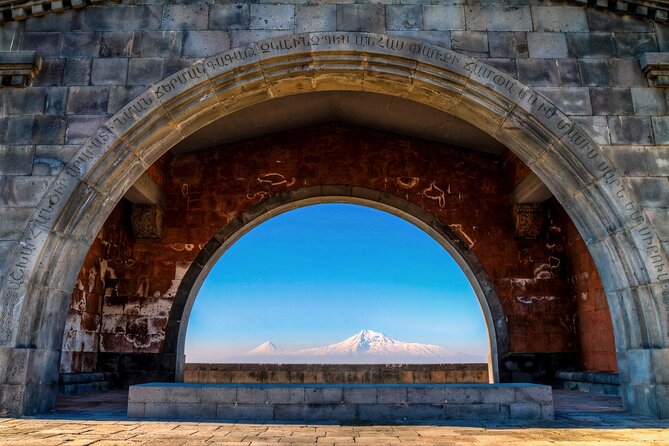
- Mount Ararat starts the day: Charents Arch gives you the tour’s best chance for a memorable view of Armenia’s national symbol, though clouds can hide it.
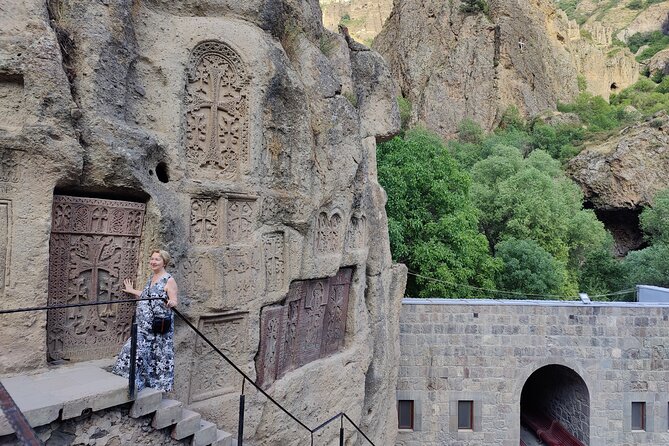
- Geghard is the spiritual highlight: The monastery is partly cut into the mountain and carries UNESCO World Heritage status.
- Garni is Armenia’s unusual ancient survivor: Its first-century temple is the only preserved pagan temple in Armenia and the former Soviet Union.
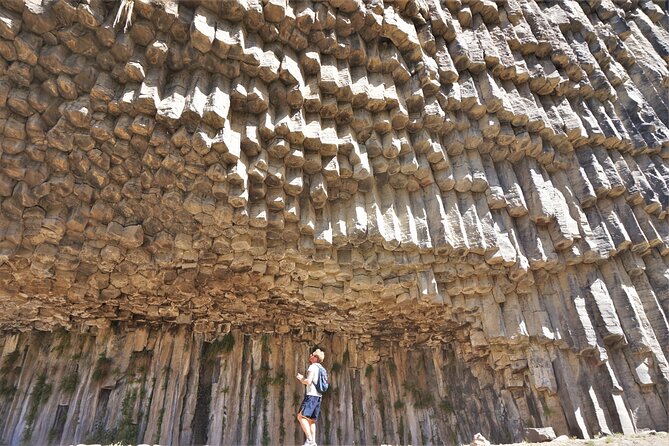
- The Symphony of Stones costs extra: Admission is 300 AMD, and the short walk into Azat Canyon rewards you with naturally formed basalt columns.
- Lavash adds a local food connection: You watch Armenian bread being prepared and usually get to taste it afterward.
- This is excellent value at $23: Transport, guiding, and the bread demonstration are included, while the Garni entrance fee of 1,500 AMD and Symphony fee are separate.
Starting at Charents Arch With Mount Ararat
The tour begins at 9:00 a.m. near the Komitas Yerevan State Conservatory on Sayat-Nova Avenue. From there, your vehicle heads toward the village of Voghjaberd and the hilltop monument commonly called Charents Arch.
The arch was completed in 1957 by architect Rafael Israelyan. Its formal name refers to Mount Ararat, and a line from Armenian poet Yeghishe Charents is carved across the front. The words express love for Masis, the Armenian name used for Ararat.
The stop is simple, but it sets the tone. You are not just pulling over for a photograph. You are being introduced to a mountain that carries enormous meaning in Armenian identity, even though it now lies across the border in Turkey.
Plan to spend about an hour here, including the drive and viewpoint time. The view depends heavily on weather. One departure could not see Ararat because of poor visibility, while another had clear views over golden fields. If the mountain is hidden, the stop still works as a short introduction to Armenia’s national symbols, but the photograph will not be the same.
Other history tours people book around the world:
- History and Hauntings of Salem Guided Walking Tour
★ 5.0 · 14,564 reviews - Colosseum: Underground and Ancient Rome Tour
★ 4.7 · 12,691 reviews - Lisbon: History, Stories and Lifestyle Walking Tour
★ 4.8 · 10,902 reviews
Geghard Monastery and Its Mountain Setting
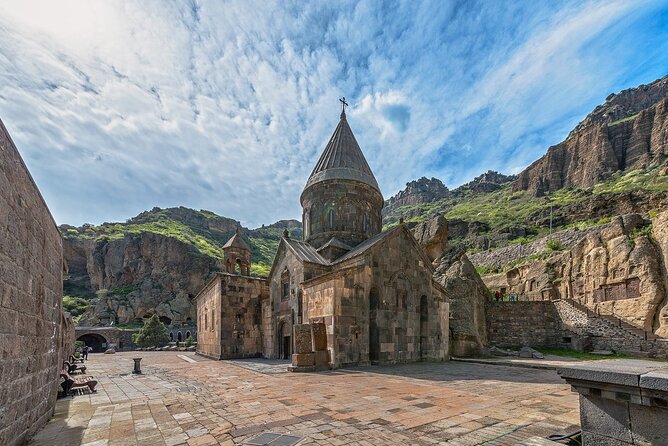
Geghard is usually the cultural high point of the day. The medieval monastery sits among cliffs in Kotayk Province, with parts of the complex carved directly into the surrounding rock. The setting feels more enclosed and dramatic than Garni, which is open to the sky.
The name Geghard means Monastery of the Spear. According to Armenian tradition, the spear that wounded Jesus at the Crucifixion was brought to Armenia by the apostle Jude, known locally as Thaddeus. The relic is now kept in the treasury at Echmiadzin, but the story remains central to Geghard’s identity.
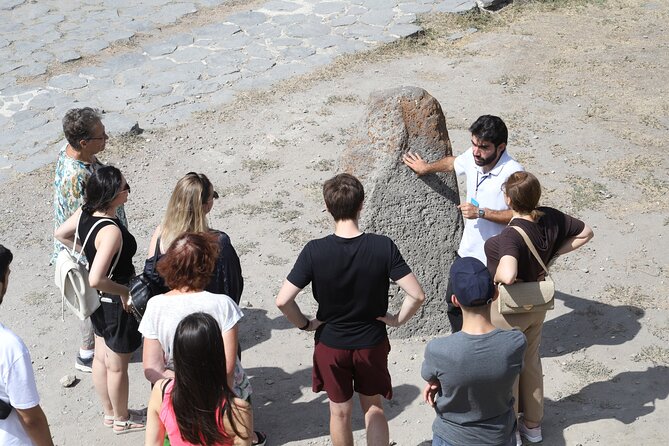
You get about an hour here. Guides generally explain the religious history before giving you time to look around on your own. Guides such as Yegor, Igor, Hasmik, and Mery have been especially praised for making the stories easy to follow without turning the visit into a lecture.
Inside, the stone chambers and carved surfaces create a quiet, serious atmosphere. One group heard spiritual singing in the monastery, which added to the visit, though that should not be treated as a guaranteed part of every departure.
Geghard is listed as a UNESCO World Heritage Site with enhanced protection status. That designation matters because this is not simply an attractive old building. The monastery connects Armenian Christianity, medieval construction, sacred relics, and the natural rock around it.
Wear shoes suitable for uneven ground. The tour is open to most people, but this is still a historic mountain site rather than a polished museum with perfectly level floors.
Walking Into Azat Canyon for the Symphony of Stones
The Symphony of Stones is the tour’s most unusual natural stop. Along the canyon walls, tall basalt columns form repeated hexagonal shapes. Seen together, the columns resemble the pipes of a giant organ, which explains the poetic name.
You spend roughly an hour in this part of Azat Canyon, but the actual walk and viewing time may feel shorter depending on the group and conditions. The entrance fee is 300 AMD and is not included in the tour price.
The basalt formed naturally as volcanic rock cooled and fractured. You do not need a geology lesson to appreciate it, but the guide’s explanation matters here. A few comments about how the columns formed would make the stop more useful. Some departures received only limited information at this site, so do not expect a long guided talk.
Weather can affect this stop more than the other monuments. Snow and poor conditions have forced changes to the route, and one group could not visit the Symphony of Stones because of weather. The operator offers a different date or a full refund if poor weather cancels the entire activity, but a changed route can still happen when conditions are difficult.
The basalt columns are worth seeing even on a quick visit. They give the day a welcome change of pace after the monastery and temple. You are outside, surrounded by canyon walls, with no grand building competing for attention.
Garni Temple, Armenia’s Pagan Monument
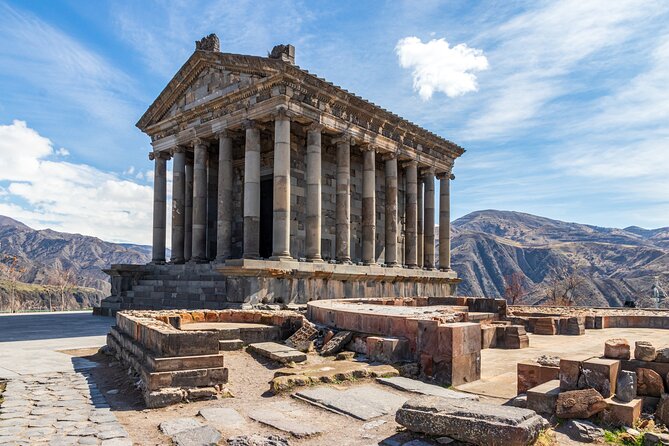
Garni gives you a very different picture of Armenia. The temple was built in the first century and dedicated to Mithra, the ancient god of the sun. It is the only preserved pagan temple in Armenia and across the former Soviet Union.
That single fact makes Garni important. The monument shows that Armenia’s story did not begin with Christianity, even though the country later became closely associated with the Christian faith. Your guide can help connect the temple to the broader changes in Armenian society and religion.
The temple was destroyed in a major earthquake in 1679 and restored between 1968 and 1975. It is not an untouched ancient ruin. It is a rebuilt monument, but the reconstruction gives you a clear sense of its classical form, with columns and a strong position above the surrounding area.
Entrance costs 1,500 AMD and is not included. Keep some Armenian dram ready, since the two small entrance fees are separate from the tour price.
The scheduled visit lasts about an hour. This is enough time to see the temple, take photographs, and listen to the guide, but it is not enough for a slow archaeological study. If ancient architecture is your main interest, you may wish the visit were longer. As part of a six-hour circuit, though, the timing is sensible.
Same place, a different slice of the past:
- London Small Group Tour of Historical Pubs
★ 5.0 · 10,422 reviews - Prague: Oldtown, Medieval Underground & Dungeon History Tour
★ 4.3 · 10,277 reviews - Charleston’s Old South Carriage Historic Horse & Carriage Tour
★ 5.0 · 10,023 reviews - Edinburgh: Edinburgh Castle Guided History Tour with Tickets
★ 4.8 · 9,933 reviews
Lavash Baking and the Taste of Armenia
The final stop is a lavash baking demonstration lasting about 40 minutes. Lavash is the thin Armenian bread that appears at tables across the country, and watching it being prepared gives you a direct connection to everyday food culture.
The best version of this stop includes a family-run restaurant or local dining setting, where the bread is baked and served fresh. Some people particularly enjoy the courtyard, the food, and the chance to taste lavash soon after it is made. The atmosphere can feel more personal than another formal monument.
Set your expectations carefully. The advertised master class may not involve much hands-on work. On some departures, the session has amounted to watching women bake the bread for around five minutes, with only a brief explanation, followed by tasting. That can still be interesting, but it is not the same as kneading, shaping, and baking your own bread.
Lunch may also be offered during this part of the day, but it is not included in the stated tour price. Several people enjoyed the meal and described the setting as pleasant. Others found the food overpriced or disliked the long wait. One reported stop lasted about an hour and 45 minutes, while another departure included a 1.5-hour restaurant break that had not been clearly presented in advance.
If you want a quick cultural demonstration, the bread stop is a nice finish. If you are mainly interested in the monuments, ask the guide how much time will be spent eating before ordering.
The Guides Make the Biggest Difference
The tour uses different guides, so the feel can vary from one date to another. Yegor is praised for humor, music on the minibus, and detailed explanations of Armenian culture. Igor is often described as passionate and well informed. Hasmik is noted for warmth, storytelling, and close attention to the group. Mery, Anna, Ani, and Taku have also received strong praise for their energy and communication.
That personal element matters. The monuments are worth seeing on their own, but a good explanation gives them meaning. At Geghard, a guide can connect the rock-cut rooms to Armenian religious tradition. At Garni, the guide can explain why a pagan temple survived in a country so closely tied to Christianity.
English is offered, but some departures have also combined English and Armenian or Russian. A bilingual format can slow the day and reduce the amount of explanation in each language. If clear English commentary is important to you, confirm the language arrangement before booking.
Transport, Group Size, and Timing
The advertised maximum is 20 people. That is small enough for a social group tour but large enough that you should not expect private-tour attention at every stop.
Transport is included, and several departures used a clean, comfortable minibus. The vehicle has generally been a strong part of the experience, though air conditioning has been an issue on some dates. One group found the van uncomfortable because requests to adjust the temperature were not handled.
The six-hour schedule is efficient. You see five distinct parts of Armenia without committing to a full, exhausting day. The trade-off is limited free time. A delayed lunch, a slow group, or bad weather can make the schedule feel tight.
One negative report raised concerns about rushed driving. Most comments praise the driver, with specific appreciation for careful handling on icy roads and safe driving from Vaxo. Still, road comfort can vary, so it is fair to regard driving style and vehicle temperature as possible weak points rather than guaranteed problems.
The meeting point is at the Komitas Yerevan State Conservatory, 1a Sayat-Nova Avenue. The tour returns there at the end, which is convenient if you are staying in central Yerevan. Confirmation is issued at booking, and the activity is near public transportation.
Is $23 Good Value?
Yes, provided you understand what is and is not included. For $23, you receive transport, a guide, and the lavash demonstration, plus access to several of Armenia’s most important sights in one morning and afternoon.
You still pay 1,500 AMD for Garni and 300 AMD for the Symphony of Stones. Lunch is separate, and the food stop can add both cost and time. Even with those extras, the package is unusually inexpensive for a guided trip covering this much ground.
The value is strongest for a first visit to Yerevan. You get religious history, pre-Christian architecture, volcanic geology, a national viewpoint, and food culture without arranging several separate transfers.
The value is weaker if you want a slow, highly personal visit. A private tour would give you more control over the timing, the language, restaurant choices, and level of explanation. This group outing is built for range and affordability.
Who Should Book This Tour?
I would choose this tour if you have limited time in Yerevan and want to see the city’s most popular nearby sights in one well-priced outing. It suits solo visitors particularly well because the minibus format makes it easy to meet other people, and several solo participants found the social side enjoyable.
It also works well for anyone who likes a guide to explain symbols, religious stories, and historical changes. You will get more from Geghard and Garni when someone places them in context.
Families and older visitors should consider the canyon and monastery surfaces, along with the amount of walking and the possibility of a crowded group. Most people can participate, but the tour is not designed around private mobility support.
I would be cautious if you dislike group dining, need strict control over meal times, or expect a true hands-on bread lesson. Ask ahead about the language mix and lunch plan if those details matter to you.
Should You Book the Garni and Geghard Tour?
For most people visiting Yerevan, yes. The combination is hard to beat at this price, and the range of sights is excellent. Geghard and Garni are the core reasons to go, while Charents Arch and the Symphony of Stones add views and variety.
Book it for the sites, the low cost, and the chance of an excellent guide such as Yegor, Igor, or Hasmik. Go in with realistic expectations about the group format, extra entrance fees, possible lunch delays, and a lavash demonstration that may be brief.
Free cancellation is available up to 24 hours before the start time. The activity requires good weather and a minimum number of participants, so a cancellation may result in a different date or a full refund.
FAQ
How long does the tour last?
The tour lasts approximately six hours.
Where does the tour start?
It starts at the Komitas Yerevan State Conservatory, 1a Sayat-Nova Avenue, Yerevan 0001, Armenia.
What time does the tour begin?
The scheduled start time is 9:00 a.m.
Does the tour return to Yerevan?
Yes. The activity ends back at the meeting point.
Is transportation included?
Yes. Transport service is included in the tour price.
Are the Garni and Symphony of Stones entrance fees included?
No. Garni costs 1,500 AMD, and the Symphony of Stones costs 300 AMD. These fees are paid separately.
Is the lavash baking class included?
Yes. The lavash baking master class is included, although the exact format can vary and may mainly involve watching the bread being prepared.
Is the tour offered in English?
Yes. English is an offered language. Some departures may combine English with another language, so confirm the language arrangement if that is important to you.
Can I cancel for a full refund?
You can cancel at least 24 hours before the start time for a full refund. Cancellations or changes made less than 24 hours before the experience are not refunded.
Just added around the world
- The Curacao’s Colorful History Walking Tour★ 5.0 · 55 reviews
- Olous – Guided Snorkelling Excursion to Discover Olous Sunken Ancient City★ 4.5 · 31 reviews
- Visita Guiada Por El Casco Histórico De Cuenca Y Su Catedral★ 5.0 · 45 reviews
- Experience Cozumel Historical Center Mayan and Beach Experience★ 5.0 · 20 reviews
- Private Half Day Cultural Tour to Mayan Ruins and Cenote★ 4.5 · 31 reviews
- From Kolymbari: Ancient Diktyna & Hidden Beach Quad Safari★ 5.0 · 22 reviews
- Historic Cork Delicious Donut Adventure by Underground Donut Tour★ 5.0 · 232 reviews
- Otoch Mayan Experience Tour: Cultural & Historical Adventure★ 3.5 · 18 reviews