
Review · PARIS
Paris Jewish Heritage: Le Marais & Montmartre Guided Walking Tour
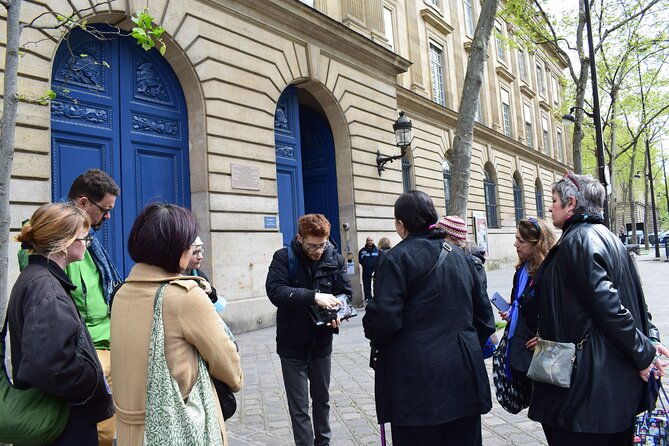
Paris tells Jewish stories on ordinary streets. This 3.5-hour walk links Le Marais with Montmartre, pairing old community life with the artistic world of Modigliani, Max Jacob, and Chagall. I like the exterior look at Hector Guimard’s Agoudas Hakehilos Synagogue, and I like the way the route includes the Holocaust Memorial and Rue des Rosiers rather than treating Jewish Paris as a single chapter.
The small-group format should give you room to ask questions, and public transport tickets are included for the change of districts. The main drawback is clear: the tour does not enter the synagogue or other monuments, so the experience depends heavily on the guide’s storytelling and your interest in history.
Key points to know before you book
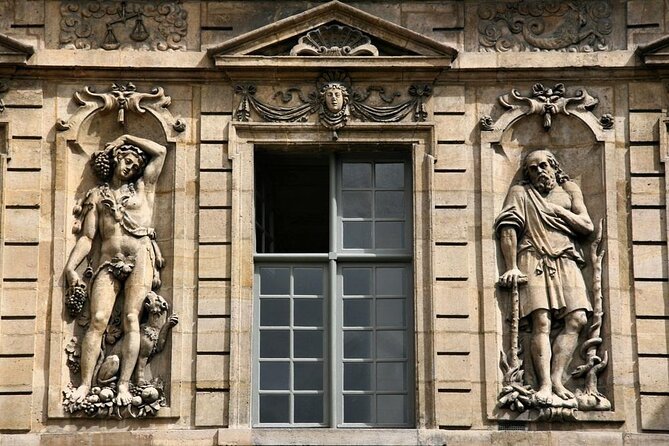
- Two very different Jewish neighborhoods: Le Marais focuses on community, migration, religion, and remembrance, while Montmartre explores Jewish artists and modern Parisian culture.
- A guide makes or breaks the walk: Benjamin, Thomas, Pierre Louis, Benoit, Adrian, and Boniet have all been praised for clear, engaging storytelling.
- No indoor synagogue visit: You see the Agoudas Hakehilos Synagogue from outside, along with the exterior of the Mémorial de la Shoah.
- A useful taste of Rue des Rosiers: Some guides have included a small falafel sample, a welcome local touch, though you should not treat it as a guaranteed meal.
- The public transfer is part of the plan: You travel from the Marais to Montmartre by public transport, with tickets included.
- It ends at Sacré-Cœur: The final stop at Square Louise-Michel gives you a famous Paris view after a serious historical walk.
What this Jewish Paris walk is really about
This is not a tour of grand Jewish monuments. Paris has fewer visible Jewish landmarks than you might expect, and much of this experience takes place on streets, outside buildings, and in the spaces between them.
That is also its strength. You see how Jewish life fits into the wider city rather than visiting isolated attractions. The guide connects medieval settlement, Eastern European immigration, wartime persecution, postwar memory, and present-day community life.
I would think of the tour as two linked stories. The first takes place in Le Marais, where Jewish life developed through homes, shops, schools, religious buildings, and community institutions. The second unfolds in Montmartre, where immigrant Jewish artists and writers helped shape modern art and Parisian mythology.
The experience is offered in English and begins at 2:30 pm. It lasts about three and a half hours, including the move between districts. The advertised group size is intimate, with an interactive format for up to nine people, while the stated maximum is 12. If group size matters to you, confirm the exact arrangement when booking.
More History Walking Tours in France
- Paris: Dark History and Ghostly Guided Walking Tour
★ 4.7 · 1,000 reviews - Paris City of Fashion History Private Guided Walking Tour
★ 5.0 · 221 reviews - Paris City Center w/ Notre Dame interior | Exclusive Walking Tour
★ 5.0 · 190 reviews
Starting in Le Marais at 2:30 pm
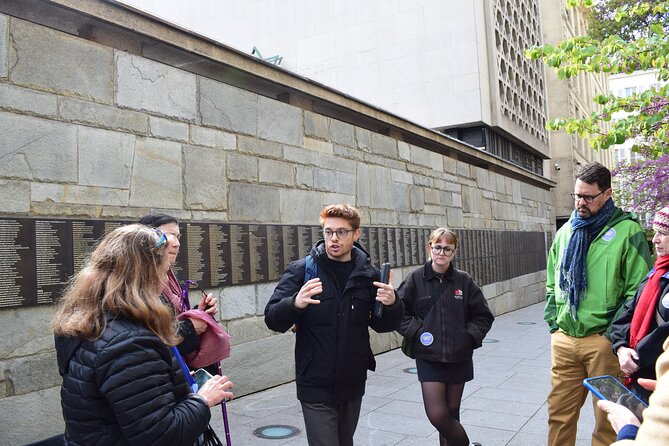
The meeting point is outside L’Elephant du Nil at 125 Rue Saint-Antoine in the fourth arrondissement. Arrive five to 10 minutes early. This is important because late arrivals cannot join once the walk has begun.
Le Marais is a good place to begin because its Jewish story is not confined to one building. The narrow streets, surviving businesses, religious sites, and modern cafés help show how a community can change while keeping links to an older neighborhood.
Your guide sets the historical frame here. You hear about the medieval Jewish presence in Paris, later waves of migration, and the influence of Eastern European Jews who arrived in the late 19th and early 20th centuries. That migration shaped schools, religious institutions, businesses, and cultural life.
The opening can feel slow if you want immediate sights and sharp explanations. One past participant found the first half hour hard to place because the guide did not explain the full sequence early enough. I think that is a useful warning: this tour rewards patience, but you should ask for context if the opening feels scattered.
Once the wider story comes together, the streets become easier to read. A shopfront, a synagogue façade, or a route through the neighborhood can carry more meaning than it would on an ordinary sightseeing walk.
Hector Guimard’s synagogue from the outside
One of the more distinctive stops is the exterior of the Agoudas Hakehilos Synagogue. Designed by Hector Guimard, the architect best known for Paris Métro entrances, it is a rare Art Nouveau synagogue.
You do not go inside. That limitation matters, especially if you are booking because of religious architecture. Still, the façade gives the guide a useful opening to explain how Eastern European Jewish immigration changed the neighborhood.
The synagogue represents more than a decorative building. It points to the need for communal prayer, education, charity, and social support as new arrivals built their lives in Paris. Your guide can also explain how Jewish institutions helped maintain identity in a city where different migrant groups were adapting to new work and new surroundings.
I would not book this walk expecting a full architectural tour. The building is one stop within a larger historical route. Its value comes from the story attached to it, not from a long indoor visit.
The Holocaust Memorial and the weight of memory
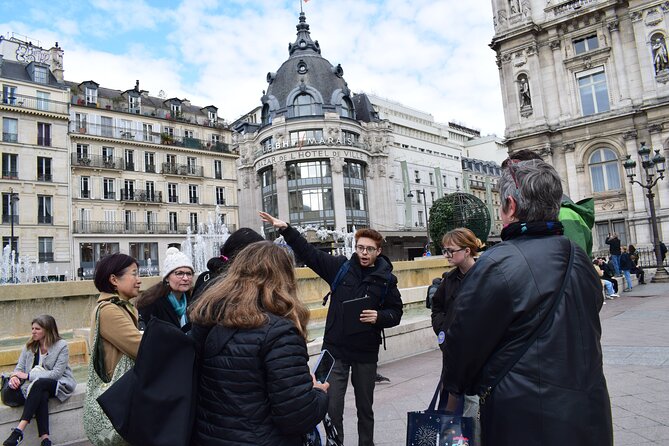
The route continues to the exterior of the Mémorial de la Shoah. This is where the tour turns more directly toward occupation, resistance, persecution, and remembrance.
The subject is serious, and the strongest guides appear to handle it with care. Benjamin has been praised for placing the history of French Jews within the wider European setting, while Pierre Louis and Benoit have also been singled out for clear, thoughtful explanations.
You should expect this section to be emotionally heavier than the opening walk. One useful feature is that the guide explains how remembrance continues to shape Jewish identity in Paris today. The memorial is not treated simply as a photo stop.
You do not receive a full indoor visit as part of the tour. A participant once chose to return and spend time inside after the walk, which is a practical option if you want more detail. You can treat the guided stop as an introduction, then decide if you want a separate visit.
If your main aim is Holocaust education, this tour may feel too brief. If you want to understand how wartime history fits into the longer story of Jewish Paris, the stop has more value.
More History Walking Tours in Paris
- Paris: Le Marais & Montmartre Jewish History Walking Tour
★ 4.8 · 170 reviews - Paris Walking Tour , Historical Sites .
★ 5.0 · 150 reviews - Paris – Historic City Center Walking Tour
★ 5.0 · 134 reviews - Unique Guided Walking Tour of Great Women in Parisian History
★ 5.0 · 89 reviews
Rue des Rosiers, shops, food, and daily life
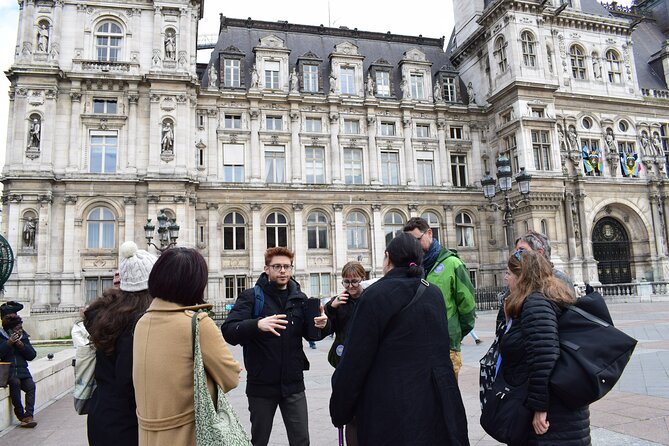
Rue des Rosiers is the most immediately accessible part of the Marais route. It has long been associated with Jewish commercial and community life, and its bakeries, delis, falafel shops, and specialty stores give you a visible connection to living traditions.
This is also where the tour can feel most like a walking experience rather than a history lecture. Your guide explains how the street changed over the 20th century, how businesses and families shaped the area, and how the neighborhood has been rebuilt and reinterpreted over time.
Some guides have included a small taste of falafel from L’As du Falafel. That was described as a welcome extra, but I would not assume it is guaranteed on every departure. It is a sample, not lunch, so eat beforehand or plan a meal after the tour.
Rue des Rosiers can also create mixed expectations. You may hope to enter several shops or community buildings, but the route is primarily an exterior walk. One less satisfied participant felt the tour offered too many general speeches and not enough detail about how people actually lived and worked in the neighborhood.
That criticism points to an important booking choice. If you want food stops, shopping, or an inside look at communal institutions, this may feel limited. If you want the guide to connect ordinary streets with migration and memory, Rue des Rosiers works well.
The public transfer from the Marais to Montmartre
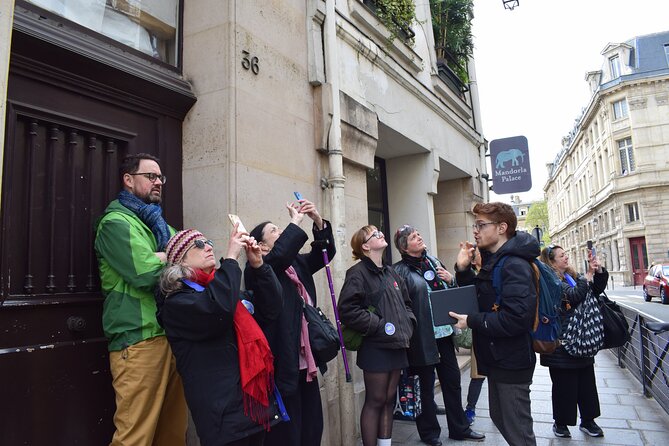
Near Hôtel de Ville, the Marais portion ends and you continue to Montmartre by public transport. Tickets are included, so you do not need to arrange this part yourself.
The transfer breaks the tour into two manageable sections. It also gives you a short rest before the uphill streets and artistic stories of Montmartre. You should still wear comfortable shoes, since the experience is a walking tour and finishes near the Sacré-Cœur steps.
The change of district is not just a practical move. Le Marais and Montmartre show different sides of Jewish Paris. In the Marais, the focus is communal life and continuity. In Montmartre, the story turns toward artists, writers, musicians, cafés, studios, and intellectual circles.
Montmartre’s Jewish artists and creative circles
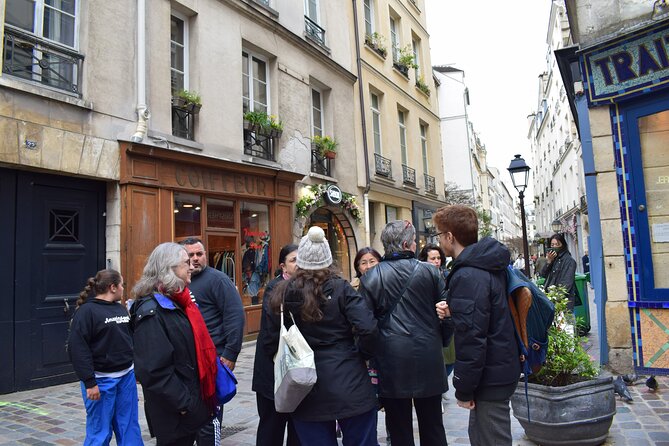
The Montmartre section lasts about an hour and a half. It looks at the immigrant artists who helped shape early 20th-century modernism, including Amedeo Modigliani, Max Jacob, and Marc Chagall.
Their connection to Montmartre was not only artistic. The neighborhood offered cafés, studios, cheap rooms, friendships, and a place where ambitious newcomers could meet people from other countries and backgrounds. Jewish artists were part of a wider international creative world that made Paris a center of experimentation.
The guide also places this creative life against rising nationalism, antisemitism, and political uncertainty. That contrast gives the walk its strongest idea: artistic freedom and social danger existed side by side.
You should not expect to visit the former studios of these artists as formal museum sites. The tour is about the people and the district’s cultural setting, not admission to an art collection. The streets serve as prompts for stories about exile, persecution, and the uncertain futures faced by many figures connected to this world.
This part will appeal most if you enjoy art, literature, and social history. If you want only the traditional Jewish quarter, Montmartre may seem less focused. Its purpose is to show that Jewish Paris was not one thing. It included religious families, shopkeepers, immigrants, artists, writers, and people who moved between several identities.
Finishing at Sacré-Cœur and Square Louise-Michel
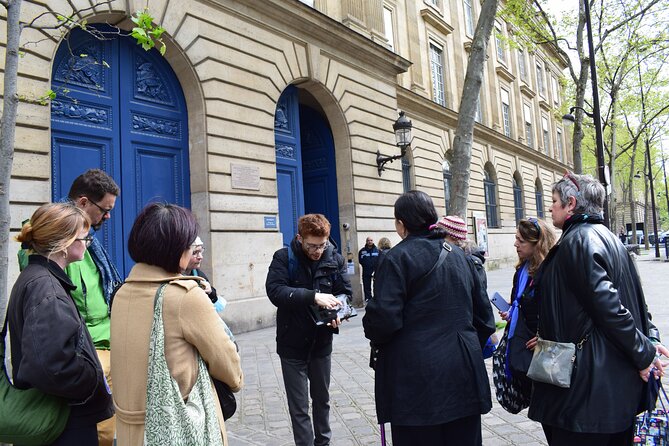
The tour ends at Square Louise-Michel, on the steps below the Sacré-Cœur Basilica. You get a wide Paris view and a natural pause after the more difficult material earlier in the walk.
The final 15 minutes are not a formal basilica visit. Entry to monuments is not included, and the experience concludes outside. If you want to go into Sacré-Cœur, you can do so separately, subject to the basilica’s own conditions.
I like this ending because it gives the tour some visual lift without pretending the history has a neat finish. You have moved from medieval Jewish life to immigration, commercial streets, persecution, artistic achievement, and remembrance. The view lets you step back and consider how these stories fit into the wider city.
There is also a practical point: the tour finishes in Montmartre, not back at the starting point. That is useful if you plan to explore the neighborhood afterward, but you should allow time to make your own way elsewhere.
How the guides affect the experience
The most praised part of this experience is the guide. Benjamin is repeatedly described as an excellent storyteller who connects local events with French, European, and world history. Thomas has been praised for energy and for making complex material easier to follow.
Pierre Louis, often called PL, receives similar praise for patience, detail, and answering questions. Benoit, Adrian, and Boniet are also described as friendly and well informed, with several guides adjusting their pace to the group.
That said, the quality may vary by departure. One participant found the English difficult to follow, while another felt the guide offered too much opinion and not enough detail about the streets themselves. These comments do not cancel out the strong overall response, but they show why the guide matters so much here.
You can help shape the tour by asking direct questions. Ask how a particular street functioned, what happened to local institutions, or how Jewish life changed after the war. A small group gives you a better chance to guide the conversation than a large bus tour would.
Is $102.12 a fair price?
At $102.12 per person, this is not a cheap neighborhood walk. You are paying for about three and a half hours with an English-speaking guide, a small-group format, and the public transport tickets between districts. The strongest value comes from interpretation, not admission tickets.
There are no major indoor entrances included. You do not receive a full synagogue visit, a museum ticket, or a meal. If you judge tours by the number of attractions entered, the price may feel high.
I see better value if you care about context and personal questions. The route covers two districts that are easy to visit on your own but harder to understand in relation to Jewish migration, French history, wartime memory, and modern art.
The experience has a 4.8 rating from 45 published evaluations, with 91 percent recommending it. The repeated praise for guides such as Benjamin, Thomas, and Pierre Louis supports the idea that a strong guide can make the price worthwhile.
Who should book this walk?
I would recommend it to you if:
- You want Jewish Paris placed in a wider French and European setting.
- You enjoy walking tours built around stories rather than major indoor attractions.
- You are interested in migration, World War II memory, art, or urban history.
- You prefer a small group where you can ask questions.
- You want to combine Le Marais with Montmartre in one afternoon.
- You are comfortable with serious historical material and several hours on foot.
I would think twice if you mainly want to enter synagogues, visit museums, or sample food. The tour includes exterior stops, and the food element is limited to a possible falafel taste rather than a planned meal.
Families can also consider it. One evaluation specifically found it suitable for children, but the subject matter includes persecution and the Holocaust. Younger children may need help with the more difficult sections.
Final verdict: book it for stories, not admissions
I think this is a worthwhile choice if you want to understand how Jewish life has shaped Paris across several centuries. The most successful departures seem to combine careful history with vivid storytelling, especially when led by guides such as Benjamin, Thomas, or Pierre Louis.
Book it for the contrast between Le Marais and Montmartre, the walk along Rue des Rosiers, the Art Nouveau synagogue exterior, and the thoughtful stop at the Shoah Memorial. Do not book it expecting extensive indoor access or a food tour.
Arrive early at L’Elephant du Nil, wear good walking shoes, and keep the afternoon free after the final stop. You can cancel for a full refund up to 24 hours before the start time, but changes or cancellations inside that window are not accepted. At $102.12, it is a considered purchase, but for the right history-minded visitor, the guide’s insight can make Paris feel far less superficial.
FAQ
How long does the Jewish Paris walking tour last?
The experience lasts approximately 3 hours and 30 minutes, including the walk through Le Marais, the public transfer to Montmartre, and the Montmartre section.
What time and where does the tour begin?
It begins at 2:30 pm outside L’Elephant du Nil, 125 Rue Saint-Antoine, 75004 Paris. You should arrive five to 10 minutes early because joining after the tour has started is not possible.
Is the tour offered in English?
Yes. The tour is offered in English.
Does the tour enter the synagogue or the Holocaust Memorial?
No. The Agoudas Hakehilos Synagogue and the Mémorial de la Shoah are seen from the exterior. Entry to monuments and historical sites is not included.
Is public transportation included?
Yes. Public transport tickets for the transfer from the Marais to Montmartre are included.
Where does the tour finish?
The tour ends at Square Louise-Michel, 6 Place Saint-Pierre, 75018 Paris, near the steps of the Sacré-Cœur Basilica.
More Jewish Heritage Tours in Paris
- Le Marais/Paris – The Historic, Trendy, Jewish, LGBT district
★ 5.0 · 341 reviews - Paris Jewish History 2-Hour Private Guided Walking Tour
★ 4.6 · 32 reviews - Budapest Jewish Heritage Memorial Walking Tour & Synagogue Entry
★ 5.0 · 568 reviews - Budapest: Jewish Heritage Guided Tour with Synagogue Ticket
★ 4.8 · 533 reviews
Just added around Paris
- Unique Guided Walking Tour of Great Women in Parisian History★ 5.0 · 89 reviews
- Paris Walking Tour , Historical Sites .★ 5.0 · 150 reviews
- Louvre Evening Escape – Avoid The Crowds! Exclusive Guided Tour★ 5.0 · 59 reviews
- Unique Tour of Literary Women in Parisian History with Tastings★ 5.0 · 75 reviews
- Paris Le Marais Walking Tour: An Incredible History – Small Group★ 5.0 · 25 reviews
- Père Lachaise Cemetery Tour: A Stroll Through Immortal History★ 5.0 · 18 reviews
- Paris – Historic City Center Walking Tour★ 5.0 · 134 reviews
- Montmartre & Sacré Coeur Private Historical 2-Hour Walking Tour in Paris★ 5.0 · 21 reviews
Jewish Heritage Tours, compared.
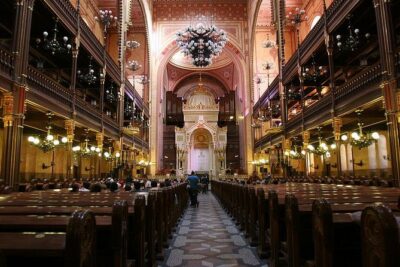
Budapest Jewish Heritage Memorial Walking Tour & Synagogue Entry
Read our review →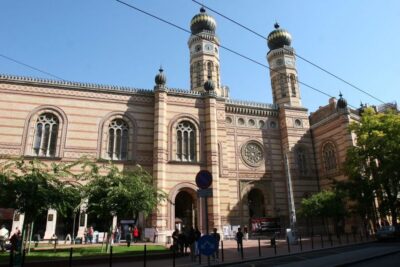
Jewish Heritage Guided Tour with Synagogue Ticket
Read our review →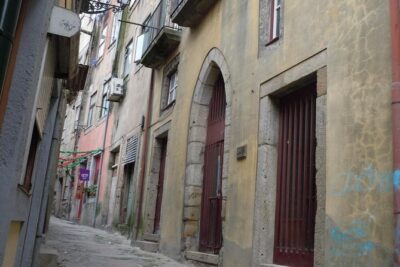
3-Hour Porto Jewish Heritage Walking Tour with Local Guide
Read our review →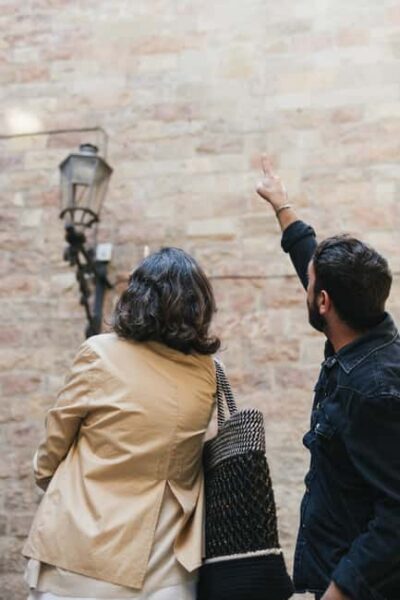
Private Jewish Heritage Journey by Barcelona Dreaming
Read our review →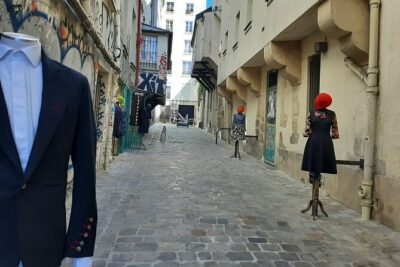
Le Marais/Paris – The Historic, Trendy, Jewish, LGBT district
Read our review →
Anne Frank and the Jewish History of Amsterdam Private Tour
Read our review →
Lisbon Jewish Heritage and History – Private Tour Van
Read our review →Browse the lists this tour appears in