
Review · LOMBARDY
MANTOVAGANDO: Exploring Mantua’s Historic Center
Mantua rewards slow steps and curious eyes. This one-hour walk links Piazza Sordello, Broletto Square, Piazza delle Erbe, and Sant’Andrea Basilica, giving you a compact introduction to the city’s streets, monuments, and Gonzaga-era setting. I like the easy pace and the fact that the route includes both major sights and smaller details, rather than rushing from one famous building to the next.
I also like the planned visit inside Sant’Andrea Basilica, where 30 minutes gives the church more attention than a quick doorway peek. The possible stop at Bibiena Scientific Theater adds another fine touch, though it depends on whether concerts or conferences are using the building. The main drawback is the short one-hour format: you will get orientation and selected highlights, not a full tour of Mantua’s great palaces.
Key points at a glance
- A compact route through Mantua’s historic center: Start at Piazza Sordello and finish at Piazza Andrea Mantegna.
- Three central squares with different moods: Broletto Square and Piazza delle Erbe add useful urban context between the larger sights.
- Thirty minutes inside Sant’Andrea Basilica: This is the main interior visit and the strongest part of the route for architecture lovers.
- A chance to see Bibiena Scientific Theater: Entry depends on whether the theater is free from concerts and conferences.
- Italian-language guiding: The guide brings the stories to life in Italian, with some content presented in its original language.
- A slow-tourism approach: Comfortable shoes and a camera are the only suggested items, but the walk works best when you allow yourself to look up and around.
Starting at Piazza Sordello beside the Ducal Palace
The meeting point is in front of the ticket office for the Ducal Palace in Piazza Sordello. The ticket office is only a landmark for finding the guide. It is not connected with this walking tour, and the palace itself is not included as a full visit.
That distinction matters. Mantua’s Ducal Palace is a major attraction, and you could easily assume your booking covers its courtyards and rooms. It does not. This experience uses the palace ticket office as a clear place to meet before moving into the public squares and streets of the historic center.
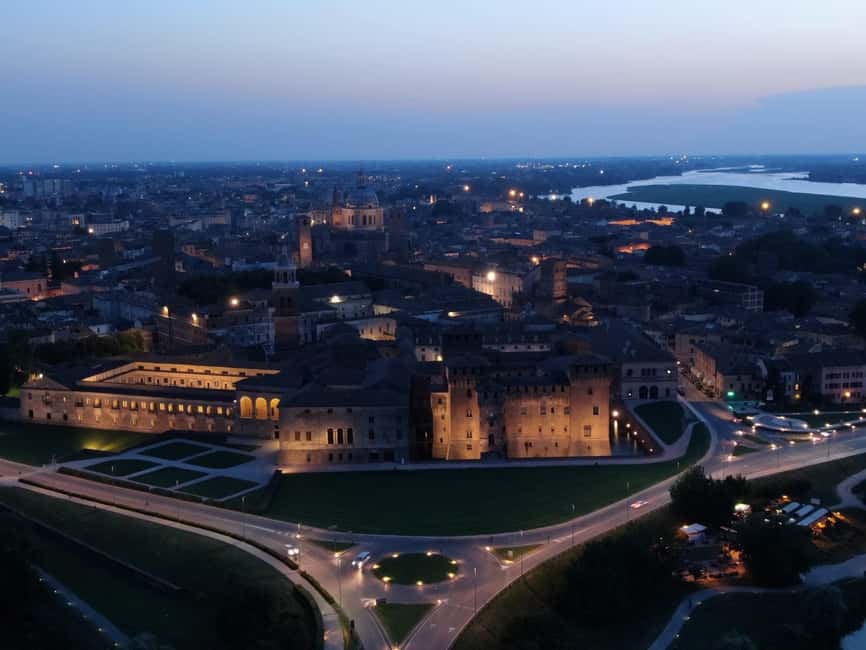
Piazza Sordello gives you an impressive opening view. From here, the walk begins with Mantua’s civic and courtly past close at hand, then shifts toward the everyday spaces where the city still functions. I like this kind of start because you get your bearings quickly without spending the whole hour inside one large museum.
The exact coordinates are 45.159854888916016, 10.796792984008789. You should arrive with enough time to identify the ticket office and look for the guide. Since the meeting point is outside, it is also a sensible place to check your shoes, camera, and phone before the walk begins.
More Old Town and Historic Centre Walks in Italy
- Rome in a Day Tour with Vatican, Colosseum and Historic Center
★ 4.5 · 1,042 reviews - Rome Food Tour in the Historic Centre with 8+ Food Tastings
★ 5.0 · 1,000 reviews - Genoa: 2-Hour Guided Walking Tour of the Historical Center
★ 4.2 · 605 reviews
Broletto Square and the city’s public face
The first scheduled stop is Broletto Square, with about 10 minutes for a guided visit. The time is brief, but the square helps explain how Mantua’s center is organized. This is not just a path between bigger attractions. It is one of the public rooms of the city, where government, commerce, and daily movement have shared the same compact center.
I value stops like this because they give you a better way to read the city. Instead of seeing only a church facade or an old tower, you begin to notice how the surrounding buildings frame the space. Your guide can connect the square to Mantua’s civic past, while you take in the proportions and details at street level.
Ten minutes will not allow for a long architectural lecture. That is both the benefit and the limit. You get a clear introduction, then keep moving. If you enjoy slow looking, use the pause to study the buildings around the square and ask the guide about anything that catches your eye.
The tour is conducted in Italian, so a basic understanding of the language will help you get more from the historical explanations. If you do not speak Italian well, the visual setting still has value, but you should not expect a translated tour.
Piazza delle Erbe and a livelier urban setting
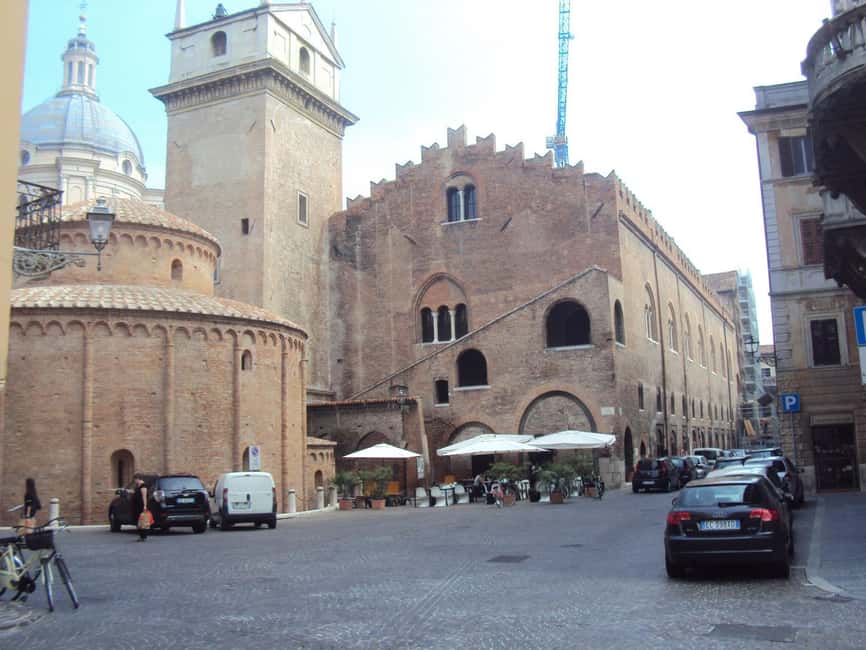
The walk continues to Piazza delle Erbe for another 10-minute guided stop. The square adds a different note from Piazza Sordello. Here, the experience feels less like an approach to a ducal complex and more like a look at the city’s shared public life.
I like the rhythm of these two squares. Ten minutes in Broletto Square, followed by 10 minutes in Piazza delle Erbe, keeps the route moving while giving you enough time to understand that Mantua is more than its princely buildings. The squares make the center feel connected, not like a collection of isolated monuments.
This is also where the walking format earns its keep. You are not sealed inside a coach or moving between distant stops. The guide can point out relationships between the buildings as you walk, and you can see how the streets open into larger spaces.
The trade-off is that the route does not promise a long stop at every building. If you want detailed information about every facade, inscription, or church interior, you may need a longer specialist tour. MANTOVAGANDO is better for getting a readable first picture of the center.
Thirty minutes inside Sant’Andrea Basilica
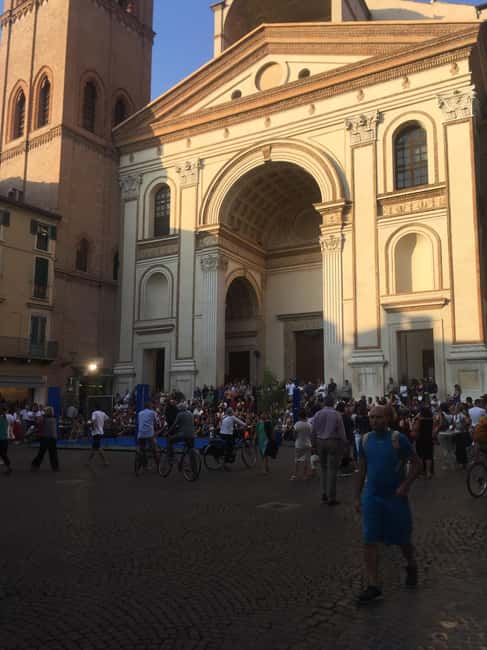
The longest scheduled stop is the Basilica Concattedrale di Sant’Andrea, with about 30 minutes devoted to the visit. This is the heart of the experience. After the outdoor squares, you move into a major religious monument where the scale, design, and interior atmosphere can be appreciated at a slower pace.
I especially like that the itinerary gives Sant’Andrea half the total tour time. A quick exterior stop would undersell the basilica. Thirty minutes gives your guide room to explain the building and gives you time to look rather than simply follow the group toward the exit.
The basilica is also a useful counterpoint to Mantua’s ducal identity. The walk begins near the palace district, then brings you into a major church at the other end of the historic center. That progression helps you see how political and religious power shaped the city side by side.
You should keep expectations realistic. This is a guided visit, not a full study of every artistic detail. The available information does not promise access to every part of the basilica or a special dome climb. If you want an ascent or an extended church tour, a separate Sant’Andrea experience would be a better match.
Comfortable shoes matter here because the tour moves through streets and squares before reaching the basilica. The route is listed as wheelchair accessible, which makes it a practical choice for many visitors, though you may still want to confirm current access conditions if your needs are specific.
Same place, a different slice of the past:
- Colosseum: Underground and Ancient Rome Tour
★ 4.7 · 12,691 reviews - Rome: Colosseum with Arena, Roman Forum and Palatine Guided Tour
★ 4.0 · 5,598 reviews - Venice: St. Mark’s Basilica Guided Tour & VR History Intro
★ 3.9 · 4,880 reviews - Colosseum with Arena, Roman Forum and Palatine Hill Guided Tour
★ 4.5 · 3,526 reviews
A final sightseeing stop with special views
After Sant’Andrea, the route includes about 15 minutes of sightseeing before finishing at Piazza Andrea Mantegna. The exact feature of this portion is not fully specified, but the experience points to special views and the city’s prisoner of the three lakes theme.
That phrase gives the final section a sense of place. Mantua is closely tied to its waters, and the city’s position among three lakes is one of its most distinctive geographic features. You might find that this final pause works best as a visual conclusion, linking the tight historic center to the wider setting around it.
I would treat this part as a chance to pause, take photographs, and ask one last question rather than as a major additional monument visit. The listing does not identify a separate museum or building for this 15-minute section, so you should not book the walk expecting another full interior tour.
The finish at Piazza Andrea Mantegna is useful for planning. You end near Sant’Andrea rather than returning to Piazza Sordello, so you can continue exploring from there, stop for a meal, or arrange your next Mantua sight without retracing the entire route.
What the Italian guide adds
The experience is led in Italian by Eleonora Scacchetti of Guidamica Mantova Guida Turistica. The strongest feedback centers on her preparation, courtesy, and willingness to answer questions. That combination matters more than a memorized stream of dates. On a short walk, a guide who listens can adjust the emphasis to what interests you.
Another guide praised in the booking information is described as very prepared and available for questions. The overall score is 4.5 out of 5 from 53 ratings, which suggests a consistently positive experience with a small number of practical issues.
One point deserves attention: on one occasion, the guide arrived without working earphones, and the microphone made a crackling sound before being switched off. If the group is large or the streets are noisy, that kind of equipment problem can make an Italian-language explanation harder to follow. It appears to be an isolated practical complaint, but it is worth remembering if you rely on audio equipment.
The positive comments are more consistent. Eleonora is praised by name for being well prepared, and the tour is described as interesting, thorough, punctual, courteous, and open to questions. I would choose this walk for the guide-led context, not just for the route itself.
The one-hour format and its real value
At one hour, MANTOVAGANDO is a sampler. It does not attempt to cover the Ducal Palace, Palazzo Te, or every important church in Mantua. Instead, it joins several central spaces into a short route that helps you understand the shape of the city.
That can be excellent value if you have limited time or want an introduction before exploring alone. You get a meeting point that is easy to find, four named areas of the center, a substantial basilica visit, and a final view-oriented section. The route also avoids the usual problem of a short city walk that spends nearly all its time on one street.
The value depends on the price you are offered, which is not provided here. I would judge it against the cost of entering the individual sights and the value of having an Italian guide explain how they connect. If the fee is modest, the tour makes sense as a first orientation. If it is priced close to a longer palace tour, you may want more time and more interiors.
The reserve-now, pay-later option keeps your plans flexible, and cancellation is allowed up to 24 hours before the start for a full refund. Those terms are useful if your Mantua schedule is still changing.
Who should book this walk
I would recommend it to you if you want a short introduction to central Mantua rather than a full day of sightseeing. It suits first-time visitors, people arriving with only a few hours, and anyone who prefers a calm walk through streets and squares instead of a packed schedule.
It is also a good fit if Sant’Andrea Basilica is high on your list. The 30-minute visit gives the church proper attention, while the earlier squares provide context.
You may want another experience if your main goal is the Gonzaga court. A dedicated Ducal Palace tour would cover the palace and Camera degli Sposi in much greater detail. Palazzo Te calls for its own visit too. A panoramic boat trip would better suit you if the lakes are your main interest.
Families and mixed-age groups may appreciate the short duration, though the value of the Italian commentary depends on each person’s language ability. Photography is welcome, and the camera recommendation makes sense for the squares, church, and special views.
Practical details before you go
Wear comfortable shoes. The route is short, but it is a walking tour through the historic center, with several stops and a church visit.
Bring a camera if you enjoy architectural details and city views. You should also arrive at the Palazzo Ducale ticket office rather than assuming the palace itself is part of the experience.
The tour is wheelchair accessible. It is conducted in Italian, and some material is presented in its original language. Check the available starting time when booking, since the exact schedule can vary.
If you hope to enter Bibiena Scientific Theater, keep your expectations flexible. The theater can be visited only if it is not being used for a concert or conference. Its inclusion is a pleasant possibility, not a guaranteed part of every departure.
FAQ
How long does MANTOVAGANDO last?
The experience lasts one hour.
Where does the tour start?
It starts in Piazza Sordello, in front of the ticket office for the Ducal Palace.
Is the Ducal Palace included in the tour?
The Ducal Palace ticket office is used as the meeting point, but the ticket office and palace visit are not part of this walking experience.
What language is the tour conducted in?
The live tour guide speaks Italian. Some content is shown in its original language.
Which main sights are included?
The route includes Broletto Square, Piazza delle Erbe, the Basilica Concattedrale di Sant’Andrea, and a final sightseeing section before ending at Piazza Andrea Mantegna.
Is Bibiena Scientific Theater guaranteed to be open?
No. The theater can be visited if it is not being used for concerts or conferences.
Is the tour wheelchair accessible?
Yes, the experience is listed as wheelchair accessible.
Should you book MANTOVAGANDO?
Book it if you want a well-paced one-hour introduction to Mantua’s historic center, especially with Sant’Andrea Basilica as a priority. The prepared Italian guide, clear route, and short format make it useful at the beginning of a stay or during a brief stop in town.
Skip it if you want a full palace tour, extensive art commentary, or a guaranteed Bibiena Theater visit. For those aims, choose a longer specialist experience. For a compact walk linking Mantua’s squares, church, and distinctive lake setting, this is a sensible and focused choice.
Just added around Italy
- Matera’s Sassi Walking Tour – History and Culture★ 4.8 · 356 reviews
- Marsala: Historic winery tour with wine tasting★ 4.8 · 112 reviews
- Lazise: Historical Center Wine Tasting Tour★ 4.9 · 110 reviews
- Lecce: Jewish History Walking Tour★ 4.7 · 67 reviews
- Pastrengo: Lake Garda Wine & Food Tasting in Historic Fort★ 4.7 · 73 reviews
- Lake Garda: Historic Castle Cruise with Wine Tasting★ 4.5 · 241 reviews
- Cosenza: Audio Guide of the Historic Center★ 4.1 · 19 reviews
- Historical walking tour of Turin (Private tour)★ 5.0 · 18 reviews
Old Town & Historic Centre Walks, compared.
Live Fado Show with Port Wine in Historic Center
Read our review →
Valencia Old Town Tour with Wine & Tapas in 11th Century Historic Monument
Read our review →
Prague Old Town, Medieval Underground and Dungeon Historical Tour
Read our review →
Historic Center and Getsemaní Shared Walking Tour
Read our review →
Old Town Walking Tour History and Tales in Edinburgh
Read our review →
Philadelphia Old City Historic Walking Tour with 10+ Top Sites
Read our review →
Saadian Tombs & Bahia Palace, Medina Guided Tour
Read our review →Browse the lists this tour appears in